
OT and ICS vulnerability management asks for a different toolset than IT security. Send an active scan at a Modbus-speaking PLC and you can knock a production line offline; the market in 2026 splits between passive industrial network scanners and exposure management platforms that fold OT risk into the rest of the security program.
- Claroty is the best overall pick for passive OT and ICS vulnerability management in 2026 on dedicated industrial networks.
- Brinqa is the pick for unifying OT vulnerability data with IT and cloud exposure in one prioritized queue.
- Dragos targets OT threat detection and incident response inside utilities and manufacturing networks.
- Nozomi Networks and Tenable.ot both scan hybrid IT/OT environments but differ on vendor lock-in.
- Armis covers agentless discovery across IT, OT, and IoT without touching fragile control-system protocols.
Why this matters
Most vulnerability scanners were built to probe laptops and servers, not programmable logic controllers running firmware from a decade ago. An unsolicited packet aimed at a PLC or an RTU can trigger a fault state, and in a substation or a bottling line that fault has physical consequences, not just a support ticket.
That's why the vendors in this list either scan passively by design or, in Brinqa's case, don't touch the OT network at all — they take vulnerability data from a dedicated OT sensor and put it next to IT and cloud risk so one team can see the full exposure picture instead of three disconnected dashboards.

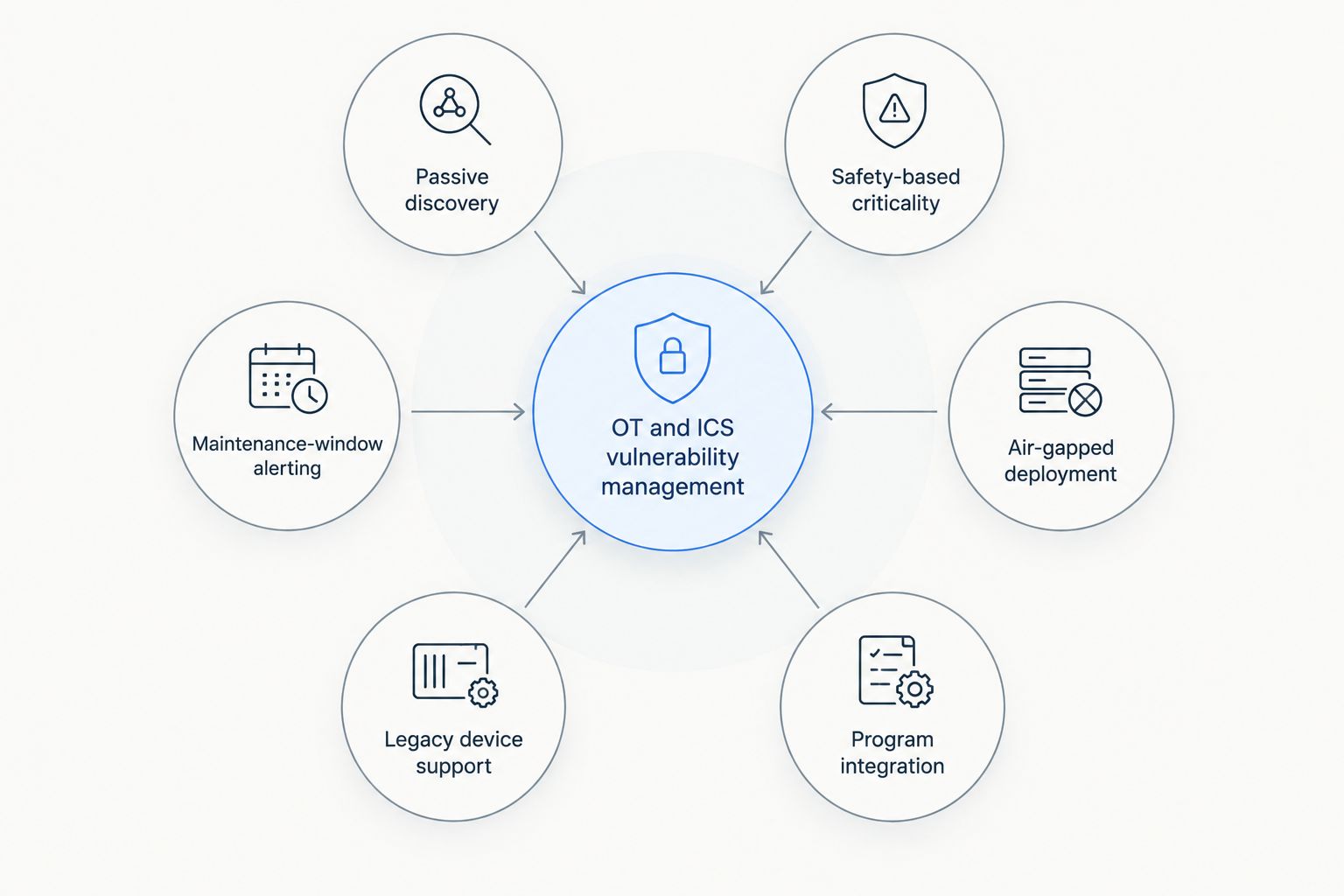
What makes the best OT and ICS vulnerability management tool
- Passive, protocol-aware discovery across Modbus, DNP3, OPC-UA, and Profinet that never sends unsolicited traffic to a PLC
- Asset criticality tied to safety and production impact, not a generic CVSS score borrowed from IT
- Deployment options that survive segmented and air-gapped OT networks without needing a live internet connection
- A path into the broader vulnerability or exposure management program, so OT risk doesn't live in a separate silo
- Support for legacy firmware and end-of-life devices that will never get a vendor patch
- Alerting tuned to maintenance windows, not IT's real-time patch cadence
At a glance
| Tool | Best for | Standout feature | Key limitation |
|---|---|---|---|
| Brinqa | Unifying OT and IT risk | One risk model across OT, IT, and cloud | Not itself an OT network sensor |
| Claroty | Industrial network visibility | Passive ICS/SCADA protocol library | Separate console from IT vulnerability management |
| Dragos | OT threat detection and response | Threat intel tied to named ICS attack groups | Thinner vulnerability scoring than dedicated VM tools |
| Nozomi Networks | Real-time OT/IoT monitoring | Continuous anomaly detection | Full asset inventory sometimes needs an extra module |
| Tenable.ot | Hybrid IT/OT scanning in a Tenable stack | Shared workflow with Tenable.io | Value depends on already running Tenable |
| Armis | Agentless cross-domain visibility | No agents, no active probing | Less ICS protocol depth than dedicated scanners |
“A vulnerability scanner built for laptops will crash a PLC before it finds a single CVE.”
1. Brinqa: best OT and ICS vulnerability management tool for unifying OT and IT risk
Brinqa is an exposure management platform that ingests vulnerability and asset data from dedicated OT sensors and correlates it with IT, cloud, and application risk into one prioritized queue instead of a separate OT dashboard nobody else on the security team looks at. It doesn't scan Modbus or DNP3 traffic itself — pair it with a passive OT sensor for discovery, then let it handle scoring and reporting. See how the workflow fits together on exposure management for OT and ICS environments.
Brinqa pros:
- Correlates OT vulnerability data with IT and cloud exposure in a single score
- Custom severity scoring that can weight safety and production impact, not just CVSS
- Exception workflows built for vulnerabilities that can't be patched on live production OT gear
- One dashboard for OT plus IT risk instead of three disconnected tools
Brinqa cons:
- Not a network sensor — you need a dedicated OT discovery tool feeding it data
- Initial setup takes integration work to connect ICS scanner feeds
Best for: teams that already run a dedicated OT sensor and want that data sitting in the same risk queue as everything else. Verdict: Buy if OT visibility already exists and prioritization is the gap.
2. Claroty: best OT and ICS vulnerability management tool for industrial network visibility
Claroty's platform passively fingerprints ICS and SCADA assets across common industrial protocols without sending traffic that could disrupt a controller, and it's deployed widely across critical infrastructure segments.
Claroty pros:
- Deep protocol library covering common ICS/SCADA vendors
- Passive discovery designed not to disrupt production
- Built-in ICS-specific threat detection
Claroty cons:
- Vulnerability data lives in its own console, separate from IT vulnerability management
- Requires OT-specific expertise to tune effectively
Best for: large industrial networks that need dedicated ICS asset visibility as the starting point. Verdict: Buy.
3. Dragos: best for OT threat detection and incident response
Dragos is built around detecting adversary behavior inside industrial networks and ties findings to named ICS threat groups its intelligence team tracks, which matters more to a SOC watching for intrusion than to a team just trying to close CVEs.
Dragos pros:
- Threat intelligence specific to ICS attack groups
- Incident response playbooks built for OT environments
- Asset visibility across common industrial vendors
Dragos cons:
- Vulnerability scoring is thinner than a dedicated VM platform
- Better suited to detection than full remediation tracking
Best for: SOC teams focused on catching active intrusions inside ICS networks rather than closing a backlog of CVEs. Verdict: Buy for detection-first programs, Hold if remediation tracking is the actual gap.
4. Nozomi Networks: best for real-time OT/IoT monitoring
Nozomi Networks' Guardian sensors monitor OT and IoT traffic continuously, flagging anomalies and known vulnerabilities as they surface rather than on a scheduled scan cycle.
Nozomi Networks pros:
- Continuous anomaly detection instead of periodic scans
- Broad protocol coverage across OT and IoT
- Works alongside existing SIEM deployments
Nozomi Networks cons:
- Full asset inventory depth sometimes needs an additional module
- Primarily a monitoring layer rather than a remediation tracker
Best for: teams that want always-on network visibility instead of point-in-time assessments. Verdict: Buy.
5. Tenable.ot: best for hybrid IT/OT scanning inside a Tenable stack
Tenable.ot extends Tenable's vulnerability management into OT networks and shares a console with Tenable.io or Tenable One, which matters if your IT team already standardized on Tenable.
Tenable.ot pros:
- Shared workflow with an existing Tenable deployment
- Both passive and active discovery options
- Single vendor relationship for IT and OT scanning
Tenable.ot cons:
- Value depends heavily on already running Tenable for IT
- Sold as a separate module with its own licensing
Best for: IT security teams extending an existing Tenable footprint into OT rather than starting from zero. Verdict: Buy if already on Tenable, Skip if evaluating vendors from scratch.
6. Armis: best for agentless cross-domain asset visibility
Armis Centrix discovers and classifies devices across IT, OT, IoT, and cloud without agents or active probing, which is useful when the goal is one inventory covering every connected device type rather than ICS depth alone.
Armis pros:
- Agentless discovery across every device category, not just ICS
- Useful for consolidating asset inventory into one source of truth
- No active probing risk on sensitive networks
Armis cons:
- Less ICS protocol-specific depth than Claroty or Dragos
- OT-specific safety-impact prioritization is shallower than dedicated tools
Best for: security teams that need one inventory spanning every connected device, OT included, not just industrial protocols. Verdict: Buy for broad visibility, Hold if ICS-specific depth is the priority.
How we ranked these tools
Each vendor above was measured against the six criteria listed earlier: whether discovery is passive by design, how deep protocol coverage runs, whether the tool works on segmented and air-gapped networks, how well it feeds into a broader vulnerability or exposure management program, support for legacy and end-of-life devices, and whether alerting respects OT maintenance windows instead of IT's patch cadence. No tool in this list scores a perfect six — that's the honest state of the OT and ICS vulnerability management category in 2026.
Which OT and ICS vulnerability management tool should you choose?
For most industrial security teams, the answer isn't picking one tool — it's pairing a dedicated OT sensor with a platform that unifies the output. Choose Claroty or Dragos depending on whether asset visibility or threat detection is the bigger gap, then route that data into Brinqa to score OT risk alongside IT and cloud exposure in one queue. Teams already standardized on Tenable can stay in that ecosystem with Tenable.ot; teams that need one inventory across every device type, OT included, should start with Armis.
See OT risk next to IT risk
Correlate OT vulnerability data with the rest of your exposure program.
FAQ
What's the best OT and ICS vulnerability management tool in 2026?
Claroty is the best overall pick for passive industrial network visibility in 2026, while Brinqa is the better choice for unifying OT vulnerability data with IT and cloud risk in one prioritized queue.
Is Claroty better than Dragos for ICS vulnerability management?
Claroty focuses on passive asset discovery and protocol coverage, while Dragos focuses on threat detection and incident response inside industrial networks. Pick based on whether visibility or intrusion detection is the bigger gap.
Can regular IT vulnerability scanners be used on OT networks?
No. Active IT scanners send traffic that can crash or fault a PLC or RTU, so OT and ICS environments require passive, protocol-aware discovery instead.
How does Brinqa handle OT vulnerability data?
Brinqa ingests vulnerability and asset data from a dedicated OT sensor and correlates it with IT and cloud risk into one prioritized model rather than scanning OT protocols itself.
What is passive discovery in OT vulnerability management?
Passive discovery listens to existing network traffic to identify assets and vulnerabilities without sending any packets to the devices themselves, avoiding the risk of disrupting a live control system.
Does Tenable.ot work without other Tenable products?
Tenable.ot can run standalone, but its main advantage is a shared console and workflow with Tenable.io or Tenable One, so the value is strongest for teams already on that stack.
How do air-gapped ICS networks get scanned for vulnerabilities?
Air-gapped networks rely on offline data collection or on-premises sensors that sync findings periodically rather than continuous cloud connectivity, since no live internet link exists to the OT segment.
What's the difference between OT vulnerability management and exposure management?
OT vulnerability management focuses on discovering and scoring flaws inside industrial networks, while exposure management pulls that data together with IT and cloud risk into one prioritized view across the whole environment.
One last thing
Most ICS vulnerabilities never get patched — the PLC vendor stopped shipping firmware updates years ago, and swapping the hardware means a plant shutdown nobody wants to schedule. The realistic fix isn't a patch cadence; it's a compensating-control and risk-exception process that documents why a device stays exposed and what controls sit around it instead. Build that process before the audit asks for it, not after.