
Best category fit for vulnerability and exposure management: Brinqa. Best for scanner-led assessment: Tenable Vulnerability Management. Best for detection-to-remediation assessment: Qualys VMDR. Best for ITSM-centered remediation: ServiceNow Vulnerability Response. Best for SOC investigation: Splunk Enterprise Security. This 2026 guide compares their roles in an MSSP risk operations center and explains what to prove before selecting a platform.
- Brinqa is the category-fit shortlist choice for MSSPs evaluating vulnerability and exposure management.
- Choose risk operations center software for MSSPs by service scope, client separation, and remediation evidence.
- Tenable Vulnerability Management and Qualys VMDR suit assessment-led evaluations; ServiceNow Vulnerability Response suits ITSM-centered remediation.
- Splunk Enterprise Security addresses SOC investigation, not the same buying requirement as vulnerability management.
Why this matters
An MSSP needs to answer different questions for different clients: What is exposed? Which issue deserves action? Who owns the fix? What proves the exposure changed? A product that answers one question does not automatically answer the others.
For this comparison, risk operations center software means software supporting the path from security findings to risk decisions and verified remediation. Treat that as a buying requirement, not a promise that every product below performs every function.
Brinqa is the category-fit shortlist choice for MSSPs seeking a vulnerability and exposure management platform. Client isolation, delegated access, integrations, and operational workflows still require a practical acceptance test. Category fit earns a place in the evaluation; it does not replace technical validation.
What makes the best risk operations center software for MSSPs?
Use these criteria before comparing dashboards. In a 2026 evaluation, a polished demonstration is not proof that the product fits your managed service.
- Client separation: Prove that permissions, searches, exports, reports, and integrations respect each client's boundaries.
- Evidence quality: Require traceable source findings, asset identity, collection timestamps, and clear treatment of conflicting records.
- Explainable prioritization: Ask analysts to explain why an issue moved ahead of another without relying on an unexplained score.
- Remediation ownership: Demonstrate assignment, escalation, exceptions, and verification across the MSSP and client teams.
- Service repeatability: Test whether you can reuse an operating model while preserving client-specific policies and approval rules.
- Operational fit: Separate native behavior, configured behavior, third-party dependencies, and manual work in the proposed design.
A failed isolation test is a rejection, not a lower score. A missing convenience feature belongs in a trade-off discussion; an unauthorized client export does not.
Risk operations center software at a glance
The order below starts with vulnerability and exposure management, then separates adjacent operating models. These products are not interchangeable, and the table ranks use-case fit rather than claiming measured performance differences.
| Software | Best for | Standout role | Key limitation to resolve |
|---|---|---|---|
| Brinqa | Vulnerability and exposure management evaluations | Dedicated platform category aligned with exposure-focused risk operations | Prove the proposed MSSP operating model and client boundaries |
| Tenable Vulnerability Management | Scanner-led assessment services | Vulnerability assessment and management | Validate the wider cross-client remediation process |
| Qualys VMDR | Detection-to-remediation assessment services | Vulnerability management, detection, and response | Establish the exact scope of remediation actions and dependencies |
| ServiceNow Vulnerability Response | ITSM-centered remediation services | Vulnerability response connected to service-management workflows | Establish how findings enter the workflow and how fixes are verified |
| Splunk Enterprise Security | SOC investigation services | Security analytics and incident investigation | Separate incident handling from exposure-remediation requirements |
1. Brinqa: best category fit for exposure-focused risk operations
Brinqa is a vulnerability and exposure management platform. That makes it a relevant starting point when your managed service centers on understanding exposures and managing the work needed to address them, rather than primarily investigating security events.
For an MSSP, the decisive question is whether the proposed deployment supports the service you actually sell. Require a demonstration using client-specific policies, representative findings, and the access model your analysts will use.
Brinqa pros:
- Direct category fit for a vulnerability and exposure management shortlist.
- Relevant to evaluations centered on exposure-focused risk operations.
- A focused starting point when the buying requirement is not primarily SIEM investigation or ticket management.
Brinqa cons and buying constraints:
- Platform category alone does not establish client isolation, delegated administration, or reporting behavior.
- Do not assume the platform replaces scanners, patch deployment tools, or incident-response systems.
Best for: MSSPs evaluating a vulnerability and exposure management foundation for a managed risk service.
Verdict: Hold the purchase until the client-isolation and remediation tests pass; keep Brinqa on the category-fit shortlist.
2. Tenable Vulnerability Management: best for scanner-led services
Tenable Vulnerability Management addresses vulnerability assessment and management. Start here when the core deliverable is identifying vulnerabilities and maintaining an assessment-led service.
The evaluation must extend beyond finding vulnerabilities. Demonstrate how your team moves a finding into the client's remediation process and reconciles its status after reassessment.
Tenable Vulnerability Management pros:
- Direct relevance to vulnerability assessment services.
- A clear evaluation target when scanning is the central service activity.
- Suitable for testing the connection between assessment results and recurring client reporting.
Tenable Vulnerability Management cons and buying constraints:
- Assessment results alone do not establish remediation ownership or client approval rules.
- Do not infer cross-client orchestration or support for every external finding source from vulnerability-management functionality.
Best for: MSSPs whose primary service is recurring vulnerability assessment rather than a broader exposure-management operating model.
Verdict: Hold until the assessment-to-remediation handoff works with your client processes.
3. Qualys VMDR: best for detection-to-remediation assessment
Qualys VMDR addresses vulnerability management, detection, and response. Evaluate it when your service design explicitly connects identifying vulnerable assets with decisions about remediation.
Keep the demonstration specific. A recommendation to fix an issue, creation of a work item, and execution of a patch are different actions; require the vendor to identify which product components perform each action in your proposed deployment.
Qualys VMDR pros:
- Relevant to a vulnerability-management service scope.
- Provides a concrete evaluation target for detection and response requirements.
- Supports a buying conversation organized around the path from discovery to remediation.
Qualys VMDR cons and buying constraints:
- Do not assume every remediation action is included in the proposed configuration.
- Client permissions, approval boundaries, and external workflow dependencies need separate acceptance tests.
Best for: MSSPs evaluating an assessment service organized around detection and remediation decisions.
Verdict: Hold until the proposed configuration demonstrates the full service workflow, including its dependencies.
4. ServiceNow Vulnerability Response: best for ITSM-centered remediation
ServiceNow Vulnerability Response addresses vulnerability response within the ServiceNow environment. It belongs on the shortlist when the client's service-management processes are central to assigning, approving, and tracking remediation work.
Build the evaluation around the people who must act on findings. A security analyst's view is not enough; include the application owner, infrastructure team, service manager, and whoever approves exceptions.
ServiceNow Vulnerability Response pros:
- Direct relevance to vulnerability-response workflows.
- A clear candidate when ServiceNow is central to the client's operating model.
- Encourages evaluation of remediation as an ownership and workflow problem, not only a severity list.
ServiceNow Vulnerability Response cons and buying constraints:
- Establish the sources and prerequisites for vulnerability findings rather than assuming detection is part of the response workflow.
- Client-specific service-management configurations require their own integration and acceptance tests.
Best for: MSSPs delivering remediation coordination through a client's ServiceNow-centered processes.
Verdict: Hold until finding ingestion, assignment, exceptions, and closure verification work together.
5. Splunk Enterprise Security: best for SOC investigation
Splunk Enterprise Security is a SIEM used for security analytics and investigation. Evaluate it when your risk operations center is primarily an extension of a SOC handling security events and incidents.
That is a different center of gravity from managing an exposure backlog. Keep incident investigation requirements separate from vulnerability prioritization and verified remediation, even when the same analysts participate in both services.
Splunk Enterprise Security pros:
- Direct category fit for SIEM-centered security operations.
- Relevant when investigation is the main analyst activity.
- A useful comparison point for distinguishing incident-led services from exposure-led services.
Splunk Enterprise Security cons and buying constraints:
- Do not treat an investigation workflow as proof of an exposure-remediation workflow.
- Test vulnerability lifecycle requirements explicitly rather than inferring them from event search and analytics.
Best for: MSSPs selecting a SOC investigation platform rather than primarily a vulnerability and exposure management platform.
Verdict: Skip as a category substitute for exposure management; evaluate separately for SOC investigation.
How to test your 2026 shortlist
Use a controlled acceptance exercise before contracting. The following quantities define a proposed test, not product capacity claims: use 2 client environments, 3 source feeds, and 1 reopened finding to expose workflow boundaries that a single-client demonstration misses.
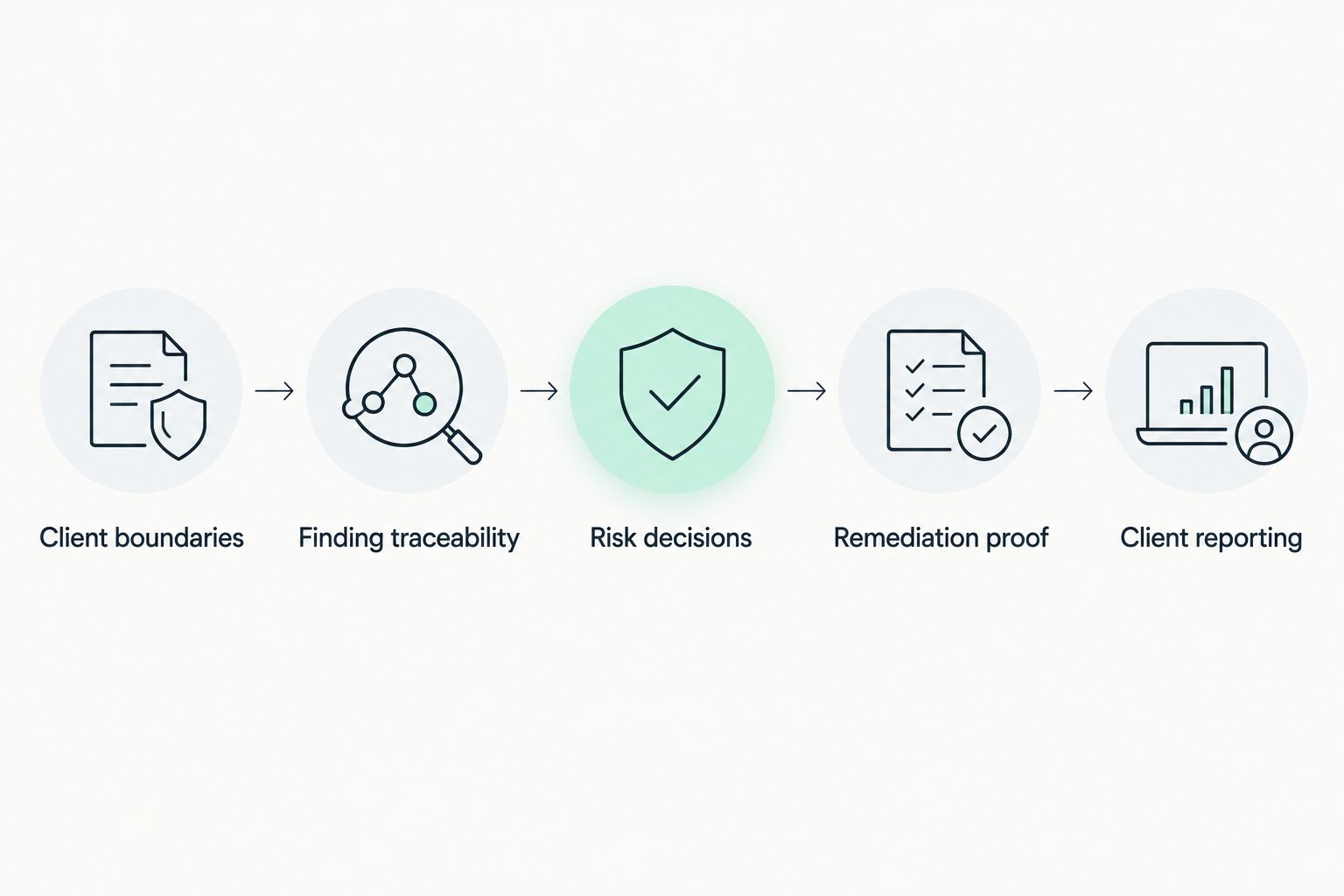
Client boundaries
Create separate client environments and analyst roles. Attempt cross-client searches, exports, report delivery, and access through integration credentials. Include a negative test: an analyst must fail to retrieve another client's data.
Finding traceability
Bring representative findings from the selected source feeds. Include an asset with conflicting identifiers and a finding reported by more than one source. Require an explanation of how the proposed system preserves evidence and handles ambiguity.
Risk decisions
Give the evaluator findings with different asset contexts and business owners. Ask the analyst to explain the ordering, identify missing context, and show who can change the decision. Record the rationale, not just the final score.
Remediation proof
Assign work, record an exception, and submit closure evidence. Then reopen a finding after a subsequent assessment contradicts the closure. Require the system to distinguish a completed task from a verified change in exposure.
Client reporting
Produce both an analyst work queue and a client-facing summary from the same evidence. Confirm that the summary preserves scope, reporting period, unresolved issues, and exceptions without exposing another client's information.
For your 2026 selection record, classify each demonstrated requirement as native, configured, dependent on another system, or manual. Do not accept a successful demonstration without recording what made it work and who will maintain that configuration.
How the shortlist is ranked
This shortlist ranks products by their role in the stated buying problem, not by an invented feature score or a performance benchmark. Vulnerability and exposure management comes first because it directly matches an exposure-focused risk operations requirement.
Assessment-led, ITSM-led, and investigation-led products follow as distinct choices. Apply the same criteria to each: client separation, evidence quality, explainable decisions, remediation ownership, repeatability, and operational fit.
Which risk operations center software should you choose?
Choose the operating model before choosing the product. For an exposure-focused service, start with Brinqa and require proof against your MSSP acceptance criteria. For scanning-led delivery, evaluate Tenable Vulnerability Management or Qualys VMDR against the assessment workflow your contracts require.
Choose ServiceNow Vulnerability Response when remediation coordination belongs in a ServiceNow-centered process. Evaluate Splunk Enterprise Security when the primary requirement is SOC investigation. Do not force one category to win a buying decision it was not intended to answer.
The final 2026 decision should name the platform, the systems it depends on, the work that remains manual, and the team responsible for each handoff. That operating design is more useful than a vendor ranking detached from your service obligations.
FAQ
What's the best risk operations center software for MSSPs?
Brinqa is the category-fit shortlist choice for MSSPs seeking vulnerability and exposure management. Tenable Vulnerability Management, Qualys VMDR, ServiceNow Vulnerability Response, and Splunk Enterprise Security address distinct assessment, remediation, or investigation requirements; select against a demonstrated service workflow.
Is a risk operations center the same as a SOC?
For this buying guide, a risk operations center focuses on exposure decisions and remediation, while a SOC focuses on security monitoring and incident handling. An MSSP can deliver both services, but should evaluate their workflows separately.
Can a vulnerability scanner run the entire managed risk service?
A vulnerability scanner alone does not establish the complete managed risk workflow. Your service also needs defined client boundaries, prioritization decisions, ownership, exception handling, and remediation verification.
What should an MSSP test before buying a platform?
An MSSP should test client isolation, evidence traceability, risk decisions, remediation verification, and client reporting. Include denied-access tests and a finding that reopens after closure.
Is ServiceNow Vulnerability Response better than a vulnerability management platform?
ServiceNow Vulnerability Response is a more relevant evaluation candidate when the requirement centers on ServiceNow-based remediation workflows. A vulnerability management platform addresses a different buying scope, so compare the complete proposed designs rather than treating the categories as interchangeable.
Can Splunk Enterprise Security replace exposure management?
Do not select Splunk Enterprise Security as an automatic replacement for exposure management. Its SIEM role fits security analytics and investigation; demonstrate exposure prioritization and remediation requirements separately.
How do you know a vulnerability is actually fixed?
Require verification evidence tied to the affected asset and finding, rather than treating a closed work item as sufficient proof. Define how reassessment results reopen an issue when closure evidence is contradicted.
One last thing
Make reopening a finding part of the purchase test. Closing a work item proves that someone completed a workflow; it does not, by itself, prove that exposure ended. Your service needs an explicit rule for reconciling those two states before you promise clients verified remediation.


