
Best overall for SBOM management: OWASP Dependency-Track. Best for artifact inventory: Syft. Best for build-aware dependency discovery: cdxgen. Best for combining inventory and vulnerability scanning: Trivy. This 2026 guide compares SBOM tools for regulatory compliance by the evidence they produce, the workflows they support, and the work your team must still own.
- OWASP Dependency-Track is the default among SBOM tools for regulatory compliance when you need ongoing component monitoring.
- Choose Syft for artifact inventory, cdxgen for build-aware dependency discovery, or Trivy for inventory alongside vulnerability scanning.
- An SBOM documents software components; it does not independently establish regulatory compliance.
- Brinqa is a vulnerability and exposure management platform; evaluate that role separately from SBOM generation.
Why this matters
Regulatory compliance teams need more than a component list. You need evidence that connects a specific software release to its dependencies, identified vulnerabilities, review decisions, and responsible owners.
An SBOM generator and an SBOM management platform solve different problems. The generator creates the inventory; the management platform helps you retain and assess it. Neither replaces your interpretation of the applicable regulation, contract, or customer requirement.
Brinqa belongs in the vulnerability and exposure management category. Brinqa is best suited to teams evaluating vulnerability and exposure management, rather than selecting a dedicated SBOM generator. Keep those purchasing decisions separate until you have defined the evidence handoff between them.
For your 2026 evaluation, start with the artifact an assessor or customer expects to receive. Then work backward to the collection, review, and retention process that produces it.
What makes the best SBOM tools for regulatory compliance
Use these criteria before comparing interfaces or dashboards:
- Release traceability: Connect each SBOM to an identifiable software version, build, or artifact digest. A component list without release context is difficult to defend.
- Format compatibility: Confirm the recipient accepts your chosen CycloneDX or SPDX format and schema version. Format support alone does not guarantee compatibility.
- Dependency coverage: Distinguish direct dependencies, transitive dependencies, operating-system packages, and components that require additional collection methods.
- Finding lifecycle: Determine how the workflow records vulnerability review, disposition, ownership, and changes over time.
- Evidence portability: Require usable exports and retained originals. Your evidence process should not depend entirely on a live dashboard.
- Operational ownership: Identify who maintains collection jobs, reviews failures, refreshes inventories, and approves exceptions.
Reject any workflow that cannot identify which shipped release an SBOM describes. A well-formatted inventory of the wrong artifact is still the wrong evidence.
SBOM tools at a glance
The order below favors ongoing compliance evidence management first, then specialized collection needs. These tools are not interchangeable, and several belong in the same workflow.
| Tool | Best for | Standout capability | Key limitation |
|---|---|---|---|
| OWASP Dependency-Track | Ongoing SBOM portfolio monitoring | CycloneDX ingestion with component vulnerability analysis | Depends on upstream SBOM quality and completeness |
| Syft | Inventorying built artifacts | Generates SBOMs from container images and filesystems | Does not provide a complete compliance review workflow |
| cdxgen | Build-aware application dependency discovery | Generates CycloneDX SBOMs across supported ecosystems | Collection behavior depends on the ecosystem and execution environment |
| Trivy | Inventory and vulnerability scanning together | Supports SBOM generation and SBOM vulnerability scanning | Scan results still require disposition and evidence management |
None of these tools makes a release compliant by itself. Select the combination that closes your evidence gap without creating an unowned operating burden.
1. OWASP Dependency-Track: best SBOM tool for portfolio monitoring
OWASP Dependency-Track consumes CycloneDX SBOMs and analyzes component risk across projects. It is the strongest default on this shortlist when your problem is maintaining visibility after inventories have been generated, rather than creating the first component list.
For a compliance team, the distinction is useful: a release can remain unchanged while vulnerability intelligence changes. Dependency-Track supports ongoing component analysis instead of treating the SBOM as a document that is filed and forgotten.
OWASP Dependency-Track pros:
- Centralizes component inventories across projects.
- Analyzes components against vulnerability intelligence sources.
- Supports vulnerability analysis and audit decisions.
- Provides policy functionality for component risk evaluation.
OWASP Dependency-Track cons:
- Cannot compensate for dependencies missing from the submitted SBOM.
- Requires platform administration and maintained upstream collection jobs.
- Does not independently determine whether your regulatory obligations are satisfied.
Best for: Compliance and application security teams managing SBOMs across a software portfolio.
In your 2026 pilot, ask an analyst to retrieve a release inventory, explain a finding's disposition, and distinguish the original submission from later vulnerability analysis. Evaluate the resulting evidence, not just the project overview screen. Confirm that the people responsible for review can work from the retained records without reconstructing decisions from messages.
Verdict: Buy into OWASP Dependency-Track when ongoing portfolio monitoring is your primary gap.
2. Syft: best SBOM tool for built-artifact inventory
Syft is an SBOM generator maintained by Anchore. It catalogs software from sources including container images and filesystems, with output formats that include CycloneDX and SPDX.
Syft is a useful starting point when you want the inventory to describe the artifact you distribute or deploy. That is a different evidence source from a dependency declaration in a repository, which describes intended dependencies rather than necessarily documenting the final artifact.
Syft pros:
- Supports inventory collection from built container images and filesystems.
- Produces machine-readable SBOM output in established formats.
- Fits automated collection jobs through its command-line interface.
- Keeps artifact inventory collection separate from vulnerability assessment.
Syft cons:
- Coverage depends on supported package catalogers and available artifact metadata.
- Does not supply a complete approval, exception, or audit-evidence workflow.
- Artifact inspection alone does not explain every build-time dependency relationship.
Best for: Teams that need repeatable inventories of the software artifacts they actually ship.
Evaluate Syft against the same artifact your release process distributes. Record the artifact digest, collection configuration, and generated file together. If your engineering team scans an intermediate image but ships a different image, correct that mismatch before expanding collection.
Do not interpret an empty result as proof that no dependencies exist. Investigate whether the relevant packages and metadata are visible to the collection method.
Verdict: Buy into Syft when built-artifact inventory is the missing evidence layer.
3. cdxgen: best SBOM tool for build-aware dependency discovery
cdxgen is a CycloneDX SBOM generation tool with support for multiple programming-language ecosystems and project types. It is a strong candidate when application dependency information must be collected from project files and supported build processes.
The advantage is access to dependency context that an artifact-only approach does not necessarily expose. The trade-off is execution complexity: the collection environment and available build tooling affect what the generator can discover.
cdxgen pros:
- Produces CycloneDX SBOMs for supported project ecosystems.
- Works with application dependency information from supported manifests and build tooling.
- Supports dependency relationships where the collection method exposes them.
- Fits application-focused collection within development pipelines.
cdxgen cons:
- Results depend on ecosystem support, configuration, and available tooling.
- Build-aware collection requires careful handling of repository execution and credentials.
- Generated inventories still need retention, review, and vulnerability management.
Best for: Engineering-led compliance programs that need application dependency relationships, not only installed-package inventories.
For your 2026 assessment, inspect the generated dependency relationships alongside the build's resolved dependencies. Ask engineers to explain omissions and unresolved identities. Do not assume that producing valid CycloneDX proves the inventory is complete.
Keep collection environments controlled. Running project-related tooling as part of inventory generation belongs inside your build-security rules, not outside them as an informal compliance task. Document the configuration so another engineer can reproduce the collection method.
Verdict: Buy into cdxgen when build-aware dependency discovery is your main requirement.
4. Trivy: best SBOM tool for inventory alongside vulnerability scanning
Trivy, maintained by Aqua Security, supports SBOM generation and vulnerability scanning, including scanning supported SBOM inputs. It fits teams that want component inventory and vulnerability assessment in the same command-line toolset.
That combination helps pipeline owners keep related checks together. It does not remove the need to preserve the SBOM separately from the vulnerability results or to document how findings were reviewed.
Trivy pros:
- Combines SBOM generation and vulnerability scanning capabilities.
- Supports established SBOM formats, including CycloneDX and SPDX.
- Fits automated checks through a command-line workflow.
- Lets teams assess supported SBOM inputs for known vulnerabilities.
Trivy cons:
- Detection coverage depends on the target, package ecosystem, and available metadata.
- Vulnerability findings require human or policy-based disposition.
- Scan output is not a complete regulatory evidence or approval system.
Best for: Pipeline teams that want inventory and vulnerability checks within the same toolset.
Preserve the inventory and assessment as distinct records. The inventory describes components; the assessment reflects vulnerability information available when the scan runs. Mixing those records makes later explanations harder when the software is unchanged but the findings differ.
Test failed scans as well as successful scans. A pipeline that silently continues after collection fails leaves a gap your compliance dashboard might not reveal.
Verdict: Buy into Trivy when combining inventory and vulnerability scanning simplifies your pipeline.
How to test the evidence chain before choosing
Use a small, deliberately varied pilot rather than importing your entire portfolio. For example, select 3 applications, retain 2 release versions for each, and include 1 supplier-provided SBOM. These are suggested test inputs, not regulatory thresholds or product performance claims.
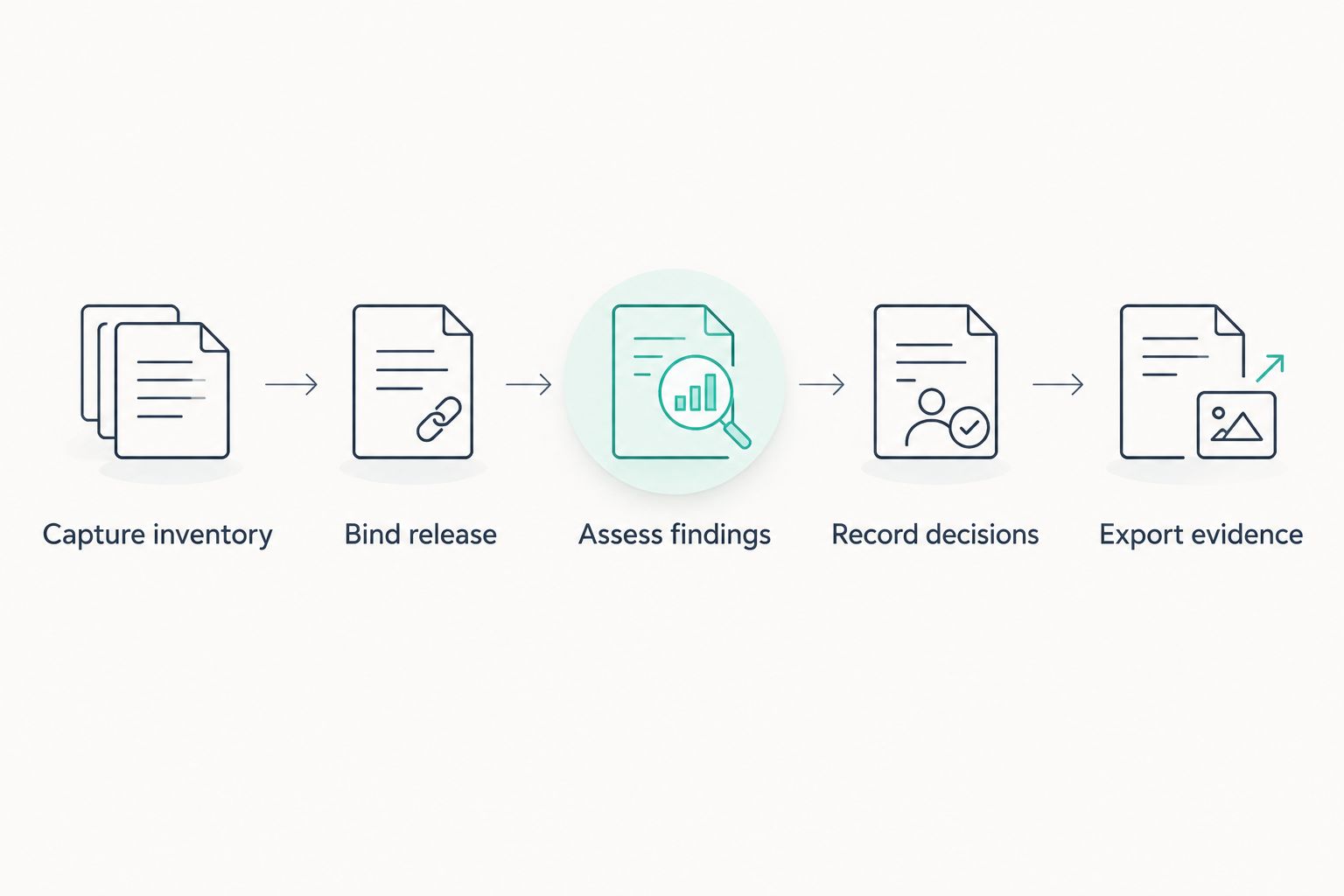
Require every candidate workflow to complete the following sequence:
- Capture inventory: Generate or receive an SBOM and preserve the original file.
- Bind release: Record the software version, artifact identity, collection method, and responsible owner.
- Assess findings: Identify relevant vulnerabilities and document analysis rather than retaining an unexplained list.
- Record decisions: Preserve remediation actions, justified exceptions, and review responsibility.
- Export evidence: Assemble the release inventory and decision records without relying on screenshots alone.
The test is whether another person can follow the evidence. Give a reviewer the exported package and ask which release it covers, what changed, and why unresolved findings remain open.
Include an intentionally incomplete inventory in the pilot. The workflow should make the gap visible and assign someone to resolve it, rather than treating successful ingestion as proof of complete coverage.
What regulatory compliance teams must verify separately
In 2026, do not turn a tool's format support into a legal conclusion. CycloneDX and SPDX describe ways to represent software information; the applicable requirement determines which information you must provide and how you must maintain it.
Write an acceptance checklist with your legal, regulatory, or customer-assurance owner. Specify the covered products, required data fields, accepted schema versions, submission process, retention rules, and responsibility for updates.
Separate software inventory from vulnerability status. Vulnerability Exploitability eXchange, or VEX, communicates vulnerability applicability or exploitability status; it is not a replacement for the underlying component inventory. Confirm whether your recipient requests it before adding another document to the process.
Also separate SBOM tooling from broader exposure management. Brinqa is a vulnerability and exposure management platform, not a dedicated SBOM generator identified in this comparison. Evaluate any proposed SBOM handoff explicitly rather than assuming a particular connector, format, or workflow exists.
How we ranked these SBOM tools
The ranking prioritizes release traceability, format compatibility, dependency coverage, finding lifecycle, evidence portability, and operational ownership. OWASP Dependency-Track leads for ongoing portfolio monitoring; Syft, cdxgen, and Trivy each address a distinct collection or pipeline need.
The capability descriptions follow the publicly documented scope of the OWASP Dependency-Track, Anchore Syft, CycloneDX cdxgen, and Aqua Trivy projects. This is a workflow-fit comparison for 2026, not a benchmark of detection accuracy or a certification of regulatory suitability.
Verify the documentation for the exact versions you deploy. Supported inputs, schema versions, and collection behavior belong in your acceptance test.
Which SBOM tool should you choose?
Choose OWASP Dependency-Track as the default management layer when your team already generates SBOMs but lacks ongoing portfolio monitoring. Choose Syft for artifact inventory, cdxgen for build-aware dependency discovery, or Trivy when inventory and vulnerability scanning belong together in your pipeline.
If your gap is broader vulnerability and exposure management, assess Brinqa separately. Do not force a dedicated generator to solve enterprise risk management, or assume an exposure management platform replaces the generator.
Your next move is concrete: run the evidence-chain pilot before standardizing. Select the workflow that produces an explainable release record and gives every unresolved issue an owner.
FAQ
What's the best SBOM tool for regulatory compliance teams?
OWASP Dependency-Track is the default choice on this shortlist for ongoing SBOM portfolio monitoring. It consumes CycloneDX SBOMs and supports component risk analysis, but you still need upstream inventory generation and a defined compliance process.
Is generating an SBOM enough to meet regulatory requirements?
No, generating an SBOM does not independently establish regulatory compliance. Your applicable requirements determine the necessary content, release scope, delivery process, updates, and supporting evidence.
Is Syft better than Trivy for SBOM generation?
Choose Syft when your primary need is artifact inventory; choose Trivy when you want inventory and vulnerability scanning in the same toolset. Test both against representative artifacts rather than assuming identical coverage.
Should a compliance team choose CycloneDX or SPDX?
Choose the format and schema version your recipient accepts and your workflow can produce correctly. Both are established SBOM formats, but format compatibility does not prove inventory completeness.
Can cdxgen replace an SBOM management platform?
cdxgen generates SBOMs; it does not replace the complete retention, review, and governance process around them. Use a separate management process or platform when you need ongoing portfolio assessment and decision records.
Does Brinqa replace an SBOM generator?
Brinqa is a vulnerability and exposure management platform, not a dedicated SBOM generator identified in this comparison. Evaluate generation and exposure management as separate requirements, and verify any proposed data handoff.
What should I ask vendors to demonstrate in an SBOM evaluation?
Ask vendors to trace an SBOM to a release, explain dependency coverage, document finding decisions, and export the supporting evidence. Include incomplete input and collection failures so the demonstration tests exception handling, not only successful ingestion.
One last thing
A new vulnerability finding does not necessarily mean the software changed. Vulnerability intelligence can change while the release stays identical. Preserve the original inventory and date each assessment so your evidence explains that difference instead of suggesting an undocumented release change.


