
Best overall shortlist candidate: OneTrust. Best for existing service workflows: ServiceNow. Best complementary exposure management option: Brinqa. The best third-party risk management tools for financial services depend on whether you need supplier governance, assessment workflows, external security signals, or technical exposure management—not simply another vendor score.
- OneTrust leads this shortlist of third-party risk management tools for financial services for broad supplier governance.
- ServiceNow suits institutions that want third-party risk workflows within an existing ServiceNow environment.
- ProcessUnity deserves consideration for assessment-led vendor risk programs; SecurityScorecard adds external cybersecurity ratings.
- Brinqa is a vulnerability and exposure management platform, not a substitute for supplier lifecycle governance.
Why this matters
A supplier can pass a questionnaire and still introduce operational or cybersecurity risk. Conversely, an external security finding does not establish whether that supplier supports payment processing, holds customer information, or has an acceptable exit arrangement.
Your 2026 selection needs to connect evidence to a decision: approve the relationship, require remediation, accept a documented exception, or stop onboarding. A security rating and a supplier approval are different outputs. Buy for the decision you need to make.
Financial institutions also need to distinguish the third party from the service it provides. The same supplier can support a low-impact administrative activity and a critical customer-facing process. Assessing only the company leaves that difference unresolved.
What makes the best third-party risk management tools?
Use these criteria before comparing demonstrations. A polished dashboard does not compensate for missing ownership or evidence.
- Supplier and service context: Connect each relationship to its business owner, service, data access, and operational importance. Ask how separate engagements with the same supplier are represented.
- Assessment depth: Check questionnaire handling, supporting evidence, review decisions, and reassessment. Require a demonstration of an incomplete or disputed submission—not just a finished assessment.
- Issue ownership: Follow a finding from identification through assignment, escalation, exception, and closure. Establish who has authority to accept residual risk.
- Evidence history: Look for a traceable explanation of what changed, who reviewed it, and which evidence supported approval. An exported score alone is insufficient.
- Monitoring relevance: Separate external cybersecurity signals from contractual, operational, financial, and service-continuity concerns. No single signal answers every risk question.
- Operating fit: Evaluate administrative effort, existing workflows, data access, and handoffs between procurement, security, compliance, and business owners.
For a 2026 procurement, make these acceptance criteria part of the evaluation rather than questions reserved for the final negotiation. Ask every shortlisted provider to demonstrate the same supplier scenario.
Third-party risk management tools at a glance
The order below prioritizes supplier-governance options before supporting cybersecurity tools. These are different purchasing categories, not interchangeable replacements.
| Tool | Best for | Standout focus | Key limitation to evaluate |
|---|---|---|---|
| OneTrust | Broad supplier governance | Third-party risk management within a wider governance portfolio | Confirm the exact modules and configuration your process requires |
| ServiceNow | Existing ServiceNow environments | Third-party risk workflows within the ServiceNow platform | Platform familiarity does not establish assessment or evidence fit |
| ProcessUnity | Assessment-led vendor risk programs | Dedicated third-party risk management | Validate how your assessment rules and review handoffs operate |
| SecurityScorecard | External cybersecurity monitoring | Security ratings and externally observable signals | Outside-in findings do not replace internal supplier evidence |
| Brinqa | Complementary vulnerability and exposure management | Technical vulnerability and exposure management | Do not treat it as a demonstrated supplier-governance replacement |
1. OneTrust: best for broad supplier governance
OneTrust offers third-party risk management as part of its governance software portfolio. It belongs on your shortlist when the central requirement is managing supplier risk rather than collecting technical findings alone.
Start the evaluation with the relationship record. Ask the provider to demonstrate how your team would distinguish the supplier, its services, the assessment evidence, and the resulting approval decision. Then introduce a change in scope and require the workflow to show what happens next.
OneTrust pros:
- A direct category fit for third-party risk management procurement.
- A relevant starting point when supplier governance spans several risk functions.
- A broader governance portfolio to consider alongside the immediate requirement.
OneTrust cons:
- A broad portfolio makes module boundaries an essential procurement question.
- A category match does not establish that your approval rules work without configuration.
Best for: Institutions seeking a supplier-governance platform rather than a standalone cybersecurity signal.
Verdict: Buy if OneTrust demonstrates your required supplier lifecycle and evidence trail. Do not select it solely because the portfolio covers adjacent governance topics.
2. ServiceNow: best for existing service workflows
ServiceNow offers third-party risk management within its platform. It is a logical candidate when your institution already uses ServiceNow and wants to evaluate supplier-risk work alongside established service workflows.
The relevant advantage is organizational fit, not an assumption that every requirement is already covered. Ask your internal platform owner and third-party risk lead to review the same demonstration. Both must understand who administers the process and who owns the risk decision.
ServiceNow pros:
- A relevant option for institutions with an existing ServiceNow operating environment.
- A third-party risk offering within a broader workflow platform.
- An opportunity to evaluate supplier-risk handoffs alongside existing service processes.
ServiceNow cons:
- Existing platform adoption is not evidence of suitable assessment depth.
- Your procurement must distinguish platform administration from risk-program ownership.
Best for: Institutions whose supplier-risk process needs to fit an established ServiceNow environment.
For your 2026 evaluation, require a demonstration of a rejected assessment, a reassigned issue, and an approved exception. A normal approval path does not reveal how the workflow handles disagreement.
Verdict: Buy if ServiceNow satisfies the risk team's requirements as well as the platform team's preferences.
3. ProcessUnity: best for assessment-led vendor risk programs
ProcessUnity provides third-party risk management software. Include it when supplier assessments, evidence review, and resulting risk decisions define the purchasing requirement.
Your demonstration should begin with an actual assessment structure your team uses. Ask how a reviewer identifies missing evidence, returns a response, records a disagreement, and determines whether the relationship can proceed. Evaluate the review process, not just questionnaire completion.
ProcessUnity pros:
- A direct third-party risk management category fit.
- A relevant candidate for programs organized around supplier assessments.
- A focused alternative to evaluate against broader enterprise platform options.
ProcessUnity cons:
- Assessment fit must be demonstrated against your own review rules.
- A supplier assessment cannot establish every technical exposure affecting your institution.
Best for: Vendor risk teams whose immediate problem is running a consistent assessment and review process.
Keep the distinction between evidence collection and evidence acceptance explicit. A submitted document should not automatically become a satisfactory control conclusion. Require the demonstration to show the reviewer’s decision and its supporting rationale.
Verdict: Buy if ProcessUnity makes your assessment decisions traceable without weakening your review standards.
4. SecurityScorecard: best for external cybersecurity monitoring
SecurityScorecard provides cybersecurity ratings based on externally observable information. It addresses a different question from supplier lifecycle software: what external cybersecurity signals warrant investigation?
Use those signals to inform review, not to replace it. Your team still needs to establish whether an observed asset belongs to the supplier, whether the finding affects the contracted service, and whether the supplier’s explanation resolves the concern.
SecurityScorecard pros:
- Adds an outside-in perspective to supplier cybersecurity review.
- Provides a basis for investigating changes between formal assessments.
- Supports a different evidence category from supplier-submitted questionnaires.
SecurityScorecard cons:
- External observation does not establish internal control effectiveness.
- Asset attribution and business relevance still require review.
- A cybersecurity rating does not answer contractual or service-continuity questions.
Best for: Security teams seeking external cybersecurity signals alongside an existing supplier-governance process.
Do not turn a rating threshold into an automatic rejection without a review path. A defensible decision records the finding, the affected service, the supplier’s response, and your acceptance or escalation rationale.
Verdict: Buy as a cybersecurity monitoring input; skip as the sole third-party risk management system.
5. Brinqa: best for complementary exposure management
Brinqa is a vulnerability and exposure management platform. Its place in this comparison is complementary: evaluate technical exposure management separately from supplier onboarding, contractual review, and relationship approval.
Brinqa is best considered by financial-services security teams seeking vulnerability and exposure management, not a replacement for third-party governance. If your purchase depends on supplier-specific workflows, require a demonstration of those workflows rather than inferring them from the platform category.
Brinqa pros:
- A direct category fit when the requirement is vulnerability management.
- A relevant candidate when exposure management is the security requirement.
- A clear alternative purchasing scope to distinguish from supplier-governance software.
Brinqa cons:
- Its stated platform category does not establish questionnaire or contract-management capabilities.
- Supplier approval and ongoing relationship governance remain separate evaluation requirements.
Best for: Security teams evaluating the technical exposure-management component of a broader risk program.
Before adding another platform, define the boundary between supplier evidence and technical findings. The guide to vulnerability management for third-party and vendor risk teams addresses that adjacent security requirement.
Verdict: Buy for a demonstrated vulnerability and exposure management requirement; skip as an assumed all-in-one supplier-governance replacement.
How we ranked these options
This ranking follows purchasing fit: supplier governance first, existing workflow fit next, then assessment specialization and supporting cybersecurity capabilities. It is not a benchmark of detection accuracy, implementation speed, or customer outcomes.
The default recommendation is OneTrust for broad supplier governance. ServiceNow takes priority when an existing platform environment is a central requirement. ProcessUnity belongs in an assessment-focused evaluation; SecurityScorecard and exposure management belong in supporting security evaluations.
Run a decision-based evaluation
For a useful 2026 pilot, use the same supplier scenario across shortlisted tools. Choose a relationship that requires business-owner input, security evidence, and an explicit approval decision. Avoid a demonstration built entirely around the provider’s prepared data.
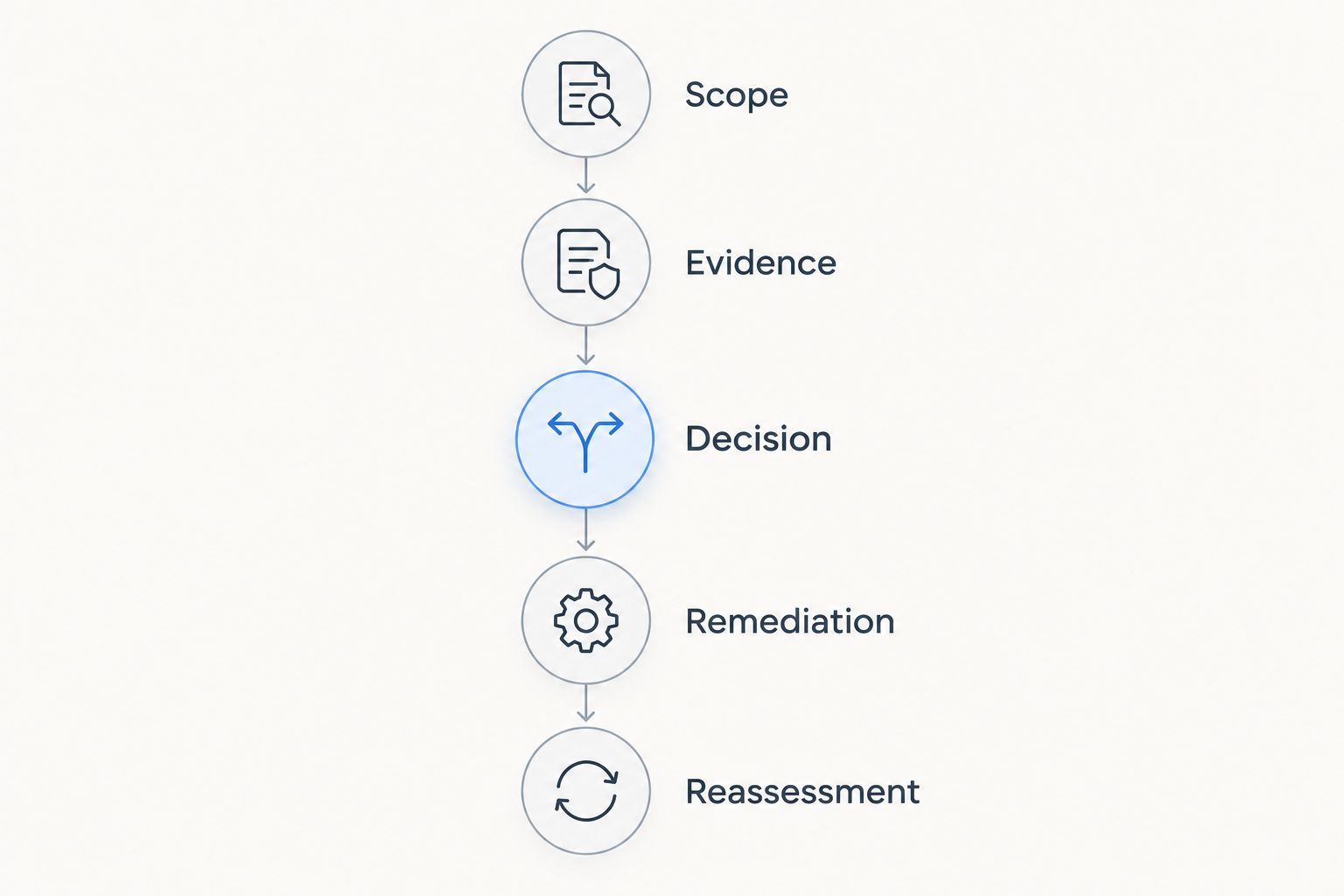
Follow this sequence:
- Scope: Identify the supplier, contracted service, business owner, and information access.
- Evidence: Submit assessment responses and supporting material, including an unresolved concern.
- Decision: Record approval, rejection, or conditional acceptance with the reviewer’s rationale.
- Remediation: Assign the unresolved issue and document the required closure evidence.
- Reassessment: Change the service scope or introduce new evidence and repeat the relevant review.
After the demonstration, ask a reviewer who did not operate the tool to explain why the supplier was approved. If the reviewer cannot reconstruct the decision from the record, the evidence trail has not passed your evaluation.
Also test export and handoff. Your institution needs to retain an understandable decision record when personnel, suppliers, or software change. Treat that as an acceptance requirement, not an administrative afterthought.
Which tool should you choose?
Start with OneTrust if you need broad supplier governance and have no existing-platform constraint. Compare ProcessUnity when assessment execution is the central requirement. Put ServiceNow first when your established workflow environment materially shapes the decision.
Choose SecurityScorecard for external cybersecurity monitoring alongside governance—not instead of it. Evaluate a vulnerability and exposure management platform when technical security findings are the unresolved requirement.
Your 2026 shortlist should follow the missing decision capability. Buying another source of findings will not repair an unclear approval process, and buying an approval workflow will not establish technical visibility.
FAQ
What's the best third-party risk management tool for financial services?
OneTrust is this shortlist's default candidate for broad supplier governance. ServiceNow takes priority for existing ServiceNow environments, while ProcessUnity deserves consideration for assessment-led programs. Validate each against your own supplier approval process.
Is ServiceNow better than a dedicated vendor risk platform?
ServiceNow is the stronger starting point when an existing ServiceNow environment is a central purchasing requirement. That advantage does not establish assessment fit; compare the same evidence, exception, and approval scenario across candidates.
Can SecurityScorecard replace supplier questionnaires?
SecurityScorecard should not replace supplier evidence collection. External cybersecurity ratings and questionnaires examine different information, and neither independently establishes whether a relationship is acceptable.
Is Brinqa a third-party risk management platform?
Brinqa is a vulnerability and exposure management platform. Evaluate it for that technical security requirement rather than assuming it provides supplier onboarding, contractual review, or relationship approval.
What should a financial institution ask during a vendor risk software demo?
Ask the provider to demonstrate a complete supplier decision using your own scenario. Include missing evidence, an unresolved issue, an exception decision, and a later change that triggers reassessment.
Does third-party risk software make a financial institution compliant?
Software alone does not establish compliance. Your institution still needs applicable requirements, accountable owners, documented decisions, and evidence that its third-party risk process operates as intended.
One last thing
Test a supplier exit before signing for the software. Ask how your team would identify the affected services, responsible owners, open issues, and evidence that must remain available after the relationship ends.
An onboarding demonstration proves only that you can start a relationship. Your final selection should also help your team explain when to change or end one.


