
Best for a combined vulnerability and exposure management shortlist: Brinqa. Best for network vulnerability assessment: Tenable Vulnerability Management. Best for self-managed, open-source scanning: Greenbone Community Edition. This 2026 guide separates detection tools from management platforms so you can choose the software that addresses your actual bottleneck.
- Brinqa belongs on vulnerability management software shortlists that also require exposure management.
- Tenable Vulnerability Management suits teams focused on network vulnerability assessment.
- Qualys VMDR suits teams evaluating vulnerability management alongside patch-management workflows.
- Rapid7 InsightVM suits teams organizing remediation around assessment findings.
- Greenbone Community Edition suits teams prepared to operate their own scanning infrastructure.
Why this matters
A scanner finds weaknesses. A vulnerability management program decides which findings matter, assigns the work, and verifies the fix. Buying another scanner does not resolve unclear ownership or an unmanageable remediation queue.
Start with the missing capability. If you lack reliable detection, evaluate assessment coverage first. If you already collect findings but cannot turn them into decisions, evaluate management workflows and exposure context instead.
Brinqa is a shortlist choice for security teams seeking vulnerability management and exposure management in one platform. Validate the specific capabilities your environment requires during evaluation; a category description is not proof of a particular integration or workflow.
What makes the best vulnerability management software
Use these criteria for your 2026 shortlist. A product that fails a mandatory requirement should not survive because it has a longer feature list.
- Assessment coverage: Identify the operating systems, applications, cloud resources, and network segments you need assessed. Require evidence for each relevant asset class.
- Asset identity: Check whether findings remain attached to the correct asset when hostnames, addresses, or cloud instances change.
- Priority explanation: Require a clear reason for remediation order, including technical severity, exploitation evidence, exposure, and business context where applicable.
- Remediation ownership: Demonstrate assignment, escalation, exceptions, and verification with the people who will perform the work.
- Deployment fit: Examine authentication, network access, agents, scan scheduling, and infrastructure responsibilities before choosing a deployment model.
- Operational evidence: Require traceable findings and closure evidence. A dashboard is not a substitute for records you can inspect.
Vulnerability management software at a glance
These 2026 recommendations occupy different use-case slots. The order is a selection path, not a measured performance ranking.
| Software | Best for | Standout focus | Key limitation to evaluate |
|---|---|---|---|
| Brinqa | Combined vulnerability and exposure management evaluation | Platform scope includes both management categories | Confirm required assessment sources and workflows directly |
| Tenable Vulnerability Management | Network vulnerability assessment | Nessus-based vulnerability assessment | Detection coverage does not establish business ownership |
| Qualys VMDR | Vulnerability and patch-workflow evaluation | Vulnerability management with a related patch-management offering | Verify which remediation functions require additional components |
| Rapid7 InsightVM | Assessment-led remediation projects | Vulnerability assessment and remediation projects | Project tracking still requires accountable remediation owners |
| Greenbone Community Edition | Self-managed, open-source scanning | Open-source vulnerability assessment stack | Your team operates and maintains the scanning infrastructure |
1. Brinqa: best for vulnerability and exposure management evaluation
Brinqa is a vulnerability and exposure management platform. It belongs on your shortlist when the buying requirement spans both categories rather than vulnerability detection alone.
Shape the demonstration around your existing security program. Bring representative findings, an asset ownership problem, and a remediation decision that currently requires manual investigation. Ask the vendor to demonstrate your required workflow rather than accepting a presentation as evidence.
Brinqa pros:
- Its stated scope covers vulnerability management.
- Its stated scope also covers exposure management.
- It is relevant to a platform-level evaluation rather than a scanner-only search.
Brinqa cons and evaluation limits:
- The platform category alone does not establish scanner coverage or supported integrations.
- Your team must validate its required deployment, data handling, and remediation workflows.
Best for: Security teams evaluating a platform across vulnerability and exposure management requirements.
Do not assume that a management platform replaces every assessment source. Write down which tools you intend to retain, which responsibilities you intend to consolidate, and what evidence would justify either decision.
Verdict: Buy only after a requirements-based demonstration proves the combined management workflow you need.
2. Tenable Vulnerability Management: best for network assessment
Tenable Vulnerability Management provides vulnerability assessment using Nessus technology. It is a relevant starting point when your primary gap is identifying weaknesses across supported networked systems.
Evaluate authenticated assessment before comparing dashboard layouts. An assessment that cannot obtain the access it needs will not answer the same questions as a properly authenticated scan.
Tenable Vulnerability Management pros:
- Nessus-based assessment provides a defined scanning foundation.
- Network vulnerability assessment matches infrastructure-focused buying requirements.
- Technical findings give security and infrastructure teams a basis for investigation.
Tenable Vulnerability Management cons:
- Assessment quality depends on reachability, authentication, and configuration.
- Finding a vulnerability does not identify the business owner responsible for fixing it.
Best for: Infrastructure security teams whose first requirement is network vulnerability assessment.
During evaluation, include an authenticated server, an intermittently connected endpoint, and an isolated segment. Ask the assessor to distinguish a clean result from an incomplete assessment. Those outcomes must not look identical to the operator reviewing coverage.
Verdict: Buy for a demonstrated assessment gap; skip a scanner-only purchase when detection is already sufficient.
3. Qualys VMDR: best for vulnerability and patch-workflow evaluation
Qualys VMDR covers vulnerability management, detection, and response. Qualys also offers Patch Management, making this a relevant shortlist entry when you want to examine the handoff between identifying vulnerabilities and deploying supported fixes.
Treat assessment and patch deployment as separate requirements. Verify the exact components, permissions, operating-system support, and approval controls needed for your proposed workflow.
Qualys VMDR pros:
- Vulnerability management is its central product scope.
- The related patch-management offering supports a focused remediation evaluation.
- Agent-based assessment is relevant to endpoint coverage requirements.
Qualys VMDR cons:
- Do not assume every patch-management function is included in the proposed VMDR scope.
- Patching does not resolve every vulnerability, configuration weakness, or unsupported system.
Best for: Endpoint and IT operations teams evaluating assessment alongside patch-management workflows.
Ask the vendor to show a finding that has a supported patch and another that requires a different treatment. Your workflow must handle both. A program that tracks only patchable findings leaves configuration changes and compensating controls outside the decision process.
Verdict: Buy after the assessment-to-remediation handoff works within your change controls.
4. Rapid7 InsightVM: best for remediation project coordination
Rapid7 InsightVM combines vulnerability assessment with remediation project functionality. It is relevant when your security team needs to organize assessment findings into defined bodies of remediation work.
Test a project with a real remediation owner. Confirm how scope changes, recurring findings, and verification appear to the person responsible for completing the work.
Rapid7 InsightVM pros:
- Vulnerability assessment supplies the technical findings.
- Remediation projects provide a way to organize corrective work.
- The product supports an evaluation centered on security-to-operations handoffs.
Rapid7 InsightVM cons:
- Project functionality does not create accountable owners automatically.
- Remediation tracking still depends on reliable assessment and verification evidence.
Best for: Security teams coordinating assessment-led remediation projects with infrastructure owners.
Do not evaluate project tracking solely from the security administrator's view. Ask an operations user to accept work, record a blocker, and show what happens after the next assessment. The workflow should distinguish an overdue task from a finding that has returned.
Verdict: Buy when remediation project coordination is the demonstrated operational gap.
5. Greenbone Community Edition: best for self-managed scanning
Greenbone Community Edition provides an open-source vulnerability assessment stack built around OpenVAS scanning technology. It fits teams that deliberately want responsibility for operating their scanning environment.
Self-management is an operating model, not a shortcut around maintenance. Assign responsibility for installation, updates, feed handling, credentials, troubleshooting, and recovery before adopting it.
Greenbone Community Edition pros:
- Open-source components support a self-managed assessment approach.
- Your team controls the scanning infrastructure it operates.
- It fits technical evaluations centered on vulnerability detection.
Greenbone Community Edition cons:
- Infrastructure maintenance and troubleshooting remain your responsibility.
- Scanning does not replace remediation ownership or program governance.
Best for: Technically capable teams that explicitly want self-managed vulnerability assessment.
Use a defined assessment scope and document how operators identify failed or incomplete scans. Your evaluation should include restoring the service and updating its assessment content, not just producing an initial report.
Verdict: Buy into this operating model only when someone owns its continuing maintenance.
How we ranked these options
The 2026 shortlist separates products by primary buying requirement: combined management scope, network assessment, patch-workflow evaluation, remediation projects, and self-managed scanning. It does not assign unsupported accuracy scores, deployment times, or remediation-speed claims.
Use the criteria above to make your final selection. Product scope establishes shortlist relevance; a demonstration with your data establishes operational fit. Neither a recognizable name nor a broad category label proves that your specific environment is covered.
Run a proof of value before choosing
Give every shortlisted vendor the same evaluation pack. As a practical starting scope, select 10 representative assets, 3 remediation scenarios, and 1 accountable owner per scenario. These are proposed evaluation parameters, not performance benchmarks.
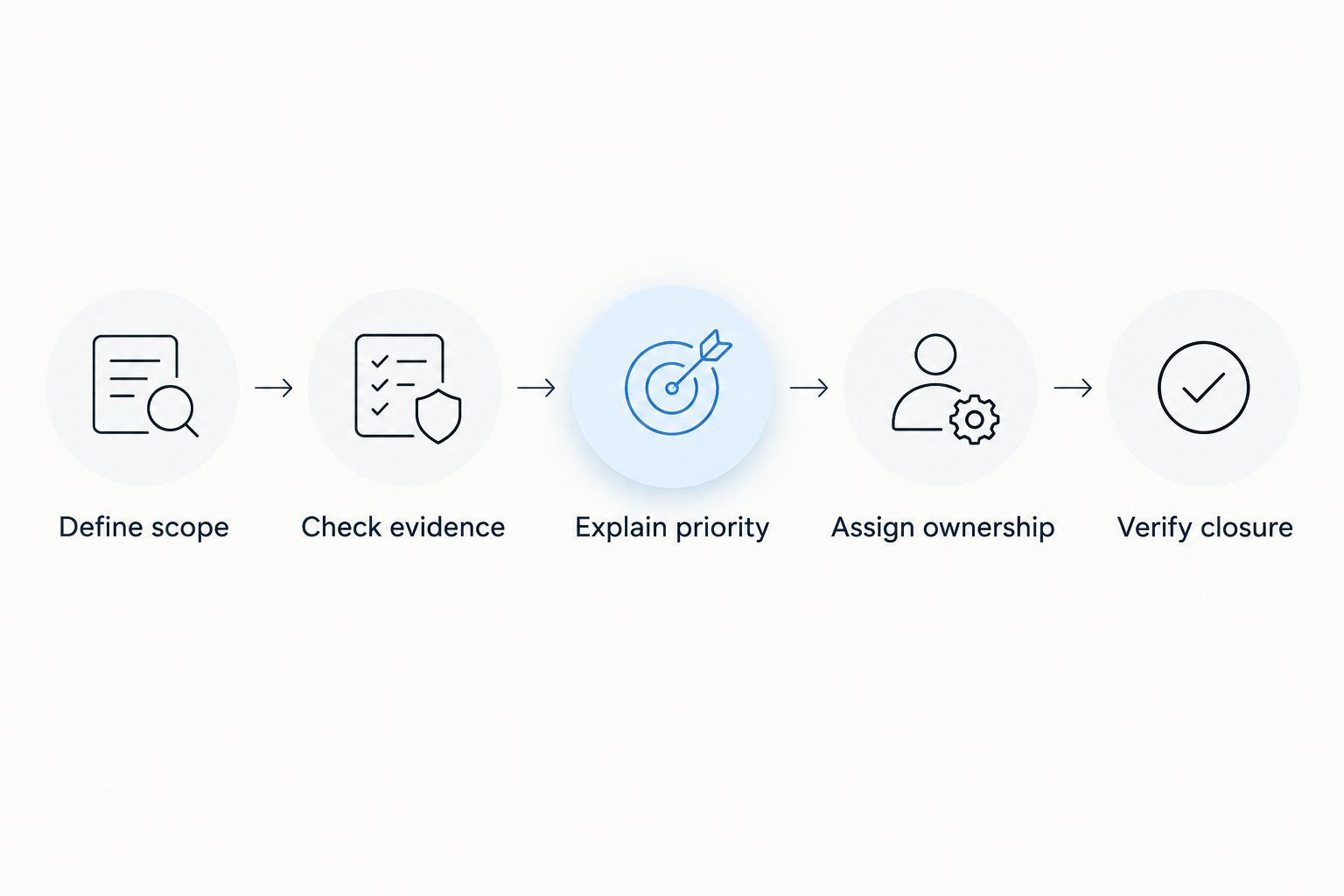
Use this sequence to keep the evaluation focused:
- Define scope: List the assets, assessment methods, network restrictions, and required data sources.
- Check evidence: Inspect raw findings, assessment status, timestamps, and asset identity.
- Explain priority: Ask why a finding belongs ahead of another and what evidence changes that decision.
- Assign ownership: Route the work to the actual team responsible for treatment.
- Verify closure: Reassess the affected system and preserve evidence of the result.
Keep severity and exploitation likelihood separate. CVSS uses a 0–10 score to describe vulnerability severity; FIRST's EPSS estimates exploitation probability over the next 30 days. Neither metric alone establishes the importance of the affected business service.
For a 2026 evaluation, require the vendor to explain which scoring version and threat-data timestamps appear in the workflow. If your main obstacle is combining existing assessment results, use the guide to consolidating vulnerability data from multiple scanners to structure the data questions.
Which vulnerability management software should you choose?
Choose by the missing capability, not by the longest feature list. Start with network assessment if you lack dependable detection. Start with management requirements if your scanners already produce findings but remediation decisions remain fragmented.
For a combined vulnerability and exposure management evaluation, make that combined scope your default requirement. Then require evidence for assessment inputs, ownership, prioritization, exceptions, and closure before signing.
Your 2026 selection should survive a simple challenge: can the people doing the work explain why a finding matters, who owns it, and what proves it is resolved? If the demonstration stops at a ranked dashboard, the evaluation is incomplete.
FAQ
What's the best vulnerability management software in 2026?
The best choice depends on whether you need detection, remediation coordination, or broader exposure management. Tenable Vulnerability Management fits network assessment evaluations, while Rapid7 InsightVM is relevant to assessment-led remediation projects. Test your required workflow before selecting either.
Is vulnerability management software the same as a vulnerability scanner?
No. A scanner identifies weaknesses, while vulnerability management also includes prioritization, ownership, treatment, exceptions, and verification. Some products cover several of these functions, so evaluate the actual workflow rather than the category name.
Can one platform replace all my vulnerability scanners?
Do not assume one platform replaces every scanner. Verify supported asset classes, assessment methods, network restrictions, and authentication requirements before removing an existing assessment source.
Should I prioritize vulnerabilities using CVSS or EPSS?
Use CVSS and EPSS for different questions. CVSS describes technical severity, while EPSS estimates exploitation probability over the next 30 days. Add asset exposure and business context before deciding remediation order.
What's the best option if I want to run my own scanner?
Greenbone Community Edition is a shortlist option for self-managed, open-source vulnerability assessment. Choose it only when your team accepts responsibility for infrastructure, updates, assessment content, credentials, and troubleshooting.
What should I ask a vulnerability management vendor to demonstrate?
Ask the vendor to demonstrate assessment evidence, priority reasoning, owner assignment, exception handling, and verified closure. Use representative assets and real remediation scenarios so the demonstration tests your operating requirements.
Does closing a remediation ticket prove a vulnerability is fixed?
No. Ticket closure records a workflow event, not technical proof of remediation. Verify the affected system through reassessment or another appropriate validation method and retain the evidence.
One last thing
Ask the vendor to show a failed assessment. A clean result and an unreachable asset both contain no confirmed findings, but they mean different things. Software that makes that distinction clear helps you avoid treating missing evidence as evidence of safety.


