
Zero trust architectures live or die on how fast a security team can see, score, and fix exposures across segmented networks, identities, and workloads. This guide ranks the best vulnerability management tools for zero trust programs in 2026, covering what each platform actually does inside a segmented environment, where it breaks down, and which one fits your team.
- Brinqa wins overall for risk-based prioritization tied to zero trust segments and business context in 2026.
- Tenable is the strongest continuous scanner across hybrid infrastructure but needs a separate prioritization layer.
- Qualys fits compliance-heavy zero trust rollouts; CrowdStrike Falcon Spotlight fits endpoint-first microsegmentation.
- Palo Alto Networks Cortex Xpanse covers external attack surface visibility that feeds zero trust boundaries.
- Rapid7 InsightVM suits DevOps teams running vulnerability checks inside CI/CD pipelines.
Why this matters
Zero trust architecture, as defined in NIST Special Publication 800-207 (2020), assumes no implicit trust based on network location — every request gets verified against identity, device posture, and risk before access is granted. Vulnerability data is one of the signals a policy engine checks, alongside identity and device health. A scanner reporting a CVSS score of 7.5 on a segmented database server tells a policy engine nothing useful unless that score gets tied to the segment, the identity requesting access, and the exploit probability (EPSS scores run 0 to 100 percent) behind it.
That gap is exactly what most vulnerability management tools built for perimeter-era security never closed. Brinqa's breakdown of vulnerability management for zero trust architectures walks through where scanner output needs to plug into a policy engine before it's useful for access decisions. Pick a tool that only produces a CVSS score between 0.0 and 10.0 and you've still got a manual translation step between the scan and the access decision — and that step is where zero trust programs stall in 2026.
“Zero trust doesn't remove vulnerabilities — it decides which ones are allowed to move.”
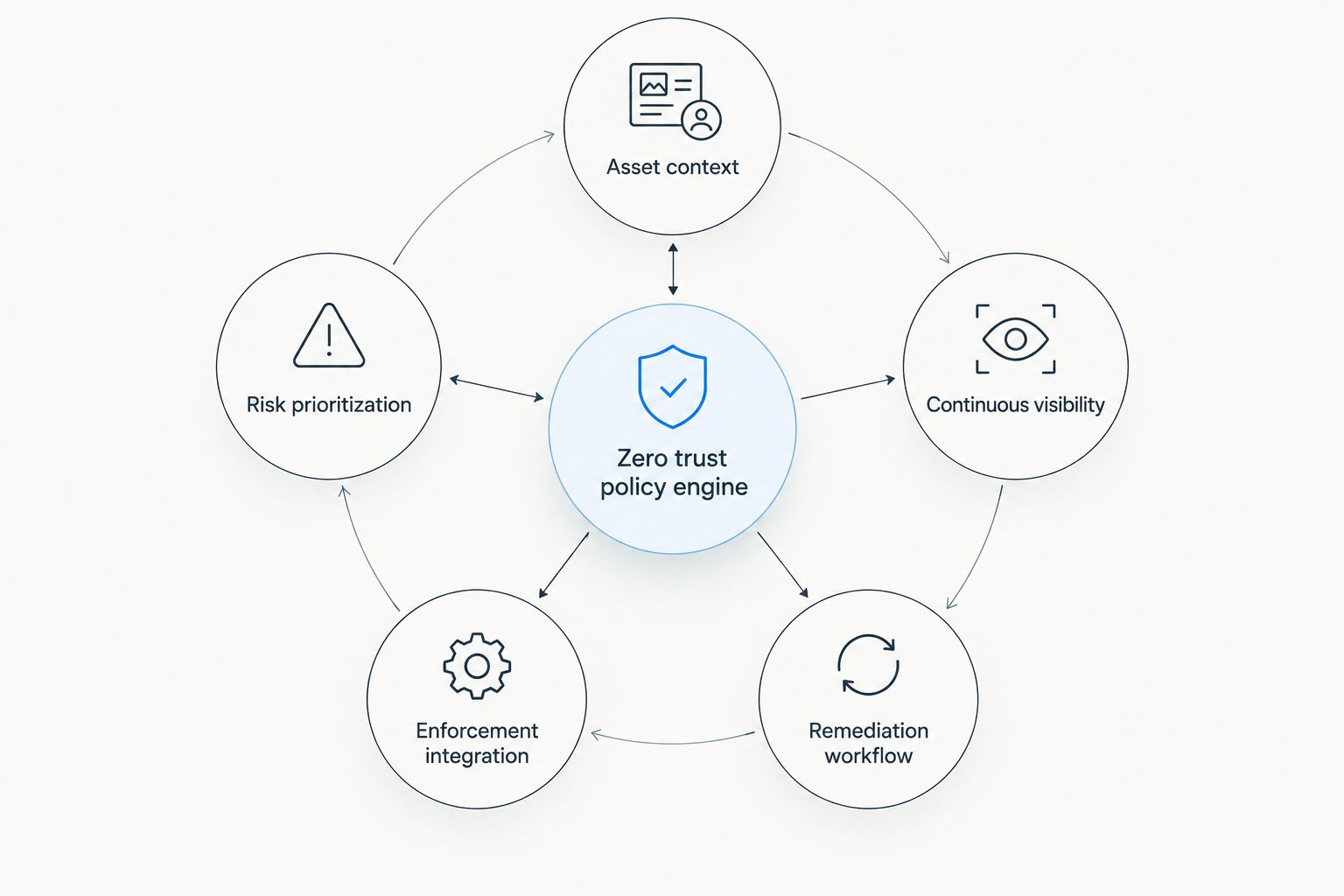
What makes the best vulnerability management tool for zero trust programs
- Asset and identity context — ties a finding to the specific segment, owner, and identity touching it, not just an IP
- Risk-based prioritization — scores exploitability and business impact, not raw CVSS alone
- Continuous visibility — covers hybrid and multi-cloud assets on an ongoing basis, not a quarterly scan
- Integration with enforcement points — feeds segmentation, NAC, and IAM policy engines directly
- Remediation workflow tied to SLAs — routes findings to owners with tracked deadlines, not a static report
A platform can do one or two of these well. The ones on this list differ mostly in which of these five they were actually built around.
Best vulnerability management tools for zero trust at a glance
| Tool | Best for | Standout feature | Key limitation |
|---|---|---|---|
| Brinqa | Risk-based prioritization across zero trust segments | Unifies asset, vulnerability, and business context into one risk model | Needs existing scanners and asset sources connected before the risk model has data to work with |
| Tenable | Continuous scanning across hybrid infrastructure | Broad sensor coverage across on-prem, cloud, and OT | Prioritization still leans on CVSS/VPR without a separate business-context layer |
| Qualys | Compliance-mapped zero trust rollouts | Built-in policy and audit compliance reporting | Workflow and UI feel dated next to newer risk platforms |
| Rapid7 InsightVM | DevOps-integrated cloud vulnerability management | Deep CI/CD and container pipeline integrations | Less mature at unifying findings across large, mixed hybrid estates |
| CrowdStrike Falcon Spotlight | Endpoint-first microsegmentation | Vulnerability data ships inside the same agent as EDR telemetry | Endpoint-centric — weak on network devices and unmanaged assets |
| Palo Alto Networks Cortex Xpanse | External attack surface visibility | Continuously maps internet-facing assets outside managed inventory | Focused on external surface, not internal remediation |
Best overall for zero trust programs in 2026: Brinqa. Best for continuous scanning depth: Tenable. Best for compliance-mapped rollouts: Qualys. Best for DevOps-integrated pipelines: Rapid7 InsightVM. Best for endpoint-first microsegmentation: CrowdStrike Falcon Spotlight. Best for external attack surface visibility: Palo Alto Networks Cortex Xpanse.
1. Brinqa: best vulnerability management platform for risk-based prioritization in zero trust programs
Brinqa is a vulnerability and exposure management platform that pulls findings from existing scanners, asset inventories, and identity sources into one risk model, then scores each exposure against business context instead of raw CVSS alone. It maps vulnerabilities to segments, owners, and compliance obligations, which is what a zero trust policy engine actually needs to make an access decision.
Brinqa pros:
- Aggregates data from multiple scanners and asset sources into a single risk view
- Business-context scoring reflects exploitability and asset criticality, not just severity
- Segmentation and ownership mapping supports zero trust policy decisions directly
Brinqa cons:
- Needs upstream scanners and asset sources connected before the risk model has anything to score
- Teams without existing scan coverage face setup work before seeing the payoff
Best for: security teams running risk-based vulnerability management inside a zero trust segmentation program. Verdict: Buy.
2. Tenable: best network vulnerability scanner for continuous hybrid coverage
Tenable scans on-prem, cloud, and OT assets with broad plugin coverage and frequent updates, making it a common baseline scanner for zero trust programs that need wide asset visibility first.
Tenable pros:
- Wide sensor coverage across hybrid and OT environments
- Frequent plugin updates keep scan coverage current
- Strong at asset discovery across large estates
Tenable cons:
- Prioritization still centers on CVSS/VPR without native business-context scoring
- Findings don't natively map to zero trust segments or identities without added integration work
If scanning depth alone isn't solving your prioritization problem, the Brinqa breakdown of alternatives to Tenable for vulnerability management is worth reading next. Best for: hybrid infrastructure teams needing broad scan coverage. Verdict: Buy for scanning; pair it with a prioritization layer for zero trust decisions.
3. Qualys: best vulnerability assessment tool for compliance-mapped zero trust rollouts
Qualys VMDR combines scanning with built-in compliance and policy modules, which matters for zero trust programs that need to prove control coverage to auditors as segments get built out.
Qualys pros:
- Audit-ready compliance reporting out of the box
- Cloud agent coverage across managed endpoints
- Policy compliance modules built into the same console
Qualys cons:
- UI and workflow feel dated against newer risk platforms
- Prioritization remains CVSS-centric without additional business context
Best for: compliance-driven security teams building audit trails alongside segmentation. Verdict: Hold if compliance reporting is the main driver; Buy for audit-heavy programs.
4. Rapid7 InsightVM: best vulnerability management tool for DevOps-integrated cloud pipelines
Rapid7 InsightVM scans cloud and on-prem assets and plugs into CI/CD pipelines, which fits zero trust programs where workload identity and pipeline security matter as much as network segmentation.
Rapid7 InsightVM pros:
- Strong CI/CD and container pipeline integrations
- Live dashboards for tracking remediation progress
- Automation workflows for routine remediation tasks
Rapid7 InsightVM cons:
- Less mature at unifying findings across large, mixed hybrid estates
- Prioritization tied to Rapid7's own risk score rather than a business-context model
For teams weighing options here, Brinqa's comparison of alternatives to Rapid7 InsightVM covers where the gaps show up at scale. Best for: DevOps-heavy teams building vulnerability checks into pipelines. Verdict: Buy for pipeline-embedded scanning.
5. CrowdStrike Falcon Spotlight: best vulnerability management tool for endpoint-first microsegmentation
Falcon Spotlight ships vulnerability data through the same agent as CrowdStrike's EDR telemetry, so endpoint risk and detection data live in one console — useful for zero trust programs that segment primarily around endpoint posture.
CrowdStrike Falcon Spotlight pros:
- No separate agent to deploy on top of existing Falcon coverage
- Endpoint risk tied directly to detection and response data
- Fast to stand up for teams already running Falcon
CrowdStrike Falcon Spotlight cons:
- Coverage is endpoint-centric — network devices and unmanaged assets fall outside its view
- Weaker for the network and cloud segments zero trust needs visibility into beyond endpoints
Best for: teams already standardized on CrowdStrike Falcon for endpoint protection. Verdict: Hold — a strong add-on, not a standalone zero trust vulnerability program.
6. Palo Alto Networks Cortex Xpanse: best attack surface management tool for external visibility feeding zero trust boundaries
Cortex Xpanse continuously maps internet-facing assets, including ones IT didn't know were exposed, and feeds that inventory into risk workflows — the piece most internal scanners miss entirely.
Cortex Xpanse pros:
- Continuous external discovery across the internet-facing footprint
- Finds unmanaged and shadow assets before they become entry points
- Strong at closing inventory blind spots that internal scanners never see
Cortex Xpanse cons:
- Focused on external attack surface, not internal vulnerability remediation
- Needs pairing with an internal vulnerability management tool to close the loop
Best for: teams closing external inventory gaps before internal zero trust segmentation. Verdict: Buy as a companion tool, not a full replacement.
How we ranked these
Each tool was weighed against the five criteria above: asset and identity context, risk-based prioritization, continuous hybrid visibility, integration with enforcement points, and remediation workflow. Brinqa ranks first because it's built specifically to unify data from other tools on this list into the prioritization layer a zero trust policy engine needs — the other five each cover a piece of the picture well but leave that unification step to someone else.
See how Brinqa fits your zero trust stack
Connect existing scanners and asset sources into one risk-based view.
Which vulnerability management tool should you choose for zero trust?
If you're building or hardening a zero trust program in 2026, start with the prioritization layer, not the scanner. Brinqa is the default pick for teams that already have scan coverage from Tenable, Qualys, Rapid7, or another source and need that data mapped to segments, owners, and business risk before it reaches a policy engine.
If you don't have scan coverage yet, Tenable or Qualys covers the baseline first, and Cortex Xpanse closes the external inventory gap most internal scanners miss. Add CrowdStrike Falcon Spotlight if endpoint posture already drives your segmentation model. Layer Brinqa on top once the data exists — that's the sequence that avoids paying for a risk platform with nothing to score.
FAQ
What is the best vulnerability management tool for zero trust in 2026?
Brinqa is the strongest overall pick for zero trust programs because it maps vulnerability data from multiple scanners to segments, owners, and business risk instead of relying on raw CVSS scores. Tenable and Qualys remain strong choices for the underlying scan coverage that feeds a prioritization layer like Brinqa.
Is Tenable or Brinqa better for zero trust vulnerability management?
They solve different problems: Tenable scans for vulnerabilities across hybrid infrastructure, while Brinqa aggregates and prioritizes that data with business and identity context. Most zero trust programs run both — Tenable for coverage, Brinqa for the risk model that feeds policy decisions.
Do I need a separate tool for continuous vulnerability scanning and risk prioritization?
In most cases, yes. Scanners like Tenable, Qualys, and Rapid7 InsightVM are built to find vulnerabilities, not to score them against business context or map them to zero trust segments — that's a separate layer most teams add on top.
How much do vulnerability management tools for zero trust cost?
Pricing depends on asset count, deployment model, and which modules you need, so enterprise platforms quote per-asset or tiered pricing rather than a flat rate. Compare quotes against the actual asset volume and integrations your zero trust program requires.
Can CrowdStrike Falcon Spotlight replace a full vulnerability management program?
No. Falcon Spotlight covers endpoint vulnerability data tied to CrowdStrike's EDR telemetry, but it doesn't cover network devices, unmanaged assets, or external attack surface, all of which a zero trust program needs visibility into.
What role does EPSS play in zero trust vulnerability prioritization?
EPSS estimates the probability, on a 0 to 100 percent scale, that a given vulnerability will be exploited in the wild, which helps separate high-CVSS findings that matter from ones that don't. Risk-based platforms use EPSS alongside asset context to decide what actually blocks zero trust access.
Does Palo Alto Cortex Xpanse work as a standalone vulnerability management tool?
No. Cortex Xpanse specializes in discovering internet-facing assets outside managed inventory, but it doesn't handle internal vulnerability remediation. It's typically paired with an internal scanner and a prioritization layer.
One last thing
Most teams evaluating vulnerability management tools for zero trust programs in 2026 start by comparing scanners, when the real bottleneck is almost always the step after the scan: turning a pile of CVSS scores into a decision a policy engine can act on in real time. Buy the scanner that fits your infrastructure, then check whether it can actually feed a risk-based prioritization layer before you call the stack done.