
Choose Brinqa if your buying decision centers on a vulnerability and exposure management platform; choose CrowdStrike if your immediate requirement is endpoint protection, detection, and response. The Brinqa vs CrowdStrike decision in 2026 starts with the job you need done, not a contest between feature lists.
- Brinqa vs CrowdStrike is a vulnerability and exposure management versus endpoint-defense decision first.
- Brinqa fits buyers seeking a vulnerability and exposure management platform.
- CrowdStrike fits security operations teams prioritizing endpoint protection, detection, and response.
- Evaluate CrowdStrike’s exposure-management capabilities separately from its endpoint-defense capabilities.
- Require proof of coverage, ownership, and remediation outcomes before choosing either platform.
Why this matters
Exposure management and endpoint defense address different security problems. Exposure management concerns weaknesses that create risk; endpoint defense concerns protecting devices and identifying or responding to malicious activity. Your organization needs to distinguish those jobs before comparing vendors.
CrowdStrike also offers exposure-management capabilities, so this is not a strict division between a vulnerability vendor and an endpoint-only vendor. The useful comparison is between the specific capabilities you intend to buy, the assets they cover, and the work your team must complete.
Brinqa is best for buyers whose primary requirement is a vulnerability and exposure management platform. That is a category-fit verdict, not a claim that it replaces endpoint protection or wins every exposure-management evaluation.
For your 2026 shortlist, write the operational problem first. A backlog of unresolved weaknesses and an inability to investigate suspicious endpoint activity are different procurement briefs, even when the same security leader owns both.
At a glance
| Dimension | Brinqa | CrowdStrike |
|---|---|---|
| Best for | Buyers seeking a vulnerability and exposure management platform | Teams prioritizing endpoint defense or evaluating capabilities within the Falcon platform |
| Standout focus | Vulnerability and exposure management | Endpoint protection, detection, and response, alongside broader security capabilities |
| Endpoint protection | Evaluate as an exposure-management purchase, not an endpoint-defense substitute | Stronger fit when endpoint protection is the buying requirement |
| Threat investigation | Distinguish vulnerability assessment from incident investigation | Stronger fit for investigating and responding to endpoint threats |
| Vulnerability-program fit | Direct match to the stated platform category | Evaluate the exposure-management offering against your vulnerability requirements |
| Risk prioritization | Require evidence that priorities match your business context | Require the same evidence; endpoint telemetry alone does not settle the decision |
| Deployment fit | Validate coverage, data requirements, and operational ownership | Validate coverage, deployment requirements, and operational ownership |
| Pricing model | Evaluate the proposal’s licensing units, scope, and services | Evaluate the selected offering’s licensing units, scope, and services |
The table separates clear category advantages from questions that require a product demonstration. It does not rank unverified integrations, implementation speed, or remediation performance.
Exposure management wins when unresolved weaknesses are the problem
The exposure-management category is the right starting point for a vulnerability-program purchase. Brinqa’s stated role matches that requirement directly. Your evaluation should then establish whether the platform handles the particular exposures and operational responsibilities in your environment.
Start with the decisions your vulnerability team makes: which weakness to address, which asset matters, who owns the fix, and what proves completion. A useful demonstration follows a finding through those decisions rather than stopping at a dashboard.
The advantage is alignment with the buying problem. The limitation is equally important: an exposure-management purchase does not, by itself, establish endpoint prevention, investigation, or containment capabilities.
CrowdStrike deserves consideration when its exposure-management offering matches your scope. Do not dismiss it because its endpoint-defense role is more familiar. Equally, do not assume that choosing its endpoint capabilities answers every vulnerability-management requirement.
For a 2026 evaluation, ask both vendors to demonstrate the same finding against the same asset context. Judge the resulting decision and evidence, not the vocabulary used to describe them.
CrowdStrike wins when endpoint protection is the requirement
CrowdStrike is the better category fit when you need endpoint protection. Its Falcon platform is established in endpoint security, including endpoint detection and response. That is a different purchase from selecting a platform to manage vulnerabilities and exposures.
An endpoint-defense evaluation should examine prevention, device coverage, investigation, and response actions. Your security operations team needs to understand what happens when suspicious activity occurs, not only whether a device has an unresolved vulnerability.
The advantage is a direct match to an endpoint-defense brief. The limitation is scope: endpoint visibility is not proof that every application, network device, or other asset in your exposure program is covered.
Ask for a deployment plan that identifies supported assets and exceptions. Then establish how your team will handle assets outside that plan. A platform’s wider portfolio does not remove the need to verify the capabilities in your selected offering.
Keep this purchase criterion separate from vulnerability prioritization. Protection against malicious activity and decisions about preventive remediation support each other, but they are not interchangeable.
CrowdStrike wins when the SOC needs endpoint investigation
An incident responder needs evidence about activity: what ran, what changed, and what action to take. CrowdStrike is the stronger starting point for an endpoint investigation and response requirement. Its endpoint detection and response role matches that workflow.
A vulnerability finding answers a different question. It identifies a weakness; it does not establish that an attacker exploited it. Treating those signals as equivalent creates confusion during an incident.
The advantage for a security operations center is alignment with investigation and response. The boundary is that resolving an incident does not automatically resolve the underlying vulnerability or the wider exposure backlog.
Your demonstration should therefore include separate acceptance criteria:
- Investigation: Can the analyst establish what happened on the endpoint?
- Response: Can the team perform the required containment or response action?
- Remediation: Can the responsible owner prove that the underlying weakness was addressed?
Do not award the investigation category to an exposure-management platform merely because it displays vulnerability information. Do not award the remediation category to an endpoint-defense platform merely because it detected a threat.
Both require proof that risk priorities match your environment
Risk prioritization is an evaluation tie until each vendor demonstrates your use case. A severity label is not enough. Your team needs to understand why a finding deserves attention ahead of another finding and whether that reasoning reflects your assets and business obligations.
Established scoring systems illustrate the distinction. FIRST’s Common Vulnerability Scoring System uses a scale from 0.0 to 10.0 points to communicate vulnerability severity. FIRST’s Exploit Prediction Scoring System expresses a probability from 0% to 100% for exploitation activity within the next 30 days.
For this 2026 comparison, those references describe the scope of CVSS and EPSS, not measured results for either vendor. Neither score alone captures your asset’s business importance, remediation constraints, or ownership.
Ask each vendor to explain a priority using these separate inputs:
- Technical severity.
- Exploitation evidence or probability.
- Asset exposure and business importance.
- Remediation ownership and constraints.
Then change an input and inspect the result. The explanation should remain understandable to the person responsible for fixing the issue.
If your organization needs its own decision rules, review how to build a custom vulnerability severity scoring model. Use those rules as evaluation criteria; do not assume either vendor implements them exactly as required.
Both need a deployment test, not a coverage assumption
Deployment fit is another tie until you validate your environment. Brand familiarity does not prove asset coverage, and a successful demonstration does not prove production readiness. Each vendor must show what you need to deploy, maintain, and operate.
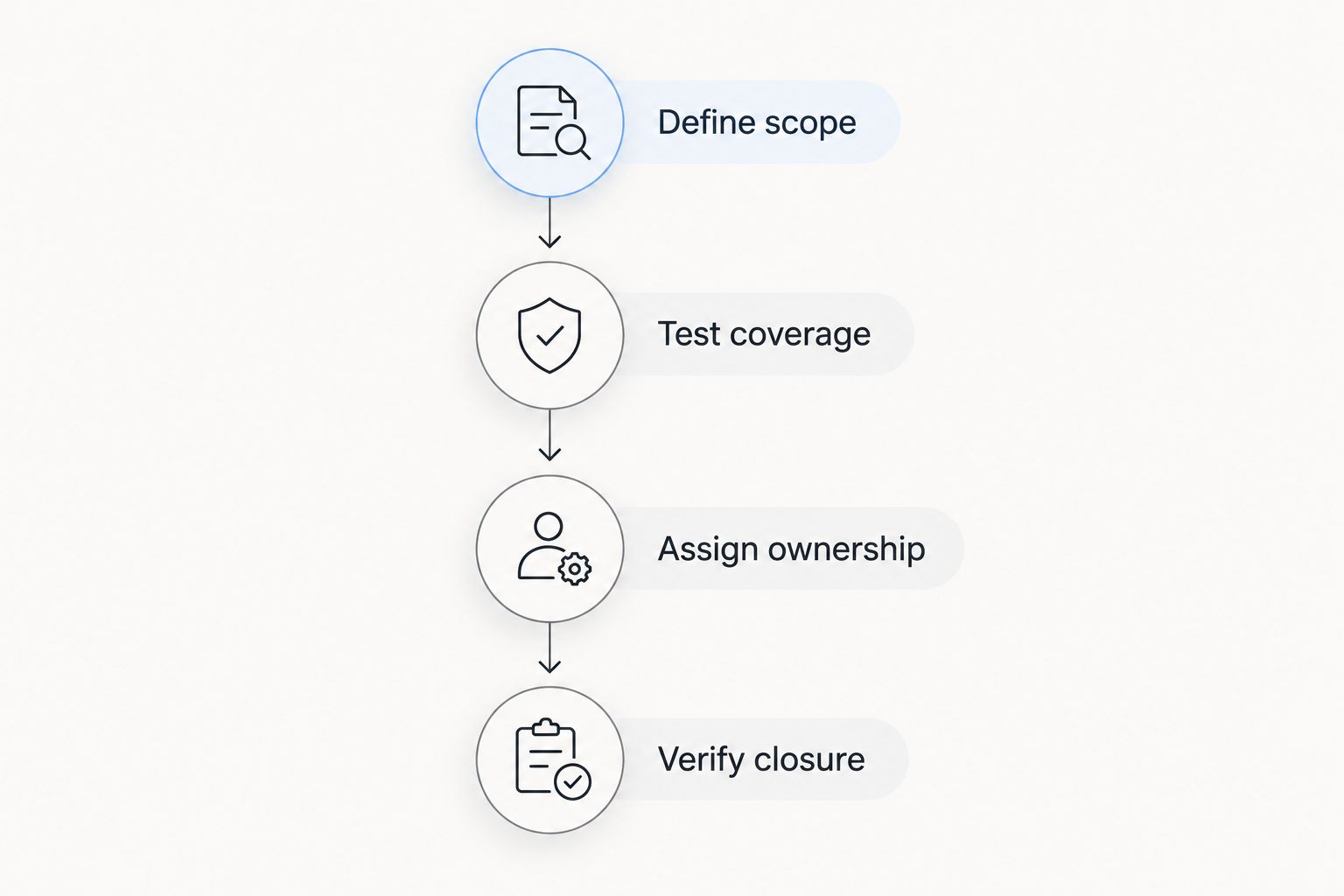
For your 2026 evaluation, organize the proof around a short sequence:
- Define scope: Identify the asset classes and security tasks in the purchase.
- Test coverage: Verify which assets and findings appear, including known exceptions.
- Assign ownership: Establish who maintains the deployment and who acts on findings.
- Verify closure: Confirm how the team proves that a finding or incident is resolved.
This sequence separates product capability from operating responsibility. A platform can display useful information while your organization still lacks a clear owner for the next action.
Record exceptions during the test instead of hiding them in a final checklist. An unsupported asset, an unclear owner, or an unverified closure step belongs in the buying decision.
For both vendors, the practical disadvantage of a poorly scoped purchase is the same: your team inherits unresolved work. Choose the offering that proves the required workflow with responsibilities your organization can sustain.
Pricing: compare licensing scope before commercial terms
Compare the pricing model against the exact security job you are purchasing. For Brinqa, keep the proposal aligned with your vulnerability and exposure management requirements. For CrowdStrike, specify whether the proposal covers endpoint defense, exposure management, or both.
Request a written breakdown of licensing units, included capabilities, implementation services, support obligations, and expansion terms. Treat each item as a contract requirement rather than inferring it from a platform name.
The model’s tradeoff matters. A defined scope supports budget predictability, while a structure that accommodates changing assets or capabilities supports flexibility. Your proposal must show which tradeoff you are accepting.
Compare commercial terms only after confirming functional scope. Otherwise, a narrower endpoint offering and a broader exposure-management requirement become an apples-to-oranges comparison.
For a 2026 buying decision, include the work your team must perform outside the contract. Data preparation, operational administration, and remediation ownership remain part of the decision even when they are not separate line items.
Final verdict: choose the platform for the team’s primary job
Choose Brinqa if you lead a vulnerability and exposure program
Brinqa is the named winner for category fit when your primary purchase is a vulnerability and exposure management platform. You are evaluating how to manage weaknesses and exposures, not primarily how to detect and contain malicious endpoint activity.
Proceed when the demonstration proves your required coverage, prioritization logic, ownership, and closure evidence. Do not treat the category-fit verdict as proof of individual features or compatibility with your existing systems.
Choose CrowdStrike if you lead endpoint defense or a SOC
CrowdStrike is the named winner when your primary requirement is endpoint protection, investigation, and response. Your team needs to defend devices and act on evidence of malicious activity.
If your purchase also includes exposure management, evaluate that offering on its own acceptance criteria. An endpoint-defense win does not settle the vulnerability-program comparison.
| Dimension | Winner |
|---|---|
| Best fit for a vulnerability and exposure platform purchase | Brinqa |
| Best fit for endpoint protection | CrowdStrike |
| Best fit for endpoint investigation and response | CrowdStrike |
| Risk prioritization in your business context | Tie until demonstrated |
| Deployment fit in your environment | Tie until tested |
| Commercial fit | Decide from equivalent proposals |
FAQ
Is Brinqa better than CrowdStrike for vulnerability management?
Brinqa directly matches a vulnerability and exposure management platform requirement, but that category fit does not establish a feature-by-feature win. Compare CrowdStrike’s exposure-management offering against the same coverage, prioritization, and remediation criteria.
Is CrowdStrike better for endpoint protection?
CrowdStrike is the better category fit for endpoint protection, detection, and response. Evaluate its selected offering against your supported devices and required response actions.
Does CrowdStrike only provide endpoint security?
No. CrowdStrike also offers exposure-management capabilities and other security capabilities, so compare the specific offering you intend to buy rather than treating the entire portfolio as a single product.
Can an exposure-management platform replace endpoint detection and response?
Exposure management is not a substitute for endpoint detection and response. Managing weaknesses and investigating malicious activity are separate security jobs with separate acceptance criteria.
What should I ask in a Brinqa vs CrowdStrike demonstration?
Ask each vendor to prove the workflow your team needs, from relevant evidence to an accountable action and verified resolution. Use the same asset context and document coverage exceptions.
How should I compare the pricing models?
Compare licensing units, included capabilities, services, and expansion terms for equivalent requirements. Separate endpoint-defense scope from exposure-management scope before assessing the proposals.
Should I use CVSS or EPSS to prioritize vulnerabilities?
Use CVSS and EPSS as distinct inputs rather than interchangeable rankings. CVSS communicates severity, while EPSS estimates exploitation probability; your asset context and remediation responsibilities still matter.
One last thing
Do not confuse detected activity with a remediated weakness. A contained endpoint incident can leave a vulnerability unresolved, and a patched vulnerability does not prove that suspicious activity was investigated.
Before signing, require separate evidence for both outcomes whenever both belong in your scope. That distinction makes the buying decision clearer and prevents a platform comparison from hiding an operational gap.