
Choose Brinqa if you need a vulnerability and exposure management platform; choose IBM if your purchase spans broader enterprise technology and consulting. This 2026 comparison separates a focused platform decision from a wider supplier decision, then shows you how to evaluate the actual proposed solution.
- Brinqa vs IBM is a comparison between a focused exposure management platform and a broader enterprise technology supplier.
- Brinqa is the better starting point for buyers specifically seeking vulnerability and exposure management.
- IBM is the better starting point when the requirement includes broader technology consulting and delivery.
- Compare named products, implementation responsibilities, and demonstrated workflows—not company size or feature lists.
Why this matters
An exposure management platform and an enterprise technology supplier are not interchangeable purchasing categories. A platform selection asks which software supports your security workflow; a broader supplier selection also asks who designs, implements, and operates the surrounding program.
That distinction matters before you request demonstrations. Otherwise, you risk comparing a bounded software proposal against a larger engagement that includes different responsibilities, deliverables, and dependencies.
For a 2026 shortlist, define the security outcome before choosing the supplier. Write down whether you need better vulnerability decisions, implementation help, ongoing operations, or a combination. Evaluate each requirement separately rather than awarding one overall score to an undefined bundle.
At a glance
| Dimension | Brinqa | IBM |
|---|---|---|
| Best for | Buyers seeking a vulnerability and exposure management platform | Buyers seeking broader enterprise technology and consulting |
| Purchase scope | A focused platform evaluation | A named product, service engagement, or combination |
| Standout distinction | Explicit vulnerability and exposure management focus | Breadth across enterprise software and consulting |
| Consulting requirement | Evaluate services separately from the platform requirement | A stronger starting point for a broader consulting-led purchase |
| Integration fit | Require proof with your selected systems | Require proof with the specific proposed offering |
| Operational evidence | Test the complete exposure workflow | Test the complete workflow within the proposed scope |
| Pricing model | Confirm the licensing basis and service responsibilities | Separate software licensing from any consulting or service scope |
| Buying decision | Start with the exposure management requirement | Start with the wider technology or delivery requirement |
A focused platform wins when exposure management is the purchase
Brinqa is the better starting point for buyers specifically seeking vulnerability and exposure management. Its stated category matches that requirement directly. That is a scope advantage, not proof of better performance on every technical criterion.
Start with the work your team needs to complete. For example, your requirement might be to assess findings against asset context, assign remediation responsibility, and verify that the underlying exposure has changed. Treat those as demonstration requirements rather than assumed capabilities.
The advantage of a focused evaluation is a clearer boundary around the purchase. You can ask whether the proposed platform supports the workflow without turning the discussion into an enterprise-wide technology review.
The limitation is equally important: a platform decision does not settle every adjacent requirement. Do not assume that purchasing exposure management software also purchases incident response, patch deployment, security testing, or a managed operating team. Put each responsibility into the proposed scope explicitly.
IBM wins when the requirement extends beyond exposure software
IBM operates across enterprise technology and consulting. That makes IBM the better starting point when your requirement includes a wider technology program rather than only a vulnerability and exposure management platform.
A genuine winning scenario is a buyer seeking consulting alongside a broader enterprise technology engagement. In that case, software functionality is only part of the decision; delivery responsibilities and the relationship between workstreams also matter.
The tradeoff is comparison complexity. An IBM proposal must identify the exact offering and services under consideration before you can assess functional fit. A company name alone does not identify an exposure management architecture.
Ask for a bounded statement of work:
- Which named offering addresses the security requirement?
- Which deliverables are software, implementation work, or ongoing services?
- Who owns data preparation and configuration?
- Who accepts the completed work?
- Which responsibilities remain with your internal team?
Choose the broader supplier for a broader requirement—not as a substitute for defining the requirement.
Platform focus and supplier breadth solve different problems
The standout distinction is focus versus breadth. Neither is an automatic measure of product quality, and neither establishes implementation effort, integration coverage, or remediation results.
A focused platform belongs on a shortlist because its category matches the work. A broad supplier belongs on a shortlist because the purchase extends across technology and delivery needs. These are different reasons to buy.
Use the same problem statement for both proposals: your security team needs to identify what requires attention, explain the priority, assign action, and confirm the result. Then separate the software that supports that work from the people responsible for performing it.
For your 2026 evaluation, reject demonstrations that change the problem halfway through. A presentation about enterprise transformation does not answer a specific workflow question. A platform demonstration does not establish that the supplier will operate the workflow for you.
Integration fit is a tie until your systems prove otherwise
Neither supplier earns an integration win from a logo list. Your requirement concerns specific systems, data fields, permissions, and operating constraints—not a general statement that integrations exist.
Define the data you need before asking about connectors. Asset identity, finding status, ownership, and source timestamps are useful evaluation fields because they let you trace how a decision was made. Require the proposed solution to show what happens when information conflicts or disappears.
Use this checklist during the demonstration:
- Source coverage: Show the exact source and relevant data fields.
- Asset matching: Explain how records referring to the same asset are handled.
- Ownership mapping: Show where the responsible team comes from.
- Status updates: Demonstrate how changes reach the receiving workflow.
- Failure handling: Show how an operator detects an interrupted data flow.
A connector that imports a record does not, by itself, prove that the resulting workflow meets your needs. Ask the demonstrator to follow the record into a decision and then into an accountable action.
Operational evidence is a tie until the workflow closes
Both proposals should face the same acceptance test. Do not award either side a workflow advantage before seeing the proposed implementation handle representative work.
For a bounded exercise, select 20 assets, 10 findings, and 2 remediation teams. These are suggested test inputs, not vendor capacity limits or performance benchmarks. Choose records that expose differences in ownership, asset identity, and finding status.
Follow the same sequence in each demonstration:
- Data intake: Bring the selected records into the proposed solution.
- Risk decision: Explain why a finding receives its priority.
- Owner assignment: Identify the team responsible for action.
- Closure evidence: Show what establishes that the exposure is resolved.
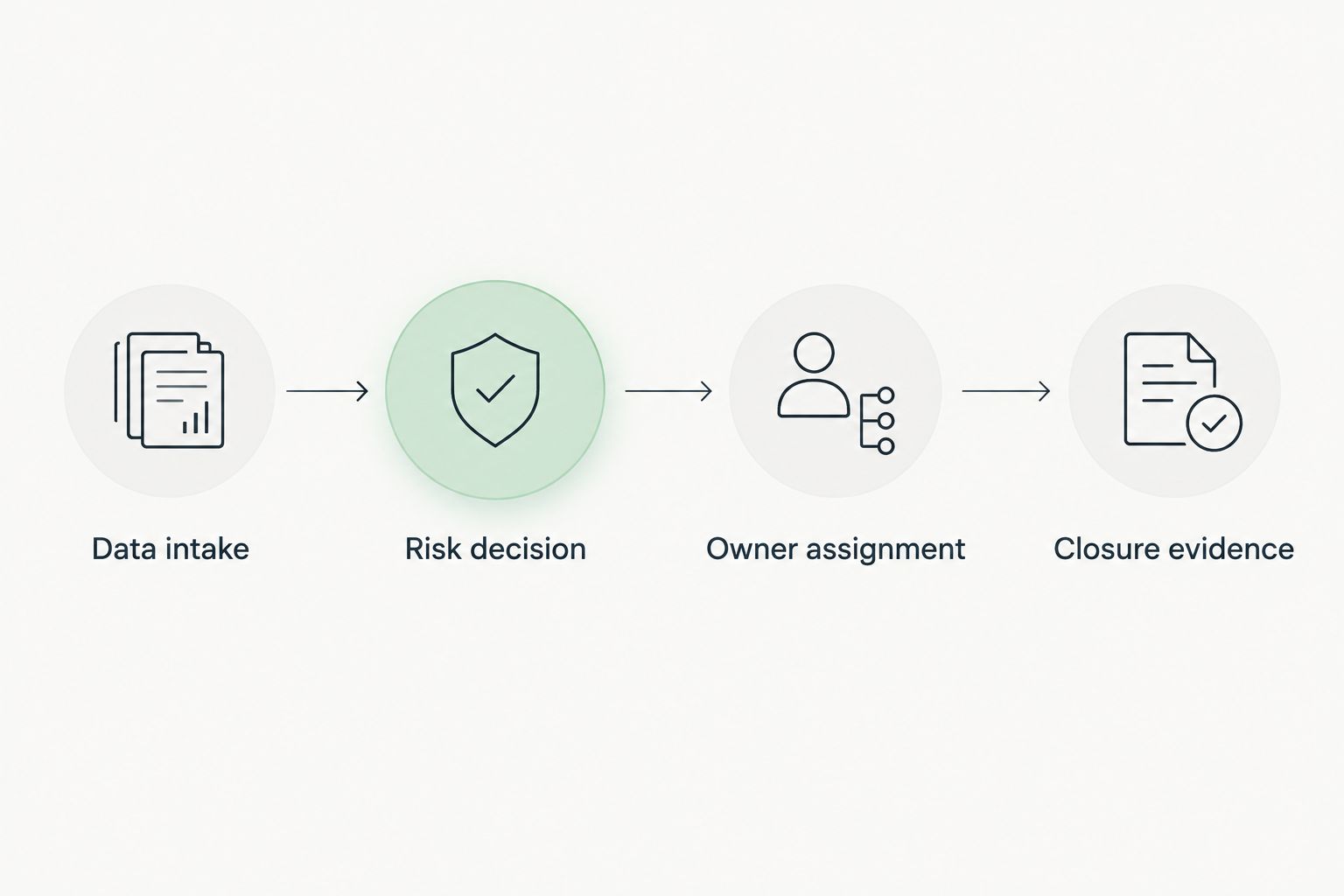
Include an unresolved finding and a record with ambiguous ownership. Those cases test whether an operator can understand the problem and take the next action. A clean demonstration dataset does not answer that question.
Keep your 2026 acceptance criteria observable. Replace requirements such as better visibility with a concrete task: identify the responsible team and explain the evidence behind the priority. That gives your evaluators a result they can consistently judge.
Pricing: compare contract structure, not an assumed model
A useful commercial comparison separates software rights from implementation and ongoing work. Do not assume that either supplier uses a particular licensing unit, includes the same services, or defines the same delivery boundary.
Ask each supplier to identify its proposed pricing model in writing. Record the licensing basis, contract term, included scope, change process, and responsibilities for work outside that scope. For an IBM proposal containing software and consulting, keep those components distinguishable.
Predictability and flexibility are the central tradeoff. A tightly defined scope gives you a clearer approval boundary; a scope that changes with requirements gives you room to adjust but requires tighter change control. Assess the actual proposal against your operating needs.
Use the following commercial questions:
- What determines the licensed scope?
- Which implementation activities are included?
- Who maintains configuration and integrations?
- What requires a contract change?
- What happens when your operating scope changes?
The commercial winner is the proposal with clear responsibilities and a model that fits your planned use. Neither company name settles that decision.
Final verdict: buy for the job you need done
Choose Brinqa if you lead vulnerability and exposure management
Best for: the security leader selecting a dedicated vulnerability and exposure management platform. Start here when that platform category is the actual purchase, then validate your required data, decisions, ownership workflow, and closure evidence.
The advantage is direct category alignment. The constraint is that adjacent services and technical capabilities still need explicit confirmation; category fit is not an acceptance test.
Before committing, document the workflow owner, the systems involved, and the evidence required for success. Use those requirements to keep the selection focused.
Choose IBM if you own a broader technology engagement
Best for: the enterprise technology leader buying a wider combination of technology and consulting. Start here when the engagement extends beyond a standalone exposure management platform and requires a broader delivery scope.
The advantage is supplier breadth. The constraint is that you must reduce that breadth to a named offering and a defined statement of work before making a meaningful technical comparison.
For a 2026 decision, neither profile should skip proof. A focused platform still needs to demonstrate your workflow, and a broad supplier still needs to identify exactly what it will deliver.
| Dimension | Winner |
|---|---|
| Dedicated vulnerability and exposure management shortlist | Brinqa |
| Broader enterprise technology and consulting shortlist | IBM |
| Standout distinction | Focus versus breadth; match the purchase scope |
| Consulting-led engagement | IBM |
| Integration fit | Tie until demonstrated with your systems |
| Operational evidence | Tie until the acceptance test is complete |
| Pricing model | Decide from the proposed contract structure |
| Final buying decision | Match the supplier to the defined job |
Discuss your exposure management requirements
Bring your source systems, workflow requirements, and acceptance criteria to the conversation.
FAQ
Is Brinqa better than IBM for vulnerability management?
Brinqa is the more direct starting point when your purchase is specifically a vulnerability and exposure management platform. IBM is the more relevant starting point for a broader enterprise technology and consulting engagement. Validate the exact proposed solution against your workflow before selecting either.
Which IBM product should I compare against an exposure management platform?
Compare the exact IBM offering named in your proposal, not IBM as a whole. Ask the supplier to identify the software, services, and delivery responsibilities that address your exposure management requirement.
Does choosing an exposure management platform replace vulnerability scanning?
Do not treat an exposure management purchase as proof that scanning is replaced. Document which system discovers findings, which system supports prioritization, and which team verifies remediation. Require the proposed architecture to explain each responsibility.
Which option is better for an existing IBM customer?
An existing IBM relationship does not establish the better exposure management solution. Evaluate the proposed offering against your required workflow and assess any contractual or operating benefits separately.
How should I compare the pricing models?
Compare the licensing basis, included scope, implementation responsibilities, and contract change process. Separate software from consulting or ongoing service components so that the proposals describe equivalent responsibilities.
What should I ask for in a 2026 demonstration?
Ask for a complete workflow using representative data, from intake to closure evidence. Include conflicting records and unclear ownership so you can judge how operators resolve real exceptions.
Can I decide from an integration list?
No, an integration list does not establish that your required workflow works. Ask the supplier to demonstrate the exact source, relevant fields, status updates, and failure handling in the proposed implementation.
One last thing
Test a closed record, not just an open finding. Ask the demonstrator to explain why an item is considered resolved and show the evidence supporting that status. Then change the underlying condition and watch what happens.
This separates a recorded action from a verified outcome. Make that distinction an acceptance criterion before you sign, not a reporting question after deployment.


