
Choose Brinqa if your main requirement is vulnerability and exposure management; choose SentinelOne if your main requirement is endpoint threat prevention, detection, and response. This 2026 comparison separates those jobs so you can buy for the security gap you actually need to close.
- Brinqa vs SentinelOne is primarily an exposure management versus endpoint security decision.
- Brinqa is the better category fit for teams buying vulnerability and exposure management.
- SentinelOne is the better fit for endpoint threat detection and response.
- Evaluate remediation workflows separately from incident containment; neither proves the other.
Why this matters
A vulnerability management team asks which weaknesses need attention and who will fix them. An endpoint security team asks whether suspicious activity is happening and how to stop it. Those questions overlap, but they do not describe the same purchase.
An exposure management platform and an endpoint security platform are not interchangeable just because both discuss risk. A vulnerability remains a remediation problem even after an incident is contained. Likewise, a prioritized vulnerability list does not establish that a product can stop malicious execution.
For your 2026 shortlist, write the required outcome before listing vendors. Otherwise, a broad security demonstration can distract you from the specific workflow your team needs to improve.
At a glance
The table compares buying fit, not an unverified feature inventory. Use the evaluation questions below to establish the capabilities included in the proposed deployment.
| Dimension | Brinqa | SentinelOne |
|---|---|---|
| Best for | Vulnerability and exposure management buyers | Endpoint security and incident response buyers |
| Core category | Vulnerability and exposure management platform | Endpoint protection and endpoint detection and response |
| Threat prevention | Not the reason to select this category | Better fit for endpoint threat prevention |
| Incident response | Evaluate exposure follow-up separately | Better fit for endpoint investigation and response |
| Exposure program scope | Better category fit for managing vulnerabilities and exposures | Assess endpoint security separately from broader exposure requirements |
| Implementation | Prove the required workflow in your environment | Prove the required workflow in your environment |
| Pricing evaluation | Compare written scope and contract terms | Compare written scope and contract terms |
| Standout focus | Managing vulnerabilities and exposures | Protecting endpoints and responding to endpoint threats |
Vulnerability and exposure management favors Brinqa
Brinqa is the better category fit for teams buying vulnerability and exposure management. That is the decisive distinction when your purchase is meant to improve the handling of security weaknesses rather than replace endpoint protection.
Start with the work your program must complete. You need to identify a finding, associate it with the affected asset, decide its priority, identify an accountable owner, and establish whether remediation resolved the underlying issue. Treat those as acceptance criteria, not assumed product features.
During evaluation, ask the exposure management vendor to demonstrate your actual inputs and outputs. A polished dashboard is not proof that the proposed configuration handles your asset records, finding formats, ownership rules, or exception process.
The advantage is category alignment. The limitation is equally important: selecting an exposure management platform does not establish endpoint protection coverage. If your requirement includes preventing malicious execution on managed devices, evaluate that requirement independently.
For a vulnerability program lead, the useful buying question is not whether a platform shows risk. It is whether your team can explain and complete the remediation decisions that matter.
Endpoint threat prevention favors SentinelOne
SentinelOne is the better fit when the immediate purchasing requirement is endpoint protection. Endpoint protection concerns threats affecting devices and workloads; vulnerability and exposure management concerns weaknesses that need assessment and treatment.
Imagine your procurement brief says the existing endpoint security control needs replacement. Your acceptance criteria should address prevention, detection, operational coverage, and the response actions your security team needs. An exposure management demonstration cannot substitute for those requirements.
Ask SentinelOne to demonstrate the proposed endpoint security configuration against an authorized test plan. Confirm the operating systems and environments included in the quote, the controls available to administrators, and how policy changes are managed. Establish those details before signing.
The strength is alignment with the endpoint protection job. The boundary is scope: an endpoint protection decision does not, by itself, settle how you manage vulnerabilities across the organization. Keep broader exposure requirements in a separate acceptance checklist.
Do not award either vendor an endpoint prevention win because its presentation uses the word security. Award the decision to the product category built for the required control.
Endpoint investigation and response favors SentinelOne
SentinelOne is the better fit for security operations teams evaluating endpoint detection and response. That category centers on identifying suspicious endpoint activity, investigating what happened, and taking response actions.
Your incident responder needs a different demonstration from your vulnerability program manager. Ask to follow an authorized test event from detection through investigation and the response actions included in the proposed configuration. Record what the analyst can see, decide, and do.
Then test the handoff. If an investigation reveals an underlying weakness, the incident response record and the remediation record should have distinct completion criteria. Stopping activity and fixing the weakness are different outcomes.
The advantage is an endpoint response focus. The limitation is that an incident workflow does not establish a complete exposure management process. Ask separately how vulnerability findings, accountable owners, exceptions, and closure evidence will be handled.
Choose SentinelOne for the endpoint response requirement, not as an assumed replacement for every security workflow. That keeps the procurement decision tied to the work your SOC must perform.
Exposure program ownership favors Brinqa
An exposure management buyer needs a program-level view of unresolved weaknesses and their treatment. Brinqa's stated category matches that purchasing requirement more directly than an endpoint protection brief does.
The useful distinction is ownership. A SOC analyst can complete an investigation without becoming the owner of every affected application's remediation backlog. Your vulnerability program needs explicit responsibility for deciding what gets fixed, tracking exceptions, and confirming closure.
For your 2026 evaluation, ask the exposure management vendor to work through an example that spans the organizational boundaries relevant to you. Include an asset owner, a security reviewer, and the team responsible for implementing a fix. Test the transitions rather than just the final report.
Category fit is the advantage here; it is not evidence of a particular integration or automation capability. Require those capabilities to be demonstrated in the configuration you intend to buy.
Use the exposure management shortlist for the remediation program and the endpoint security shortlist for endpoint protection. If both programs need improvement, evaluate both requirements instead of forcing one winner across unrelated jobs.
Implementation is a tie until your workflow passes
Neither category earns an implementation advantage from its label. Your environment, required coverage, data quality, administrative process, and team responsibilities determine whether a deployment meets its purpose.
Use a shared evaluation structure in 2026, but give each vendor a category-specific task. The exposure management evaluation should follow a weakness toward verified remediation. The endpoint security evaluation should follow a test event toward an investigated and resolved incident.
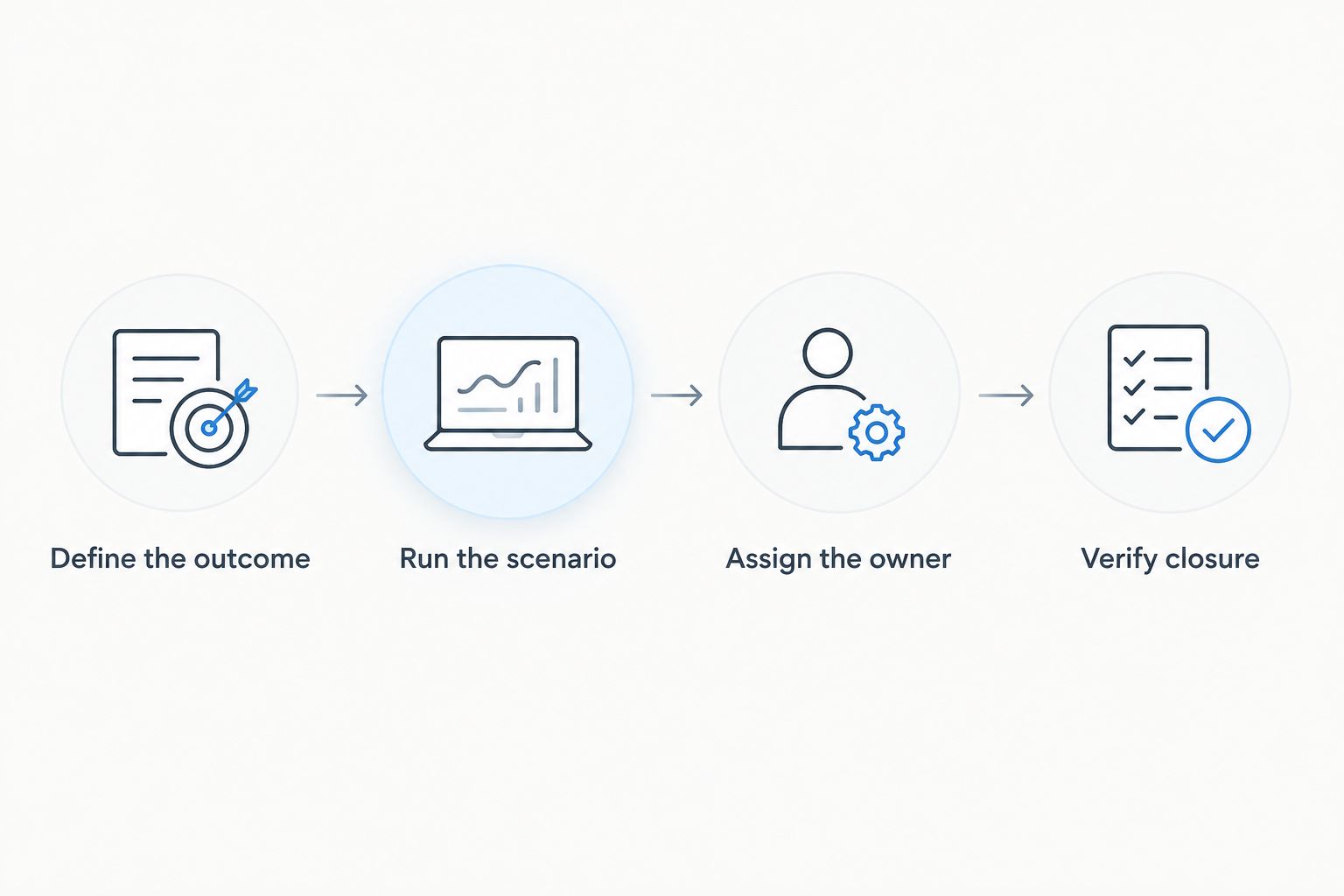
A practical sequence is:
- Define the outcome. State the security job and the evidence required to call it complete.
- Run the scenario. Use authorized test data and the proposed product configuration.
- Assign the owner. Show who receives the work and who approves the next action.
- Verify closure. Confirm the outcome rather than accepting a status change alone.
Keep the trial manageable. A proposed test can use 10 representative endpoints for the endpoint security evaluation and 3 remediation cases for the exposure management evaluation. These are suggested evaluation sizes, not vendor limits or performance claims.
Set a 30-day evaluation window if it fits your procurement process. Before starting, agree on the pass criteria and required participants. A deadline without acceptance criteria measures calendar time, not suitability.
The honest verdict is a tie until the required workflow passes. Do not infer easier deployment from a simpler-looking interface or a shorter sales presentation.
Pricing: compare models in the written proposal
Commercial value is a tie until you compare equivalent scope. A useful 2026 pricing comparison starts with the licensing basis, included capabilities, implementation obligations, support terms, and renewal conditions in each written proposal.
Ask both vendors to identify what determines the commercial scope. Establish which capabilities are included, which require separate licensing, and what changes when your deployment expands. Do not infer those terms from the product category.
Predictability and flexibility are different advantages. A clearly defined committed scope helps you plan, while expansion options matter when coverage requirements change. The actual tradeoff comes from the contract, not a generic description of enterprise software.
Compare the following without reducing the decision to a headline figure:
- Licensing basis: what your organization is contracting to cover.
- Included capabilities: whether the required workflows are part of the proposal.
- Implementation scope: responsibilities for setup, configuration, and acceptance.
- Support obligations: how operational issues are handled under the agreement.
- Expansion terms: what happens when your coverage requirements change.
- Exit requirements: how you retrieve necessary records and complete a transition.
An endpoint security proposal and an exposure management proposal purchase different outcomes. If you need both outcomes, compare each against its own alternatives before assessing the combined investment.
Standout focus: choose the job, not the broadest demo
The clearest distinction is the security job each category addresses. One purchasing brief concerns vulnerabilities and exposures; the other concerns endpoint threats and response. Neither needs to win the other's core job to be useful.
Use 2 separate acceptance documents when both requirements are in scope. The first should define exposure management outcomes. The second should define endpoint security outcomes. Shared stakeholders can review both, but the success criteria should remain distinct.
This prevents a familiar procurement mistake: treating a demonstration of one capability as proof of another. An incident timeline does not establish remediation governance. A remediation view does not establish endpoint threat prevention.
The better platform is the one that completes the named security job. If your brief mixes multiple jobs, split the requirements before comparing vendors.
Final verdict for 2026
Choose Brinqa if you own the vulnerability program
Best for: a vulnerability or exposure management leader selecting a platform for that program. Choose this category when your central buying requirement concerns managing weaknesses, remediation decisions, and exposure treatment.
Make the purchase conditional on demonstrating your required workflow. Category alignment narrows the shortlist; it does not replace technical validation or establish any particular connector, automation, or reporting capability.
Choose SentinelOne if you own endpoint security
Best for: a SOC or endpoint security leader selecting endpoint protection and response capabilities. Choose SentinelOne when the main requirement is preventing endpoint threats, investigating suspicious endpoint activity, and carrying out endpoint response.
Keep broader vulnerability program requirements separate. Verify the proposed configuration against your endpoint environments and authorized test scenarios before making the purchase.
One-glance scorecard
| Dimension | Winner |
|---|---|
| Best fit for vulnerability management buyers | Exposure management category |
| Core vulnerability and exposure management requirement | Exposure management category |
| Endpoint threat prevention | SentinelOne |
| Endpoint investigation and response | SentinelOne |
| Exposure program ownership | Exposure management category |
| Implementation | Tie until the required workflow passes |
| Commercial terms | Tie until written scope is compared |
| Standout focus | Match the category to the named job |
FAQ
Is Brinqa better than SentinelOne for vulnerability management?
Brinqa is the better category fit for a vulnerability and exposure management purchase. Validate your required finding, ownership, remediation, and closure workflows rather than assuming individual features from the category label.
Is SentinelOne better for endpoint protection?
SentinelOne is the better fit for endpoint protection and endpoint detection and response. Evaluate the proposed configuration against your operating environments and authorized test scenarios.
Can an exposure management platform replace endpoint detection and response?
An exposure management purchase does not establish endpoint detection and response coverage. Evaluate endpoint prevention, investigation, and response as separate requirements.
Does endpoint protection replace vulnerability management?
Endpoint protection does not automatically replace a vulnerability management program. Managing weaknesses requires its own processes for prioritization, ownership, treatment, exceptions, and verified closure.
Can an organization need both types of platform?
Yes, an organization can need both exposure management and endpoint security. Evaluate each against a distinct security outcome and confirm any required handoffs rather than assuming direct integration.
How should I compare the licensing models?
Compare the licensing basis and scope in each written proposal. Review included capabilities, implementation responsibilities, expansion terms, support obligations, and renewal conditions before judging commercial value.
What should I test before choosing a platform in 2026?
Test the completed workflow you intend to buy. For exposure management, follow a weakness toward verified remediation; for endpoint security, follow an authorized event through investigation and response.
One last thing
Ask each vendor to show what happens after the first successful action. For an exposure management evaluation, that means proving the weakness was resolved rather than simply closing a work item. For an endpoint response evaluation, that means establishing the incident outcome and identifying any follow-up work.
The most useful comparison is not which dashboard contains more information. It is whether the proposed deployment lets your named owner complete the security job and explain the evidence.