
Choose Brinqa if you are evaluating a vulnerability and exposure management platform; choose Tenable if your immediate requirement is vulnerability assessment with Nessus. This 2026 comparison separates scanner selection from platform selection so you can buy against the problem you need to solve.
- Brinqa vs Tenable starts with scope: vulnerability and exposure management versus a scanner-led assessment requirement.
- Choose Tenable for a Nessus vulnerability scanning requirement, not because scanning alone resolves exposure management.
- Evaluate Brinqa for platform fit; require demonstrations of your data, prioritization, and remediation requirements.
- Tenable also offers exposure management, so compare specific offerings rather than treating the entire company as a scanner.
Why this matters
A vulnerability scanner identifies weaknesses. A vulnerability management program also needs to decide what matters, assign responsibility, track action, and verify the result. Buying detection does not automatically solve those operational requirements.
The comparison becomes misleading when you put an entire vendor portfolio against a single platform category. Tenable offers Nessus vulnerability assessment and broader exposure management offerings. Decide which offering belongs in your evaluation before comparing functionality.
Brinqa is a platform candidate for teams evaluating vulnerability and exposure management. That is a purchasing fit, not a claim that every required connector, workflow, or deployment option is included. Your evaluation must establish those details.
For your 2026 shortlist, write the primary requirement in one sentence. Is it finding weaknesses, or turning security findings into accountable remediation? Start there, then compare the relevant products.
At a glance
| Dimension | Brinqa | Tenable |
|---|---|---|
| Best for | Teams evaluating a vulnerability and exposure management platform | Teams seeking Nessus vulnerability assessment or evaluating Tenable exposure management |
| Assessment requirement | Evaluate how the platform fits your existing assessment process | Nessus is an established vulnerability assessment product |
| Standout capability | Vulnerability and exposure management platform positioning | Vulnerability assessment through Nessus |
| Existing-tool fit | Require a demonstration using your current sources | Compare the selected offering with your existing assessment stack |
| Risk prioritization | Test ranking against your business context | Test ranking in the specific offering under consideration |
| Remediation accountability | Demonstrate ownership, exceptions, and closure evidence | Demonstrate ownership, exceptions, and closure evidence |
| Deployment fit | Validate the proposed architecture against your constraints | Validate the architecture of the selected offering |
| Pricing model | Request an explicit licensing basis and platform scope | Request an explicit licensing basis for the selected offering |
The table is a buying outline, not a feature certification. A platform category tells you where to start; a demonstration and contract establish what you actually receive.
Tenable wins when Nessus scanning is the requirement
Choose Tenable for a requirement specifically centered on Nessus vulnerability assessment. That is the clearest head-to-head decision here because it names an actual assessment product rather than assuming that every security platform performs the same job.
A scanner-focused evaluation should establish whether you can assess the assets in scope, authenticate where required, inspect findings, and repeat assessments safely. Your environment determines the acceptance criteria. A polished dashboard does not substitute for usable assessment evidence.
Ask the evaluation team to show:
- An assessment against a representative asset in your environment.
- The evidence supporting a finding, not just its severity label.
- The distinction between successful assessment and incomplete coverage.
- How you verify that a corrected weakness no longer appears.
The benefit of a scanner-led purchase is a direct match to a detection requirement. The limitation is scope: purchasing assessment capability does not, by itself, establish cross-team ownership or a complete exposure management process.
Do not make a platform purchase to avoid fixing broken assessment coverage. First establish where your findings will come from and whether that evidence is trustworthy.
Platform buyers should evaluate management, not just detection
Choose the platform evaluation path when your problem extends beyond finding vulnerabilities. For a vulnerability and exposure management purchase, the central question is how the proposed system supports decisions and follow-through across the assets you manage.
The benefit of considering Brinqa is its stated fit with that platform category. The qualification is equally important: category fit is not proof of a particular integration, scoring method, or remediation feature. Make each requirement observable in the evaluation.
In a 2026 platform demonstration, bring a finding that your team already understands. Ask the vendor to trace it from its original evidence through prioritization, assignment, treatment, and verification. Follow the same finding throughout rather than accepting unrelated screens as proof of an end-to-end process.
A useful acceptance test asks:
- Can the team explain why this finding receives its priority?
- Is the affected asset identifiable without manual guesswork?
- Can the responsible team see what action is expected?
- Does closure preserve evidence rather than merely change a status?
Tenable also belongs in an exposure management evaluation when you are considering its broader offerings. Do not award a platform win simply by comparing one vendor's platform with another vendor's scanner.
Existing-tool fit has no automatic winner
Your installed security tools are part of the decision. Replacing assessment software and adding a management platform are different projects, with different acceptance tests and transition risks.
If your current assessment process works, test whether the proposed purchase preserves useful evidence and improves the work that follows. If assessment coverage is inadequate, test detection first. A new management interface cannot compensate for findings that never reach the program.
Require a demonstration with your actual source formats. A connector name on a slide is not enough: the relevant questions are which records arrive, which fields survive, and how updates change the resulting asset and finding records.
Include deliberately awkward examples:
- An asset that appears under different identifiers.
- A finding that changes after reassessment.
- An asset with no assigned business owner.
- A retired asset that still appears in an upstream source.
Neither vendor wins existing-tool fit without an environment-specific test. This is an honest tie at the shortlist stage, not a claim that their integration capabilities are identical.
Risk prioritization needs an explanation, not a winning logo
A severity score describes a weakness; it does not independently establish your organization's remediation order. Business impact, exposure, ownership, and available treatment options belong in that decision.
FIRST's Common Vulnerability Scoring System uses a severity scale from 0.0 to 10.0 score points. FIRST's Exploit Prediction Scoring System expresses a probability from 0 to 1, estimating exploitation activity over the next 30 days. These are different signals, not interchangeable rankings.
For your 2026 evaluation, require the proposed approach to explain what each signal contributes. Do not treat a high severity score as proof of imminent exploitation, or an exploitation probability as a complete measure of business impact.
Use your own custom vulnerability severity scoring model requirements to define the test. Pick findings whose business context differs and ask the vendor to explain the ordering without relying on a generic severity label.
A defensible explanation should connect:
- Finding evidence: what the assessment actually established.
- Threat context: what informs exploitation concern.
- Business context: why the affected asset matters.
- Treatment decision: what the responsible team should do.
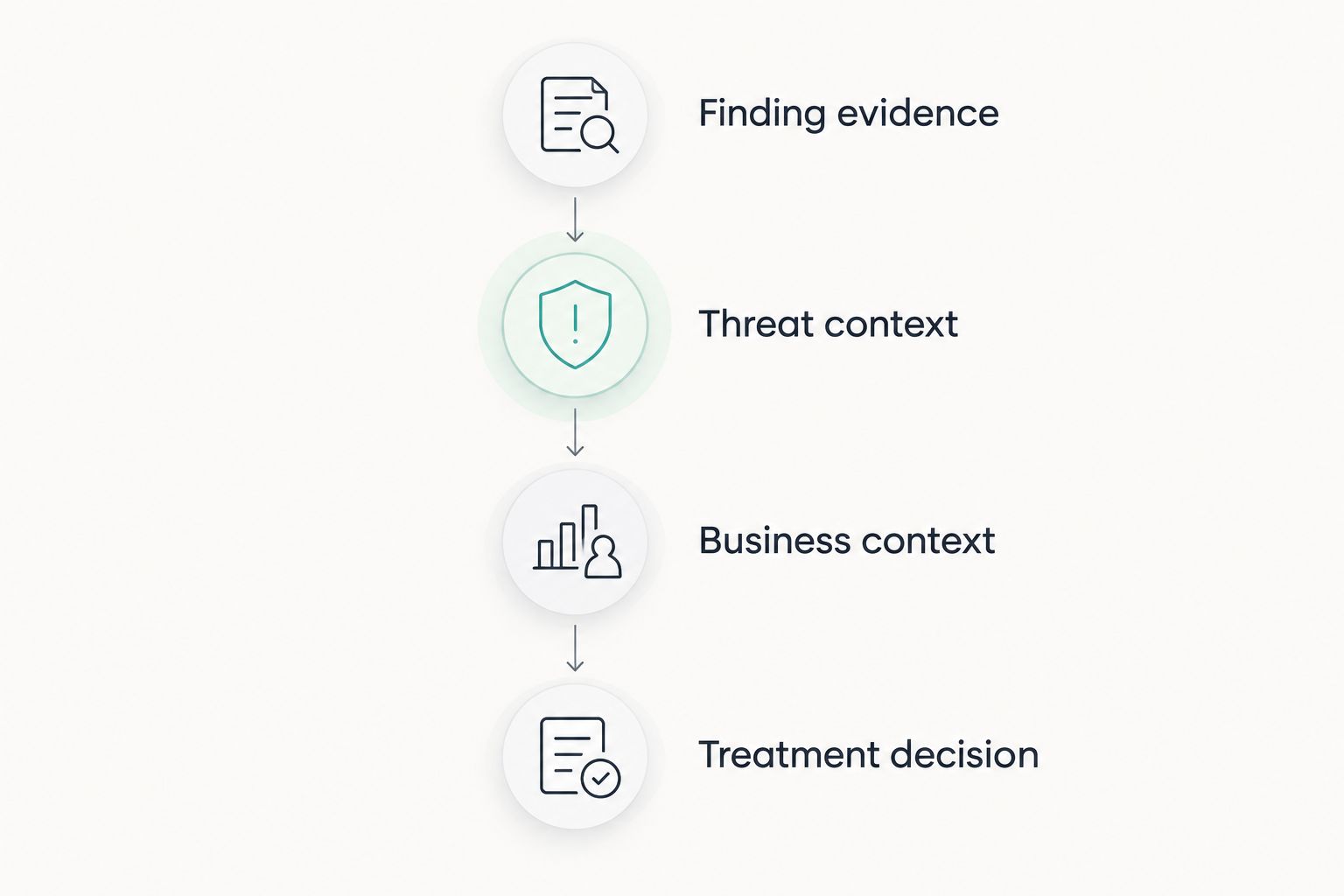
Neither vendor earns a prioritization win from a score alone. Award this dimension to the offering that makes your decision understandable and repeatable in the demonstration. Do not assume a named scoring system is supported until the proposed implementation establishes it.
Remediation accountability is a shared acceptance test
The useful output of vulnerability management is an accountable action, not another list of findings. Your evaluation should follow work across the boundary between security and the team responsible for the affected system.
Start with a finding that requires a real operational decision. Ask how an owner receives it, how disagreement is recorded, how an exception is reviewed, and how verification determines closure. Keep the original evidence visible throughout the exercise.
A strong demonstration distinguishes these states:
- Work assigned but not accepted.
- Work completed but not verified.
- Risk accepted under an exception.
- A finding confirmed as resolved.
Those distinctions are evaluation requirements, not assertions about either vendor's implementation. Request a demonstration of the proposed configuration rather than inferring functionality from the phrase exposure management.
There is no established winner on remediation accountability before the workflow test. The practical winner is the offering that passes your ownership and evidence requirements without depending on undocumented manual steps.
Deployment fit outranks a generic feature comparison
Your architecture can disqualify an otherwise suitable product. Assessment access, data movement, authentication, segmentation, and administrative permissions all affect whether the proposed deployment is acceptable.
For a 2026 purchase, have the security architecture team review the exact configuration being proposed. Separate the placement of assessment components from the location and treatment of management data. They are related decisions, but they are not the same decision.
Ask each vendor to document:
- Which components your team operates.
- What data crosses each system boundary.
- Which permissions the proposed implementation requires.
- How updates, failures, and recovery are handled.
Neither a vendor name nor a category label proves compatibility with restricted networks or particular data-handling requirements. Reject a proposal that cannot explain its architecture clearly, even if its demonstration looks good.
Pricing: compare the licensing basis and the complete scope
Compare written commercial scopes, not product labels. Establish which offering is being quoted, what the license measures, and which components are included before evaluating the commercial tradeoff.
For the platform proposal, request the licensing basis, covered scope, implementation responsibilities, and treatment of future expansion. For Tenable, first identify whether the proposal concerns Nessus, another vulnerability management offering, or an exposure management offering. Those are not interchangeable purchase scopes.
Predictability and flexibility are questions to resolve in the contract. A defined scope helps budgeting only when you understand what happens as your environment changes. Expansion terms matter when assets, sources, or operational requirements change.
Use the same procurement checklist for both:
- What exactly is licensed?
- What change triggers a commercial revision?
- Which implementation work is included?
- Which responsibilities remain with your team?
- What happens to your data when the agreement ends?
This approach avoids claiming that either vendor uses a particular billing model across its portfolio. Make the proposed agreement, not an assumed model, the basis for your decision.
Final verdict: choose by the job you need done
Choose Brinqa if you are a platform buyer
Best for: a security program owner evaluating vulnerability and exposure management. Choose Brinqa for that platform shortlist, then require proof against your sources, decision rules, ownership process, and architecture.
The advantage is category alignment with a management-platform requirement. The limitation is that category alignment alone does not establish implementation fit. Purchase only after the proposed configuration passes your acceptance tests.
Choose Tenable if you are an assessment buyer
Best for: a vulnerability assessment lead with a Nessus scanning requirement. Choose Tenable when that named assessment capability is the job you need to buy.
The advantage is a direct match to a scanner requirement. The limitation is that assessment alone is not a complete management process. If you need exposure management, evaluate the relevant Tenable offering against the platform requirements instead.
| Dimension | Winner |
|---|---|
| Best for | Platform shortlist: Brinqa; Nessus assessment: Tenable |
| Assessment requirement | Tenable for a Nessus requirement |
| Standout capability | Depends on whether you are buying assessment or platform management |
| Existing-tool fit | Tie pending an environment-specific test |
| Risk prioritization | No winner until ranking is demonstrated |
| Remediation accountability | Tie pending a workflow test |
| Deployment fit | The offering that passes your architecture requirements |
| Pricing model | The proposal with an acceptable, explicit licensing basis |
FAQ
Is Brinqa better than Tenable for vulnerability management?
Brinqa belongs on a vulnerability and exposure management platform shortlist; Tenable is the direct choice for a Nessus assessment requirement. For platform-to-platform selection, compare the specific offerings using the same acceptance tests.
Is Tenable only a vulnerability scanner?
No, Tenable offers vulnerability assessment and broader exposure management offerings. Identify the offering under evaluation before comparing its scope with another platform.
Can a vulnerability management platform replace my scanner?
Do not assume a management platform replaces vulnerability assessment. Require the proposed architecture to explain where findings originate and how assessment coverage is maintained.
What should I test in a vulnerability management demonstration?
Trace a real finding from evidence through prioritization, assignment, treatment, and verification. Use your own asset and ownership context rather than accepting unrelated demonstration screens.
Should I use CVSS or EPSS to prioritize vulnerabilities?
Use CVSS and EPSS as different inputs, not interchangeable rankings. CVSS describes severity, while EPSS estimates exploitation probability; business context still belongs in the treatment decision.
How should I compare licensing proposals?
Compare the licensed scope, measurement basis, implementation responsibilities, and expansion terms. Make sure both proposals cover the same operational requirement before judging their commercial fit.
What is the best way to decide in 2026?
Define whether the purchase solves an assessment gap or a management gap first. Then require the selected offering to pass documented tests for evidence, ownership, architecture, and verification.
One last thing
Take a previously resolved finding into the demonstration, not just an open one. Ask the vendor to reconstruct why it mattered, who acted, what changed, and what evidence justified closure. That exercise tests the management record rather than the appearance of a current dashboard.