
Yes—vulnerability management at cloud migration scale works when discovery, asset identity, risk prioritization, remediation ownership, and verification stay connected as workloads move. For a 2026 migration, the limiting factor is not just scanning capacity: you also need to preserve coverage and accountability across the source environment, cloud destination, and temporary overlap.
- Vulnerability management at cloud migration scale requires connected discovery, risk prioritization, ownership, and verification.
- Keep source and destination workloads visible until retirement is verified; a migration ticket is not closure evidence.
- Evaluate Brinqa for vulnerability and exposure management; validate migration requirements before selecting a platform.
- Measure coverage and remediation outcomes by migration wave, not just total findings.
Can vulnerability management scale during cloud migration?
Yes, provided your remediation process scales with your asset inventory. Adding detection without assigning owners, preserving asset relationships, and verifying fixes leaves you with a larger queue rather than a controlled migration.
Use the following 5-step workflow as an operating design, not a vendor performance benchmark. The companion guide to vulnerability management for cloud migration projects addresses the broader project context.
1. Establish coverage
Before moving a workload, record what exists, which business service it supports, who owns it, and how you assess it. Include the source environment and planned destination in the same migration scope. Otherwise, a successful deployment can conceal an unassessed destination or an abandoned source system.
Define what counts as assessed for each workload type. A scan that reaches a server does not establish that every application dependency or cloud configuration has been evaluated. Record gaps explicitly rather than treating an empty findings list as proof of security.
2. Preserve identity
Connect the source workload, destination resource, deployed image, and business application without treating them as interchangeable objects. Preserve their relationships. A finding on an image and a finding on a running workload can require the same engineering change while representing different affected instances.
Do not merge assets solely because they share an address or hostname. Use identifiers with their environment context, retain source records, and document the matching rules so analysts can inspect questionable associations.
3. Prioritize risk
Combine technical severity with evidence about exposure, affected services, exploitation, and available controls. Keep the reasoning visible. An urgent finding needs an explanation that an application owner can act on, not just a position in a queue.
Reassess priorities at cutover because the environment has changed. A workload's network access, privileges, dependencies, or business role can differ after migration even when its vulnerable component remains the same.
4. Assign remediation
Route work to the team that controls the fix. That might be the application owner, infrastructure team, image maintainer, or cloud platform team. Assigning everything to the migration project manager hides the actual dependency.
Specify the affected object, required action, verification method, and escalation owner. Keep risk acceptance separate from remediation, and require an accountable approver for exceptions.
5. Verify closure
Confirm the fix against the relevant deployed state before closing the finding. Updating an image does not establish that every running workload uses it. Likewise, moving an application does not prove the original system has been retired.
Use 3 lifecycle states for review: source active, destination active, and source retired. These are recommended tracking labels, not industry benchmarks; they make overlap and retirement decisions visible.
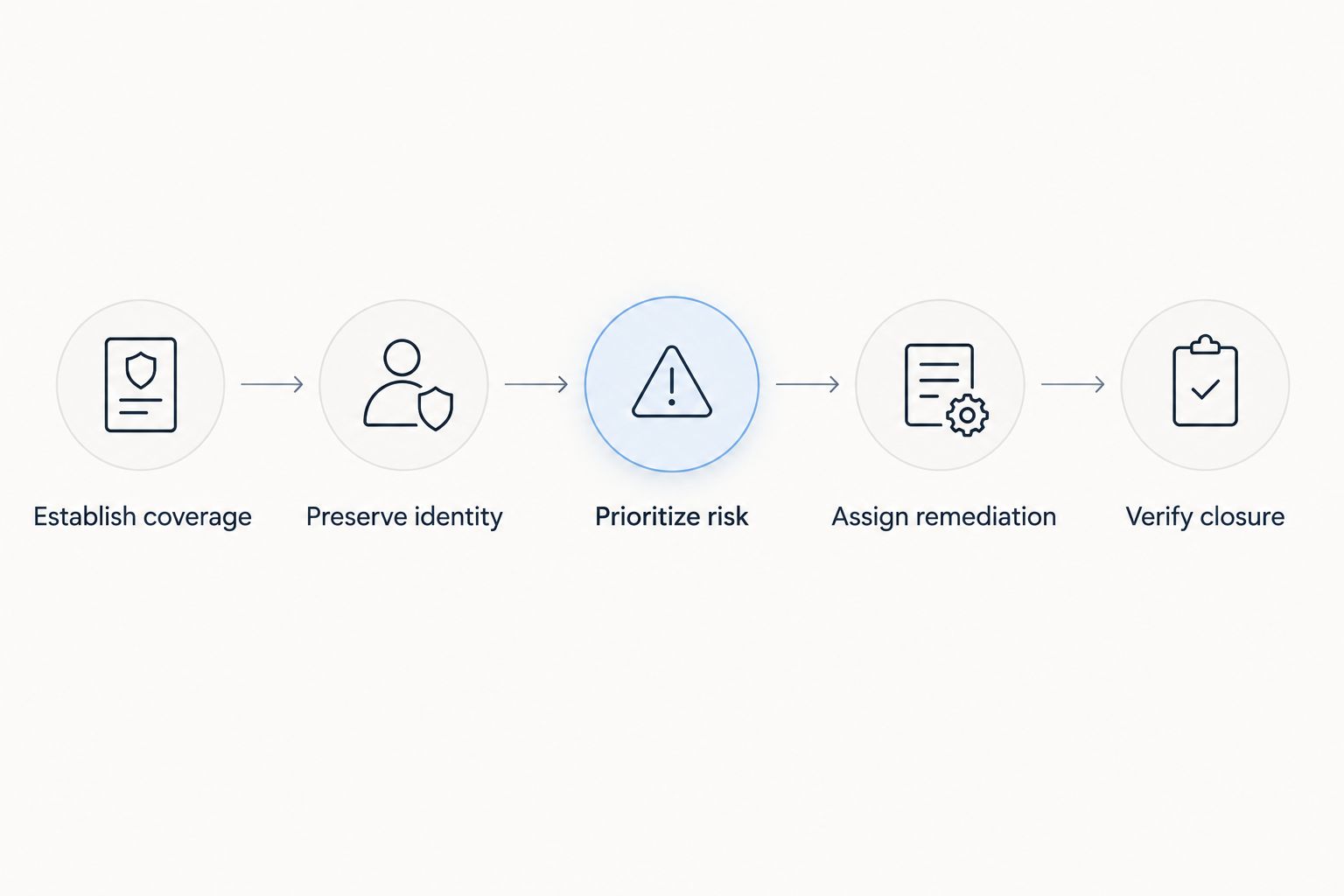
Why this matters
During migration, you must manage the systems you are leaving and the systems you are introducing. Closing a project task does not settle either environment's security state. Your vulnerability process needs evidence for both.
For a 2026 migration plan, make security acceptance part of each migration wave rather than a cleanup task after cutover. Define who can approve unresolved exposure and what evidence permits source retirement. This puts the decision where it belongs: with the people accountable for the affected service.
Treat cloud migration as a change in exposure, not a reset of the vulnerability backlog. Carry unresolved findings forward with their history, then reassess them against the destination environment.
Which operating model supports migration scale?
Detection and coordination solve different problems. Detection identifies issues within its assessment scope; coordination connects findings to assets, owners, decisions, and outcomes. Choose your operating model based on the work you need to control, not the appearance of a consolidated dashboard.
| Operating model | Best for | Strength | Limitation |
|---|---|---|---|
| Separate scanner queues | Bounded environments with clear ownership | Keeps source-specific findings close to the team using them | Cross-environment reconciliation and reporting require explicit coordination |
| Centralized coordination over assessment tools | Migrations spanning teams and environments | Provides a place to reconcile assets, decisions, and remediation work | Depends on accurate inputs, matching rules, and ownership records |
| Combined assessment and coordination | Teams evaluating a shared operating workflow | Connects detection and follow-through within the proposed design | Still requires proof of coverage across every relevant workload type |
Select the model that preserves evidence from detection through closure. Centralization is useful only when you can inspect the underlying records and explain why findings were matched, prioritized, assigned, or closed.
Avoid interpreting this comparison as a reason to replace every assessment tool. First document which tools cover which assets. Then decide whether the missing capability is detection, coordination, or both.
Why scaling difficulty varies during migration
Use these factors to scope your 2026 migration controls. Each factor changes what your team must identify, assess, assign, or verify; none establishes a universal capacity limit.
- Workload change: Moving an existing server and rebuilding an application create different assessment and remediation tasks. Define the destination architecture before deciding which evidence remains valid.
- Environment overlap: Active source and destination systems both need ownership and coverage until retirement is confirmed. Track overlap explicitly in the migration record.
- Asset identity: Recreated resources need traceable relationships to applications and deployment sources. Treat ambiguous matches as review items rather than silently merging them.
- Remediation authority: The team receiving a finding must control the affected configuration, component, image, or deployment. Resolve ownership gaps before accelerating migration waves.
- Evidence freshness: Findings describe an observed state. Preserve observation times and confirm that evidence still applies after deployment or configuration changes.
- Dependency structure: A shared component can affect several services, while a single service can depend on multiple teams. Route the underlying fix without losing the affected-service context.
These factors belong in migration readiness reviews. Increasing scanner capacity does not resolve an unclear owner or an untraceable deployment.
How do you prove the process can handle another migration wave?
Use a representative migration wave to test the workflow before expanding it. Include the kinds of assets, ownership boundaries, and deployment changes that the next wave will introduce. A test consisting only of familiar workloads does not validate a new operating pattern.
Apply 4 acceptance checks. These are recommended checks, not published service levels:
- Coverage check: Every in-scope workload has an assessment method, a current assessment state, and a recorded explanation for any gap.
- Identity check: Reviewers can distinguish source and destination assets and trace their relationship to the business service.
- Ownership check: Actionable findings reach a responsible team; unassigned work has an escalation path.
- Closure check: Closed findings have evidence of remediation, verified retirement, or a separately recorded risk decision.
For the 2026 rollout, record failures against these checks and correct the underlying workflow before adding scope. Do not solve a matching defect by asking analysts to manually reconcile every subsequent wave.
Keep acceptance decisions explicit. If a wave proceeds with unresolved findings, record the approver, affected service, compensating measures, and review trigger. Migration approval and vulnerability closure are separate decisions.
What should you measure as migration volume grows?
Measure whether the process maintains coverage and completes accountable work. Total findings alone cannot distinguish newly discovered exposure from deteriorating remediation performance. Break reporting out by migration wave, environment, and responsible team.
Use measures with defined denominators and timestamps:
- Assessment coverage: Assessed in-scope assets divided by all in-scope assets. Show unknown assessment states separately.
- Ownership completeness: Actionable findings with an accountable team divided by actionable findings requiring assignment.
- Remediation age: Elapsed time since the defined starting event. Keep that event consistent when workloads move.
- Verification backlog: Remediation tasks marked implemented but still awaiting evidence that the affected state is resolved.
- Retirement status: Source assets awaiting verified retirement, grouped by migration wave and owner.
Preserve historical context when resource identifiers change. Otherwise, recreating a workload can make old exposure look new and distort the trend. Define how reopened findings, accepted risks, and retired assets appear before presenting results to leadership.
Report unresolved exposure alongside process health. A shorter queue is not automatically a safer environment if coverage also declined.
Where does a vulnerability and exposure management platform fit?
Brinqa is for teams evaluating a vulnerability and exposure management platform. For cloud migration, make the selection depend on demonstrated handling of your assets, findings, ownership rules, and closure evidence—not on assumed capabilities.
When evaluating Brinqa, bring representative records from the source and destination environments. Ask the evaluation team to show how the proposed configuration preserves identity, explains priority decisions, handles unassigned findings, and records verification. Require the same evidence from every candidate.
The value of a platform depends on the workflow it supports. Its limitation is equally important: a platform selection does not establish assessment coverage, repair inaccurate ownership records, or authorize a production change. Keep those responsibilities explicit in your operating design.
For a 2026 procurement decision, document the acceptance criteria before demonstrations begin. Distinguish capabilities demonstrated with your sample data from capabilities described but not yet validated.
Do we need to replace our existing scanners?
No—replacement is not a prerequisite for scaling vulnerability management during cloud migration. Start by checking whether existing assessment methods cover the destination workloads and provide usable evidence. Retain effective detection and address documented gaps rather than replacing tools simply to create a cleaner architecture diagram.
Should migration stop until every vulnerability is fixed?
No—a zero-findings rule is not a substitute for a risk decision. Define migration acceptance criteria, escalate exposure outside those criteria, and document any approved exception. Do not label accepted risk as remediated risk.
How do we avoid losing findings when assets disappear?
Retain the finding history and record why the affected asset disappeared. Distinguish verified retirement from missing telemetry, assessment failure, and resource replacement. Reconcile the destination workload before treating the source finding as resolved.
FAQ
Can vulnerability management keep up with a large cloud migration?
Yes, when discovery, asset identity, risk prioritization, ownership, and verification remain connected as migration scope grows. Validate that workflow on representative workloads before expanding it.
What's the first thing to check before migrating a workload?
Check assessment coverage and accountable ownership for both the source workload and its destination. Record unresolved findings and the criteria for accepting the migration.
Does moving a vulnerable server to the cloud fix its vulnerabilities?
Moving a server does not establish that its vulnerable components were fixed. Assess the destination state and retain unresolved findings until remediation or retirement is verified.
Is a cloud resource disappearing enough to close its findings?
A disappearing resource is not sufficient closure evidence by itself. Determine whether it was retired, replaced, or simply lost from assessment coverage.
What should we ask Brinqa during a cloud migration evaluation?
Ask Brinqa to demonstrate your required vulnerability and exposure management workflow using representative migration records. Validate asset matching, ownership, prioritization, and closure evidence rather than assuming support.
Which metrics show whether vulnerability management is scaling?
Assessment coverage, ownership completeness, remediation age, verification backlog, and retirement status show different parts of the process. Segment them by migration wave and preserve consistent definitions.
Who should own vulnerability remediation during migration?
The team with authority to change the affected component should own remediation. The migration lead coordinates dependencies, while the accountable service owner handles risk acceptance under your policy.
One last thing
Test the disappearance case before the next migration wave. Remove a test resource from the assessment feed without marking it retired, then check whether the workflow preserves an unresolved state or incorrectly closes its findings. This exposes a dangerous distinction: losing sight of an asset is not the same as removing its exposure.


