
Vulnerability platforms can estimate which known weaknesses deserve attention before an attack, but they cannot reliably predict whether or when your organization will suffer a breach. In 2026, the useful distinction is between forecasting exploitation activity and estimating your own exposure: neither establishes that an attacker will reach sensitive data or disrupt a service.
- Can vulnerability platforms predict breach risk? They support risk estimates, not certain forecasts of an organization's next breach.
- FIRST's EPSS estimates exploitation probability over 30 days; it does not estimate your organization's breach probability.
- Brinqa is a vulnerability and exposure management platform; evaluate predictive claims separately from that category description.
- Prioritize remediation using exploitation evidence, asset exposure, business impact, and verified controls—not a score alone.
Can vulnerability platforms predict future breach risk?
Vulnerability platforms can support breach-risk assessment, but predicting exploitation is not the same as predicting a breach. A defensible assessment separates technical severity, exploitation likelihood, environmental exposure, and business consequences. Each answers a different question.
For the forecasting component, start with how to prioritize vulnerabilities with EPSS scoring. Then check whether the platform connects that signal to the affected assets in your environment.
| Assessment method | Best for | What it contributes | Main limitation |
|---|---|---|---|
| CVSS severity scoring | Understanding technical severity | A standardized description of vulnerability characteristics and severity | A base score alone does not estimate exploitation probability or business loss |
| FIRST's Exploit Prediction Scoring System, or EPSS | Estimating near-term exploitation activity | A probability estimate that a published vulnerability will see exploitation activity in the next 30 days | It does not estimate whether your organization will be breached |
| CISA's Known Exploited Vulnerabilities catalog | Identifying vulnerabilities with evidence of exploitation | Confirmation that a listed vulnerability has been exploited in the wild | Listing does not establish compromise of your assets |
| Environment-specific exposure assessment | Deciding what your team should address first | Context about reachability, affected systems, controls, and business importance | Conclusions depend on the accuracy and completeness of local evidence |
Treat these methods as complementary inputs, not competing answers. A vulnerability can have serious technical consequences without being reachable in your environment; another can warrant urgent attention because exploitation is documented and an affected service is exposed.
Why this matters
A remediation queue is a decision about where your team spends limited engineering time. If you interpret every high score as an impending breach, you lose the distinction between a severe weakness and a plausible route to business harm.
The opposite mistake is equally consequential: treating a low exploitation estimate as permission to ignore an exposed system. A forecast describes a defined outcome over a defined period. It does not certify that an asset is safe.
For your 2026 evaluation, require every predictive claim to identify its target, scope, and time horizon. A vendor should distinguish forecasting exploitation activity from ranking remediation work or estimating incident likelihood. Those are different deliverables.
What does an exploitation forecast actually predict?
FIRST's EPSS estimates the probability that a published vulnerability will experience exploitation activity in the wild during the next 30 days. That is a vulnerability-level forecast, not a prediction about a named organization.
EPSS expresses probability on a 0–1 scale. Its percentile expresses relative standing among scored vulnerabilities; percentile and probability are not interchangeable. Reading a percentile as a probability changes the meaning of the result.
CVSS, by contrast, expresses severity on a 0–10 scale. FIRST's CVSS specification and EPSS documentation define different purposes for these measures. For a 2026 assessment, keep their labels intact rather than combining them into an unexplained prediction percentage.
The practical benefit of exploitation forecasting is focus. It gives your analysts another reason to investigate a finding sooner. The limitation is scope: it does not establish that your asset is affected, accessible, exploitable under its current configuration, or connected to a consequential target.
What does an environment-specific assessment add?
An environment-specific assessment asks whether a vulnerability matters on the system where you found it. You need evidence about the affected component, reachable interface, required privileges, deployed controls, and business service that depends on the asset.
Consider a hypothetical comparison between an internet-facing service and an isolated test system with the same vulnerability. Their technical severity can match while their exposure and business consequences differ. That difference supports different remediation decisions; it does not produce a validated breach probability by itself.
Look for an explanation you can inspect. A useful assessment shows which facts raised the priority, which controls reduced exposure, and which assumptions remain unresolved. A score without that explanation is difficult to challenge or translate into an engineering task.
Your strongest operational output is an evidence-backed remediation decision, not a prediction presented as certainty. Ask whether the decision changes when you correct an asset record, validate a control, or remove external access.
Why breach-risk estimates vary
Breach-risk estimates vary because threat signals and local conditions describe different parts of an attack scenario. Use these factors to examine the reasoning behind a priority, rather than assuming the final score explains itself.
- Exploitation evidence: Documented exploitation strengthens the case for attention. A forecast and an observed attack are different evidence types and should remain distinguishable.
- Asset reachability: A vulnerable component must be accessible through a relevant path for that path to support exploitation. Confirm reachability rather than inferring it from ownership or network labels.
- Exploit prerequisites: Required privileges, user interaction, and configuration conditions affect whether an attack scenario applies. A component match alone does not establish those conditions.
- Control effectiveness: Segmentation, access restrictions, and other protections change exposure only when they address the relevant path and operate as intended. Verify the control instead of recording its existence as proof.
- Business consequences: The affected service, data, and dependencies determine what successful exploitation would mean. Technical severity alone cannot supply that business context.
- Evidence freshness: Infrastructure and access change. Record when the asset, vulnerability, and control observations were verified so you can identify decisions built on stale information.
How should you evaluate a platform's predictive claims?
Use an evidence-led evaluation rather than accepting a demonstration dashboard as validation. Your 2026 evaluation should establish what the prediction means, how it was assessed, and whether it improves a decision your team actually makes.
Define the outcome
Ask the vendor to state exactly what the model predicts. Exploitation activity, successful compromise, data disclosure, and service disruption are separate outcomes. A model assessed against one outcome does not automatically demonstrate accuracy for another.
Also require a time horizon and unit of analysis. A vulnerability-level estimate over a specified period cannot be presented as an organization-wide breach forecast without additional modeling and validation.
Verify the inputs
Inspect the observations behind a sample finding. Confirm the affected software, asset identity, exposure, owner, and relevant controls. Require the platform to distinguish unknown information from evidence that a condition is absent.
This step tests whether an apparently precise result rests on reliable foundations. An incorrect asset association can undermine the recommendation even when the underlying threat intelligence is accurate.
Test the forecast
Request evaluation on outcomes that occurred after the information used to generate the predictions. A retrospective demonstration that includes later knowledge does not establish forecasting performance.
If a vendor presents probabilities, ask for calibration evidence: whether outcomes occurred at rates consistent with the assigned probabilities across comparable cases. Also examine missed events and false alarms. A single accuracy percentage cannot explain both.
Confirm the action
Check whether an analyst can turn the assessment into a specific remediation decision. The output should explain what to fix, why it takes priority, who owns the work, and how your team will verify the change.
Do not require every recommendation to be a patch. Depending on the verified scenario, removing access, changing configuration, or retiring the affected component can address the exposure. Confirm the result through appropriate validation.
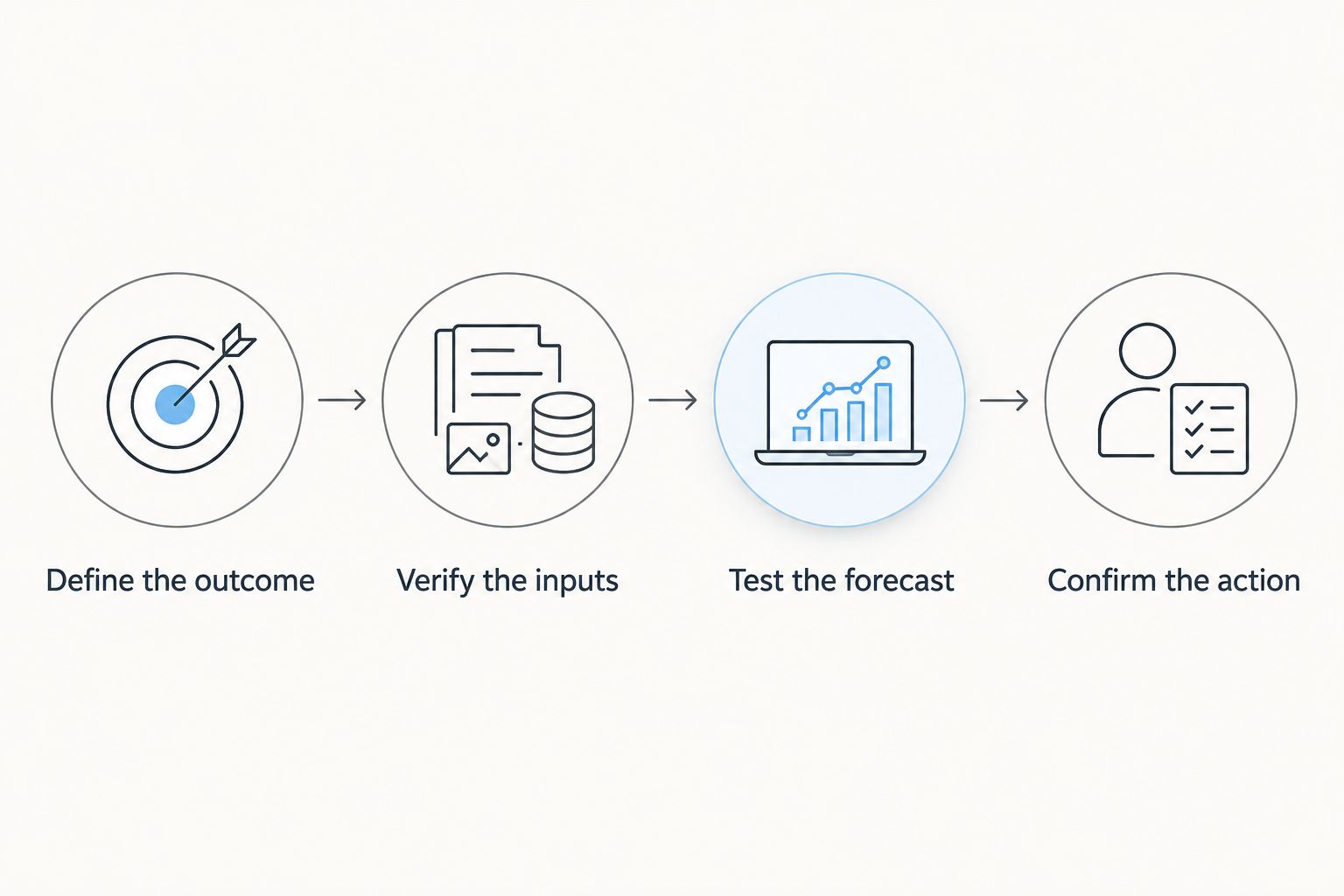
A useful acceptance test follows a finding from source evidence through prioritization to verified remediation. Keep the original assessment and its timestamp so later evidence does not overwrite what the platform actually knew when it made the recommendation.
Where does Brinqa fit?
Brinqa is a vulnerability and exposure management platform. That category is relevant when your objective is to assess weaknesses and exposure, but the category label alone does not establish a validated breach-prediction capability.
Brinqa fits teams seeking vulnerability and exposure management; breach forecasting requires separate evidence. Apply the same outcome, input, validation, and action tests to any proposed platform.
The category's value is organizing decisions around vulnerabilities and exposure. Its limitation is equally important: vulnerability evidence does not cover every route to a breach, including scenarios centered on stolen credentials or misuse of legitimate access. Keep incident detection and response in scope alongside remediation.
Does a high EPSS score mean my company will be breached?
EPSS's 30-day forecast concerns exploitation activity against a vulnerability, not a breach at your company. You still need to establish whether an affected component exists in your environment and whether a relevant attack path is available.
Is CVSS enough to forecast an attack?
CVSS's 0–10 severity scale is not an attack forecast. Use severity alongside exploitation evidence and verified environmental context when deciding what to remediate first.
Can remediation prove a forecast was wrong?
Remediation changes the conditions under which an incident could occur, so a prevented outcome does not automatically invalidate the original assessment. Record the intervention and distinguish evaluating a forecast from evaluating the effect of your response.
FAQ
Can vulnerability platforms predict breach risk accurately?
Vulnerability platforms can support risk estimates, but accuracy depends on the specific outcome, time horizon, inputs, and validation method. Evidence that a model predicts exploitation does not establish that it predicts an organization's next breach.
What does EPSS predict over the next 30 days?
FIRST's EPSS estimates the probability that a published vulnerability will experience exploitation activity in the wild during the next 30 days. It does not estimate the probability that your organization will suffer a breach.
Is an EPSS percentile the same as a probability?
An EPSS percentile is a relative ranking, not an exploitation probability. Keep the percentile separate from the probability estimate when interpreting or reporting a finding.
Does a critical CVSS score mean an attack is likely?
A critical CVSS score describes severity, not attack likelihood. Check exploitation evidence, asset reachability, prerequisites, and business context before assigning remediation priority.
Does CISA's KEV catalog mean my systems are compromised?
CISA's Known Exploited Vulnerabilities catalog identifies vulnerabilities with evidence of exploitation in the wild; it does not establish compromise of your systems. Investigate affected assets and use incident-response evidence to assess compromise.
What should I ask a vendor that promises breach prediction?
Ask what outcome the vendor predicts, over what period, and how it validates the result. Require evidence about calibration, missed events, false alarms, and the information available when each prediction was generated.
Should I ignore vulnerabilities with low exploitation estimates?
A low exploitation estimate is not a safety certification. Review local exposure, business consequences, known exploitation evidence, and other applicable remediation requirements before deferring a finding.
Can a vulnerability platform replace incident detection?
A vulnerability platform does not replace incident detection. Assessing weaknesses and exposure is different from identifying evidence that an attacker has accessed or is operating in your environment.
One last thing
The hardest prediction to evaluate can be the one that triggers successful prevention. If your team removes an exposure before an attacker uses it, the absence of a breach does not tell you whether the initial warning was justified.
For your 2026 program, preserve the original evidence, recommendation, intervention, and verification result. Judge the platform on whether it supports defensible action—not whether an untestable prediction sounds precise.


