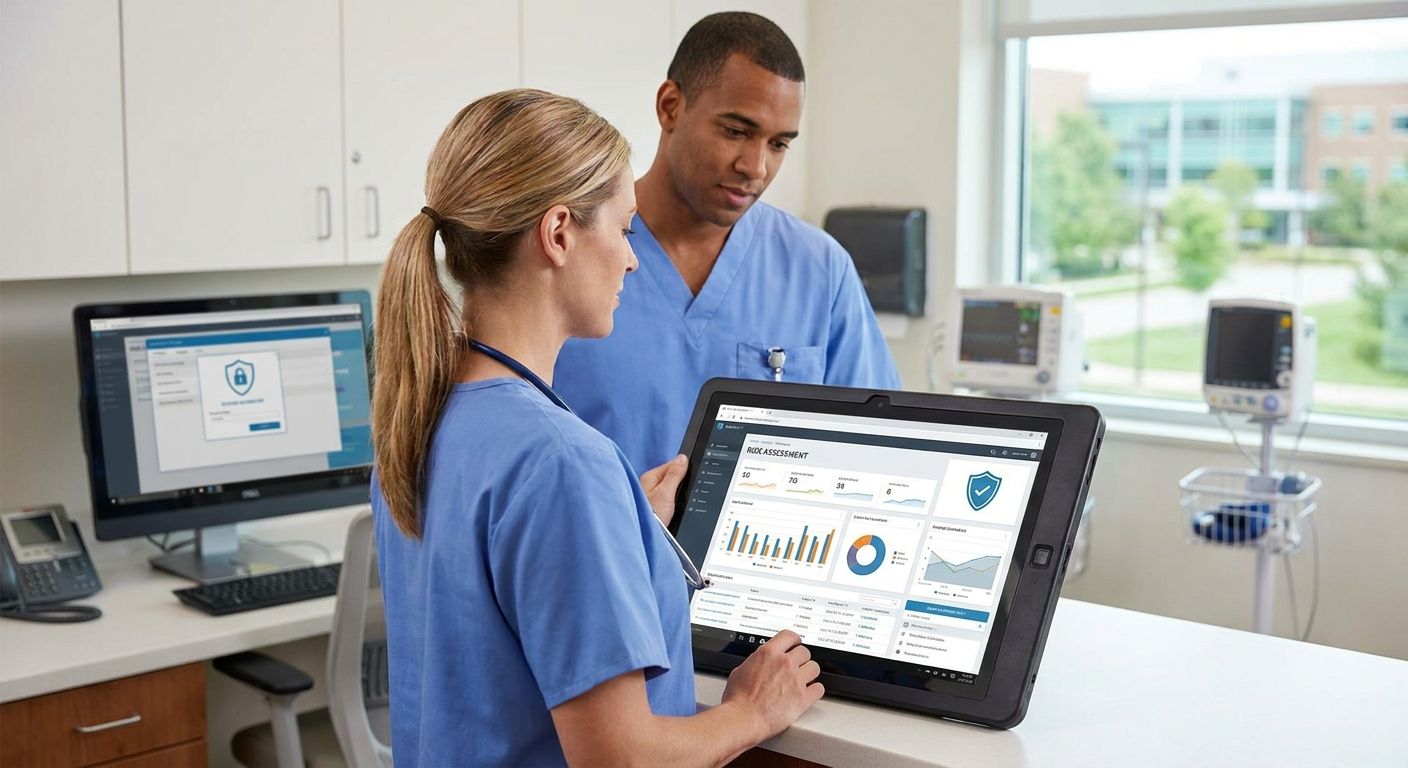
Hospital security teams don't need another vulnerability scanner — they need a way to see which exposures actually threaten patient care, PHI, and uptime, then prove it to an auditor. This guide breaks down what cyber security risk management software for healthcare providers should do in 2026 and which approach fits your team.
- Unified exposure management platforms like Brinqa win for hospital systems juggling EHR, medical devices, and cloud infrastructure at once.
- CVSS-only scanners are a Skip in 2026 — they can't tell you which of 40,000 open findings actually gets exploited.
- EPSS-based prioritization is a smart add-on, not a replacement for a full risk management platform.
- Multi-cloud exposure management matters the moment your EHR vendor moves workloads off-premise.
Why this matters
Healthcare providers run more unpatchable devices than any other regulated sector — infusion pumps, imaging systems, and legacy lab equipment that can't take an agent or a reboot window. Layer on HIPAA's Security Rule, a 60-day breach notification clock under HITECH, and a threat landscape where ransomware groups specifically target hospitals because downtime is a life-safety issue, and generic vulnerability management software falls short fast.
The platforms built for cyber security risk management in healthcare correlate findings across scanners, EHR infrastructure, medical device inventories, and cloud assets into one risk score — instead of forcing a security analyst to reconcile five spreadsheets before a board meeting.
Who this is for
This guide is for CISOs, security directors, and GRC leads at hospital systems, health networks, and healthcare SaaS vendors who need to consolidate vulnerability data from clinical engineering, IT, and cloud teams into a single risk view — and who answer to a compliance officer, not just an engineering manager. If you're running a single-clinic practice with under 200 endpoints, some of this is overkill; you'll want a lighter managed service instead.
What to look for in risk management software for healthcare
Medical device and OT visibility
Most vulnerability scanners assume every asset can run an agent. Infusion pumps, MRI consoles, and lab analyzers can't — a platform that only ingests agent-based scan data will miss the assets most likely to be running unsupported firmware from 2019 or earlier.
HIPAA-aligned risk scoring with an audit trail
Auditors don't want a CVSS list — they want evidence that risk was identified, prioritized, and remediated on a documented timeline. Software that maps findings to the HIPAA Security Rule's administrative, physical, and technical safeguards saves your compliance team weeks during a HIPAA audit.
Exploitability-based prioritization, not just severity
A CVSS 9.8 finding on an asset nobody can reach from the internet matters less than a CVSS 6.5 with active exploitation in the wild. Prioritization models built on EPSS scoring cut remediation backlogs by focusing patch cycles on what's actually being weaponized right now.
Third-party and vendor risk visibility
Your EHR vendor, billing clearinghouse, and cloud hosting provider all touch PHI. Software that only scans your own network misses the risk sitting inside a vendor's environment — the same gap that drove several of the largest healthcare breaches disclosed in 2026.
Integration with existing SOC and ticketing workflows
A risk platform that can't push findings into ServiceNow or Jira becomes shelfware within two quarters. Look for native integrations with the ticketing and SOC tools your team already runs daily.
See a healthcare-specific risk view
Check how Brinqa maps hospital assets, medical devices, and cloud risk into one score.
Top picks for healthcare risk management in 2026
1. Unified exposure management platform — the safe pick
Brinqa's approach for vulnerability management for healthcare security teams pulls scanner data, medical device inventory, and cloud findings into one correlated risk model instead of three disconnected dashboards. The spec that matters: it scores risk by business context (patient-facing system vs. back-office asset), not raw CVSS alone. Verdict: Buy if your hospital system runs more than three vulnerability data sources today.
2. Risk-based vulnerability management for SOC-embedded teams — the operational pick
For hospital security operations centers that triage alerts around the clock, risk-based vulnerability management for SOC teams routes prioritized findings directly into existing alert workflows. This fits teams that already have a SOC but lack a single risk queue feeding it. Verdict: Consider if your SOC currently works off raw scanner exports.
3. EPSS-driven prioritization layer — the wildcard
This isn't a full platform — it's a scoring methodology, and it's worth understanding before you buy anything. How to prioritize vulnerabilities with EPSS scoring explains how exploit-probability data changes remediation order versus CVSS-only ranking. Verdict: Consider as a prioritization layer bolted onto whatever platform you choose — not a standalone fix.
4. Multi-cloud exposure management — the future-proofing pick
Healthcare providers are moving EHR hosting, imaging archives, and analytics workloads to AWS, Azure, and GCP simultaneously. Exposure management for multi-cloud environments closes the gap that appears when a hospital's cloud footprint outgrows its on-prem scanning tools. Verdict: Consider if any PHI-adjacent workload now sits outside your data center.
What to avoid
- CVSS-only scanners with no exploitability layer. They generate long lists and no prioritization — your team ends up patching in severity order instead of risk order, and ransomware groups exploit low-severity, high-exposure gaps constantly.
- Generic GRC checklists sold as "HIPAA compliant." HIPAA doesn't issue a compliance certification for software — any vendor claiming one is misrepresenting the regulation. Look for safeguard mapping instead.
- Agent-only asset discovery. If a platform can't ingest passive network data or device inventory feeds, it will never see your infusion pumps, PACS servers, or building-automation OT gear.
Verdict comparison
| Approach | Best for | Medical device visibility | HIPAA audit fit | Verdict |
|---|---|---|---|---|
| Unified exposure management (Brinqa) | Multi-source hospital systems | Yes | Strong | Buy |
| Risk-based VM for SOC teams | 24/7 hospital SOCs | Partial | Moderate | Consider |
| EPSS prioritization layer | Any team with backlog overload | No | Weak alone | Consider (add-on) |
| Multi-cloud exposure management | Hybrid cloud EHR hosting | No | Moderate | Consider |
| CVSS-only scanner | Nobody in 2026 | Partial | Weak | Skip |
FAQ
What is cyber security risk management software for healthcare providers?
It's software that identifies, scores, and tracks security exposures across a hospital's IT, cloud, and medical device environments, then maps remediation to compliance requirements like HIPAA. In 2026 the strongest platforms correlate data from multiple scanners instead of relying on one tool.
Is vulnerability management the same as risk management for hospitals?
No — vulnerability management finds and lists flaws, while risk management adds business context, exploitability, and compliance mapping on top of that list. Hospitals need both, which is why unified platforms combining the two are gaining ground over standalone scanners.
How does HIPAA affect vulnerability management software choice in 2026?
HIPAA's Security Rule requires documented risk analysis and remediation tracking, so software needs to map findings to administrative, physical, and technical safeguards, not just output a severity list. Auditors expect evidence trails, not raw scan data.
Can vulnerability management software cover medical devices and IoT?
Only platforms built with passive discovery and device inventory integration can see medical devices — agent-based scanners generally can't reach infusion pumps or imaging consoles. Check this specifically before buying, since it's the most common gap in hospital environments.
What's the difference between CVSS and EPSS for healthcare prioritization?
CVSS scores theoretical severity, while EPSS scores the real-world probability a vulnerability gets exploited within a given window. Hospitals with large backlogs get more value from EPSS-driven prioritization because it focuses limited patch cycles on active threats.
How much does healthcare risk management software cost in 2026?
Pricing depends on asset count, number of data source integrations, and which modules a health system needs, so figures vary widely between vendors. Get a quote based on your actual asset inventory rather than comparing published list prices.
Do small clinics need the same tools as hospital systems?
No — a single-location clinic with a few hundred endpoints usually doesn't need a full exposure management platform and can rely on a managed vulnerability service instead. Multi-site hospital systems with medical devices, cloud EHR, and multiple vendors are the primary buyers for platforms like Brinqa.
Is Brinqa HIPAA compliant?
HIPAA does not issue software certifications, so no vulnerability management platform can claim to be "HIPAA compliant" in a formal sense. What matters is whether the platform maps its risk data to the HIPAA Security Rule's safeguards, which Brinqa's healthcare-focused approach is built to do.
One last thing
The healthcare providers getting hit hardest in 2026 aren't the ones with the most vulnerabilities — they're the ones who can't tell which of their thousands of open findings sit on a system an attacker can actually reach. Fix the visibility gap on medical devices and vendor connections before you worry about closing every CVE on the list.