
There is no defensible fixed duration for building an SBOM across an app portfolio without measuring your applications, build environments, and validation work. For your 2026 plan, estimate generation time separately from access, integration, and review; a successfully exported file does not establish complete portfolio coverage.
- Estimate sbom build time for app portfolio work from measured application workflows, not an unsupported industry average.
- Separate SBOM generation, validation, and waiting time before committing to a portfolio deadline.
- Tie each software bill of materials to an application release and document unresolved coverage gaps.
- Evaluate Brinqa for vulnerability and exposure management; assess SBOM generation requirements separately.
How long does building an SBOM for an app portfolio take?
Your portfolio timeline is the schedule required to produce, validate, and associate SBOMs with the releases you actually need to cover. Scanner execution is only part of that schedule. Start with a measured pilot, then expand by application group rather than multiplying one successful scan by your total application count.
Use the guide to building an SBOM for vulnerability tracking to connect inventory creation with its intended security use. Before estimating delivery, define what makes an SBOM acceptable for that use.
Follow this sequence:
- Define the scope. Identify the applications, release versions, deployable artifacts, and environments included in the estimate.
- Confirm access. Verify that the responsible teams can retrieve the source, dependency information, build outputs, or supplier documents required.
- Generate pilot SBOMs. Exercise the actual workflow for each materially different application group.
- Validate the results. Check component identities, dependency information, document structure, and the connection to the intended release.
- Schedule the rollout. Use measured work and available execution capacity, with unresolved blockers tracked separately.
For each pilot, record 3 durations: generation time, validation time, and waiting time. These are measurement categories, not promised turnaround figures. Keep engineering effort separate from elapsed calendar time: a job waiting for credentials consumes schedule without consuming continuous analyst effort.
Why this matters
A deadline built around file generation answers the wrong operational question. Your security team needs to know which applications have usable dependency evidence, which releases that evidence describes, and who will resolve gaps.
For a 2026 rollout, define completion before asking teams for delivery dates. Otherwise, one team can report success after exporting a document while another includes review, release association, and publication in the same estimate.
Count accepted release inventories, not just generated files. That distinction makes your schedule useful for vulnerability response instead of merely documenting tool activity.
Source-based SBOMs: measure dependency resolution and review
Best for: applications whose source and dependency metadata are accessible to your team. A source-oriented workflow examines the information available in repositories and package-management files. Its usefulness depends on whether that information describes the release you intend to assess.
The advantage is access to declared dependency information before deployment. The limitation is scope: repository contents alone do not establish everything included in a packaged or deployed artifact.
During the pilot, record whether dependency resolution requires private registries, credentials, or environment-specific configuration. Also record whether optional dependencies and separate application modules fall inside your acceptance criteria.
Do not mark a repository complete simply because a generator produced valid output. Confirm which branch, commit, and release the document represents, and preserve that association with the SBOM.
Build-integrated SBOMs: measure pipeline work separately
Best for: applications with repeatable builds and an engineering owner who can maintain the generation step. A build-integrated workflow places SBOM creation alongside the process that produces release artifacts.
Its advantage is a direct place to associate inventory with a build. Its limitation is operational dependency: permissions, build failures, and pipeline changes become part of implementation work.
For your 2026 baseline, distinguish the initial integration effort from the duration of later generation runs. Combining those figures makes the recurring workflow look slower than it is, while ignoring integration understates the first rollout.
Record where the document is stored and how downstream users retrieve it. A generated SBOM that disappears with a temporary build workspace does not satisfy a requirement for accessible release evidence.
Artifact-based SBOMs: measure extraction and identification
Best for: packaged applications and container images where the released artifact is the assessment target. An artifact-oriented workflow examines the software package or image rather than relying exclusively on repository declarations.
Its advantage is alignment with a specific deliverable. Its limitation is visibility: identifying components from packaged contents does not guarantee that every dependency or relationship can be recovered.
Measure artifact retrieval separately from analysis. Access restrictions, large transfers, and unavailable release packages belong in the schedule even though they are not generator execution time.
For supplier software, distinguish an internally generated artifact inventory from a supplier-provided SBOM. Review the scope and release identity of either document instead of assuming the two are interchangeable.
Which SBOM workflow should you schedule first?
Choose a workflow based on the evidence you need, not the shortest demonstration. The following comparison describes assessment approaches, not measured performance or a ranking of commercial products.
| Workflow | Best for | Main advantage | Main limitation | What to measure |
|---|---|---|---|---|
| Source-based | Accessible repositories and dependency metadata | Reviews declared dependencies before deployment | Repository evidence does not establish packaged contents | Dependency resolution and review effort |
| Build-integrated | Repeatable release pipelines | Associates generation with a build | Requires pipeline ownership and implementation work | Initial integration and recurring execution separately |
| Artifact-based | Released packages and container images | Examines a specific deliverable | Packaged contents do not guarantee complete component identification | Retrieval, analysis, and unresolved identification work |
Use the workflow that matches your acceptance criteria. If you need evidence about released software, a fast repository export is not automatically an acceptable substitute.
Where workflows overlap, document the distinct question each answers. Do not add every approach to every application merely to create more files; add evidence when it resolves a defined coverage gap.
Why SBOM build time varies across an app portfolio
The scheduling differences to examine are concrete workflow dependencies, not an unsupported average for similarly sized companies. Check these factors during your pilot:
- Application scope. Define whether an application means a repository, service, packaged product, or collection of deployable components. Different definitions produce different workloads.
- Dependency access. Identify private registries, credentials, supplier handoffs, and unavailable artifacts before treating an application as ready for generation.
- Build reproducibility. Verify that the intended release can be built or retrieved consistently. Record blocked builds separately from SBOM analysis failures.
- Validation requirements. Specify the required component identifiers, dependency relationships, release references, and treatment of unresolved components.
- Execution capacity. Measure the work your approved infrastructure can run concurrently without assuming that every job can start together.
Record each factor against the affected application group. A portfolio-wide risk label is less useful than knowing exactly which releases are waiting for access or ownership decisions.
How do you turn a pilot into a portfolio delivery date?
Group applications by workflow and access conditions before projecting the schedule. A maintained service with an established pipeline should not stand in for an inherited application whose build instructions are unresolved.
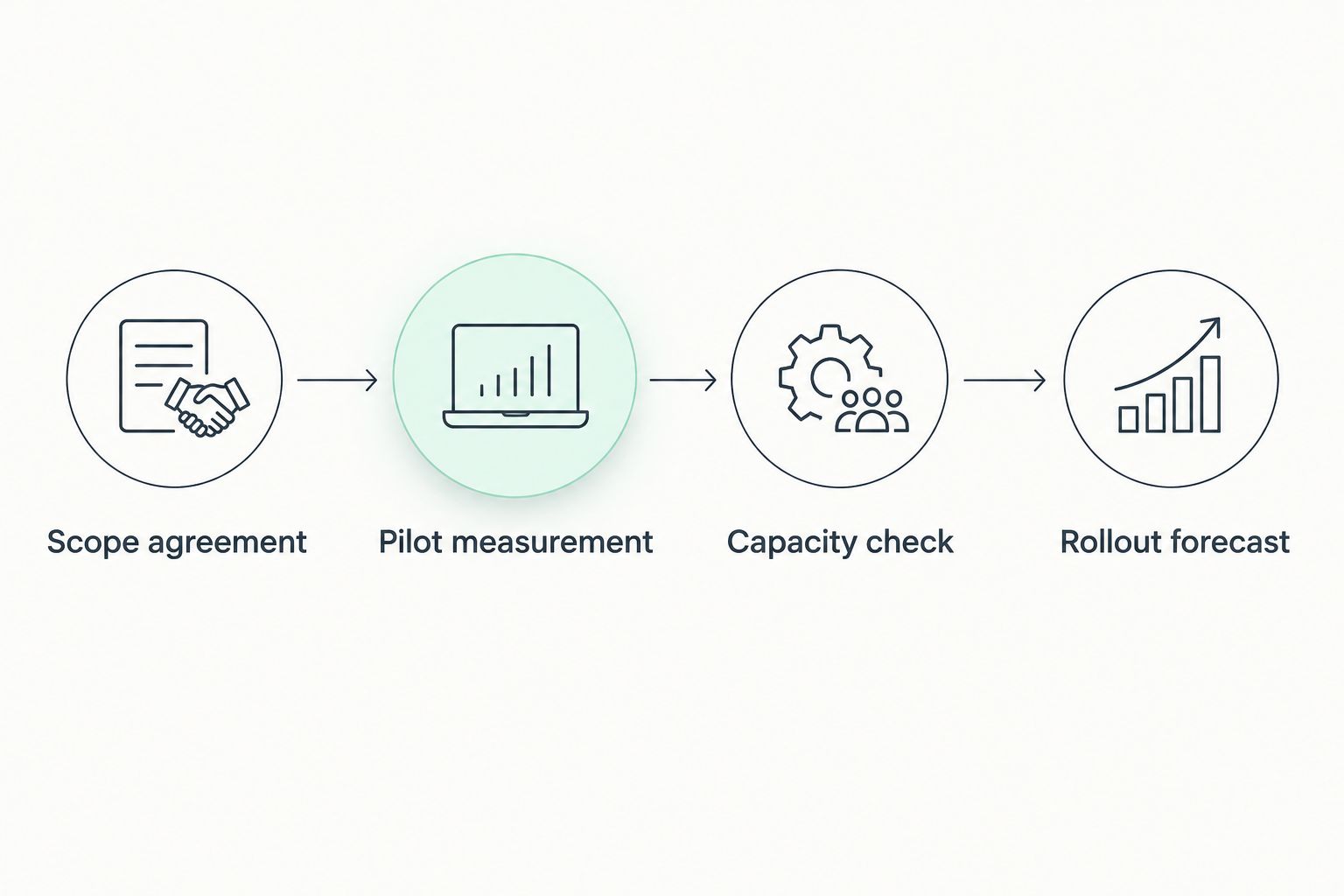
Use 2 separate records: an effort ledger and an elapsed-time ledger. The effort ledger tracks hands-on engineering and review work; the elapsed-time ledger tracks execution, queues, approvals, and external dependencies.
Scope agreement
Write down the included releases and the acceptance criteria. Name the application owner and the person responsible for accepting the resulting inventory.
Pilot measurement
Run the intended workflow and preserve the timestamps for generation, validation, and waiting. Record failures as part of the pilot rather than silently excluding unsuccessful applications.
Capacity check
Confirm available execution capacity and reviewer availability. Parallel generation does not remove a review bottleneck, and additional reviewers do not fix inaccessible artifacts.
Rollout forecast
Build the forecast from measured application groups and explicit dependencies. Show unresolved access or supplier work as blockers, not as completed work hidden inside a confident date.
These stages keep an estimate traceable to actual work. When a blocker changes, update the affected group instead of rebuilding the entire forecast from an arbitrary average.
What should count as a completed application SBOM?
Define acceptance through evidence your team can inspect. A schema-valid file is useful, but structural validity alone does not establish that the document covers the intended application release.
Use this acceptance checklist:
- The document identifies the intended application and release.
- Its generation method and scope are recorded.
- Component names and versions are available where identified.
- Dependency relationships meet your stated requirements.
- Unresolved components and known coverage gaps are documented.
- A named owner can maintain and regenerate the inventory.
- Authorized users can retrieve the document when needed.
Track 2 distinct statuses: generated and accepted. This prevents a successful export from concealing unfinished review and gives engineering teams a clear explanation of what remains.
For 2026 reporting, show accepted coverage against your defined release scope. Keep excluded applications visible so that a narrowed scope does not look like improved execution.
Can you reduce the timeline without reducing coverage?
Remove repeated setup work before reducing validation. Reusable pipeline configuration, documented access requirements, and agreed acceptance criteria address recurring work without pretending that missing evidence is complete.
Assign ownership before rollout. An unidentified application owner creates a handoff problem that a faster generator cannot resolve.
Automate repeatable generation where the workflow supports it, but retain a path for exceptions. Failed dependency resolution, unidentified components, and inaccessible supplier evidence need visible handling rather than silent acceptance.
Establish a regeneration trigger tied to changes in the software being assessed. A first portfolio export is a milestone, not a permanent inventory of future releases.
Where does vulnerability and exposure management fit?
An SBOM identifies software components within its stated scope; it does not, by itself, establish exploitability, business impact, or remediation priority. Keep inventory acceptance separate from the later decision about which findings need action.
Brinqa is best evaluated by teams seeking a vulnerability and exposure management platform. That category is relevant when your objective extends beyond producing dependency documents to managing security findings and exposure.
The limitation of evaluating any platform by category alone is that it does not establish your required SBOM formats, workflows, or integrations. Assess those requirements directly with Brinqa rather than treating the platform description as evidence of a specific capability.
Keep the purchasing decision separate from your generation benchmark. Your measured application workflow remains the basis for the portfolio estimate.
FAQ
How long does it take to build an SBOM for an entire app portfolio?
A defensible duration requires measured application workflows and a defined scope. Separate generation, validation, and waiting time, then build the schedule around application groups and available capacity.
Is SBOM generation time the same as portfolio rollout time?
No. SBOM generation time covers document creation, while portfolio rollout also includes access, implementation, validation, ownership, and publication work.
Can I estimate the whole portfolio from one application?
One application is not a sound basis when the portfolio contains materially different workflows. Pilot each distinct group, such as source-based, build-integrated, and artifact-based applications.
Does a successful SBOM export mean an application is complete?
No. Accept the application only after checking the intended release, required inventory information, documented gaps, ownership, and document accessibility.
Should I generate an SBOM from source or from the released artifact?
Choose the approach that matches your evidence requirements. Source-based analysis examines repository dependency information; artifact-based analysis examines packaged software, and each has visibility limits.
What should a 2026 SBOM rollout report include?
A 2026 SBOM rollout report should include defined release scope, generated and accepted statuses, unresolved blockers, and the measurements behind the forecast. Keep engineering effort separate from elapsed calendar time.
Do I need to regenerate an SBOM after software changes?
Regenerate or update the SBOM when relevant software changes make the existing inventory no longer describe the assessed release. Preserve the association between each document and its release.
One last thing
Check the release association before celebrating the runtime. A quickly generated inventory of the wrong branch, obsolete image, or unshipped build does not answer which components are present in the software you need to assess.
Make that check part of acceptance, not an investigation reserved for an incident. The most useful deadline is the date you can retrieve accepted evidence for the releases in scope.


