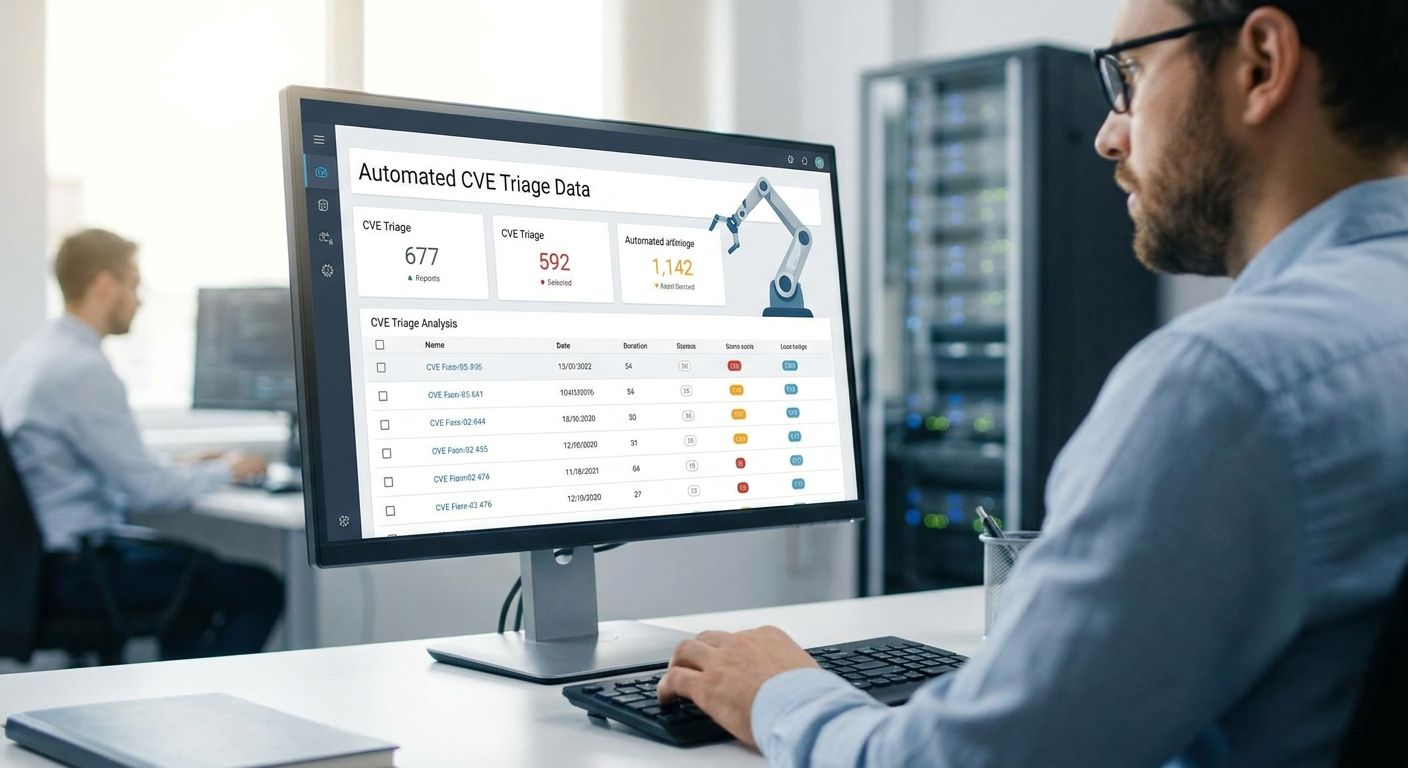
Automating CVE triage at scale means building a pipeline that ingests every vulnerability feed automatically, scores each finding with more than a raw CVSS number, routes it to the right owner with a deadline attached, and tunes itself as remediation data comes back in. Skip any one of those four steps and "automation" just becomes a faster way to generate a spreadsheet nobody reads. The teams that do this well in 2026 aren't scanning less — they're scoring smarter and routing faster.
- Automating CVE triage at scale requires ingestion, layered scoring (CVSS + EPSS + KEV), SLA-based routing, and a feedback loop — not just a scanner with more rules.
- CVSS alone flags too much: a 9.0 score with no known exploit activity often sits behind a 7.0 CVE actively used in attacks.
- CISA's Binding Operational Directive 22-01 gives federal agencies 15 days to remediate KEV-listed vulnerabilities — a useful SLA benchmark for any team.
- Brinqa's exposure management platform correlates CVE data with asset and business context so triage rules fire on risk, not just severity.
Why this matters
CVE volume has outpaced headcount for years. Security teams that still triage by CVSS score alone end up chasing thousands of "Critical" tickets a month, most of which have no known exploit and no path to a real asset. A vulnerability prioritization workflow built for lean teams doesn't try to fix everything — it automates the decision of what gets fixed first, and that decision has to happen in software, not in a weekly meeting.
Manual triage breaks down at scale for a specific reason: CVSS was never designed as a prioritization tool. It measures theoretical severity, not real-world exploitability or business impact. A 9.8 CVSS score on an internal test server with no internet exposure is lower risk than a 7.2 score on an internet-facing asset tied to an active exploitation campaign. Automated triage has to encode that logic, not just sort by number.
How to automate CVE triage at scale
The process breaks into four repeatable stages. Each one is a separate system decision, not a single toggle in a scanner dashboard.
- Ingest and normalize every CVE feed — NVD, vendor advisories, scanner outputs — into one schema so duplicate findings across tools collapse into a single record.
- Score with layered context: CVSS base score, EPSS exploitation probability, CISA KEV catalog status, and asset criticality combined into one risk score.
- Route automatically to the owning team with a deadline attached based on that score, not a manual ticket assignment.
- Feed remediation outcomes back into the scoring model so false-positive patterns and slow-moving rules get corrected over time.
| Stage | What it replaces | Typical failure without automation |
|---|---|---|
| Ingest | Manual CSV exports from each scanner | Duplicate CVEs counted 3-4x across tools |
| Score | CVSS-only sorting | Thousands of "Critical" tickets, no real signal |
| Route | Manual ticket assignment | Findings sit unowned for weeks |
| Feedback | No loop at all | Rules never improve, alert fatigue compounds |
Ingest and normalize CVE data first
Nothing downstream works if the same CVE shows up as three different findings because it came from three different scanners. Consolidating vulnerability data from multiple scanners into one normalized record is the step most teams skip, and it's the reason triage queues look bigger than they actually are. A single asset with five overlapping scan results should produce one prioritized finding, not five.
Score with EPSS and KEV, not CVSS alone
CVSS gives you a severity band: 0.1–3.9 is Low, 4.0–6.9 is Medium, 7.0–8.9 is High, 9.0–10.0 is Critical. That band tells you nothing about whether anyone is actually exploiting the vulnerability right now. EPSS (Exploit Prediction Scoring System) adds a probability score between 0 and 1 estimating the likelihood of exploitation in the next 30 days, and the CISA KEV catalog flags CVEs with confirmed active exploitation. Combine all three and a CVE with a 7.2 CVSS score, high EPSS, and KEV listing should out-triage a 9.6 CVSS score sitting on an air-gapped test box. Prioritizing vulnerabilities with EPSS scoring is the single highest-leverage change most teams can make to an automated triage pipeline in 2026.
Route by SLA, not by inbox
Once a CVE has a combined risk score, routing has to happen without a human picking a ticket queue. Rules should route by asset owner, environment, and deadline simultaneously — a KEV-listed CVE on a production database gets a 15-day SLA (the same window CISA's Binding Operational Directive 22-01 sets for federal agencies), while a Medium-severity finding on a dev box can wait a full quarter.
Why CVE triage speed varies across teams
Not every team automating this process in 2026 gets the same results. The gap usually comes down to a short list of factors:
- Feed count and overlap — teams running four or five scanners without deduplication see triage volume inflated 2-3x over the real number of distinct issues.
- Asset context completeness — a risk score is only as good as the asset inventory feeding it; missing ownership data forces manual routing even after automation is built.
- Scoring model maturity — CVSS-only shops triage far more volume than teams layering EPSS and KEV data in.
- SLA enforcement — automated routing without an enforced deadline just moves the backlog from one queue to another.
- Feedback loop existence — teams with no way to mark false positives keep re-triaging the same noisy CVEs month after month.
“A 9.6 CVSS score with no exploit activity is lower priority than a 7.2 with a KEV listing on an internet-facing asset.”
Related questions
Is CVSS enough for automated CVE triage?
CVSS alone is not enough for automated triage at scale — it measures theoretical severity, not real-world exploitability, so pipelines built on CVSS score alone tend to flag far more "Critical" findings than any team can act on. Pairing CVSS with EPSS and KEV status narrows that list to CVEs with confirmed or probable active exploitation.
How does EPSS improve CVE prioritization?
EPSS improves CVE prioritization by adding a 0-to-1 probability score estimating exploitation likelihood within 30 days, giving automated rules a real-world signal CVSS doesn't provide. A CVE with a high EPSS score and no patch available often needs faster action than a higher-CVSS finding with no exploitation data at all.
What's a realistic SLA for critical CVEs in 2026?
A realistic SLA for critical, actively exploited CVEs mirrors CISA's Binding Operational Directive 22-01: 15 days for KEV-listed vulnerabilities on high-value assets. Lower-risk findings without exploit activity or internet exposure can run on 60- to 90-day cycles without materially increasing risk.
Brinqa's exposure management platform is one option built specifically for this layered scoring model — it correlates CVE, EPSS, and KEV data against asset and business context so triage rules fire on combined risk rather than CVSS alone. That's the mechanism, not the marketing: best for teams that have already automated ingestion and need the scoring layer to catch up to the volume.
See automated CVE triage in action
Walk through how risk-based scoring cuts triage volume.
FAQ
How do you automate CVE triage at scale?
You automate CVE triage at scale by normalizing every scanner feed into one record, scoring each CVE with CVSS plus EPSS and KEV data, routing by SLA automatically, and feeding remediation outcomes back into the model. Skipping the feedback loop is the most common reason automated triage stalls after the first few months.
What's the difference between CVSS and EPSS?
CVSS scores theoretical severity on a 0-to-10 scale based on the vulnerability itself, while EPSS scores the probability of real-world exploitation in the next 30 days on a 0-to-1 scale. Automated triage pipelines that use both catch exploited CVEs that CVSS alone would rank lower.
Is CISA's KEV catalog useful for automated triage rules?
Yes, the CISA KEV catalog flags CVEs with confirmed active exploitation, making it one of the strongest signals for automated triage rules in 2026. A KEV listing should override a lower CVSS score when routing rules decide what gets remediated first.
How much can automation reduce CVE triage volume?
Deduplicating overlapping scanner feeds alone removes duplicate findings that inflate triage queues 2-3x over the real distinct-CVE count, before any scoring logic is even applied. Layering EPSS and KEV data on top typically narrows the 'act now' list to a fraction of the CVSS-only Critical count.
What SLA should critical CVEs get?
Critical, actively exploited CVEs on high-value assets should get a 15-day remediation SLA, matching the window CISA's Binding Operational Directive 22-01 sets for federal agencies. Lower-risk findings without exploit activity can run on longer 60- to 90-day cycles.
Does automated CVE triage replace manual review entirely?
No, automated CVE triage handles the volume and routing decisions, but findings near SLA breach or with conflicting signals still need a human check before closure. The goal is to route the 90% of clear-cut findings automatically so analysts spend their time on the ambiguous 10%.
One last thing
The fastest win in most 2026 triage pipelines isn't a new scoring model — it's deduplication. Teams running multiple scanners routinely find that a third or more of their "backlog" evaporates the moment overlapping findings collapse into single records, before EPSS or KEV logic even touches the queue.