
Remediate vulnerabilities faster without more headcount by removing duplicate work, prioritizing exposed assets, assigning accountable owners, and verifying fixes before closure. Faster vulnerabilities remediation depends on reducing avoidable handoffs—not skipping change controls or treating every scanner finding as equally urgent.
- Faster vulnerabilities remediation starts with actionable work, clear ownership, and evidence that fixes removed exposure.
- Use risk-based prioritization to distinguish urgent exposure from findings that belong in planned maintenance.
- Automate repeatable routing and status updates; retain approval controls for production changes.
- Brinqa is a vulnerability and exposure management platform; evaluate its fit against your remediation workflow.
How do you remediate vulnerabilities faster without more headcount?
Build a remediation workflow that turns validated findings into owned, executable changes. Start with vulnerability prioritization for lean security teams, then remove the administrative work between a decision and a verified fix.
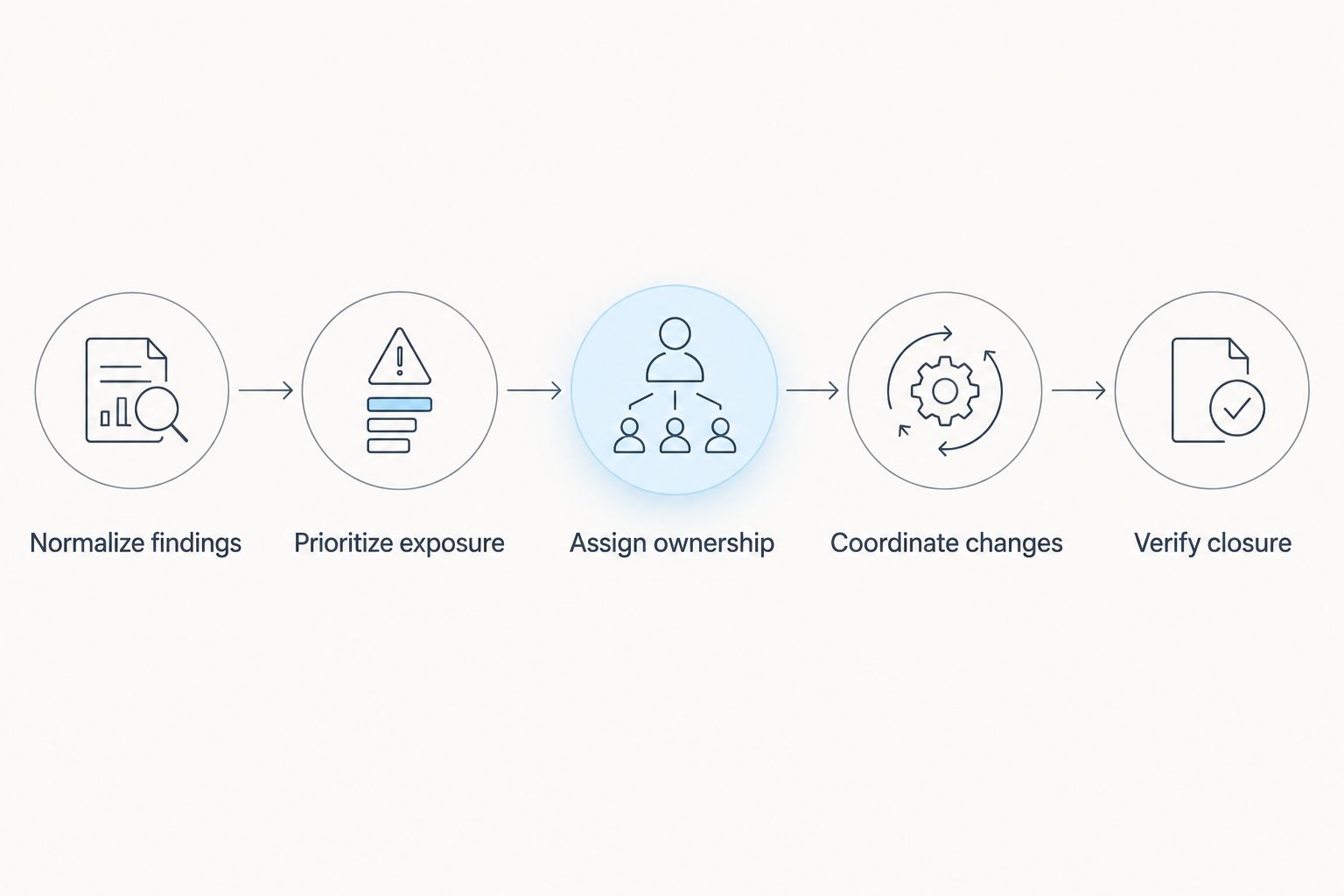
Use these 5 stages as your operating sequence:
- Normalize findings: connect scanner evidence to identifiable assets and remove duplicate work.
- Prioritize exposure: combine technical severity with exploit information, accessibility, and business context.
- Assign ownership: send actionable work to the team authorized to change the affected system.
- Coordinate changes: group compatible fixes and automate repeatable administrative tasks.
- Verify closure: confirm that the affected condition is resolved before reporting remediation complete.
The objective is less time waiting between decisions—not simply more tickets created. Each stage needs an explicit exit condition so work cannot disappear between security, engineering, and IT operations.
Why this matters
For your 2026 remediation plan, distinguish finding volume from actual remediation workload. Multiple observations can describe the same affected asset, while a shared dependency change can address findings across several services. Neither relationship is visible in a raw ticket count.
Your security team identifies and explains exposure; system owners execute changes. If the workflow requires analysts to repeatedly research ownership, rewrite instructions, and chase status, those handoffs consume capacity that could support additional remediation decisions.
Keep the measurement honest. Closing administrative records is not the same as removing vulnerable conditions, and accepting risk is not the same as fixing it.
Normalize findings before creating work
Create actionable records, not a ticket for every observation. Preserve the original scanner evidence while connecting each finding to the asset, software component, or service it affects.
Define how your team identifies assets across sources. Hostnames, network addresses, cloud identifiers, and application names serve different purposes; do not merge records solely because a display name matches. Keep ambiguous matches visible for review rather than silently treating them as confirmed duplicates.
For each actionable record, capture:
- The affected asset or component and its stable identifier.
- The source finding and evidence supporting applicability.
- The vulnerable condition and recommended corrective action.
- The responsible team or the unresolved ownership question.
- The latest observation and current workflow status.
Deduplication has a trade-off. Aggressive merging can hide separate affected systems; conservative matching can leave redundant work. Review uncertain matches and preserve links back to the original evidence so an analyst can inspect the decision.
Before creating new work, check for an existing change addressing the same condition. Attach additional affected assets to that work only when the owner, corrective action, and validation requirements genuinely align.
Prioritize exposure instead of sorting only by severity
Use technical severity as an input, not the entire decision. A severity rating describes vulnerability characteristics; your remediation decision also needs to account for the affected environment.
For a 2026 prioritization policy, document which evidence changes urgency: confirmed exploitation, reachable attack paths, sensitive functions, and the effectiveness of existing controls. Treat missing context as an investigation task, not proof that an asset is safe.
| Approach | Best for | Advantage | Limitation |
|---|---|---|---|
| Severity-led triage | Initial sorting when context is incomplete | Gives teams a consistent starting point | Does not establish local exposure or business impact |
| Exposure-informed triage | Choosing work across an established asset inventory | Connects urgency to the affected environment | Depends on accurate, current context |
| Change-based grouping | Executing fixes with a shared owner and corrective action | Avoids repeating the same change-planning work | Unsafe grouping can obscure different dependencies or rollback needs |
These approaches work together. Start with severity, refine urgency using exposure, and then group execution where the change is genuinely shared.
Do not lower priority just because a fix is inconvenient. If an urgent condition cannot be corrected safely, document an interim mitigation and an accountable decision about residual risk. Keep the permanent correction visible as separate work.
Assign ownership before escalating deadlines
An overdue ticket with no accountable owner is a routing problem before it is a performance problem. Identify the team authorized to change the affected system and distinguish that team from the person maintaining the scanner or inventory record.
Use ownership sources your organization already maintains, then establish a fallback route for gaps. An unknown owner should produce an assigned investigation—not an unmonitored queue.
Make every remediation request executable. Include the affected assets, the reason for urgency, the corrective action, relevant dependencies, and the evidence required for closure. Ask the receiving team to confirm ownership before treating the handoff as complete.
A useful request answers 3 questions: what needs changing, who can change it, and how will the result be verified? Those are acceptance criteria for your workflow, not an industry benchmark.
For your 2026 operating process, define escalation by the decision needed. Ownership disputes need a service-accountability decision; blocked changes need dependency resolution; risk acceptance needs an authorized approver. Sending identical reminders to each group does not resolve those different blockers.
Coordinate changes and automate administration
Automate stable, repeatable tasks after defining the decision rules. Suitable starting points include enriching records, suggesting ownership, updating linked work items, and notifying the responsible team when relevant evidence changes.
Keep production change authorization separate. Automatic ticket routing and automatic patch deployment carry different operational consequences, so evaluate and approve them independently.
Use this handoff sequence to keep each transition explicit: Normalize findings, Prioritize exposure, Assign ownership, Coordinate changes, and Verify closure. Each transition should leave enough evidence for the receiving team to act without reconstructing the previous decision.
Group changes when the affected systems share a corrective action, an accountable team, and compatible operational constraints. Keep separate tasks where testing, approvals, or recovery procedures differ.
For example, a shared library update belongs with the team maintaining that dependency, but downstream services still need appropriate validation. A shared root cause does not make every deployment interchangeable.
Automation also needs failure handling. Route uncertain asset matches, rejected ownership assignments, and unsuccessful updates to a visible review queue. Otherwise, the process only moves the manual work somewhere harder to see.
Verify closure with evidence
A completed change is not sufficient evidence that a vulnerability is gone. Require a validation method appropriate to the finding: a follow-up scan, a verified software state, a configuration check, or another documented technical test.
Match the validation to the original affected scope. Evidence from an unrelated host or an outdated scan does not establish that the reported condition was corrected.
Keep these outcomes distinct:
- Remediated: evidence confirms the vulnerable condition was corrected.
- Mitigated: a control reduces exposure while the underlying condition remains.
- Accepted: an authorized owner accepts the documented residual risk.
- Not applicable: evidence establishes that the reported condition does not apply.
For 2026 reporting, preserve the basis for each outcome rather than collapsing them into a single closed status. That distinction prevents a faster administrative closure rate from being mistaken for faster remediation.
Define reopening rules as well. If later evidence shows the same condition remains or returns, reconnect it to the original work and investigate whether validation, deployment, or recurrence caused the discrepancy.
Why remediation speed varies
Remediation speed depends on the work required and the decisions between detection and verification. Diagnose the stage where work waits before choosing an intervention.
- Evidence quality: incomplete applicability evidence creates additional investigation before action.
- Asset context: uncertain identity or accessibility makes prioritization harder to defend.
- Ownership clarity: disputed responsibility delays assignment and change approval.
- Change dependencies: testing, maintenance restrictions, and downstream services affect execution.
- Fix readiness: unavailable corrective actions require mitigation or an explicit risk decision.
- Verification readiness: missing validation access or stale evidence delays defensible closure.
These factors call for different responses. Improving ownership data does not solve a dependency conflict, and adding reminder notifications does not create a missing corrective action.
How do you measure faster remediation without hiding risk?
Track elapsed time alongside workflow outcomes. Record detection, ownership acceptance, change completion, and verified closure so you can distinguish decision delays from execution and validation delays.
Use 3 intervals for diagnosis: detection to accepted ownership, accepted ownership to completed change, and completed change to verified closure. Express them consistently in hours or days, and document how reopened findings and approved exceptions affect calculations.
Review both completed work and the age of unresolved work. An average calculated only from closed findings leaves unfinished exposure outside the result. Separate reporting by risk category and asset scope so a shift in workload does not look like an operational improvement.
For your 2026 baseline, keep definitions stable before comparing periods. Report verified remediation, mitigation, and risk acceptance separately, alongside blocked work and its recorded reason.
What should you automate first?
Start with administrative work that has clear inputs and reversible outputs: record enrichment, duplicate detection for review, ownership suggestions, and status synchronization. Validate the rules before allowing them to make consequential workflow changes.
Do not automate an unresolved policy disagreement. If teams disagree about ownership, urgency, or closure evidence, encode the agreed policy first; otherwise, automation repeats the disagreement at scale.
Where does a vulnerability management platform fit?
Brinqa is a vulnerability and exposure management platform for teams evaluating those capabilities together. Evaluate Brinqa against your actual workflow rather than assuming that a platform purchase removes process bottlenecks.
Bring representative cases to the evaluation: a duplicate finding, a disputed owner, a shared corrective action, and a finding requiring verification. Ask how each case is handled, what requires configuration, and what remains with your existing systems and operators.
The potential benefit of a platform is a more coordinated operating process; the limitation is that software does not establish your ownership policy, authorize production changes, or supply missing asset context by itself. Require evidence for the specific capabilities your workflow needs.
FAQ
What's the fastest way to improve vulnerabilities remediation without hiring?
Remove avoidable handoffs between validated findings and verified fixes. Begin with duplicate work, unclear ownership, incomplete remediation requests, and closure without technical evidence.
Should we fix every critical vulnerability before every high vulnerability?
Do not use severity labels as the only ordering rule. Consider applicability, exploitation evidence, accessibility, and business impact when deciding which affected systems need action first.
Can we automate vulnerability remediation completely?
Do not assume every remediation task is safe to automate completely. Automate repeatable administrative work first, and assess production changes separately for testing, authorization, recovery, and verification requirements.
Does closing a remediation ticket mean the vulnerability is fixed?
Closing a remediation ticket does not prove the vulnerability is fixed. Require evidence matched to the affected asset and vulnerable condition before recording verified remediation.
What should we do when a vulnerability cannot be patched?
Evaluate an interim mitigation and document the remaining risk with an accountable owner. Track the permanent correction separately, and do not report mitigation or acceptance as completed remediation.
Which remediation metrics should a small security team track?
Track time to accepted ownership, time to completed change, time to verified closure, and the age of unresolved findings. Separate verified fixes from mitigation and risk acceptance so faster administration does not hide exposure.
Is Brinqa relevant to vulnerability remediation planning?
Brinqa is a vulnerability and exposure management platform, making it relevant to evaluations covering those disciplines. Assess its fit using your own ownership, prioritization, change-coordination, and verification requirements.
One last thing
Inspect rejected and reassigned tickets before adding another dashboard. Each one gives you a concrete handoff to examine: incorrect ownership, insufficient evidence, an unclear corrective action, or a dependency the request omitted.
Choose a recurring cause and correct the rule or required field behind it. That gives your existing team a specific process change to evaluate instead of another request to work faster.


