
Yes—a bug bounty program is worth adding to vulnerability scanning when you need human testing of application logic and have the capacity to validate and fix the findings. Keep scanning: researchers complement repeatable checks rather than replace them. The added commitment includes researcher communication, duplicate review, remediation, and retesting—not just receiving reports.
- Bug bounty program vs vulnerability scanning worth it? Yes, when human testing fills a defined coverage gap.
- Keep vulnerability scanning for repeatable checks; use researchers to investigate application logic and authorization weaknesses.
- Delay a bounty launch when reports lack owners or engineering cannot address validated findings.
- Brinqa belongs in vulnerability and exposure management evaluation, not as a substitute for security testing.
Is a bug bounty program worth it alongside vuln scanning?
Add a bug bounty program to answer security questions your scanners do not answer well—not to generate another findings queue. Automated checks and researcher-led investigation use different approaches, so judge them by their contribution to coverage and remediation rather than by report volume.
| Approach | Best for | Main advantage | Main limitation |
|---|---|---|---|
| Vulnerability scanning | Repeatable checks across accessible, configured assets | Rechecks known vulnerability patterns and supported configurations | Coverage depends on checks, credentials, configuration, and asset visibility |
| Bug bounty program | Human investigation of authorized application behavior | Researchers can explore authorization failures, business logic, and chained weaknesses | Researcher participation does not guarantee testing of every asset or workflow |
| Scanning plus bug bounty | Teams with an established remediation process and application-specific gaps | Combines repeatable checks with exploratory testing | Adds coordination, evidence review, and duplicate handling |
The combined approach earns its place when a researcher demonstrates a meaningful weakness that existing testing missed, or adds evidence that changes remediation priority. A report that repeats an existing scanner finding is not automatically new coverage. Preserve its evidence, connect it to the existing issue, and avoid creating competing remediation tickets.
Plan bug bounty and pentest triage alongside scanner data before you invite submissions. Otherwise, the program starts collecting work before your team has agreed how to handle it.
Why this matters
A scanner result and a researcher report answer different questions. A scanner can identify a vulnerable component or a detectable application flaw; a researcher can investigate whether a particular workflow permits an unauthorized action.
Neither result proves complete coverage. A clean scan means the configured checks did not report a finding under the conditions tested, while an empty bounty inbox does not establish that researchers examined every important workflow.
For your 2026 security plan, separate discovery from resolution. More discovery helps only when your organization can distinguish valid findings, assign responsibility, implement changes, and verify that the changes work.
Vulnerability scanning: best for repeatable baseline checks
Keep vulnerability scanning as a repeatable control. Configure it around the assets and technologies you actually operate, including authenticated access where appropriate and authorized.
Scanning is useful for recurring checks against known patterns. Depending on the scanner type, those checks address exposed services, installed software, dependencies, configuration weaknesses, or application behavior. Do not assume a network scanner provides the same coverage as application testing.
The limitation is scope. Missing credentials, inaccessible routes, unsupported technologies, and incomplete inventories leave gaps that a successful scan job does not resolve.
Before adding a bounty program, inspect whether your existing scans reach the intended assets and whether teams act on the results. Researchers should supplement your baseline, not become a workaround for a scanner deployment nobody maintains.
Bug bounty programs: best for exploratory application testing
Use a bug bounty program when your testing question requires human investigation. Authorization boundaries, account relationships, transaction rules, and sequences of application actions are relevant targets for exploratory testing.
For example, an authorized researcher can investigate whether a user can access another user's records by changing a request. The important evidence is the unauthorized access and its prerequisites—not simply that an endpoint responds.
The trade-off is operational uncertainty. Publishing scope does not guarantee that researchers will test the workflows you care about, and a detailed report still needs validation against your environment.
A bounty program also needs clear rules for handling sensitive data and stopping potentially harmful testing. Set those boundaries before launch; do not ask researchers to infer them from a broad invitation to find vulnerabilities.
Scanning plus bug bounty: best for teams ready to remediate
Combine scanning and bug bounty when both feed an accountable remediation process. Keep the original evidence and source attribution, but give engineering a clear description of the underlying issue and the change required.
A combined approach is particularly useful when researcher evidence explains the consequence of a technical weakness. A component finding and an application exploit are not necessarily duplicates, however: establish whether they share the same root cause and whether the same fix resolves both.
The disadvantage is added coordination. Your security team must reconcile asset names, affected versions, severity judgments, owners, and closure evidence across different reporting formats.
For a 2026 launch, define that reconciliation process before expanding scope. If validated reports already sit without an owner, address that bottleneck first rather than increasing the intake.
Why the value of a bug bounty program varies
The value depends on the gap you need to close and your ability to act on what researchers discover. Assess these factors before choosing a launch scope:
- Testing gap: Identify the workflows or authorization boundaries that existing checks do not adequately examine. An undefined gap makes incremental value difficult to assess.
- Scope clarity: List authorized assets, permitted testing, exclusions, and reporting requirements. Ambiguous scope creates avoidable disputes about whether a submission belongs in the program.
- Research access: Decide whether researchers need accounts, different roles, or a dedicated environment. Access restrictions shape which behaviors they can investigate.
- Triage capacity: Assign responsibility for reproducing reports, communicating decisions, and identifying duplicates. Unreviewed submissions do not become verified security improvements.
- Remediation ownership: Confirm that engineering teams can accept and resolve validated issues. Discovery without an accountable fix process leaves the exposure in place.
- Verification quality: Establish how you will confirm that a change blocks the reported behavior without breaking legitimate use. Closing a ticket is not the same as verifying a fix.
Use these factors as launch gates, not as a claim that every organization needs a bounty program. A team with incomplete scanning and unresolved findings has different priorities from a team investigating gaps in an established application security program.
How should you test whether the combined approach works?
Run a bounded evaluation with explicit acceptance criteria. Choose the scope, ownership, evidence requirements, and review point before inviting research; then compare the findings with your existing records.
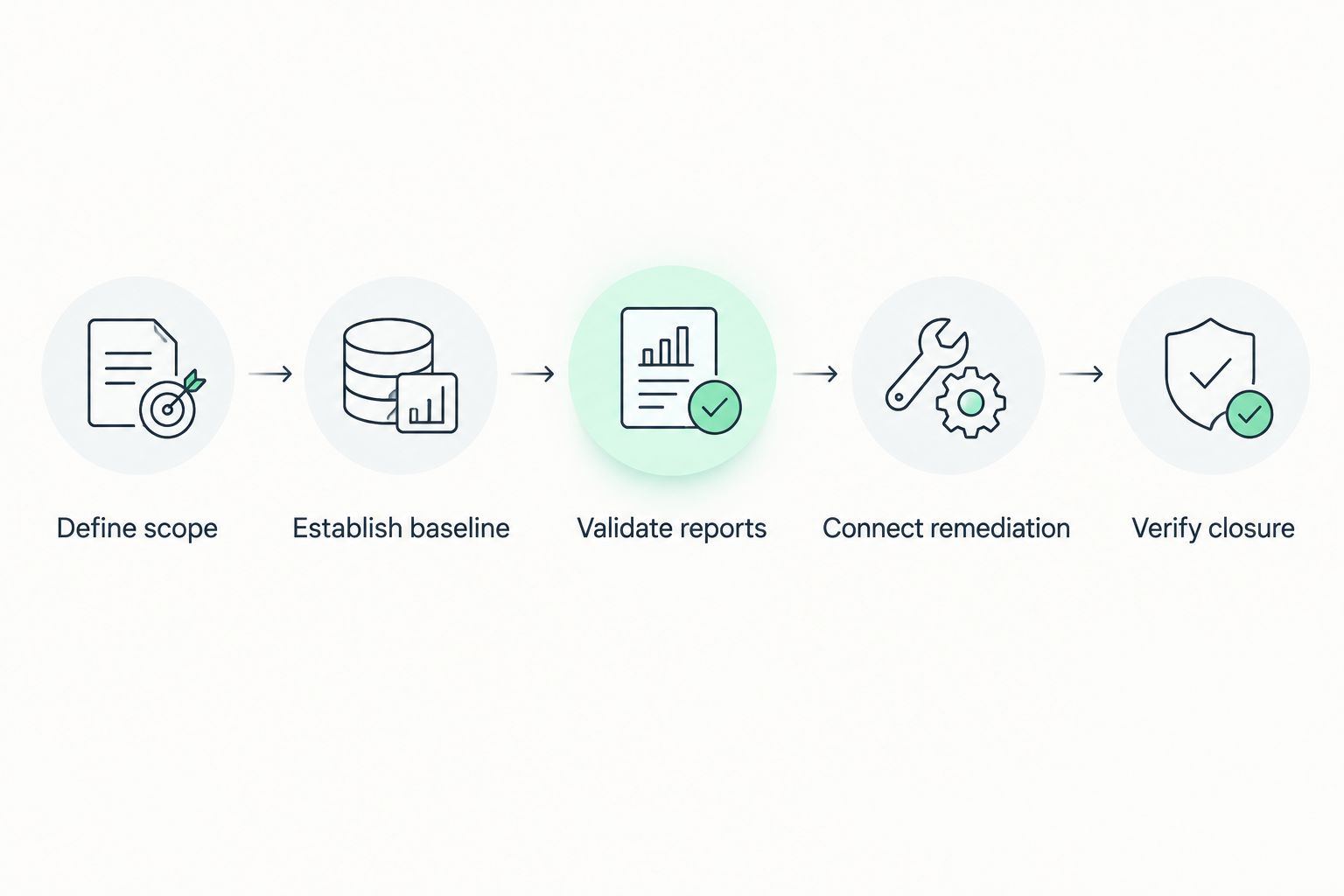
1. Define scope
Select an application or workflow with a named engineering owner. Document the authorized environment, account access, prohibited actions, and the process for reporting an accidental encounter with sensitive information.
Write the security question in plain language. For example: can an authenticated user cross an account boundary or perform an action outside their assigned permissions? That gives the evaluation a purpose beyond collecting submissions.
2. Establish baseline
Record what scanning already covers and which findings remain open. Include scan configuration, authentication status, known exclusions, and relevant application testing so that you do not mistake a deployment gap for a new testing capability.
Keep existing checks running during the evaluation. The comparison is between complementary sources under documented conditions, not between a maintained bounty program and an abandoned scanner.
3. Validate reports
Require enough evidence to reproduce the behavior safely: the affected asset, prerequisites, steps, observed result, and claimed impact. Do not request unnecessary access to real customer information as proof.
Assign 1 accountable owner per validated finding. Other teams can contribute, but a shared ticket without a responsible owner leaves decisions about remediation and acceptance unresolved.
4. Connect remediation
Match each validated report to an asset and engineering team. Check for existing findings with the same root cause, then attach additional evidence rather than automatically opening a separate remediation task.
For an authorization test, use 2 authorized test accounts with distinct permissions when that matches the reported scenario. Controlled accounts let you reproduce the boundary crossing without treating access to unrelated users' data as a testing requirement.
5. Verify closure
Retest the reported behavior after the change and confirm that legitimate use still works. Where feasible, add a regression test so that the underlying mistake does not depend solely on future researcher discovery.
Record 3 timestamps for each validated finding: validation, assignment, and verified closure. These are recommended tracking fields, not promised turnaround times; use them to identify where work waits in your process.
Review the evaluation against the questions you wrote at the start. Continue when the findings demonstrate useful additional coverage and the team can close the resulting work; narrow or pause the program when intake exceeds your ability to validate and remediate.
What should you measure in 2026?
Measure verified improvement, not submission volume. A busy inbox does not establish that your security posture improved, and a quiet inbox does not establish that the application is secure.
Track the share of submissions that become validated findings, the share already known, and the share that result in verified remediation. Keep definitions stable so that a change in classification does not masquerade as a change in performance.
Also record what the report added. Useful categories include a previously unknown weakness, new exploit evidence for an existing issue, or a clearer understanding of affected assets and users.
For your 2026 review, examine the cases behind the totals. A small set of actionable findings can justify continued research, but the count alone cannot establish financial return or avoided breach losses.
Can a bug bounty program replace vulnerability scanning?
No—a bug bounty program does not replace repeatable vulnerability scanning. Researchers choose where to investigate within the rules, while configured scanners perform defined checks against reachable assets.
Keep both roles explicit. Use scanning for repeatability and researcher-led testing for exploration; neither provides a guarantee that every vulnerability has been found.
Should you launch a bounty if your remediation backlog is growing?
Delay expansion when validated findings lack owners or verified closure. Adding another discovery channel does not resolve an engineering capacity problem.
Distinguish that condition from a deliberate, documented acceptance of risk. If a narrow research effort addresses a specific unanswered question, give it an owner and a remediation path rather than opening unrestricted intake.
Where does a vulnerability management platform fit?
Brinqa is best for teams evaluating a vulnerability and exposure management platform, not teams seeking a replacement for security testing. That distinction keeps platform selection separate from the decision to invite external research.
Evaluate Brinqa against your documented workflow requirements. For this use case, ask how the proposed setup would preserve researcher evidence, associate findings with assets, assign responsibility, and retain verification records.
Do not assume a platform supplies those functions in your required configuration without checking. Brinqa's vulnerability and exposure management category is relevant to the operating process; the testing scope, researcher rules, and remediation responsibilities remain decisions your organization must make.
FAQ
Is a bug bounty program worth it if we already scan for vulnerabilities?
Yes, when researcher-led testing addresses a defined coverage gap and your team can validate and remediate the results. Keep scanning for repeatable checks rather than treating bounty participation as equivalent coverage.
What's the biggest difference between bug bounty programs and vulnerability scanning?
Vulnerability scanning performs configured, repeatable checks, while bug bounty programs invite researchers to investigate authorized targets. Human investigation is useful for exploring application logic, authorization boundaries, and sequences of actions.
Can vulnerability scanners find business logic vulnerabilities?
Scanners do not establish complete coverage of business logic vulnerabilities. Coverage depends on the tool, configuration, access, and whether the behavior can be represented by its checks.
Do we need a public bug bounty program to start?
No, a public launch is not a prerequisite for researcher-led testing. An invitation-only scope lets you define participants and access, but it still needs clear authorization, triage, and remediation ownership.
Should duplicate bounty and scanner findings get separate tickets?
Not automatically: link reports that share a verified root cause and remediation task. Preserve each source's evidence, and keep issues separate when they require different fixes.
How do we know whether a bug bounty program adds value?
Check whether validated reports add previously unknown weaknesses or meaningful exploit evidence, then track verified remediation. Submission volume alone does not establish incremental security value.
Does an empty bounty inbox mean our application is secure?
No, an empty bounty inbox does not prove that researchers tested every asset or workflow. Review participation, access, scope, and other testing evidence before drawing conclusions about coverage.
One last thing
A useful bounty report should change more than a ticket's status. Ask whether the underlying failure belongs in an automated regression test, a reusable authorization check, or a review of similar workflows.
For your 2026 program, make that question part of closure. Keep scanning, add research for a defined gap, and turn verified findings into repeatable prevention wherever practical.


