
No—CVSS alone is not enough to prioritize vulnerabilities in 2026. Use it to describe technical severity, then combine exploitation evidence, asset exposure, business impact, and verified controls to decide what to fix first; even a contextualized CVSS score does not replace an accountable remediation decision.
- Is CVSS enough to prioritize vulnerabilities? No: technical severity alone does not establish remediation priority.
- FIRST’s EPSS estimates exploitation probability; CISA’s KEV catalog identifies vulnerabilities known to be exploited.
- Keep CVSS, but add asset exposure, business impact, verified controls, and remediation ownership.
- Brinqa fits teams evaluating vulnerability and exposure management platforms, not teams seeking only a severity reference.
Is CVSS enough to prioritize vulnerabilities in 2026?
CVSS is a severity input, not a complete remediation queue. A vulnerability’s technical characteristics do not establish whether the affected software is deployed, whether an attacker can reach it, or which business service depends on it.
For the probability component, see this guide to prioritizing vulnerabilities with EPSS scoring. Keep probability separate from severity so your team can explain why a finding moved ahead of another.
| Input or approach | Best for | What it contributes | Limitation |
|---|---|---|---|
| CVSS Base score | Comparing technical severity | Standardized vulnerability characteristics and impact | Does not describe your specific deployment or business priorities |
| Contextualized CVSS | Refining technical severity | Threat and Environmental metrics applicable to the assessment | Depends on accurate inputs and still needs operational decisions |
| FIRST EPSS | Estimating near-term exploitation probability | Probability that a published CVE will be exploited in the wild within 30 days | Does not measure business impact or confirm exploitation on your asset |
| CISA KEV catalog | Identifying known exploitation | Evidence that a listed vulnerability has been exploited in the wild | Absence is not evidence that exploitation cannot occur |
| Asset and business context | Choosing remediation order | Deployment, reachability, service importance, and ownership | Requires current inventory and verified relationships |
FIRST’s CVSS Specification Document and User Guide describe severity scoring. FIRST’s EPSS documentation describes exploitation probability, while CISA’s Known Exploited Vulnerabilities catalog documents known exploitation. These sources answer different questions; none independently describes your organization’s complete risk.
Why this matters
When every high-severity finding enters the same urgent queue, engineering still has to choose what happens first. Sorting by CVSS simply moves that decision downstream without supplying the missing evidence.
In your 2026 remediation policy, require a reason for priority beyond the severity label. The reason should connect the finding to an affected asset, an exploitation condition, and a business consequence—or explicitly identify what remains unknown.
Do not turn missing context into a low-risk designation. An unknown owner, uncertain deployment, or unverified network boundary is a validation task, not evidence that the vulnerability is harmless.
What CVSS tells you—and what it does not
FIRST’s CVSS uses a severity scale from 0.0 to 10.0 points. Under its qualitative rating scale, Critical spans 9.0 to 10.0 points; these are severity boundaries, not probabilities of compromise.
A higher Base score describes greater technical severity under the scoring assumptions. It does not automatically mean the affected instance should precede every lower-scoring finding in your environment.
CVSS Base: best for consistent technical comparison
CVSS Base metrics describe intrinsic vulnerability characteristics, including exploitation conditions and technical impact. The benefit is a shared vocabulary: security and engineering can inspect the vector rather than debate an unexplained label.
The limitation is scope. A Base vector does not identify your application owner, confirm an installed component, or establish whether a vulnerable service supports a business-critical process.
Contextualized CVSS: best for adjusting technical assumptions
CVSS v4.0 includes Threat and Environmental metric groups alongside Base metrics. Environmental metrics support adjustments for the assessed environment, including security requirements and modified vulnerability characteristics.
This makes the claim that “CVSS ignores all context” inaccurate. The problem is relying on a generic Base score—or treating any score as the entire decision. Record which metric groups were used before comparing results.
CVSS Supplemental metrics: best for additional context
CVSS v4.0 also provides Supplemental metrics. FIRST specifies that these communicate additional characteristics without changing the final CVSS score.
That distinction matters when designing a queue: information can affect your operational response without appearing in the headline number. Preserve the supporting fields instead of retaining only a score exported from a scanner.
Why vulnerability priority varies
The same CVE can require different responses across different deployments. Use the following factors to explain those differences rather than changing priorities through undocumented analyst judgment.
- Exploitation evidence: Distinguish known exploitation, a public exploit, and a probability estimate. They are different signals, not interchangeable labels.
- Asset exposure: Verify whether the vulnerable service is reachable through the relevant attack path. Internet exposure is relevant, but internal access does not establish safety.
- Business impact: Identify the affected service, sensitive information, operational dependency, and consequence of compromise. Technical impact alone does not supply these details.
- Verified controls: Check whether a control blocks the applicable exploitation condition. Record evidence and limitations instead of assuming that a deployed security product provides protection.
- Remediation conditions: Identify the available fix, affected owner, dependencies, and validation method. A patching constraint changes the response plan; it does not erase the underlying exposure.
For 2026 prioritization reviews, keep these factors visible beside CVSS. A single combined score is easier to sort, but the underlying evidence is what lets an owner challenge or defend the decision.
How should you prioritize vulnerabilities beyond CVSS?
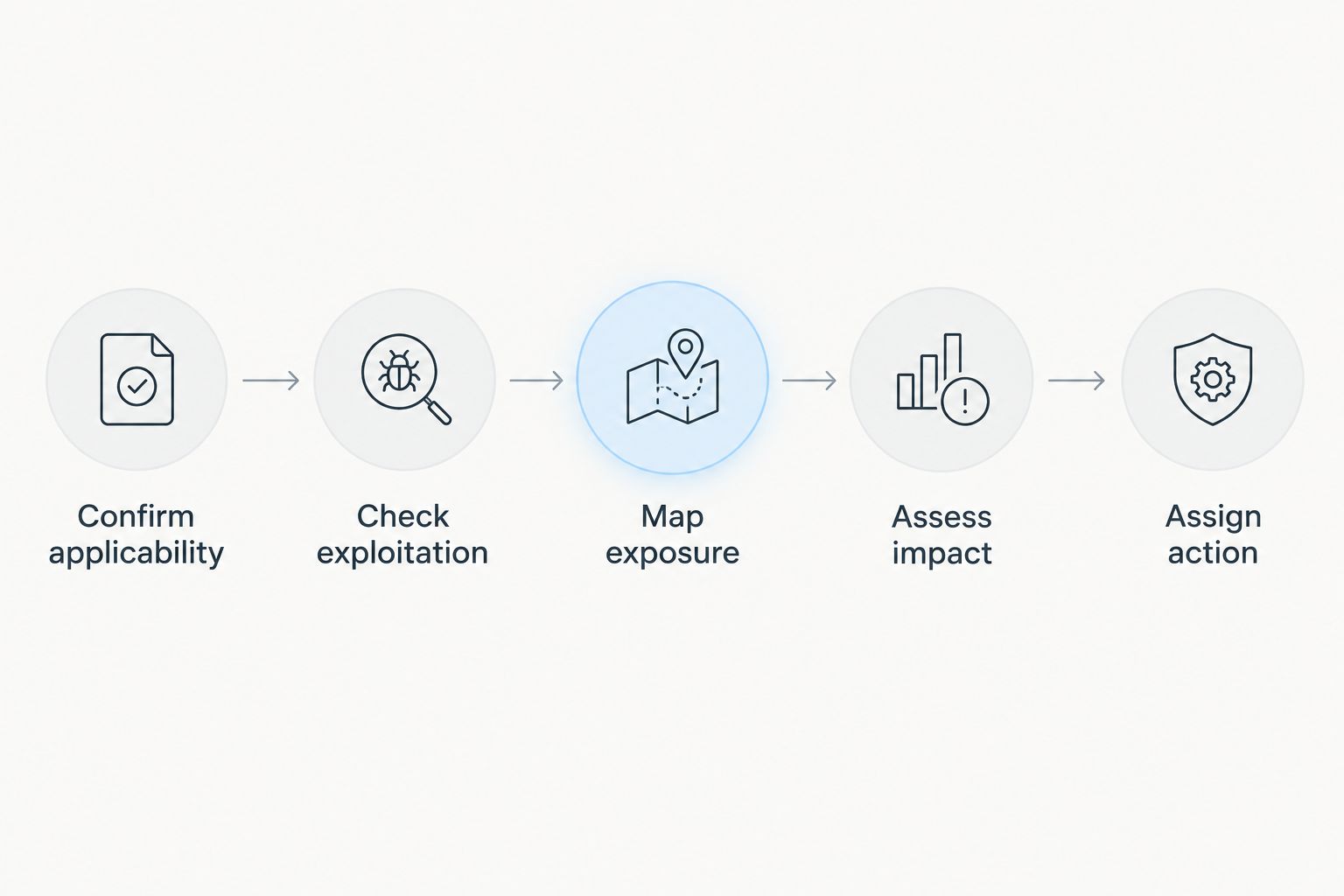
Build a repeatable decision sequence rather than a formula with unexplained weights. The output should name the affected asset, the required action, the accountable owner, and the evidence supporting urgency.
Confirm applicability
Verify the affected product, version, configuration, and deployed instance. A component name in an inventory is a starting point, not proof that every instance meets the advisory’s affected conditions.
Keep the scanner observation and the applicability decision distinct. When they disagree, preserve the reason and supporting evidence rather than silently deleting the finding.
Check exploitation
Check CISA KEV membership, relevant vendor advisories, available exploit information, and the current EPSS estimate. Record when you checked because threat information changes.
EPSS estimates exploitation in the wild over the next 30 days; it does not predict whether your organization will be breached. Known exploitation deserves explicit attention even when another signal appears reassuring.
Map exposure
Establish how an attacker could reach the affected functionality and what access is required. Include relevant application routes, network paths, and authentication conditions rather than relying solely on an asset’s public or private address.
Verify claimed barriers. A segmentation rule that does not cover the vulnerable service is not a reason to defer that finding.
Assess impact
Connect the asset to the business service and the consequence of compromise. Ask the service owner to validate criticality rather than inferring it from a hostname.
Separate technical impact from business impact. The ability to disrupt a component matters differently depending on what depends on that component and what alternatives exist.
Assign action
Choose remediation, a verified temporary mitigation, further investigation, or a documented exception. Assign ownership and a deadline under your policy, then define the evidence required to close the work.
Reassess when exploitation evidence, asset exposure, or deployment changes. A priority decision is valid under its recorded assumptions, not permanently valid because someone approved it once.
Should a lower-CVSS vulnerability ever be fixed first?
Yes—a lower-CVSS vulnerability can deserve earlier remediation when deployment-specific evidence supports that decision. Document the evidence instead of presenting the exception as a contradiction of the severity standard.
Consider an illustrative comparison: a lower-severity vulnerability is known to be exploited and affects a reachable production service, while a higher-severity finding requires a condition your team has verified is absent. The first finding has a stronger case for immediate action despite its lower technical severity.
The comparison reverses if the evidence changes. If the supposedly absent condition becomes present, or the reachable service is removed, reassess both findings rather than preserving yesterday’s order.
Do not generalize this example into “always patch internet-facing assets first.” Internal systems, privileged access, and business dependencies still require examination.
Is EPSS better than CVSS for prioritization?
EPSS’s 30-day exploitation estimate answers a different question from CVSS severity. Use EPSS to inform likelihood and CVSS to describe technical severity; neither supplies your asset’s business impact.
A probability threshold alone creates another incomplete queue. It can exclude consequential findings without explaining applicability, known exploitation, or the conditions on your affected systems.
For your 2026 process, document how EPSS influences decisions and what evidence overrides a threshold. Review the exceptions as carefully as the findings that pass the filter.
Can you ignore vulnerabilities outside CISA KEV?
No—CISA KEV membership is evidence of known exploitation, not a complete boundary around vulnerabilities that matter. A finding outside the catalog still needs applicability, exposure, and impact assessment.
Use catalog inclusion as an explicit escalation signal under your policy. Do not treat non-inclusion as proof of safety or as permission to stop reviewing vendor guidance.
Where a vulnerability and exposure management platform fits
Brinqa is best suited to teams evaluating a vulnerability and exposure management platform. If that is your requirement, assess Brinqa against the decision workflow above rather than assuming that a platform label proves a particular capability.
The benefit of evaluating this category is its fit with a broader exposure-management requirement. The constraint is equally important: buying software does not establish accurate asset ownership, business criticality, or defensible remediation policy.
Ask any vendor to demonstrate how your sample findings become explainable decisions. Require evidence of data freshness, traceable priority changes, exception handling, and closure validation before accepting those capabilities as established.
For a 2026 evaluation, use findings your analysts already understand. Include an ambiguous deployment and a disputed priority so the assessment tests decision quality, not just a clean dashboard demonstration.
FAQ
Is CVSS enough to prioritize vulnerabilities in 2026?
No—CVSS alone is not enough to prioritize vulnerabilities in 2026. Combine severity with exploitation evidence, deployment applicability, asset exposure, business impact, and verified controls.
What does a Critical CVSS score mean?
Critical spans 9.0 to 10.0 points on FIRST’s CVSS qualitative severity scale. The rating describes technical severity, not the probability that your organization will suffer a breach.
Is EPSS a replacement for CVSS?
No—EPSS estimates exploitation probability over the next 30 days, while CVSS describes technical severity. Use both with asset and business context rather than replacing one incomplete decision input with another.
Should every CISA KEV vulnerability be treated as urgent?
An applicable CISA KEV vulnerability deserves explicit escalation because catalog inclusion establishes known exploitation. Set the response using affected assets, exposure, applicable obligations, and your remediation policy.
Can a firewall justify delaying a vulnerability fix?
A firewall supports a deferral decision only when verified rules block the relevant exploitation path. Record the evidence, limitations, responsible owner, and conditions that trigger reassessment.
Does CVSS include environmental context?
Yes—CVSS includes Environmental metrics for adjusting an assessment to the relevant environment. A generic Base score does not contain those adjustments, and contextual scoring still needs an operational response decision.
Is Brinqa a vulnerability scanner or an exposure management platform?
Brinqa describes itself as a vulnerability and exposure management platform. Evaluate the specific capabilities your workflow requires rather than inferring scanning coverage or integrations from that category description.
One last thing
Keep the original CVSS vector when you change remediation priority. Preserve technical severity and record the operational decision separately so an auditor or service owner can understand both.
Before approving your next queue, choose a finding and ask its owner to explain why it comes before the next item. If the only answer is a larger CVSS number, add the missing context before calling the queue risk-based.


