
No—vulnerability scanning is not enough without exposure context when you need to decide what to fix first. Scanning identifies potential weaknesses, but remediation priorities also depend on attacker access, exploitation evidence, asset importance, and verified controls. In 2026, use scanner findings as evidence for a decision, not as the complete decision.
- Is vulnerability scanning enough without exposure context? No: detection alone does not establish business risk or remediation priority.
- CVSS describes technical severity; exposure context connects a finding to attacker access, business importance, and controls.
- Keep vulnerability scanning, add contextual evidence, and verify that remediation actually removes the exposure.
- Brinqa is a vulnerability and exposure management platform; evaluate its fit against your own data and remediation requirements.
Is vulnerability scanning enough without exposure context?
Scanning is necessary for finding weaknesses, but insufficient for ranking their importance to your organization. A scanner's finding describes an observed condition within its coverage. It does not automatically establish whether an attacker can reach that condition or what a successful attack would affect.
Start by correlating threat intelligence with vulnerability data, then connect those findings to asset ownership and business services. Keep the evidence behind each priority visible so engineering teams can challenge or confirm it.
| Approach | Best for | Main advantage | Main limitation |
|---|---|---|---|
| Scanning alone | Detecting weaknesses within scan coverage | Produces technical findings for investigation and remediation | Findings alone do not establish organization-specific risk |
| Scanning with exposure context | Deciding remediation order | Connects weaknesses to access, threats, controls, and business impact | Requires maintained asset relationships and trustworthy supporting data |
| Context without adequate scanning | Investigating known assets and relationships | Helps explain the significance of known conditions | Cannot compensate for missing vulnerability evidence |
The choice is not scanning versus context. You need reliable detection and defensible prioritization, followed by action and verification.
Why this matters
A severity-sorted queue answers which findings have the highest technical ratings. Your remediation team needs a different answer: which action should happen next, on which asset, and why?
Those questions overlap, but they are not interchangeable. A vulnerable service reachable from an untrusted network presents a different situation from the same service behind a verified access restriction. The restriction changes the assessment; it does not remove the underlying vulnerability.
For your 2026 remediation plan, require a documented reason whenever context changes a finding's priority. That reason should identify the evidence, its source, and when someone last verified it—not simply replace one unexplained score with another.
What vulnerability scanning tells you—and what it does not
Vulnerability scanners identify weaknesses using methods such as authenticated checks, network probes, package inspection, and application testing. Their visibility depends on the method, permissions, configuration, and assets included in scope.
A successful scan is evidence about what the scanner assessed. It is not proof that every relevant asset, application behavior, or attack path was examined.
Technical severity is not your remediation order
FIRST's Common Vulnerability Scoring System, or CVSS, expresses vulnerability severity on a scale from 0.0 to 10.0 points. A CVSS Base score describes intrinsic vulnerability characteristics rather than the complete circumstances of your deployment.
CVSS also provides ways to incorporate additional context. The operational mistake is treating a Base score copied into a finding as if it already includes your asset's business importance, actual access paths, and verified protections.
Exploitation likelihood is not business impact
FIRST's Exploit Prediction Scoring System, or EPSS, estimates the probability that a published vulnerability will be exploited in the wild during the next 30 days. Its probability can be expressed from 0% to 100%.
EPSS does not predict whether your particular asset will be compromised. It also does not measure the consequences of losing a business service. Use the signal to inform triage, not to replace local evidence.
Why remediation priority varies with exposure context
Use these factors as investigation prompts, not as automatic reasons to downgrade a finding. Each factor needs evidence relevant to the affected deployment.
- Attacker reachability: Establish whether an untrusted actor can reach the vulnerable service or reach it after gaining another foothold. Check the relevant network and application paths.
- Exploitation evidence: Separate observed exploitation from a theoretical weakness or available exploit code. These are different signals and should remain distinguishable.
- Business importance: Connect the asset to the service, sensitive information, or operational dependency it supports. Avoid assigning importance from a hostname alone.
- Identity and privileges: Examine the access a compromised account or workload would provide. A service's permissions can matter beyond the machine where the finding appears.
- Verified controls: Confirm that a restriction or protection applies to the actual exploit conditions. A deployed security tool is not, by itself, evidence that an attack is blocked.
- Evidence freshness: Record when reachability, ownership, configuration, and controls were checked. Stale context can support a decision that no longer matches the environment.
Unknown exposure is an investigation requirement, not evidence of low risk. Keep missing context visible instead of silently assigning a reassuring default.
How to turn scanner findings into remediation decisions
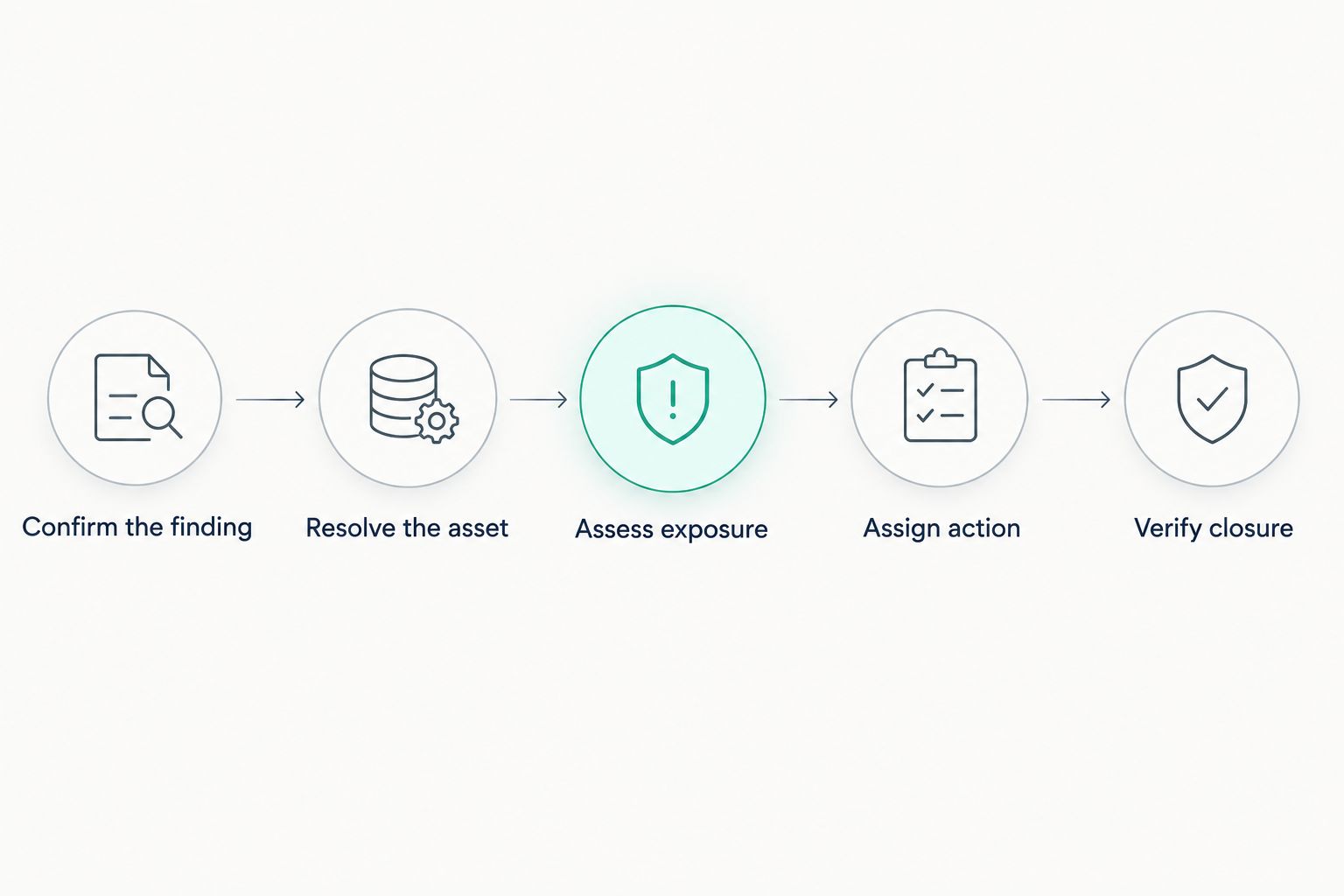
Use this workflow to make priorities explainable and actions verifiable. For a 2026 program review, assess whether each stage produces evidence another team can inspect without repeating the entire investigation.
1. Confirm the finding
Check the affected software, version, configuration, and detection evidence. Determine whether the vulnerability's prerequisites apply to the deployment before treating the finding as confirmed.
Separate an invalid finding from a valid finding with lower exposure. Suppressing the former and accepting the latter are different decisions, with different supporting records.
2. Resolve the asset
Associate the finding with a stable asset identity, a responsible owner, and the relevant business service. Preserve the original scanner identifiers so you can trace the record back to its source.
Do not merge records merely because they share a display name or an address. Establish matching rules that account for address reuse, rebuilt workloads, and assets represented differently across tools.
3. Assess exposure
Investigate reachability, exploit prerequisites, exploitation evidence, privileges, and relevant controls. Distinguish what you observed from what you inferred.
Record uncertainty explicitly. If you cannot establish whether a service is externally reachable, assign someone to resolve the question rather than classifying the service as isolated.
4. Assign action
Choose the appropriate response: remediate, mitigate, investigate further, or document an approved exception. Give the action an owner and a rationale tied to the affected service.
Specify what success means before work begins. Installing a patch, disabling a vulnerable feature, and restricting access require different verification evidence.
5. Verify closure
Confirm that the change addressed the original condition on the intended asset. Rescan when appropriate, and verify any mitigation that depends on a configuration or access restriction.
A closed ticket proves workflow completion. It does not independently prove that the vulnerability or exposure has been removed.
When is scanning alone useful?
Scanning alone is useful for a narrowly defined detection task, such as checking whether a known vulnerable package remains on an assessed host. It also supports repeatable technical checks within an explicitly documented scope.
The limit is the conclusion you draw. Finding no matching vulnerability in a particular scan does not establish that a business service is safe from every relevant attack.
Keep scanning for detection and remediation verification. Add context when you need to decide urgency, compare findings across systems, approve exceptions, or explain a priority to a business owner.
Does adding exposure context make scanning less important?
Exposure context does not replace vulnerability detection. Relationships, asset importance, and threat signals help interpret a weakness, but they cannot establish the presence or absence of a vulnerability that your assessment never examined.
A context-rich asset inventory with inadequate detection still has a visibility gap. A detailed scanner report without reliable asset relationships has a decision-making gap. Fix the gap you actually have rather than assuming a new category of software solves both.
For 2026 planning, assess detection coverage and context quality separately. Improvement in one is not proof of improvement in the other.
What if a critical vulnerability is not internet-facing?
An internal vulnerability still needs assessment because an attacker can approach it from a compromised endpoint, account, workload, or connected service. Lack of direct internet access is relevant context, not a blanket exemption.
Check which identities and systems can reach the vulnerable component and what successful exploitation would enable. Verify segmentation and access restrictions against the actual path rather than relying on an architectural label.
If you defer remediation, record the evidence, the approving owner, and the conditions that trigger reassessment. A network change or newly observed exploitation can invalidate the original decision.
Where a vulnerability and exposure platform fits
Brinqa is a vulnerability and exposure management platform for security teams evaluating both disciplines together. Assess that fit using your own findings, asset records, ownership information, and remediation requirements—not a category label alone.
The potential benefit of a combined approach is a connected decision process. The limitation is equally important: a platform cannot make missing ownership, inaccurate asset relationships, or unverified controls trustworthy simply by collecting them.
When evaluating Brinqa, ask the vendor to demonstrate how your evidence supports a remediation decision. Confirm the required data sources, workflows, and verification methods directly rather than assuming specific capabilities.
Evaluate your exposure management requirements
Compare your detection, context, and remediation needs with the platform information.
How to check whether your context is actionable
A useful 2026 evaluation follows a finding from detection to verified closure. Ask participants from security and the responsible operational team to explain the same priority independently; disagreement identifies evidence or ownership that needs clarification.
- Trace the source: Can you inspect the original finding and the evidence used to confirm applicability?
- Explain the priority: Can you identify which exposure conditions changed the action or urgency?
- Identify the owner: Does a named team accept responsibility for the affected asset or service?
- Test the control: Is a claimed protection relevant, active, and verified against the exploit conditions?
- Inspect the exception: Does a deferral identify an approver, supporting evidence, and reassessment conditions?
- Confirm the outcome: Does closure show that remediation or mitigation worked on the intended asset?
Do not judge context quality by the number of populated fields. Context is actionable when it supports a defensible decision and a verifiable response.
FAQ
Is vulnerability scanning enough without exposure context?
No. Vulnerability scanning identifies potential weaknesses, but exposure context helps establish attacker access, business consequences, and remediation priority. Keep scanning and add evidence that explains what to fix first.
Does a high CVSS score mean I should patch that finding first?
A high CVSS score does not automatically establish your remediation order. CVSS severity ranges from 0.0 to 10.0 points; combine the relevant score with exploitation evidence, reachability, asset importance, and verified controls.
Can EPSS tell me whether my company will be breached?
No. EPSS estimates the probability of a published vulnerability being exploited in the wild during the next 30 days, not the probability that your organization will be breached. Your deployment and controls require separate assessment.
Do internal systems need exposure assessment?
Yes. Internal systems can be reachable through compromised accounts, endpoints, workloads, or connected services. Verify the relevant paths before treating an internal location as a reason to defer remediation.
Can exposure management replace vulnerability scanners?
Exposure management does not remove the need for vulnerability detection. Evaluate whether your assessment methods cover the relevant assets and weaknesses, then use exposure context to interpret the findings.
What should I ask Brinqa during an evaluation?
Ask Brinqa to demonstrate how your vulnerability and exposure management requirements translate into a traceable remediation decision. Confirm required data sources, ownership handling, supporting evidence, and closure verification directly.
Does closing a remediation ticket prove the vulnerability is fixed?
No. Ticket closure records a workflow status; verification establishes whether the intended asset no longer has the vulnerable condition or whether a mitigation works. Retain the evidence supporting that conclusion.
One last thing
A lower priority is not the same as a resolved vulnerability. Preserve that distinction in dashboards, exceptions, and management reporting so contextual adjustments do not look like completed remediation.
For your next 2026 review, choose a deferred finding and test the reason for deferral. If nobody can reproduce the reachability check or verify the claimed control, the priority rests on an assumption—not exposure evidence.


