
Instead of manually sorting Noname Security findings and chasing API owners, build a workflow that matches findings to services, adds business context, and routes evidence-backed remediation tasks. This 2026 guide defines the data contract, priority rules, and closure checks for that workflow without assuming a particular connector or console layout.
- Noname Security findings need service ownership and exposure context before API risk prioritization.
- Evaluate Brinqa for vulnerability and exposure management; verify the required data exchange before implementation.
- Keep source severity separate from remediation priority, and preserve the evidence behind each decision.
- Close findings after verification, not simply because a task was completed.
Why this matters
A source finding and a remediation decision answer different questions. The finding describes a security condition; the decision establishes who must act, why the work matters, and what proves resolution.
Brinqa is a vulnerability and exposure management platform for security teams evaluating centralized risk management. Start with Brinqa when assessing the platform category, then confirm the specific ingestion, mapping, and task-handling requirements described below.
For your 2026 workflow, keep detection evidence separate from business context. That separation lets you change a service's priority without rewriting the original finding or losing the explanation behind an earlier decision.
Before you start
- Source access and a representative extract: Obtain authorized access to the Noname Security data you intend to process. Confirm the supported extraction method, available identifiers, timestamps, status meanings, and permission scope against your deployed documentation.
- Destination access and ownership records: Secure permission to configure your chosen processing system and remediation destination. Prepare a service inventory containing environments, accountable teams, business importance, and approved routing rules.
- Identity and deletion semantics: Establish how findings remain identifiable across updates and how the source represents resolved or removed records. An absent finding is not proof of remediation; incomplete extraction and changed filters must not trigger automatic closure.
Gate implementation on a verified data exchange. Confirm the supported path into Brinqa before designing around a native connector, webhook, scheduled import, or outbound task action. This guide specifies workflow behavior rather than unverified product buttons.
Source intake configuration
The first configuration unit establishes a repeatable intake contract. Preserve the source record so an analyst can trace every normalized field back to its origin.
Define the intake contract
- Select the source scope. Start with one application boundary and its relevant environments. Document exclusions so downstream readers understand what the queue does not cover.
- Choose a supported extraction method. Use the method documented for your deployment. Verify authorization, pagination, filtering, and extraction completeness before scheduling repeat runs.
- Create a mapping specification. Use the suggested destination fields below as your own schema, not as claimed Noname Security or Brinqa interface labels.
- Separate observation from processing. Retain the source observation timestamp and your ingestion timestamp. Do not substitute ingestion time for evidence freshness.
- Protect the payload. Limit collection to what remediation requires. Redact credentials, tokens, personal data, and sensitive request or response content before moving records downstream.
| Suggested destination field | Purpose | Handling rule |
|---|---|---|
source_finding_id | Links updates to the original finding | Preserve the source identifier where supplied |
api_identity | Associates evidence with an API | Retain the source identity and mapping basis |
environment | Separates deployment contexts | Keep unknown environments explicit |
source_severity | Preserves the original assessment | Do not replace it with business priority |
source_observed_at | Records evidence freshness | Preserve timezone information |
source_status | Preserves lifecycle evidence | Translate only through an approved status map |
ingested_at | Records processing time | Generate during intake |
Treat these as destination design choices. Where the source does not supply a required value, mark it unresolved rather than manufacturing a default.
Expected result: You can trace each imported record to its source, distinguish observation time from ingestion time, and identify incomplete records before they enter the remediation queue.
API identity and ownership mapping
API risk prioritization depends on matching the right finding to the right service. A hostname alone does not establish application ownership or distinguish production from testing.
Establish the service match
- Define API identity. Use stable source identifiers where available. Where endpoint attributes are necessary, document how method, host, route, service, and environment contribute to the match.
- Normalize carefully. Separate variable path values from route templates only when the route structure is established. Avoid merging endpoints merely because their URLs look similar.
- Attach service context. Map the API to an application or service record. Record the evidence supporting the relationship, such as an approved inventory entry or confirmed deployment association.
- Assign an accountable team. Use a maintained team record rather than the name of whoever last investigated the finding. Send unmatched ownership to a dedicated triage queue.
- Retain mapping uncertainty. Distinguish confirmed matches from unresolved or conflicting matches. Do not let a guessed association silently determine business importance.
For your 2026 rollout, review mappings with application owners before enabling automatic routing. An incorrect join can send a valid finding to the wrong team while making the workflow appear successful.
Use a recommended pilot of 10 finding records across 3 test cases: a confirmed service match, an unmatched API, and a conflicting ownership record. These are acceptance-test choices, not vendor limits or performance benchmarks.
Expected result: Every pilot finding has either a supported service-and-owner association or an explicit exception requiring review. No record disappears because an ownership lookup failed.
Priority policy configuration
Keep technical severity, business importance, and evidence confidence visible as separate inputs. A single unexplained score makes it difficult for engineering teams to understand why their work moved ahead of another task.
Build the decision rules
- Define priority inputs. Select evidence your organization can support: validated exposure, affected functionality, service importance, data sensitivity, and relevant controls. Keep unknown values distinct from negative findings.
- Write ordered rules. Describe which combinations require immediate review, planned remediation, or further investigation. Have security and service owners approve the policy before applying it broadly.
- Record the explanation. Store the rule identifier, policy version, supporting facts, and evaluation timestamp with each priority decision.
- Create an uncertainty route. Send records lacking decisive context to review rather than automatically assigning the lowest priority.
- Test contradictory inputs. Check how the policy handles high source severity on a lower-impact service and lower source severity affecting important functionality. Review the evidence, not just the resulting order.
A missing exposure value is not evidence that an API is unreachable. Likewise, a control should affect priority only when its applicability to the finding has been established.
The following sequence describes the proposed workflow, not a claim about built-in product functionality.
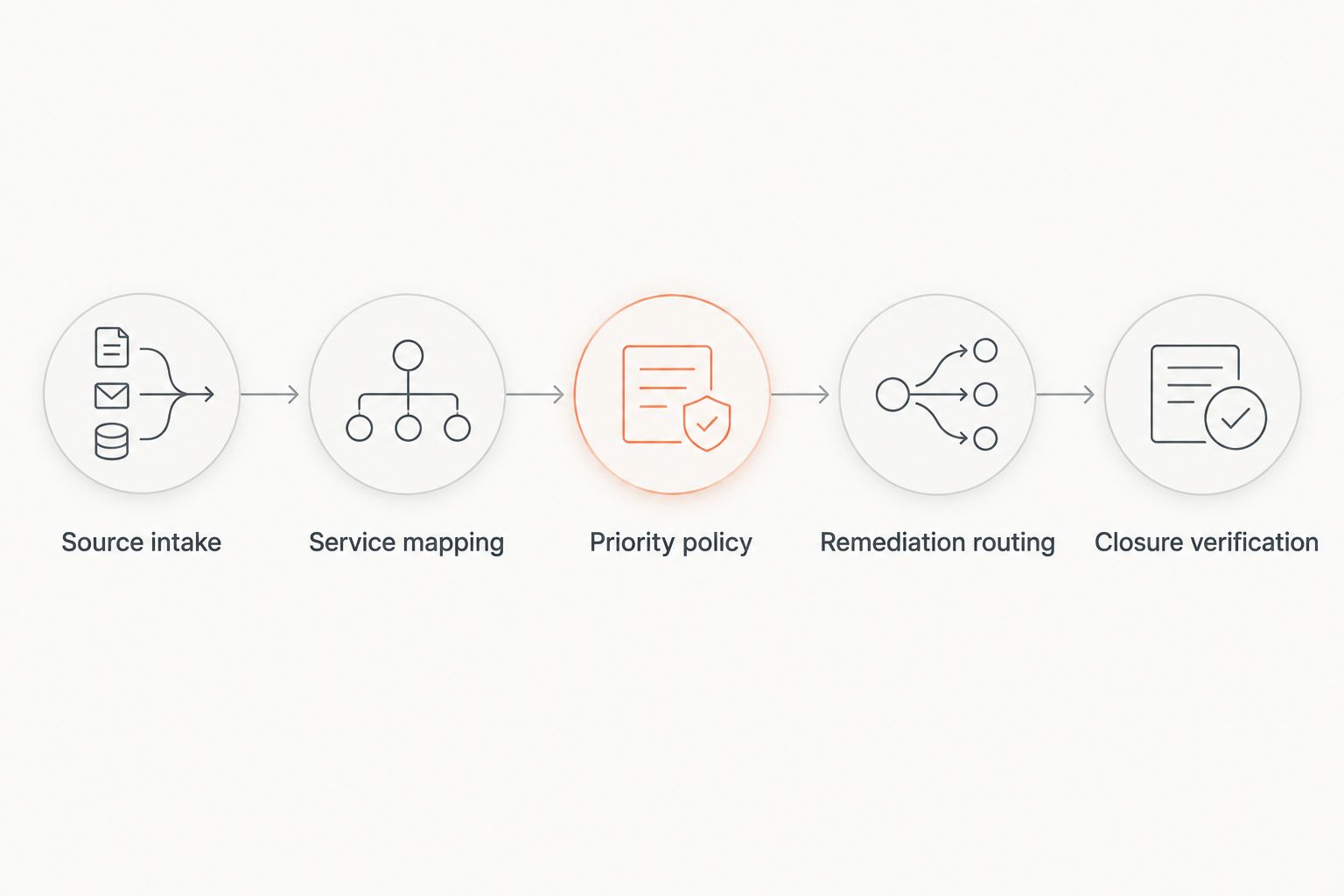
Before approving the 2026 policy, ask an application owner to explain a sample decision using only the stored evidence. If the explanation requires undocumented analyst knowledge, add that context to the decision record.
Expected result: Each prioritized finding has a reproducible explanation. Changing a rule produces a traceable policy change rather than an unexplained reshuffle of the queue.
Remediation routing and closure verification
A remediation task needs enough context for an owner to act without reconstructing the entire investigation. Keep the task actionable while protecting sensitive evidence.
Configure the handoff
- Define task contents. Include the service, environment, finding summary, priority rationale, accountable team, source reference where authorized, and required verification evidence.
- Choose the task identity. Base it on stable finding and service associations. Define how related findings are grouped without erasing their individual lifecycle states.
- Make processing repeat-safe. Update the existing task when the same finding arrives again. Preserve creation history and avoid resetting deadlines merely because intake repeats.
- Separate task completion from resolution. Treat an engineering completion signal as a request for verification. Require a documented retest or other approved evidence before marking the security condition resolved.
- Test the full lifecycle. Run the same pilot through 2 intake runs, then introduce a changed priority, reassigned owner, and verified resolution. Check that updates affect the intended records only.
Use your organization's approved remediation deadlines. Do not copy generic deadlines into the workflow without agreement on severity, business impact, exceptions, and accountability.
Expected result: Repeated intake does not create duplicate work, ownership changes remain visible, and task completion cannot silently substitute for verified risk reduction.
Second variant: Reprioritize when API context changes
New findings are not the only useful trigger. Reevaluate an existing finding when its service importance, exposure evidence, accountable team, or applicable control changes.
| Workflow option | Best for | Advantage | Limitation |
|---|---|---|---|
| Finding-driven evaluation | Teams establishing initial intake | Connects a source change to a remediation decision | Does not capture independent business-context changes |
| Context-driven reevaluation | Teams with maintained service records | Updates priority when the service context changes | Requires reliable relationships and change detection |
For the context-driven variant, identify the affected service, retrieve its open findings, and apply the approved policy again. Update existing tasks and retain the previous decision for comparison.
Use finding-driven intake first, then add context-driven reevaluation after mapping is reliable. This keeps the initial scope testable while extending the workflow beyond source severity changes.
Apply the same repeat-safe behavior to both variants. A context update should not create another remediation task for an unchanged finding.
Troubleshooting
The same finding creates multiple tasks
Check whether the task key contains changing values such as ingestion timestamps or display text. Replace those components with a stable identity and test replay behavior before clearing duplicates.
Keep a documented recovery path for partial failures. If task creation succeeds but recording its identifier fails, the next run must search for the existing task before creating another.
Findings route to the wrong application team
Inspect the service join before changing routing rules. Shared hosts, reused endpoint names, and missing environment distinctions can produce incorrect associations.
Quarantine ambiguous matches and ask the service owner to confirm the relationship. Do not repair a mapping problem by hard-coding an individual analyst as the permanent owner.
Resolved tasks reopen after intake
Compare the source observation time with the verification evidence. Older source data should not silently override a newer decision; conflicting evidence should enter review.
Separate a genuine recurrence from a delayed update. Preserve both observations so the reviewer can establish what changed.
Findings vanish after an import
Check filters, permissions, pagination, and run-completeness checks. A partial import must not be interpreted as a complete inventory of remaining exposure.
Suspend absence-based lifecycle changes until extraction completeness is established. Keep previously open records visible with their last known evidence.
Customize your workflow
Expand your 2026 workflow only after the pilot passes its identity, ownership, replay, and closure tests. Add another application boundary before adding more elaborate scoring logic; that tests whether the design survives different ownership and environment structures.
Document exception ownership, review conditions, and expiration behavior alongside the main policy. A risk acceptance should remain distinguishable from a verified fix.
When evaluating Brinqa for vulnerability and exposure management, use the pilot artifacts as acceptance criteria: a mapping specification, decision history, routing record, and closure evidence. Verify each required capability in the proposed implementation rather than assuming the platform name establishes compatibility.
FAQ
How do I turn Noname Security findings into API risk priorities?
Match findings to services, add supported business and exposure context, and apply an approved priority policy. Preserve the source severity and the evidence behind the resulting remediation decision.
Does this workflow require a native Noname Security connector?
No, the workflow design does not depend on a native connector. Confirm a supported extraction and ingestion path for your deployed systems before implementation.
Can I assume Brinqa supports the exact integration described here?
No. Confirm the source data exchange, destination mapping, task handling, and lifecycle requirements with the proposed implementation before committing to the workflow.
What should I do when an API has no owner?
Route the finding to a dedicated ownership-triage queue. Preserve its evidence and priority inputs while the service relationship is investigated.
Should source severity determine API remediation priority?
Source severity should remain an input rather than the entire decision. Evaluate supported service importance, exposure evidence, affected functionality, and applicable controls alongside it.
When should an API security finding be closed?
Close a finding after approved verification establishes resolution. An engineering task marked complete or a record missing from an incomplete import does not establish that result.
How do I test whether repeated imports create duplicate work?
Replay the same pilot records and check that the existing findings and tasks are updated. Then change ownership and priority inputs to confirm those updates reach the correct records.
One last thing
Replay is the acceptance test that exposes hidden workflow assumptions. Before scaling, deliberately process an unchanged finding again, then process older evidence after newer evidence. Your workflow should preserve identity and send conflicting lifecycle evidence to review rather than silently creating work or reversing a verified decision.


