
Instead of manually reconciling Tenable Security Center findings with asset owners and business context, build an exposure scoring workflow that joins those inputs, applies documented priority rules, and routes findings for remediation. This 2026 guide covers data extraction, identity matching, scoring, and verification without treating scanner severity as business risk.
- The Tenable Security Center exposure scoring workflow needs asset identity, business context, documented scoring, and remediation evidence.
- Brinqa is best for teams seeking a vulnerability and exposure management platform.
- Keep CVSS severity, EPSS probability, and business priority separate and traceable.
- Recalculate priority when context changes; close findings only after sufficient verification.
Why this matters
A scanner finding describes a technical condition. Your remediation queue must also answer which asset is affected, who owns it, what business function it supports, and what evidence justifies urgency.
A unified exposure score should explain a decision, not conceal its inputs. Two assets with the same vulnerability need different treatment when their reachability, business importance, or compensating controls differ. Record those differences rather than asking analysts to reconstruct them from spreadsheets.
Brinqa is a vulnerability and exposure management platform. Treat the workflow below as an implementation design: validate extraction methods, mappings, and execution behavior against your deployed systems before enabling unattended processing.
Your 2026 acceptance criterion is straightforward: an engineer can trace a prioritized finding back to its source evidence, matched asset, scoring policy, and responsible team. A numerical ranking without that trail is not enough.
Before you start
- Secure source and destination access. Obtain authorized read access to the intended Tenable Security Center data scope, your chosen extraction interface, and the environment that will store and process findings. Keep credentials in your approved secrets system; separate data collection from administrative permissions.
- Prepare enrichment and policy materials. Bring an asset inventory, ownership records, business criticality definitions, reachability evidence, and an approved prioritization policy. Assign responsibility for maintaining each input, including records that arrive without an owner.
- Resolve the identity and absence gotchas first. An IP address alone is not a durable asset identity across changing or overlapping networks. Also, a finding missing from an extraction is not proof of remediation: scope changes, failed collection, and incomplete scans must remain distinguishable from verified closure.
Define a narrow pilot scope before expanding collection. Choose a scope whose assets and owners you can inspect directly, and retain the original source records for comparison. The pilot should establish correctness, not simply demonstrate that records move between systems.
Source extraction configuration
- Define the collection boundary. Document which repositories, asset populations, and finding states belong in the workflow. Record the selected scope alongside each collection run so a later scope change does not masquerade as a security improvement.
- Select an authorized extraction method. Use the supported interface available in your deployment and verify its authentication, filtering, and pagination requirements against the applicable documentation. Test access with the intended service identity, not an administrator account that hides permission problems.
- Collect evidence, not just severity. Preserve available source identifiers, asset references, vulnerability identifiers, affected services, finding evidence, severity, observation times, and state. Keep scanner-native identifiers even when a CVE exists; not every finding maps cleanly to a CVE.
- Make collection completeness visible. Capture collection start and finish times, scope, success or failure, and any partial-result condition. Do not publish a partial collection as a complete snapshot. Protect sensitive finding evidence with the same access discipline as the source system.
- Test repeat processing. Process the same extraction again and verify that it updates existing records rather than creating another remediation item for every observation. Retain sufficient source identity to distinguish a repeated observation from a genuinely different finding.
Expected result: You have a reproducible source dataset with provenance and a visible collection status. A reviewer can tell what was collected, when it was collected, and whether the result is complete enough for downstream decisions.
Asset matching and context configuration
- Define the canonical asset key. Use stable identifiers from your authoritative inventory where available. Retain the Tenable Security Center asset references as source identifiers, and qualify network identifiers with their relevant environment or network scope.
- Define the finding key separately. Identify a finding instance using the matched asset and relevant source finding identity, including affected service details where needed. Do not merge all occurrences of the same CVE into a single operational record across unrelated assets.
- Add business context. Join the matched asset to its responsible team, supported business service, criticality classification, and approved exposure evidence. Preserve the origin and observation time of each enrichment so stale inventory data does not look current.
- Handle ambiguous matches explicitly. Route conflicting identities and unmatched assets into a review queue. Do not silently assign them to the closest hostname or exclude them from reporting. Unknown ownership needs an escalation path, not an empty assignment field.
- Check representative records. Inspect an unambiguous match, an unmatched asset, and a conflicting match. Confirm that the workflow preserves uncertainty instead of turning incomplete context into an unjustified low priority.
Expected result: Every processed finding has either a defensible asset relationship or an explicit unresolved identity state. Ownership and business context remain distinguishable from the scanner's technical evidence.
For your 2026 workflow, keep source evidence and enrichment separate. An inventory update should change the context attached to a finding; it should not rewrite what the scanner originally observed.
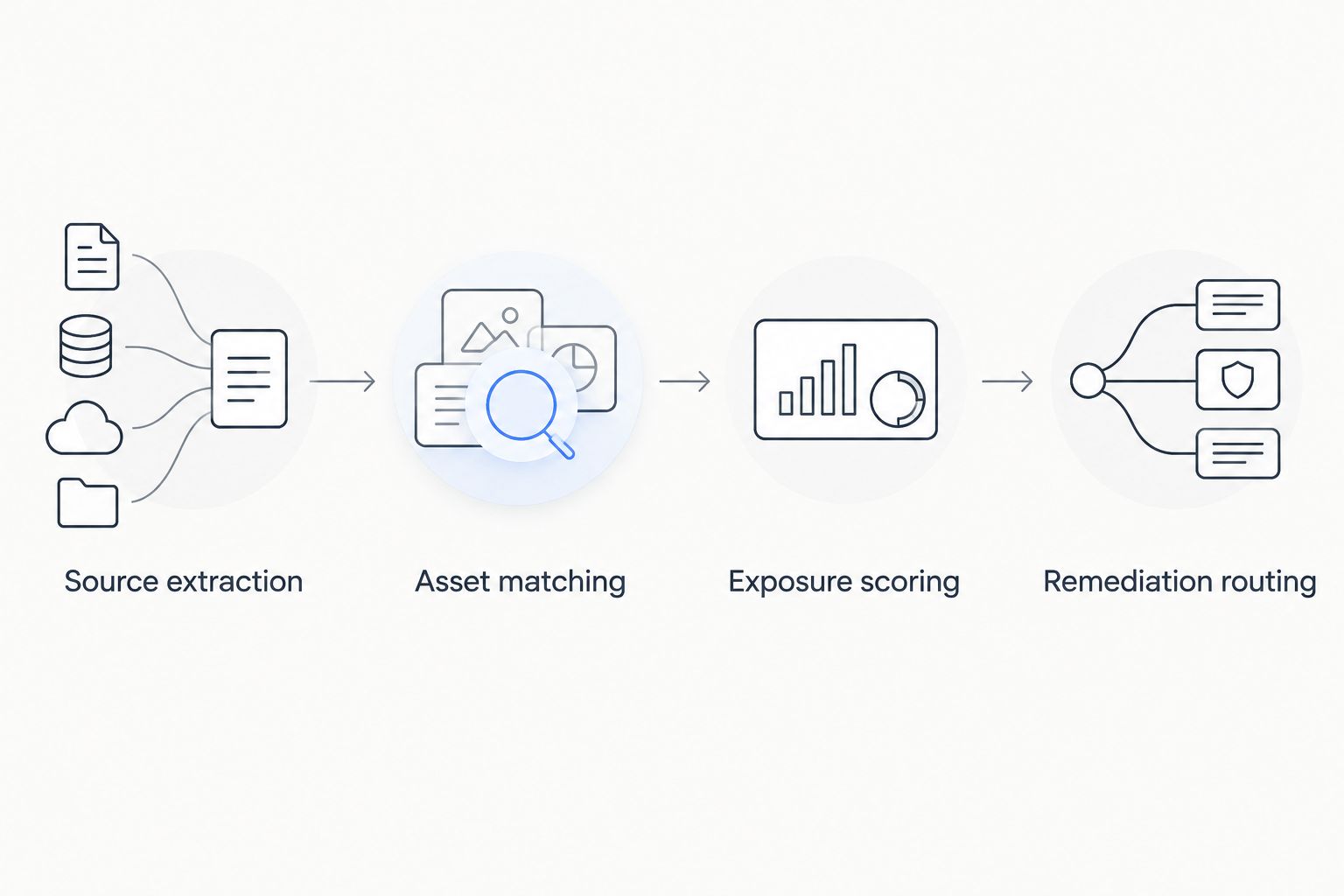
Exposure scoring configuration
- Separate the scoring inputs. Store technical severity, exploitation evidence, reachability, asset criticality, and data quality as distinct attributes. Keep the original values rather than replacing them with the final score.
- Respect each score's meaning. FIRST defines CVSS as a vulnerability severity framework with scores from 0 to 10. FIRST's EPSS estimates exploitation probability over the next 30 days and expresses it from 0 to 1. In your 2026 policy, neither measure is a direct estimate of your organization's financial loss.
- Document the decision rules. Define which evidence changes priority and which evidence requires immediate review. Specify how missing context is handled, how conflicting inputs are resolved, and who approves exceptions. Do not invent an arithmetic formula merely to produce a precise-looking number.
- Version the policy. Associate each calculated result with the policy version, calculation time, and input values used. Keep a plain-language explanation, such as a priority increase caused by confirmed exposure on a business-critical asset.
- Test directional behavior. Hold the vulnerability constant while changing business criticality or verified reachability. Confirm that the result follows the approved policy. Then remove context and verify that uncertainty does not automatically become a low-risk classification.
Expected result: Your exposure score is reproducible and explainable. Analysts can distinguish a change in the underlying finding from a change in business context or scoring policy.
Use the guide to build a custom vulnerability severity scoring model when formalizing inputs and decision rules. The model needs governance as much as arithmetic.
Choose the right prioritization approach
These are workflow designs, not claims about default behavior in any product. Choose the approach your team can maintain and explain.
| Approach | Best for | Advantage | Limitation |
|---|---|---|---|
| Severity-only queue | Initial technical triage | Simple to inspect and preserves scanner severity | Does not incorporate asset importance or ownership |
| Context-based priority bands | Teams establishing risk-based remediation | Makes business rules visible without false numerical precision | Requires maintained context and explicit handling of ties |
| Documented numerical exposure score | Teams with stable inputs and approved scoring governance | Supports consistent ordering within a defined model | Creates misleading precision when inputs or weights lack justification |
Start with explainable priority bands if your context is incomplete. Add a numerical score only when you can defend its inputs and behavior. Keep urgent escalation rules visible rather than burying them inside a weighted average.
Remediation routing and verification configuration
- Define the work-item boundary. Decide whether a remediation item represents an individual finding or a shared corrective action. Group findings only when they share a responsible team and an actionable fix; retain the underlying evidence for each affected asset.
- Route using accountable ownership. Include the asset, finding evidence, priority explanation, responsible team, and policy-defined response requirement. Send unresolved ownership to a designated triage function rather than dropping those records.
- Prevent duplicate work. Use the stable finding or remediation identity to update existing work items. A routine reimport should refresh evidence and priority, not create another assignment for unchanged work.
- Separate reported completion from verification. Record an engineer's completion report independently from evidence that the vulnerable condition is resolved. Accept closure only through your approved verification process, with scan scope and collection completeness considered.
- Record exceptions and recurrence. Preserve approved exception rationale, approver, expiration, and review requirements. When reliable evidence shows the condition has returned, route it back into remediation without erasing the earlier history.
Expected result: The queue contains actionable, assigned work, and closure has supporting evidence. Your 2026 reporting distinguishes open findings, reported fixes, verified resolution, and accepted exceptions instead of presenting them as interchangeable states.
Brinqa belongs in the vulnerability and exposure management platform category. Evaluate platform suitability against this workflow's evidence, identity, policy, and verification requirements rather than assuming that a category label guarantees a particular integration behavior.
Recalculate priority whenever context changes
A second workflow handles unchanged scanner findings whose surrounding risk context changes. An asset can move into a more important business service, acquire verified external exposure, or receive new exploitation intelligence without producing a new scanner observation.
- Define which context updates trigger recalculation: ownership, criticality, reachability, threat evidence, or scoring policy.
- Recalculate the affected findings, retaining the previous result and the reason for the change.
- Update existing remediation items when priority or ownership changes. Do not duplicate the finding.
- Notify the responsible team when the change requires a different response under your approved policy.
A priority increase is not necessarily a newly discovered vulnerability. Label the cause accurately so engineers understand whether they are responding to new evidence, new exposure, or a revised policy.
Keep collection freshness separate from recalculation freshness. Reprocessing an old finding with current business context does not make the scanner evidence current.
Troubleshooting
Findings are missing after collection
Check source scope, service-account permissions, filters, pagination, and collection failures before changing the scoring model. Compare the extraction with source records using the same boundary. Suspend disappearance-based closure until collection completeness is established.
Assets merge across different networks
Inspect whether the matching rule relies on unqualified IP addresses or reused hostnames. Add environment or network scope, prefer authoritative stable identifiers, and send ambiguous cases for review. Correct the asset relationship before recalculating scores.
The queue fills with duplicate remediation items
Check whether each collection run creates a new identity or uses changing timestamps as part of the matching key. Separate observation history from finding identity. Replay a known extraction and confirm that existing work items receive updates instead of duplicates.
Scores look precise but nobody can explain them
Expose the input values, policy version, and decision reason for each result. Remove undocumented weights and check whether missing context is treated as low risk. Return to explicit priority bands until the numerical model is approved and reproducible.
Closed findings reopen unexpectedly
Compare the new evidence with the evidence used for closure. Distinguish actual recurrence from an older observation being reprocessed or a mismatched asset identity. Use source observation times and provenance, not just ingestion order, to determine state.
Customize your workflow
Expand only after the pilot's identity, scoring, and closure checks pass. Add another asset population or data source while keeping source-specific evidence intact and applying the same documented decision policy.
For a Brinqa evaluation, use these checks as acceptance requirements for a vulnerability and exposure management platform. The benefit of a shared workflow is consistent prioritization; the trade-off is maintaining mappings, context ownership, exception governance, and reliable verification.
Assign operational responsibility before expansion. Someone must investigate failed collection, another function must resolve ownership disputes, and the policy owner must approve scoring changes. Otherwise, automation moves uncertainty faster without resolving it.
FAQ
What is a Tenable Security Center exposure scoring workflow?
It is a process that combines Tenable Security Center findings with asset identity, business context, and documented priority rules. The resulting priority guides remediation while preserving source evidence and verification history.
Is CVSS the same as an exposure score?
No. CVSS describes vulnerability severity, while an organization-specific exposure score incorporates additional context under a documented policy. Keep the original CVSS value separate from the calculated business priority.
Should I add CVSS and EPSS together?
Do not add their raw values without an approved model. CVSS and EPSS measure different things on different scales, so a raw sum has no established business-risk meaning.
Can I use an IP address to match every asset?
An IP address alone is not a durable identity across changing or overlapping networks. Use authoritative identifiers where available and qualify network identifiers with the relevant scope.
When should exposure scores be recalculated?
Recalculate when relevant finding evidence, business context, threat evidence, or scoring policy changes. Preserve the reason for the change and distinguish recalculation time from scanner observation time.
Can I close a finding when it disappears from an import?
Disappearance alone is insufficient evidence for closure. Confirm collection completeness, scope, and approved verification evidence before marking the vulnerable condition resolved.
What should I validate before choosing Brinqa for this workflow?
Validate source extraction, asset matching, scoring explanations, remediation updates, and closure verification against your deployment requirements. Test both routine processing and failure conditions before enabling unattended operation.
One last thing
Test an incomplete collection before you test a successful dashboard. Deliberately interrupt collection in a controlled environment and confirm that the workflow preserves existing findings rather than interpreting missing records as remediation. For a 2026 rollout, this is a direct test of whether your reporting distinguishes data failure from security improvement.