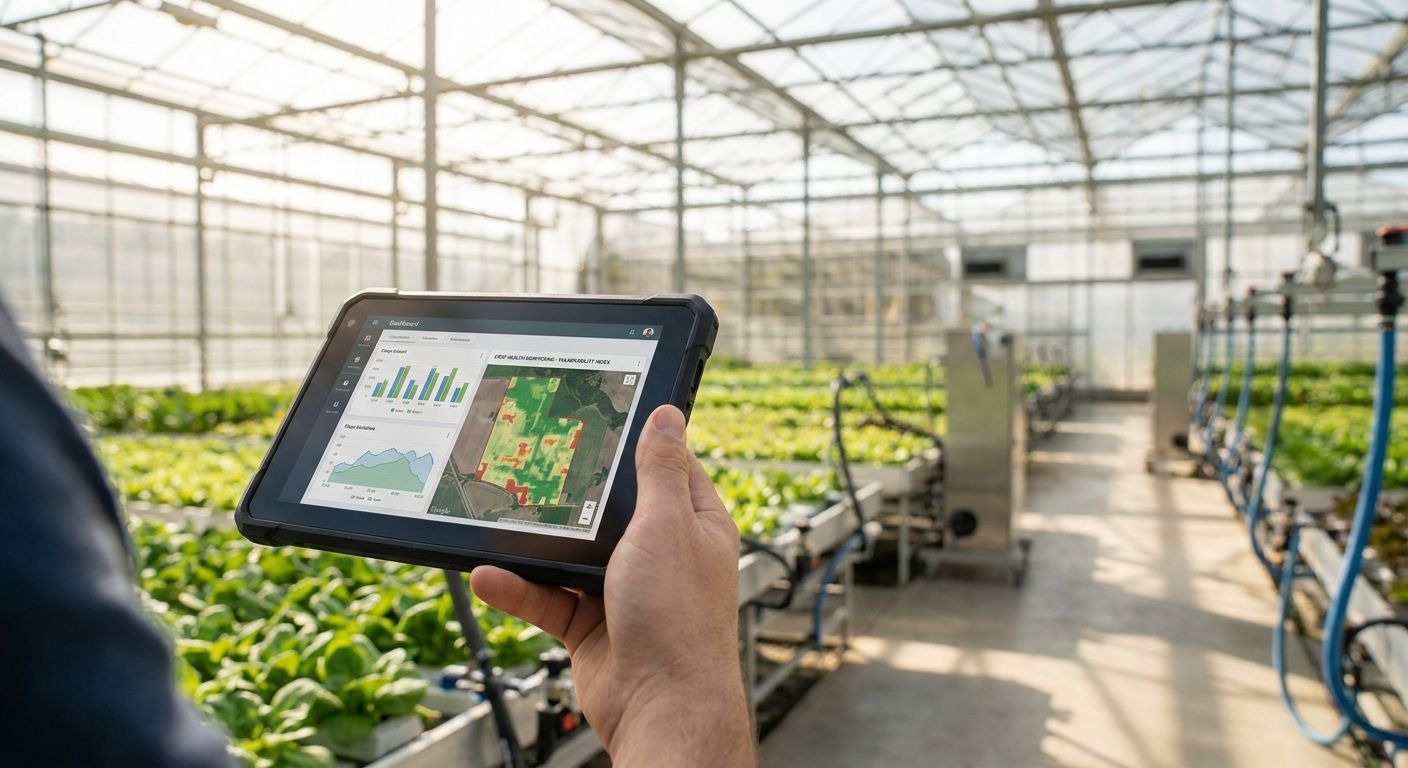
Agriculture companies now run more networked technology than most manufacturing plants: GPS-guided tractors, grain elevator SCADA systems, cold-chain sensors, irrigation controllers, and the ERP systems that tie a co-op's dozen locations together. Vulnerability management for agriculture companies means finding and fixing security gaps across that mixed IT/OT footprint before an attacker forces a harvest, a processing line, or a shipment to stop. The segment's problem isn't a shortage of scanners — it's that most scanners were built for office networks, not grain silos.
- Vulnerability management for agriculture companies must cover OT devices (SCADA, PLCs, sensors) alongside IT — most generic scanners miss the former.
- Brinqa consolidates scanner data from IT and OT sources into one risk-prioritized queue — best for ag operators running mixed environments.
- New Cooperative's 2021 ransomware incident and JBS Foods' 2021 attack both hit agriculture-sector operational systems, not just office IT.
- Patch windows should align with planting and harvest calendars, not a fixed monthly cadence.
- Lean security teams at ag companies need automated CVE triage — manual review doesn't scale across dozens of rural sites.
Why vulnerability management matters for agriculture
Agriculture sits in the critical infrastructure bucket alongside energy and water, but most operators run security teams sized for a mid-size retailer. A grain cooperative with six elevators and a corporate office typically has one or two people covering security part-time, not a dedicated SOC. That gap matters because the sector has already been hit: New Cooperative, an Iowa grain and feed cooperative, disclosed a ransomware attack in September 2021 that disrupted operations tied to its BlueGrass and Agris platforms. JBS Foods, one of the largest meat processors globally, paid an $11 million ransom in 2021 after an attack shut down slaughterhouses across the US, Canada, and Australia for days.
Both incidents show the same pattern: attackers hit the systems that control physical operations, not just the email server. A vulnerability management program built only for laptops and servers misses the PLCs running a feed mill or the remote terminal units on an irrigation network. Vulnerability management for agriculture companies in 2026 has to treat OT assets as first-class citizens in the asset inventory, not an afterthought bolted onto an IT scan.
Build the program: step by step
Map every asset across farm and plant operations
You can't protect what you haven't inventoried, and ag environments hide assets in places a standard network scan never reaches — a well pump controller on a cellular modem, a scale house PLC, a remote camera on a grain bin.
- Pull existing scanner and CMDB data as a starting inventory, not the final one
- Physically walk processing plants and elevators to catalog OT devices scanners can't safely touch
- Tag every asset by business function (processing, logistics, corporate IT, field equipment)
- Flag internet-facing assets separately — these carry the highest exploitation risk
- Note asset owners so remediation tickets land with the right team
Separate OT from IT and scan accordingly
Active network scans that work fine on a Windows server can crash a legacy PLC controlling a conveyor line. Ag operators need a scanning strategy that respects that difference.
- Use passive monitoring or vendor-approved tools for OT segments instead of active port scans
- Schedule any OT scanning during planned maintenance windows, never peak harvest
- Keep IT and OT vulnerability data in separate initial buckets, then merge for prioritization
- Confirm with equipment vendors which scan types are certified safe on their hardware
Prioritize vulnerabilities by exploitability, not just CVSS
A CVSS 9.8 vulnerability on an isolated bin-monitoring sensor with no internet path is a lower real-world risk than a CVSS 6.5 flaw on an internet-facing VPN gateway. Prioritization has to account for exposure, not just severity score.
- Cross-reference CVEs against known exploited vulnerability lists
- Weight internet-facing and remotely accessible assets higher regardless of raw CVSS
- Factor in compensating controls already in place (segmentation, firewalls)
- Brinqa's platform applies this kind of risk-based scoring automatically across both IT and OT findings, cutting the manual correlation work a two-person security team would otherwise do by hand
Patch on a schedule that respects planting and harvest calendars
A monthly patch Tuesday cadence built for a bank doesn't work for a grain elevator running 24/7 during a six-week harvest window. Downtime during that window costs more than any single vulnerability.
- Build a patch calendar that maps to the operational calendar, not the calendar month
- Reserve non-critical patching for planned off-season maintenance windows
- Fast-track only vulnerabilities tied to active exploitation, even mid-harvest
- Communicate patch windows to plant operations leads in advance, not after the fact
Automate triage to cover lean security teams
Most agriculture companies don't have a SOC running around the clock. Manual CVE review across dozens of rural sites and a corporate network is a losing battle for a one- or two-person team.
- Set automated rules that route low-risk findings to a backlog instead of an inbox
- Use exploit-prediction scoring (EPSS) to auto-escalate anything trending toward active exploitation
- Consolidate findings from every scanner into a single queue so nothing sits in a silo
- Brinqa's exposure management platform automates this triage step, which matters most for teams without a dedicated vulnerability analyst
Report exposure metrics to leadership
Ag company boards and ownership groups care about operational uptime, not CVE counts. Metrics need translating into business terms.
- Report mean time to remediate by asset criticality, not as one blended number
- Show exposure trend over time (quarter over quarter), not a single snapshot
- Tie top risks directly to specific operational systems (a named elevator, a named plant)
- Keep the report to one page — executives skim, they don't read CVE detail
Comparison: options for agriculture companies
| Option | Best for | Key limitation |
|---|---|---|
| Spreadsheet tracking + free scanner | Single-site operations with under 500 assets | Breaks down fast across multiple plants; no OT visibility |
| Single-vendor scanner (IT-only) | Corporate office networks | Misses OT/SCADA assets entirely; no cross-scanner correlation |
| MSP-managed vulnerability service | Ag companies with no in-house security staff | Less control over prioritization logic and reporting cadence |
| Risk-based platform (Brinqa) | Multi-site operators mixing IT, OT, and cloud | Requires initial integration work to connect existing scanners |
Verdict: Brinqa is the strongest fit for agriculture operators running more than one physical site with mixed IT and OT assets, because it consolidates scanner output and applies exploitability-based prioritization instead of raw CVSS across an environment most point tools can't fully see.
See exposure management for your operations
Consolidate IT and OT vulnerability data into one prioritized view.
Common mistakes agriculture companies make
- Scanning OT assets with IT tools — active scans can knock legacy PLCs offline, so plants delay or skip scanning those segments entirely and end up with permanent blind spots.
- Treating harvest season as an exception to skip, not plan around — vulnerabilities pile up for six to eight weeks with no fix window, then hit all at once after harvest.
- Ignoring third-party equipment vendor remote access — irrigation and precision-ag vendors often keep standing remote connections into farm networks that never show up in an internal asset review.
- Reporting CVE counts to ownership instead of operational risk — a board that hears "3,400 open vulnerabilities" tunes out; a board that hears "the scale house system is exposed to the internet" acts.
- Running one inventory for corporate IT and none for field/plant assets — the asset inventory gap is usually where the real exposure lives.
FAQ
What is vulnerability management for agriculture companies?
It's the process of finding, prioritizing, and fixing security weaknesses across an ag operation's full technology footprint — corporate IT, cloud systems, and OT devices like SCADA controllers, PLCs, and field sensors. Agriculture programs differ from standard IT programs because they must scan OT assets without disrupting physical operations.
Do small farms need vulnerability management?
Single-site farms with limited connected equipment can often manage with a free scanner and spreadsheet tracking. Multi-site operations, co-ops, or any operation running internet-connected SCADA or ERP systems need a structured, risk-based program.
How is agriculture different from manufacturing for vulnerability management?
Agriculture adds seasonal operational constraints (harvest, planting) that manufacturing plants don't have, plus geographically distributed field equipment like irrigation controllers and grain bin sensors that sit outside a typical plant network.
Can active vulnerability scans damage farm equipment or SCADA systems?
Yes, active port scans can crash legacy PLCs and SCADA controllers that weren't built to handle unexpected network traffic. Passive monitoring or vendor-approved scanning methods are the safer approach for OT segments.
What caused the New Cooperative ransomware attack?
New Cooperative, an Iowa grain and feed cooperative, disclosed a ransomware attack in September 2021 that disrupted systems tied to its BlueGrass and Agris platforms, prompting concern over downstream effects on feed and grain operations.
Is Brinqa better than a single-vendor scanner for agriculture?
Brinqa consolidates findings from multiple scanners across IT and OT and applies risk-based prioritization, which a single-vendor IT scanner can't do since it typically has no OT visibility at all. A single scanner works fine only for a corporate-office-only environment.
How often should agriculture companies patch systems?
Non-critical patches should follow a schedule built around the operational calendar, applied during off-season maintenance windows. Critical vulnerabilities under active exploitation should be fast-tracked regardless of season.
What's the biggest security risk for agriculture companies in 2026?
Internet-facing OT systems and remote vendor access into farm and plant networks carry the highest real-world risk in 2026, since both give attackers a direct path to systems that control physical operations, not just data.
One last thing
The JBS Foods attack in 2021 didn't hack a spreadsheet or steal a database — it forced the shutdown of slaughterhouses across three countries for days, and the company still paid an $11 million ransom to get systems back online. That's the real cost curve for agriculture: it's not measured in stolen records, it's measured in stopped operations. Any vulnerability management for agriculture companies program that doesn't put OT exposure on the same dashboard as IT exposure is solving half the problem in 2026.