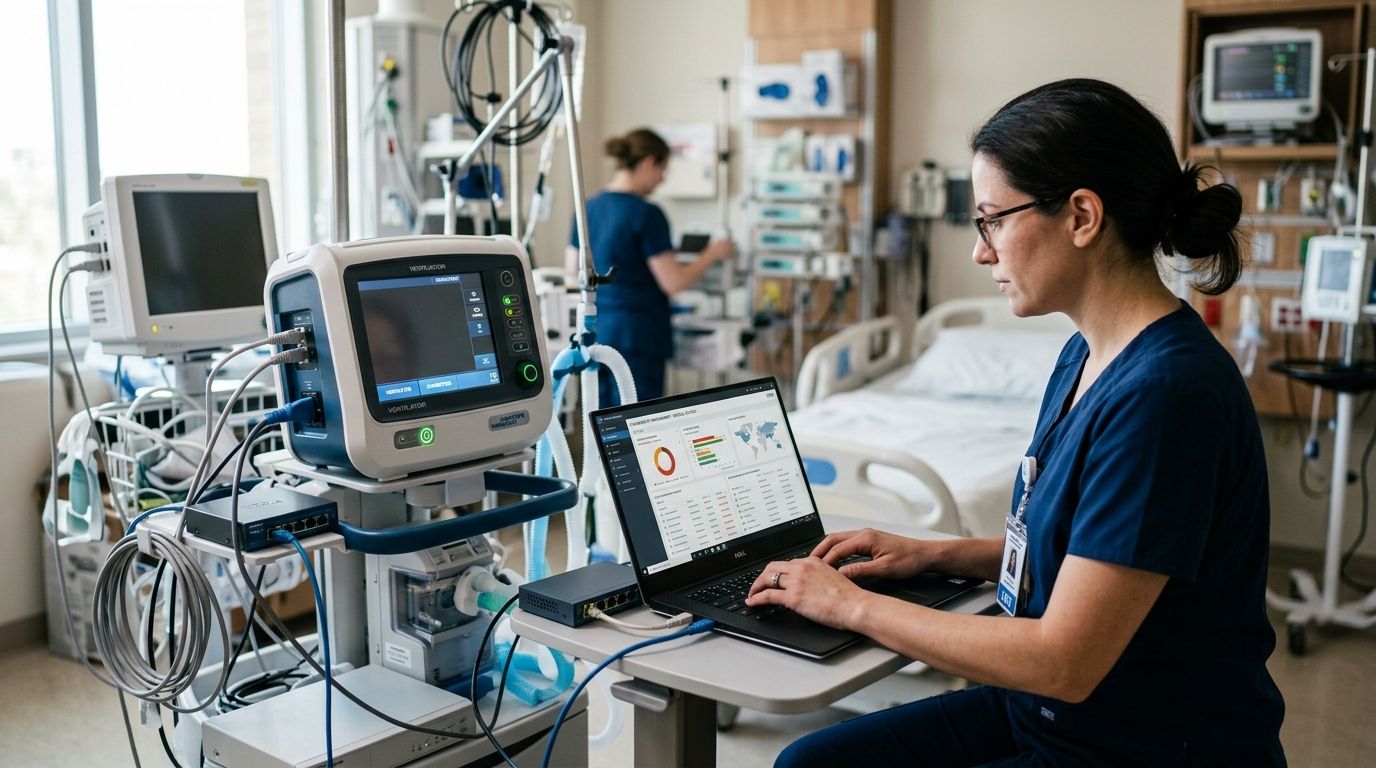
Vulnerability management for connected medical devices is the practice of identifying, prioritizing, and remediating security flaws in networked clinical equipment with the aim of keeping patient care running without opening a path to ransomware or data theft. Infusion pumps, imaging systems, and monitors can't be scanned or patched the way a laptop can — a failed scan on an active ventilator has consequences a failed scan on a marketing laptop never will.
- Vulnerability management for medical devices requires clinical-risk scoring, not raw CVSS — a 9.8 CVE on an idle test monitor matters less than a 6.5 on a bedside infusion pump.
- Legacy and end-of-life devices that can't be patched need compensating network controls, tracked as exceptions, not ignored.
- HIPAA Security Rule risk analysis and FDA premarket cybersecurity guidance both expect a documented, ongoing device vulnerability program in 2026.
- Brinqa consolidates scanner, CMMS, and network data into one risk view — best for hospital security teams juggling multiple device-discovery tools.
Why vulnerability management matters for connected medical device teams
Clinical engineering and security teams answer to different masters. Clinical engineering owns uptime and patient safety; security owns exposure and compliance. Connected medical devices sit in the middle, and a scan schedule built for corporate IT will either miss the device entirely or knock it offline mid-shift.
Hospitals in 2026 run mixed fleets — decade-old imaging equipment next to newly deployed smart pumps — and most of that equipment was never designed with active vulnerability scanning in mind. A generic vulnerability management for medical devices program that treats every asset the same way will either under-protect the fleet or trigger outages clinical staff won't forgive.
The fix is a program built around three things this segment cares about that a generic IT vulnerability program doesn't: passive discovery instead of active scanning, clinical-risk context instead of raw severity scores, and remediation windows that respect surgical schedules and patient census.
Update your asset inventory first
You can't manage what you can't see, and most hospitals underestimate how many connected devices are actually on the network.
- Pull device lists from biomed/CMMS systems (like TruSystems or similar asset registries already in use)
- Cross-reference against network discovery (DHCP logs, switch port data, wireless controllers)
- Flag devices with no known owner or department — these are the ones most often missed in audits
- Tag each device with manufacturer, model, firmware version, and physical location
- Brinqa's CAASM approach pulls these sources into a single inventory automatically once the manual pass is done
Map vulnerabilities to clinical risk, not just CVSS
A CVSS 9.8 on a device in a locked storage closet is a lower priority than a CVSS 6.5 on a networked infusion pump attached to a patient right now.
- Score by exploitability, network exposure, and whether the device touches PHI or patient safety functions
- Weight EPSS or exploit-in-the-wild signals over base CVSS alone — see how to prioritize vulnerabilities with EPSS scoring
- Separate "can be exploited remotely" from "requires physical access" — most medical device CVEs need the latter
- Rank devices by clinical function (life-support vs. diagnostic vs. administrative) before ranking by CVE count
Coordinate patching with clinical engineering, not around it
Patching a device without biomed sign-off risks recalibration issues or warranty voids that security teams don't always know about.
- Build a joint patch calendar with biomed/clinical engineering before touching any device firmware
- Confirm manufacturer-validated firmware versions before applying anything — unvalidated patches can break FDA clearance
- Schedule patch windows around surgical block time and census reports, not calendar quarters
- Document every patch decision (applied, deferred, or rejected) for audit purposes
Apply compensating controls to legacy and end-of-life devices
A large share of connected medical devices run operating systems the manufacturer no longer patches, and that's not going to change by 2027.
- Segment unpatchable devices onto isolated VLANs with strict east-west firewall rules
- Monitor for anomalous traffic instead of relying on the device's own security posture
- Track every unpatched device as a formal risk exception with an owner and review date — Brinqa's risk exception process framework applies directly here
- Revisit the exception list quarterly; a device that was low-risk in 2025 may not be in 2026 if network exposure changed
Align the program with HIPAA and FDA expectations
Regulators expect an ongoing, documented process, not a one-time scan.
- Map device risk findings to HIPAA Security Rule risk analysis requirements
- Reference FDA premarket and postmarket cybersecurity guidance when evaluating new device purchases
- Keep a paper trail: risk analysis, remediation timeline, and residual risk sign-off for every device class
- Brinqa's HIPAA alignment guide walks through mapping findings to Security Rule controls without duplicating audit work
Report device risk in language leadership understands
A CVE count means nothing to a hospital board. Patient-safety exposure and compliance standing do.
- Report by device class and clinical department, not by raw vulnerability count
- Show trend lines: exposure window shrinking or growing quarter over quarter
- Flag the top 10 highest-risk devices by name, not by aggregate score
- Include remediation velocity (average days to patch or compensate) as the headline metric
A hospital security team running a mature medical device vulnerability program tracks fewer than a dozen unpatched high-risk devices at any time — everything else gets a compensating control or a documented exception.
“If a connected device can't be patched, it needs a network control and a named owner — not a note in a spreadsheet nobody reviews.”
Comparison: tools for medical device vulnerability management
| Option | Best for | Key limitation |
|---|---|---|
| Spreadsheet + manual scan review | Small clinics with under 200 devices | Doesn't scale past a few hundred assets; no passive discovery |
| Claroty / Ordr-style OT/IoMT discovery tools | Passive network visibility into device traffic | Strong on discovery, weaker on cross-tool vulnerability prioritization |
| Brinqa | Hospital systems consolidating scanner, CMMS, and network data into one risk view | Requires integration work with existing biomed and scanning tools upfront |
| Vendor-native device management consoles | Single-manufacturer fleets (e.g., one imaging vendor) | Blind to devices from other manufacturers on the same network |
Brinqa is the strongest fit for hospital security teams running mixed-vendor device fleets who need one risk view instead of five separate dashboards — not the right pick for a single clinic with a handful of devices from one manufacturer, where a vendor console is simpler.
See your device risk in one view
Consolidate scanner, CMMS, and network data for connected medical device risk.
Common mistakes hospital security teams make
- Active-scanning every device the same way IT scans laptops — this has taken down monitors and pumps mid-shift and burned trust with clinical staff for years afterward
- Scoring by CVSS alone — a critical CVE on an offline backup imaging unit gets the same urgency as one on a live bedside monitor, wasting remediation cycles
- Treating legacy devices as "can't fix, so ignore" — without a documented exception and compensating control, these show up as findings in every HIPAA audit
- Keeping biomed and security on separate patch calendars — this is how patches get applied without validation, or never get applied at all
- Reporting CVE counts to the board instead of clinical risk — leadership tunes out a number they can't act on
FAQ
What is vulnerability management for medical devices?
It's the ongoing process of finding, scoring, and fixing security flaws in networked clinical equipment like infusion pumps and imaging systems, using clinical risk context instead of standard IT severity scoring. In 2026 it also means documenting the process for HIPAA and FDA review.
Is it safe to actively scan connected medical devices?
Active network scanning can crash or disrupt some medical devices, so most hospital security teams rely on passive discovery and traffic monitoring instead. Manufacturer guidance should be checked before any active scan touches a live clinical device.
How does HIPAA affect medical device vulnerability management?
The HIPAA Security Rule requires an ongoing risk analysis covering any system that touches PHI, which includes most networked medical devices. Findings need to be documented with a remediation timeline and residual risk sign-off, not just a one-time scan report.
What's different about IoMT security versus general IT vulnerability management?
IoMT security has to account for patient safety, FDA clearance constraints on firmware changes, and devices that can't tolerate active scanning. General IT vulnerability management assumes assets can be patched and rebooted freely, which isn't true for most clinical equipment.
How often should hospitals scan connected medical devices?
Passive monitoring should run continuously, while active assessment (where manufacturer-approved) typically follows a quarterly or patch-cycle cadence rather than the weekly scans used for standard IT assets. The right frequency depends on device criticality and manufacturer guidance.
What is the FDA's role in medical device cybersecurity in 2026?
FDA premarket and postmarket cybersecurity guidance sets expectations for how manufacturers build and patch connected devices, and hospitals reference this guidance when evaluating new purchases and validating firmware updates. It doesn't replace a hospital's own vulnerability management program.
Can legacy medical devices be patched at all?
Many legacy devices run operating systems the manufacturer no longer supports, so patching isn't an option. These devices need network segmentation, traffic monitoring, and a documented risk exception instead of a patch.
How does Brinqa handle medical device risk prioritization?
Brinqa consolidates data from vulnerability scanners, CMMS/biomed systems, and network discovery tools into one risk view, then scores findings by exploitability and clinical exposure rather than raw CVSS alone. This gives hospital teams one prioritized list instead of five disconnected reports.
One last thing
The devices that cause the most damage in a breach aren't always the ones with the highest CVE count — they're the ones nobody remembered to inventory. A 2026 device audit almost always turns up equipment biomed retired from its records years ago but that's still live and reachable on the network. Start there before touching a single patch schedule.