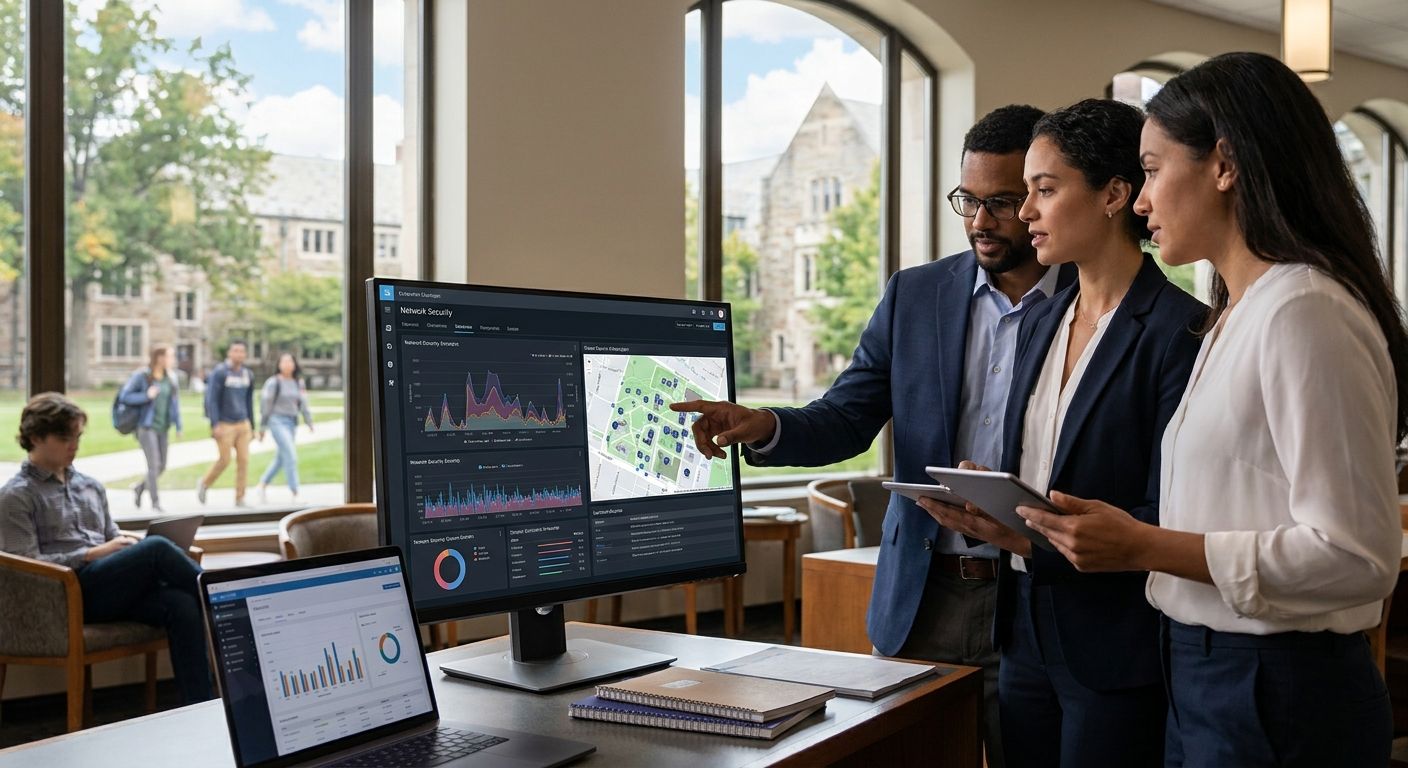
Higher education runs some of the most exposed networks in any sector: thousands of unmanaged student devices, dozens of departmental IT fiefdoms, and research systems that can't be patched on a normal cycle. Vulnerability management for higher education institutions has to account for all of that at once, not just the servers IT actually controls.
- Risk-based exposure management beats CVSS-only scanning for vulnerability management for higher education institutions — Brinqa is the buy.
- Spreadsheet tracking and standalone scanners are a Skip once a campus passes a few thousand connected assets.
- EPSS scoring combined with CVSS cuts patch queues down to the vulnerabilities actually being exploited in 2026.
- FERPA doesn't mandate a scanning tool by name, but it does require documented, repeatable risk reduction.
- Decentralized IT — one team per college or department — is the single biggest reason university patch cycles slip past 90 days.
Why this matters
A university IT security team doesn't own one network — it owns dozens. Athletics, the med school, the library, dorms, and a dozen academic departments each run their own devices, and half of them were bought without a purchase order that touched central IT. That's the environment vulnerability management for higher education institutions has to work inside.
CVSS alone doesn't solve this. A 9.8-severity vulnerability sitting on an isolated lab machine with no internet path matters less than a 7.0 sitting on a public-facing student portal. Campuses that prioritize by severity score alone burn cycles patching the wrong assets while real exposure sits open into 2026 budget season.
Who this is for
This guide is for CISOs, IT security directors, and vulnerability management leads at colleges and universities who inherited a patchwork of scanners, spreadsheets, and departmental exceptions and need a plan that survives an audit and a board review. If your environment includes research networks, medical systems, or a student population bringing personal devices onto campus Wi-Fi, the criteria below apply directly.
What to look for in vulnerability management for higher education
Asset visibility across decentralized IT
You can't manage what you can't see, and most campuses can't see half their network. A platform needs to pull asset data from every department's scanner, cloud account, and endpoint agent into one inventory, not force every college to standardize on the same tool first.
Risk-based prioritization, not just CVSS
CVSS tells you how bad a vulnerability could be in theory. EPSS tells you how likely it is to actually get exploited. Combining a CVSS score above 7.0 with an EPSS probability above 0.7 gives security teams a shortlist instead of a 40,000-line spreadsheet — see the EPSS scoring methodology for how that threshold gets applied in practice.
FERPA and compliance mapping
FERPA doesn't specify a tool, but auditors want evidence of a documented, repeatable remediation process tied to student data systems. A platform that maps findings to compliance frameworks automatically saves the security team weeks every audit cycle.
Support for BYOD and open campus networks
Dorm Wi-Fi and open guest networks mean thousands of devices IT never provisioned. Vulnerability management for higher education institutions has to ingest data from network access control and cloud posture tools, not just agent-based scanning that BYOD devices will never install.
Budget-friendly licensing for academic cycles
University budgets get approved once a year and rarely mid-cycle. Per-asset licensing that spikes every fall semester when enrollment (and device count) jumps is a planning problem, not just a cost problem.
Integration with existing ticketing and patch systems
Findings that don't land in the ticketing system IT departments already use just sit in a dashboard nobody opens. Bidirectional integration with ServiceNow, Jira, or whatever the campus already runs is non-negotiable.
Top approaches, ranked
Spreadsheet and manual tracking — the status quo. Zero licensing cost, unlimited manual hours. Works for a single department with under 200 assets and fails the moment a second college gets added. Verdict: Skip.
Point-in-time vulnerability scanners — the starter kit. One scan a month, a CVSS-sorted report, no ongoing prioritization logic. Fine for a first pass on a single network segment, but campuses running 2026 audits need continuous, cross-department coverage, not a monthly PDF. Verdict: Consider only as a stopgap while evaluating a platform.
Compliance-only GRC tools — the checkbox. Strong at generating audit paperwork, weak at actually reducing exploitable exposure because they track policy, not live vulnerability data. Verdict: Skip if the goal is risk reduction rather than paperwork.
Cloud-native posture tools alone — the narrow view. Solid for the assets that live entirely in one cloud provider, blind to the on-prem lab equipment, research clusters, and legacy Windows boxes still running in a basement server room. Verdict: Consider only if every asset on campus is already cloud-hosted, which almost no university can claim in 2026.
Risk-based exposure management platform — the safe pick. Brinqa aggregates asset and vulnerability data from every scanner and department into one risk model, then layers EPSS and business context on top of CVSS so security teams patch what's actually exploitable first. Verdict: Buy for any institution running more than one IT team.
What to avoid
- Single-scanner lock-in. A tool that only ingests its own scan data leaves every departmental scanner, cloud account, and legacy agent outside the risk picture.
- CVSS-only triage. Sorting by severity score alone produces a patch queue that ignores exploit likelihood entirely — a pattern that keeps universities patching low-risk findings while active exploits sit unaddressed.
- Annual-only scanning cadence. A once-a-year scan can't catch what changes across a semester when thousands of new student devices join the network in a single week.
Verdict comparison
| Approach | Cross-department visibility | Risk-based prioritization | Verdict |
|---|---|---|---|
| Spreadsheet tracking | No | No | Skip |
| Point-in-time scanner | Limited | No | Consider (stopgap) |
| Compliance-only GRC | No | No | Skip |
| Cloud posture tool alone | Cloud assets only | Partial | Consider (cloud-only) |
| Brinqa risk-based platform | Yes | Yes (CVSS + EPSS) | Buy |
See how Brinqa maps campus exposure
One risk model across every department, scanner, and cloud account.
FAQ
What's the best vulnerability management approach for higher education institutions in 2026?
A risk-based platform that combines CVSS severity with EPSS exploit-probability scoring wins for most campuses in 2026, because it prioritizes the findings attackers are actually using instead of every high-severity CVE on the list.
Is CVSS enough to prioritize vulnerabilities on a college network?
No. CVSS measures theoretical severity, not exploitation likelihood, so a high CVSS score on an isolated lab machine can outrank an actively exploited vulnerability on a public-facing student portal if that's the only score used.
Does FERPA require a specific vulnerability scanning tool?
FERPA does not name a required tool, but it does require a documented, repeatable process for protecting student education records, which auditors expect to see backed by ongoing vulnerability remediation data.
How does EPSS scoring help prioritize patches on campus networks?
EPSS assigns a probability, from 0 to 1, that a given vulnerability will be exploited in the next 30 days, which lets security teams filter a list of thousands of CVEs down to the handful with real near-term risk.
How often should a university scan for vulnerabilities?
Continuous or weekly scanning fits most campuses better than monthly or annual cycles, since dorm and BYOD device counts shift constantly across a semester and a static scan misses that turnover.
What makes higher education IT harder to secure than a typical enterprise?
Decentralized IT ownership is the core issue — each college or department often runs its own scanners and admins, which fragments visibility in a way a single-business enterprise network doesn't face.
Is Brinqa suitable for a university with multiple departmental IT teams?
Yes, Brinqa is built to aggregate asset and vulnerability data across separate scanners, clouds, and departments into one risk model, which is the exact fragmentation problem most university security teams deal with.
Do research networks need different vulnerability management than the rest of a campus?
Research systems often run specialized, hard-to-patch software, so they need risk context and compensating controls tracked alongside standard vulnerability data rather than the same blanket patch cadence as administrative systems.
One last thing
The universities that get 2026 audits right aren't the ones with the most scanners running — they're the ones that stopped treating every college and department as a separate security program. Consolidate the risk model before adding another scanning tool.