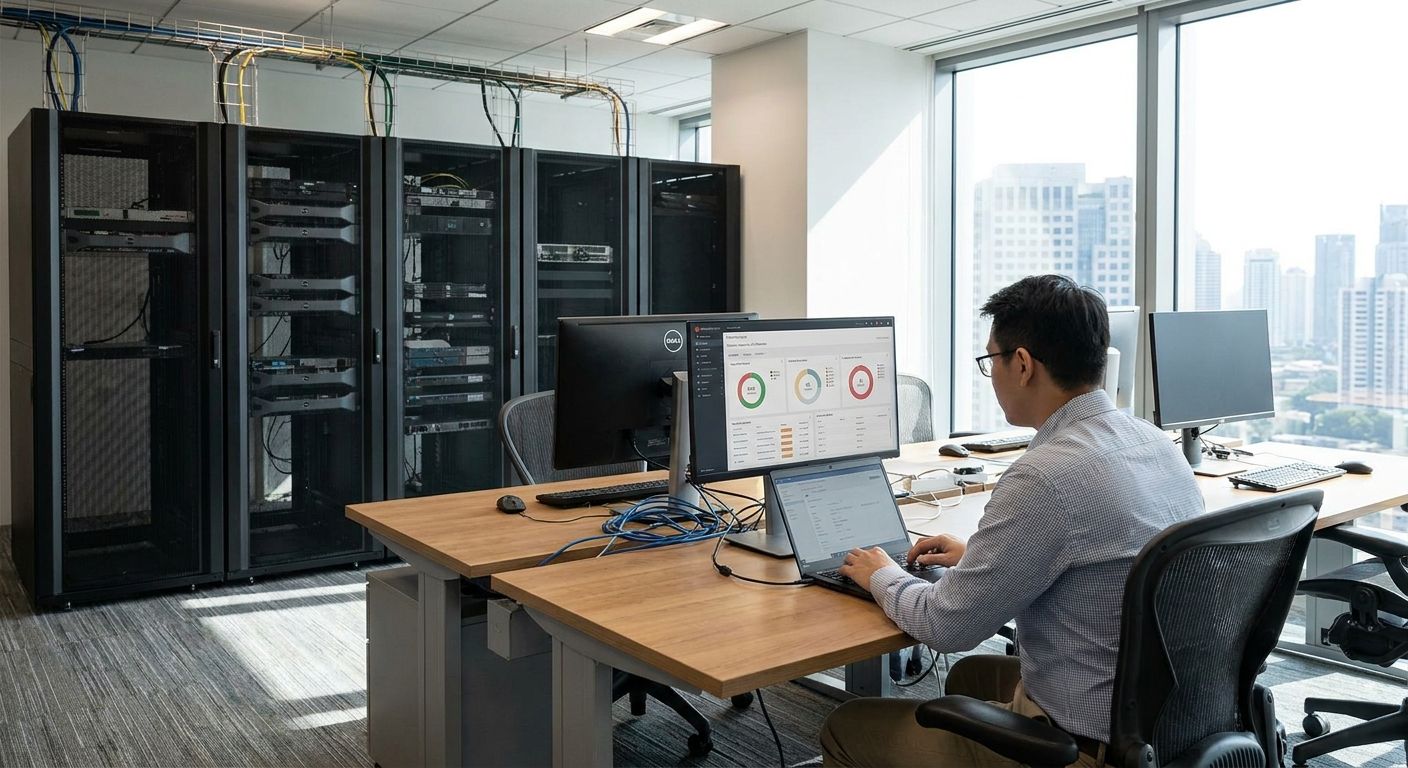
Hybrid IT environments — on-premises data centers, private cloud, and two or more public clouds running side by side — break most vulnerability scanners because no single tool sees the whole attack surface. This guide breaks down what vulnerability management for hybrid IT environments actually requires in 2026, and which capabilities separate a program that closes gaps from one that just generates reports.
- Vulnerability management for hybrid IT environments needs one asset graph across on-prem, multi-cloud, and containers. Buy unified platforms over point tools.
- CVSS-only scanners rank noise as critical in 2026 hybrid stacks. Pair EPSS with CVSS or skip the scanner.
- Kubernetes and container workloads need runtime-aware scanning, not quarterly snapshots. Ephemeral assets disappear before periodic scans catch them.
- Risk-based vulnerability management for SOC teams ties exposure data to active exploitation feeds like the CISA KEV catalog.
Why this matters
A hybrid network doesn't have one perimeter — it has as many perimeters as you have environments. An on-prem scanner can't see a misconfigured S3 bucket, and a cloud security posture tool has no idea what's running on the legacy Windows Server box in the data center. That gap is where attackers live in 2026.
Most security teams run three to five separate scanning tools already and still miss assets, because none of those tools share a common asset inventory. Brinqa builds vulnerability management around one exposure data model that ingests every scanner, cloud API, and CMDB feed into a single graph, so a vulnerability on a container image and a vulnerability on a physical server get scored against the same business context.
Who this is for
This is written for security and IT leaders — CISOs, vulnerability management program owners, SOC managers — running infrastructure that spans at least two of: on-premises data centers, private cloud, public cloud (AWS, Azure, GCP), and containerized or Kubernetes workloads. If your entire footprint sits in one cloud with no legacy systems, a lot of this still applies, but the urgency around unified asset visibility is lower. If you're managing a genuine hybrid estate — the kind with a decade of technical debt sitting next to a 2026 Kubernetes rollout — the criteria below are the ones that actually predict whether a program works.
What to look for in vulnerability management for hybrid IT environments
Unified asset inventory across on-prem and cloud
You can't patch what you can't see, and hybrid networks make blind spots the default rather than the exception. A tool that only ingests cloud-native scanner data will silently drop every on-prem endpoint from its risk picture, and vice versa. The program needs one asset graph that reconciles duplicate entries across scanners — the same server showing up in Qualys, Tenable, and a cloud-native agent should collapse into one record, not three.
Risk-based prioritization, not raw CVSS scores
CVSS measures theoretical severity on a 0-10 scale; it says nothing about whether anyone is actually exploiting a given flaw. EPSS scores that probability on a 0 to 1 scale using real exploitation data, and combining the two cuts remediation queues down to what genuinely matters. A hybrid environment easily generates tens of thousands of open findings — teams that patch by CVSS alone burn cycles on vulnerabilities nobody will ever exploit.
Coverage for ephemeral and container workloads
Containers and Kubernetes pods spin up and die in minutes. A scanning cadence built for physical servers — weekly or quarterly sweeps — misses workloads that no longer exist by the time results come back. Vulnerability management for hybrid IT environments has to treat container images and running clusters as first-class assets, scanned at build time and monitored at runtime, not bolted on as an afterthought.
Business context tied to every finding
A critical vulnerability on an internet-facing payment server is not the same risk as the identical CVE on an isolated test box. Programs that score every finding identically regardless of asset criticality end up either over-alerting or missing the assets that actually matter. Context — data sensitivity, network exposure, compliance scope — has to sit inside the prioritization logic, not in a spreadsheet someone maintains on the side.
Remediation workflows that close the loop
Finding vulnerabilities is the easy part. A program only works if findings route automatically to the right owner — cloud team, infrastructure team, app team — with SLAs tracked and re-verification built in. Manual ticketing across five tools for one hybrid environment is where most programs quietly stall out by month three.
Top picks for hybrid IT vulnerability management
Multi-cloud exposure coverage — the foundation pick. Any hybrid program that spans more than one public cloud needs a single exposure view that normalizes findings from AWS, Azure, and GCP native scanners alongside on-prem data. Exposure management for multi-cloud environments is built specifically to reconcile that data into one prioritized queue instead of three separate cloud consoles. If your team is toggling between cloud-native dashboards to figure out total exposure, this is the gap to close first. Buy if you run workloads across two or more public clouds.
Kubernetes cluster coverage — the modern workload pick. Container orchestration is where scanning cadence breaks down fastest, since pods can live for minutes and clusters scale up and down by the hour. Vulnerability management for Kubernetes clusters tracks cluster and image-level findings continuously rather than on a fixed scan schedule, matching how fast these environments actually change in 2026. Buy if Kubernetes runs any production traffic; Consider if it's still dev-only.
Risk-based prioritization for SOC teams — the operational pick. SOC teams drowning in duplicate alerts from five scanners need one prioritized queue tied to active exploitation signals, not five separate backlogs. Risk-based vulnerability management for SOC teams folds threat intelligence feeds — including known-exploited-vulnerability lists — directly into the scoring so analysts triage against real-world risk instead of theoretical severity. Buy if your SOC currently works from more than one vulnerability queue.
“If a scanner can't see it, it can't be patched — hybrid networks make blind spots the default, not the exception.”
What to avoid
- Point-in-time scanners with no continuous inventory sync. A tool that only refreshes asset data on a scan cycle will report a server as "remediated" long after it's been decommissioned or reconfigured — the data is stale before it's even reviewed.
- Cloud-only or on-prem-only tools sold as "hybrid." Some vendors bolt on a thin cloud connector to an on-prem scanner and call it hybrid coverage. Ask specifically how asset reconciliation works across environments before buying — if the answer is a manual export/import process, it's not unified.
- CVSS-only severity ranking with no exploitability layer. A tool that sorts findings purely by CVSS score will bury actively exploited medium-severity flaws under a pile of theoretical criticals that nobody is targeting.
Verdict comparison
| Approach | Asset visibility | Prioritization method | Remediation workflow | Verdict |
|---|---|---|---|---|
| Legacy on-prem scanner alone | On-prem only | CVSS-only | Manual ticketing | Skip |
| Cloud-native CSPM alone | Cloud only | Native cloud risk scoring | Cloud-native automation | Consider (cloud-only estates) |
| Unified exposure management platform | On-prem + multi-cloud + containers | CVSS + EPSS + threat intel | Automated routing with SLA tracking | Buy |
See how Brinqa unifies hybrid exposure data
One asset graph across on-prem, cloud, and containers, scored by real exploitability.
FAQ
What is vulnerability management for hybrid IT environments?
It's the practice of finding, prioritizing, and remediating vulnerabilities across a mix of on-premises infrastructure and one or more public or private clouds using a single unified process. In 2026, that almost always means reconciling data from multiple scanners into one asset inventory rather than managing each environment separately.
Is a cloud-native tool enough for hybrid environments?
No — a cloud-native tool only sees cloud assets and will have zero visibility into on-premises servers, network devices, or legacy applications. Hybrid environments need a platform that ingests both cloud and on-prem scanner data into one view.
What's the difference between CVSS and EPSS scoring?
CVSS scores theoretical severity on a 0-10 scale based on how bad a vulnerability could be if exploited. EPSS scores the probability of actual exploitation on a 0 to 1 scale using observed attack data, which is why combining both gives a sharper prioritization signal than either alone.
How often should hybrid environments be scanned?
Static on-prem assets can run on weekly or monthly cycles, but container and Kubernetes workloads need continuous or near-real-time scanning because they can spin up and disappear within minutes. PCI DSS still requires quarterly external scans at minimum for compliance scope, but that cadence is a floor, not a target.
Do I need separate tools for cloud and on-prem vulnerability management?
You don't need separate programs, but you likely already have separate scanners feeding each environment. The fix is a platform that unifies that data into one asset graph rather than replacing every existing scanner.
How does Kubernetes vulnerability management differ from server patching?
Kubernetes vulnerability management has to account for both the container image (scanned at build time) and the running cluster (scanned at runtime), because a clean image can still be misconfigured once deployed. Traditional server patching only deals with one persistent asset, not a workload that can be recreated dozens of times a day.
What is the CISA KEV catalog and why does it matter for prioritization?
The CISA Known Exploited Vulnerabilities catalog is a public list of vulnerabilities confirmed to be under active attack. Cross-referencing open findings against it is one of the fastest ways to identify which vulnerabilities in a hybrid environment need remediation this week, not this quarter.
One last thing
The single most common failure in hybrid vulnerability management programs isn't a missing scanner — it's duplicate asset records. When the same server shows up as three separate entries across three tools, remediation tracking, SLA reporting, and executive dashboards all quote different numbers for the same environment. Fixing asset reconciliation before adding another scanning tool solves more of the 2026 hybrid visibility problem than most teams expect.