
Platform engineering vulnerability management is the process of finding, prioritizing, and fixing weaknesses in shared infrastructure with the aim of reducing exposure across the services that depend on it. Vulnerability management for platform engineering teams must connect findings to reusable components, deployment paths, and accountable owners—not just produce a longer patch queue.
- Vulnerability management for platform engineering teams should prioritize shared components, deployment context, and verified remediation.
- Evaluate Brinqa when your requirements span vulnerability management and exposure management.
- Fix vulnerable source artifacts as well as deployed workloads; otherwise, later releases can reintroduce the weakness.
- Separate platform-owned remediation from application-owned changes before creating tickets.
Why vulnerability management matters for platform engineers
Platform engineers maintain infrastructure and delivery capabilities that other engineering teams consume. A vulnerable base image, build runner, or shared service therefore creates a coordination problem as well as a technical problem: who changes the source, who rolls out the replacement, and who verifies the result?
Your 2026 vulnerability management plan should follow the deployment path, not stop at the scanner finding. A patched instance does not resolve an unchanged image or template that recreates the vulnerable state. The useful unit of work is the corrective change and its affected deployments.
Start by connecting infrastructure remediation to vulnerability management for CI/CD pipelines. Keep security policy consistent across those workflows, but distinguish build-time evidence from evidence about what is actually running.
Build a platform-focused remediation workflow
Use the following sequence to move from raw findings to verified changes. Start with your existing inventories, scanner exports, repositories, and issue tracker; select additional software only after you understand where the process breaks.
The sequence below is a proposed operating model, not a benchmark. Adapt ownership boundaries and approval requirements to your environment while keeping the evidence needed to reproduce each decision.
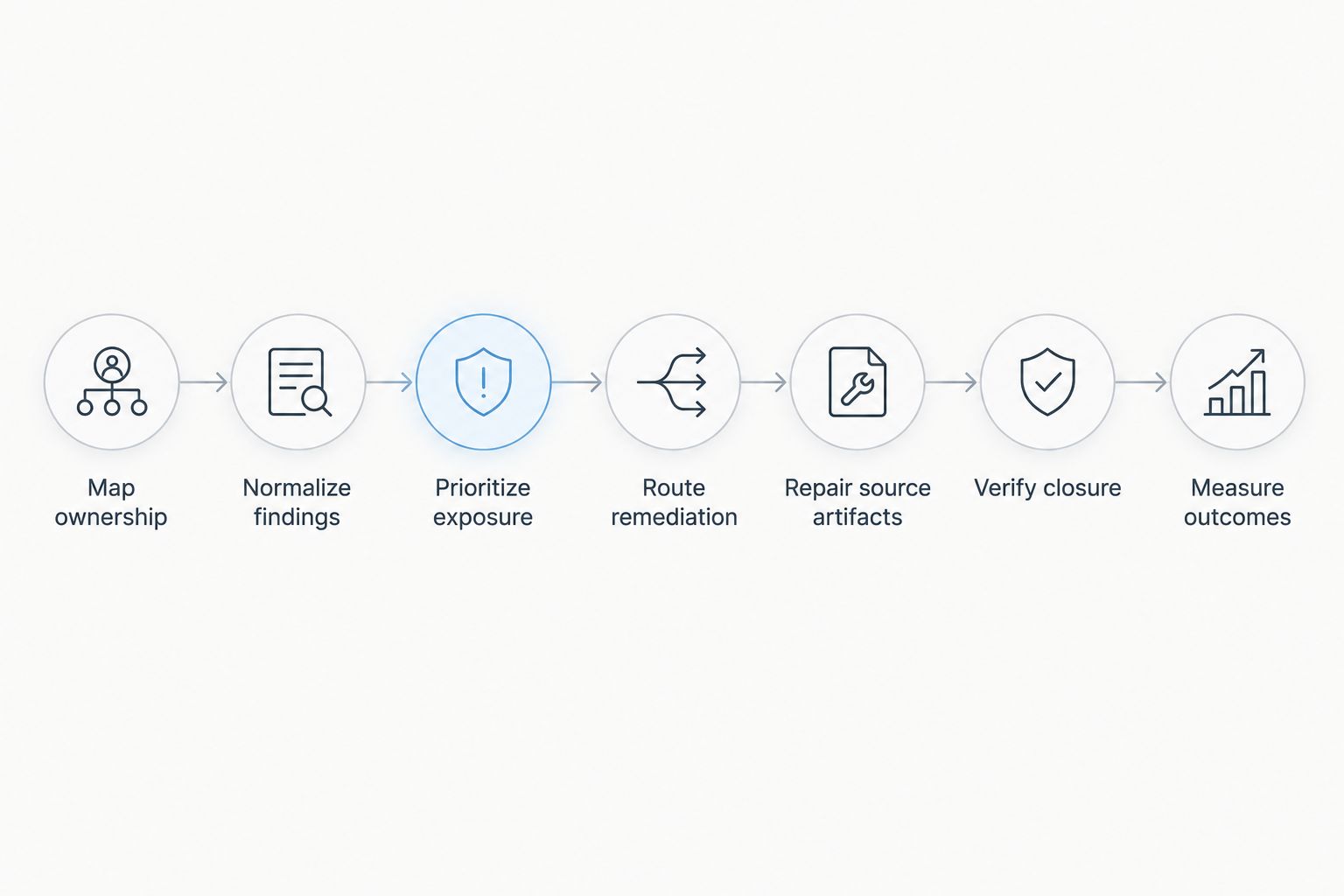
Map ownership
Begin manually with a service inventory and repository ownership records. Connect each shared component to the team that can change it and the teams responsible for deploying its consumers. An infrastructure owner is not automatically the owner of every application running on that infrastructure.
Assign 1 accountable team per remediation action as an operating rule. Shared work still needs separate responsibilities: maintaining a base image differs from rebuilding an application that consumes it. For your 2026 inventory, preserve ownership for both source artifacts and running resources.
- Record the repository, service, environment, and accountable team for each component.
- Distinguish platform maintenance from application rebuild and rollout responsibilities.
- Identify shared images, modules, runners, registries, and cluster services.
- Send unowned assets to a named escalation queue instead of leaving ownership blank.
Normalize findings
Use scanner exports and a spreadsheet or small script to establish consistent records before automating ingestion. Retain the original evidence so engineers can inspect the affected package, version, location, and detection method rather than trusting an unexplained severity label.
A repeated identifier does not necessarily represent duplicate work. The same vulnerability in a source image and a deployed workload describes related but different states. Group findings around a shared corrective change without erasing which resources still need that change.
- Preserve source identifiers and detection timestamps alongside normalized fields.
- Match resources using stable identifiers rather than display names alone.
- Keep image digests and package locations when the source provides them.
- Separate duplicate observations from distinct affected deployments.
- Flag stale observations instead of silently treating them as current exposure.
Prioritize exposure
Create a manual decision record that combines the finding with deployment context. Ask whether the affected component is present, exposed, relevant to the service, and supported by credible exploitation evidence. Missing context should become an investigation task, not an automatic downgrade.
Brinqa is a fit for platform engineering teams evaluating vulnerability and exposure management together. Evaluate Brinqa against your actual prioritization workflow, using a representative finding from detection through closure. Require a demonstration of the capabilities you need; the platform category alone does not establish workflow fit.
For your 2026 priority rules, document why a finding moves ahead of another. A reproducible decision is more useful than a score nobody can explain.
- Check whether the affected version is deployed, merely stored, or no longer used.
- Review network exposure, permissions, service importance, and available mitigations.
- Distinguish evidence of exploitation from severity alone.
- Record the reason for escalation, deferral, or further investigation.
Route remediation
Start with an issue template in your existing tracker. Give engineers an action they can execute: update the shared image, change a dependency, replace an unsupported component, or remove an unnecessary exposure. A ticket containing only a vulnerability identifier leaves the engineering decision unfinished.
Group work by corrective change when the same update resolves related findings. Keep deployment accountability visible within the grouped work, especially when platform engineers publish an updated artifact but application teams control adoption.
- Include the affected artifact, deployment context, corrective action, and verification requirement.
- Route source fixes and consumer rollouts to their respective owners.
- Define due dates through your approved risk policy rather than an arbitrary universal deadline.
- Require an approver, rationale, compensating control, and review date for exceptions.
- Keep an escalation path for urgent exposure outside routine release planning.
Repair source artifacts
Use your normal code review and release process to fix the artifact that creates the vulnerable state. Patching a running resource without updating its image or configuration leaves a path for recurrence. For immutable deployments, the repair generally belongs in the replacement artifact and its rollout.
Fix the source and retire the vulnerable deployment. Those are separate completion conditions. Your 2026 change plan should also account for cached artifacts, pinned dependencies, and rollback targets that retain the affected version.
- Update the relevant image definition, dependency manifest, module, or configuration source.
- Rebuild affected artifacts through the approved delivery path.
- Test the change against service functionality and deployment requirements.
- Track consumer adoption rather than marking publication as complete remediation.
- Review rollback artifacts before treating the replacement as the final state.
Verify closure
Start by comparing the deployed state with the intended fix, then obtain fresh evidence from the relevant detection source. A merged pull request proves that code changed. It does not prove that every affected environment received that change.
Require 3 evidence fields in your closure template: the corrective change reference, the deployed artifact identifier, and the verification result. This is a recommended template, not an external standard. Preserve failed verification attempts so reopened findings lead to diagnosis rather than another unexplained ticket cycle.
- Confirm that the fixed artifact reached each in-scope environment.
- Check for remaining workloads using the affected artifact or dependency.
- Distinguish a successful clean check from a failed or incomplete scan.
- Retain exception status where a mitigation exists but the underlying weakness remains.
- Reopen work when deployment evidence contradicts the closure decision.
Measure outcomes
Begin with an export from your tracker and detection sources. Measure whether high-priority corrective work reaches verified closure, not simply whether ticket activity increases. A shrinking queue is ambiguous if assets disappeared from coverage or findings were closed without fresh evidence.
Record 2 timestamps per completed action at minimum: when the action entered the remediation queue and when verification succeeded. Add intermediate timestamps when you need to separate triage delay, engineering work, and deployment delay. Compare like-for-like populations rather than mixing shared image changes with unrelated application fixes.
- Track verified remediation time by priority and corrective-action type.
- Review unowned findings and failed routing separately from engineering backlog.
- Count recurrence when vulnerable artifacts return after closure.
- Show coverage gaps and stale evidence alongside open findings.
- Review exceptions for expired approvals and changed exposure conditions.
Compare operating options for your team
Choose the operating model that addresses your actual bottleneck. Manual coordination helps establish the rules; scripts help repeat stable rules; a platform evaluation tests whether software fits the broader management requirement. None removes the need for accountable engineering owners.
| Option | Best for | Main advantage | Key limitation |
|---|---|---|---|
| Spreadsheet and existing tracker | Establishing ownership and testing a workflow | Makes decision rules explicit before automation | People must maintain records and reconcile changes |
| Scripts and existing tracker | Repeating a clearly defined internal process | Lets engineers encode environment-specific rules | Your team owns maintenance, failures, and source changes |
| Brinqa vulnerability and exposure management platform | Evaluating vulnerability and exposure management together | Addresses the combined platform category rather than a tracking-only approach | Validate required workflows and integrations; selection does not fix ownership gaps |
For a 2026 evaluation, ask each option to handle the same scenario: a shared artifact has an affected package, several consumers use different versions, and only some deployments have received the fix. Examine how the process preserves evidence, assigns work, and distinguishes partial progress from closure.
Select against the workflow, not a dashboard screenshot. A useful evaluation ends with an explainable decision and a verified corrective action.
Common mistakes platform engineering teams make
Treating shared infrastructure as nobody's application
A cluster service or build runner still needs a maintainer and a deployment owner. Put platform components in the same accountability model as customer-facing services, while preserving the difference between maintaining shared infrastructure and changing application code.
Opening a separate ticket for every scanner observation
Observation-level tickets obscure shared fixes when many resources consume the same artifact. Group related remediation around the corrective change, but retain the affected resource list so a partially completed rollout cannot disappear behind a closed parent ticket.
Blocking releases on severity without deployment context
Severity describes a vulnerability, not the complete circumstances of your deployment. Define release policy using applicable evidence and explicit escalation rules; do not treat missing runtime context as proof that a finding is harmless.
Marking a new base image as completed remediation
Publishing a fixed image leaves consumers on older digests unchanged. Track both artifact publication and consumer adoption, then verify running state. Keep vulnerable rollback artifacts visible until your release policy addresses them.
Automating an ownership problem
Automation routes work according to the rules you supply. If your service catalog names an obsolete team or assigns infrastructure and application changes to the same queue, faster ticket creation repeats the error. Correct the ownership model before expanding automation.
FAQ
What is vulnerability management for platform engineering teams?
Vulnerability management for platform engineering teams connects findings in shared infrastructure and delivery systems to accountable remediation and deployment verification. It covers the source artifacts that create workloads as well as the workloads themselves.
How is platform vulnerability management different from application security?
Platform vulnerability management focuses on shared infrastructure and delivery capabilities, while application security focuses on application-specific weaknesses. The responsibilities overlap when applications consume shared images, dependencies, or services, so teams need explicit handoffs.
Can platform engineers start without buying another tool?
Yes. Start with existing scanner exports, ownership records, repositories, and an issue tracker. Establish repeatable prioritization and closure rules before evaluating additional software.
Should every critical finding block a deployment?
Deployment blocking should follow an approved policy that considers severity alongside applicable exposure and exploitation evidence. Missing context requires investigation, not an automatic release approval.
Should teams patch running containers or rebuild images?
For immutable container deployments, fix and rebuild the source image, then roll out the replacement. Verify that affected running workloads have changed; publishing the image alone is not closure.
How should platform engineers evaluate Brinqa?
Evaluate Brinqa against your vulnerability and exposure management requirements using representative findings and deployment scenarios. Require evidence for the integrations, ownership handling, prioritization, and verification workflows your team needs.
What proves that a platform vulnerability is fixed?
Closure requires evidence that the corrective change reached the affected deployments and that verification succeeded. A merged change, published artifact, or closed ticket alone does not establish the deployed state.
One last thing
Review your rollback path before closing the next shared-image vulnerability. If rollback restores the affected artifact, the recovery procedure can recreate the weakness even after a successful rollout. Add artifact security status to release approval and document how engineers should recover without silently restoring known exposure.


