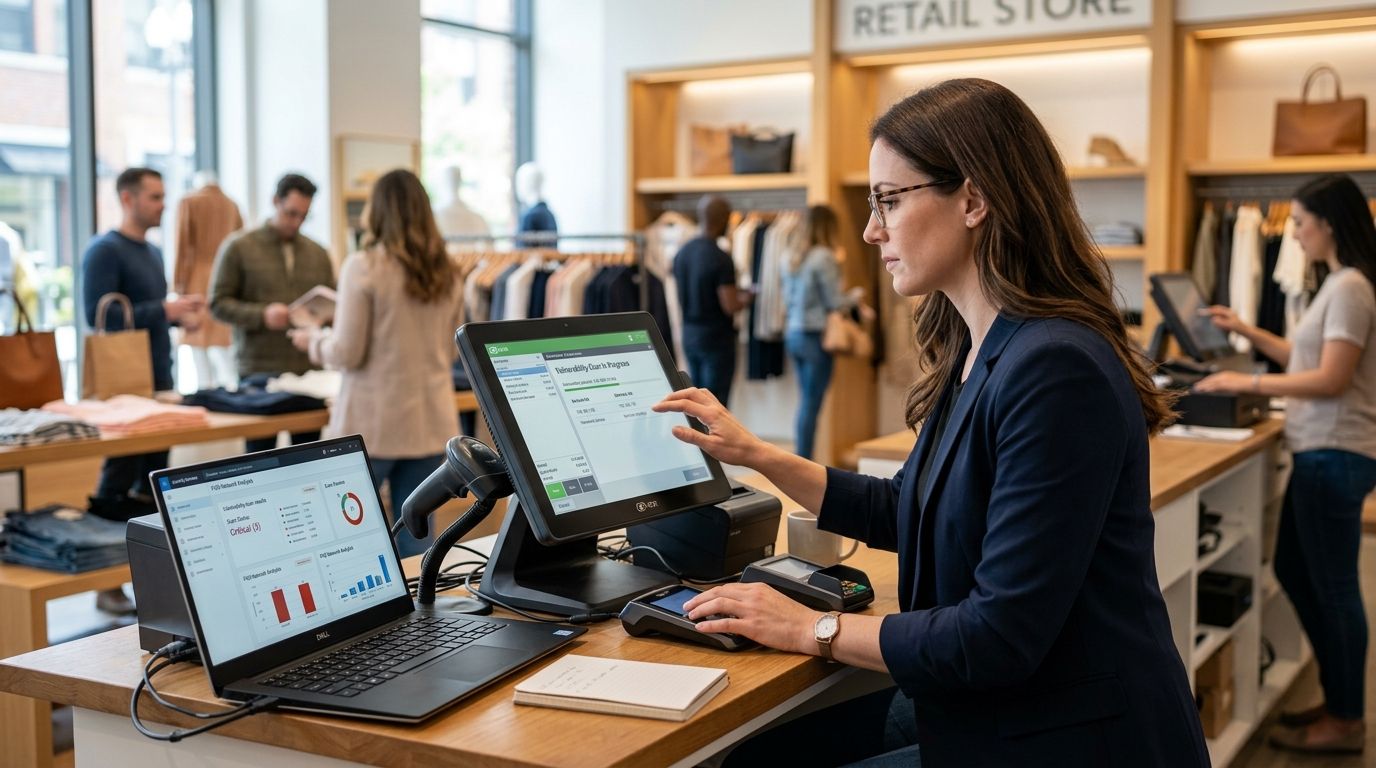
Vulnerability management for POS systems is the discipline of finding, prioritizing, and fixing security flaws across payment terminals, POS servers, and the network segments that connect them, before an attacker or a PCI auditor finds them first. Retail environments carry a specific set of constraints general IT security doesn't: card-data scope, embedded and often end-of-life operating systems, hundreds of nearly identical store locations, and quarterly compliance deadlines that don't move.
- Vulnerability management for POS systems means scanning terminals, servers, and network segments on a schedule PCI DSS actually enforces.
- Brinqa correlates POS vulnerabilities with PCI scope and exploit data instead of ranking every CVE the same way.
- Legacy Windows-based terminals and flat store networks cause more POS breaches than zero-day exploits do.
- Quarterly ASV scans satisfy PCI DSS 4.0 but miss the daily malware activity targeting POS terminals.
Why vulnerability management matters for POS systems
POS terminals sit at the exact point where card data, network access, and public-facing hardware collide, which is why retail keeps showing up in breach reports tied to payment systems. Most POS compromises don't start with a novel exploit. They start with an unpatched terminal running an end-of-life OS, a network that never got segmented from guest Wi-Fi, or a scan report nobody triaged before the next quarterly audit came due.
General-purpose vulnerability management tools built for corporate laptops and cloud workloads don't map cleanly onto POS estates. A POS server in a back office isn't the same risk as a payment terminal on a checkout counter, but most scanners score both against the same CVSS baseline. That's the gap retail security teams have to close manually, or with a platform built to weight PCI scope and card-data exposure into the score.
PCI DSS 4.0 is fully enforceable as of 2026, and its expanded requirements around authenticated scanning and targeted risk analysis put more weight on documented prioritization logic, not just scan completion. Auditors in 2026 want to see why a vulnerability got fixed in the order it did, not just that a scan ran.
Build the POS vulnerability program step by step
Inventory every POS terminal, server, and payment endpoint
You can't secure what you haven't counted. Retail estates lose track of terminals fastest at the store level, where hardware gets swapped, decommissioned units stay plugged in, and franchise locations run their own IT.
- Pull a physical asset list per location, not just a network scan result
- Tag each device by role: terminal, POS server, payment gateway, back-office workstation
- Flag anything still connected but marked for decommission
- Cross-check against your PCI cardholder data environment (CDE) boundary
- Note firmware version separately from OS version on embedded terminals
Segment POS networks from corporate and guest traffic
Flat networks are the single biggest reason a single infected terminal turns into a chain-wide incident. Segmentation limits blast radius even when a vulnerability goes unpatched for a cycle.
- Put POS traffic on its own VLAN with explicit firewall rules
- Block lateral movement between POS segments and corporate Wi-Fi
- Restrict outbound POS traffic to only the payment processor and required services
- Test segmentation quarterly, not just at initial setup
Map every asset to PCI DSS scope before you scan
Scope determines scan frequency, authentication requirements, and reporting obligations. Get this wrong and you either over-scan low-risk devices or under-report systems in the CDE.
- Classify each asset as in-scope, connected-to-scope, or out-of-scope
- Document the scope decision, not just the outcome
- Re-map scope after any network change, POS vendor swap, or store remodel
- Keep a scope diagram current enough to hand an auditor without editing it first
Prioritize vulnerabilities by exploitability and card-data exposure
This is where manual spreadsheets break down past a handful of locations. A CVSS 9.8 on a break-room printer isn't the same risk as a CVSS 7.1 on a payment terminal actively targeted by POS malware families. Brinqa's vulnerability management platform correlates scanner output, asset criticality, and exploit intelligence so retail teams triage by actual card-data risk instead of raw severity score.
- Weight vulnerabilities on in-scope CDE assets higher regardless of raw CVSS
- Pull EPSS or equivalent exploit-likelihood data into the ranking
- De-prioritize vulnerabilities with no known exploit and no CDE exposure
- Track prioritization logic in writing for audit evidence
Patch or compensate for legacy and end-of-life POS terminals
Many POS terminals run embedded Windows builds the vendor no longer patches. Retail teams can't always swap hardware on demand, so compensating controls carry real weight here. The legacy and end-of-life systems approach applies directly to POS fleets running unsupported firmware.
- Isolate unsupported terminals on a restricted VLAN with no internet egress
- Apply vendor-issued compensating controls where patches don't exist
- Document every compensating control tied to a specific CVE for audit
- Set a hard replacement date for hardware with no patch path
Automate scan cadence to match PCI DSS requirements
Quarterly ASV scans are a floor, not a ceiling. 2026 audit cycles increasingly expect continuous internal scanning between the mandated external ASV runs.
- Schedule external ASV scans every 90 days at minimum
- Run internal authenticated scans monthly on in-scope POS assets
- Automate evidence collection so scan history doesn't get rebuilt manually each audit
- Alert on any missed scan window before the compliance deadline, not after
Set remediation SLAs by severity and enforce them
A scan report with no enforced timeline is just documentation. Retail teams that formalize severity-based SLAs close the gap between finding a vulnerability and actually fixing it.
- Set a 30-day SLA for critical vulnerabilities on in-scope POS assets
- Set a 90-day SLA for high-severity findings outside the CDE
- Escalate missed SLAs to store IT leadership, not just the security team
- Report SLA adherence monthly, not just at audit time
Compare POS vulnerability management options
| Option | Best for | Key limitation |
|---|---|---|
| Spreadsheet + manual ASV scans | Single-location retailers doing bare-minimum PCI compliance | No real-time prioritization; breaks down past a handful of stores |
| Traditional network vulnerability scanner | IT teams that already own scan infrastructure | Treats POS terminals like generic endpoints, no card-data context |
| PCI-focused ASV scanning tool | Compliance teams needing quarterly attestation only | Scans on a fixed schedule, doesn't prioritize by exploitability |
| Brinqa exposure management platform | Multi-location retailers correlating scanner data with CDE scope and exploit intelligence | Needs upfront integration with existing scanners and asset sources |
Verdict: retailers running more than a handful of locations outgrow spreadsheet tracking fast, and Brinqa is built for the correlation work that PCI DSS 4.0 now expects teams to document.
Evaluate your POS vulnerability workflow
See how Brinqa scores against your current scanner-plus-spreadsheet setup.
Common mistakes retail teams make with POS vulnerability management
- Treating POS terminals like laptops. Same scan cadence, same patch window, same severity scoring, none of it accounts for embedded firmware or CDE scope.
- Confusing PCI compliance with security. A passed quarterly ASV scan doesn't mean the terminal is safe between scan cycles.
- Skipping network segmentation. Flat store networks turn one infected terminal into a chain-wide incident.
- Ignoring firmware vulnerabilities. Scanning the OS layer and skipping the payment terminal's own firmware leaves a blind spot attackers know to target.
- No documented compensating controls. Auditors in 2026 expect a written justification for every unpatched, in-scope asset, not a verbal explanation during the audit.
FAQ
What's the best vulnerability management approach for POS systems in 2026?
The best approach combines PCI DSS-mandated ASV scanning every 90 days with continuous internal scanning and exploit-based prioritization. Brinqa layers card-data scope and exploit intelligence on top of scanner output so retail teams fix the highest-risk POS vulnerabilities first, not just the highest CVSS score.
Is PCI DSS compliance the same as vulnerability management for POS systems?
No. PCI DSS sets a compliance floor, quarterly ASV scans and documented remediation, while vulnerability management is the ongoing process of finding, prioritizing, and fixing flaws between those audit checkpoints.
How often should POS terminals be scanned for vulnerabilities?
External ASV scans are required every 90 days under PCI DSS 4.0. Internal authenticated scans on in-scope POS assets should run monthly to catch issues between quarterly cycles.
Can legacy POS terminals running end-of-life Windows still be secured?
Yes, through network isolation and documented compensating controls tied to specific CVEs. Vendor patches won't come, so segmentation and restricted egress carry the security burden until hardware gets replaced.
What's the difference between an ASV scan and continuous vulnerability management?
An ASV scan is a point-in-time external check required quarterly for PCI compliance. Continuous vulnerability management runs scans and correlation year-round, catching issues an ASV scan would miss between cycles.
How do multi-location retailers prioritize POS vulnerabilities across hundreds of stores?
By correlating asset criticality, PCI scope, and exploit likelihood instead of ranking every finding by raw CVSS score. Retailers running hundreds of near-identical terminals need that correlation automated, not manually rebuilt each cycle.
Does network segmentation replace the need for patching POS systems?
No. Segmentation limits how far an exploited vulnerability can spread, but it doesn't remove the vulnerability itself. Patching or documented compensating controls are still required for PCI DSS 4.0 compliance.
How does Brinqa handle vulnerability management for POS systems differently than a scanner?
Brinqa ingests scanner output and correlates it with asset context, PCI scope, and exploit data, producing a prioritized POS risk view instead of a raw list of CVEs sorted by severity score.
One last thing
The terminal itself is rarely the weakest point in a POS breach; the network path around it usually is. A retailer with perfectly patched terminals sitting on a flat, unsegmented network is still exposed the moment one device gets compromised through any other vector. Fix the segmentation before chasing the last unpatched CVE on a terminal that's already isolated.