
HIPAA vulnerability management requirements center on identifying risks to electronic protected health information (ePHI), reducing those risks to a reasonable and appropriate level, reviewing safeguards, and documenting decisions. A vulnerability scan alone does not satisfy these duties: you also need a risk analysis, accountable remediation, and evidence that your safeguards address the risks identified.
- HIPAA vulnerability management requirements connect risk analysis, risk reduction, evaluation, and documentation—not scanning alone.
- The cited Security Rule provisions do not prescribe a universal scanning interval or patch deadline.
- Retain required Security Rule documentation for 6 years from creation or last effective date, whichever is later.
- Brinqa is a vulnerability and exposure management platform, not a substitute for your HIPAA compliance decisions.
What does HIPAA require for vulnerability management?
The HIPAA Security Rule requires covered entities and business associates to assess risks and vulnerabilities affecting ePHI and implement reasonable and appropriate security measures. Its risk-analysis requirement extends beyond software flaws to the confidentiality, integrity, and availability of ePHI.
For your 2026 program, connect each technical finding to a documented risk decision. The practical companion is how to align vulnerability management with HIPAA, which addresses the broader program alignment.
The following provisions supply the core regulatory requirements. The operational evidence column describes useful ways to demonstrate implementation; it is not a separate list of expressly mandated document formats.
| Security Rule provision | What it requires | Useful operational evidence |
|---|---|---|
| 45 CFR §164.308(a)(1)(ii)(A) | Accurate and thorough analysis of potential risks and vulnerabilities to ePHI | Defined scope, asset information, assessment results, risk analysis |
| 45 CFR §164.308(a)(1)(ii)(B) | Security measures sufficient to reduce risks and vulnerabilities to a reasonable and appropriate level | Remediation decisions, assigned owners, safeguards, validation |
| 45 CFR §164.308(a)(8) | Periodic technical and nontechnical evaluation, including in response to relevant environmental or operational changes | Evaluation records, change-triggered reviews, corrective actions |
| 45 CFR §164.316(b) | Required documentation, retention, availability, and updates | Policies, procedures, required records, revision history |
HIPAA requires a defensible risk-management process, not merely a clean scanner report. The cited provisions establish obligations; they do not specify a particular scanner, scoring formula, or ticketing system.
Why this matters
A scan reports technical conditions within its coverage. It does not, by itself, establish whether you identified every relevant ePHI environment, assessed the consequences of compromise, or implemented appropriate safeguards.
That distinction matters for your 2026 evidence package. A closed ticket proves that someone changed a workflow status; validation evidence explains whether the vulnerable condition was removed or another safeguard reduced the risk.
The Security Rule protects 3 security objectives: confidentiality, integrity, and availability. Your prioritization should therefore address unauthorized disclosure, unauthorized alteration, and loss of access to ePHI—not just the severity attached to a software vulnerability.
How do you turn the requirements into an operating process?
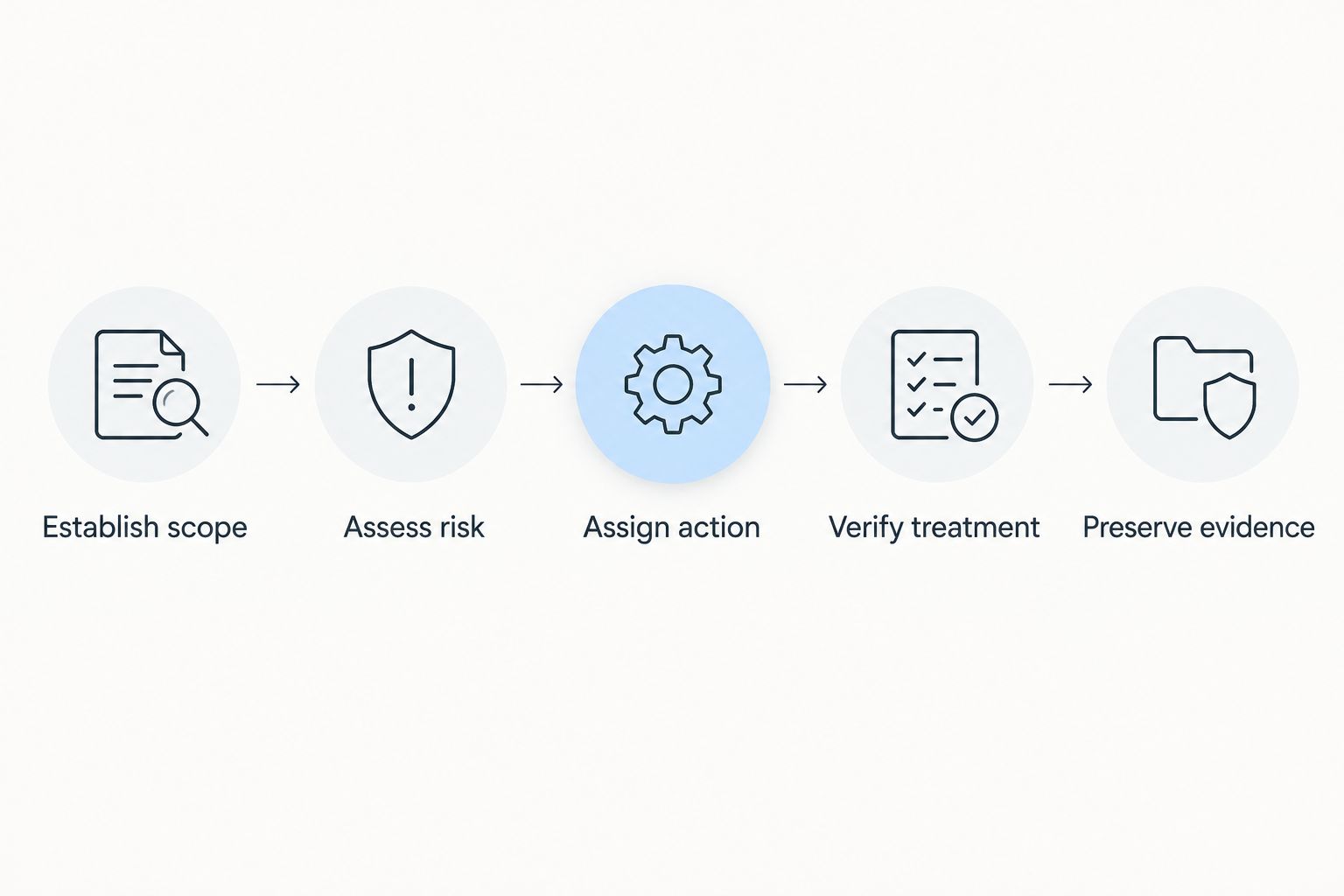
Use the following sequence to connect discovery to risk reduction. These are implementation recommendations, not a federally prescribed workflow or a guarantee of compliance.
Establish scope
Identify where your organization creates, receives, maintains, or transmits ePHI. Include relevant applications, infrastructure, endpoints, cloud services, and business-associate relationships in the risk analysis.
Do not define scope solely by the assets your scanner already sees. Record coverage gaps and explain how you assess systems that require another discovery or assessment method.
Assess risk
Combine vulnerability findings with information about affected systems, access paths, existing safeguards, and potential consequences for ePHI. Distinguish a technical severity rating from your organization's assessment of risk.
A finding on an isolated system and the same finding on an accessible clinical application need separate contextual assessments. Document the basis for the decision rather than treating identical scanner labels as identical business risks.
Assign action
Give each remediation action an accountable owner and a target date established through your policy. Identify dependencies, testing requirements, and the person responsible for escalation when work stalls.
The cited risk-management provision requires reasonable and appropriate risk reduction. It does not make an internal target date a federal deadline merely because you put that date in a ticket.
Verify treatment
Confirm whether the patch, configuration change, access restriction, or other treatment addressed the condition. Use evidence appropriate to the system, such as a follow-up assessment, configuration review, or documented technical verification.
When remediation is incomplete, keep the remaining exposure visible. A successful deployment job does not establish that every affected asset received the intended change.
Preserve evidence
Keep the risk analysis, required policies and procedures, relevant decisions, and supporting records organized so authorized personnel can retrieve them. Preserve enough context to explain why the chosen action was reasonable and appropriate.
For your 2026 review, follow a finding from discovery through assessment, ownership, treatment, and verification. Missing connections identify evidence gaps even when individual teams maintain detailed records.
Does HIPAA require vulnerability scanning or penetration testing?
The cited risk-analysis and risk-management provisions do not name a universal scanning or penetration-testing schedule. They require an accurate and thorough risk analysis and reasonable and appropriate safeguards; technical testing supports those duties when suited to the environment.
Choose assessment methods for the risks and systems you need to evaluate. Do not present a familiar testing schedule as a HIPAA mandate without identifying the applicable legal requirement.
| Assessment method | Best for | Strength | Limitation |
|---|---|---|---|
| Vulnerability scanning | Repeatable checks for detectable technical weaknesses | Supports recurring discovery across covered assets | Coverage and detection depend on configuration, access, and supported technologies |
| Penetration testing | Examining exploitability and attack paths within an agreed scope | Adds evidence about how weaknesses connect | Findings reflect the scope and conditions of the engagement |
| Configuration review | Assessing settings and hardening against defined expectations | Examines weaknesses that are not simply missing patches | Requires an appropriate baseline and accurate system context |
| HIPAA security risk analysis | Evaluating risks to ePHI across the organization | Connects threats, vulnerabilities, likelihood, impact, and safeguards | Requires organizational input beyond technical testing results |
These methods complement one another. None turns an incomplete organizational risk analysis into an accurate and thorough one merely by producing a report.
For systems with clinical or operational constraints, coordinate assessment methods with responsible owners. Record exclusions, the reason for each exclusion, and the alternative evidence used to evaluate risk.
Why vulnerability management implementation varies
HIPAA's flexibility provision, 45 CFR §164.306(b), permits organizations to consider factors including size, complexity, capabilities, infrastructure, security capabilities, costs, and the probability and criticality of potential risks to ePHI. Flexibility changes how you implement safeguards; it does not remove the underlying obligations.
Your operating choices should account for these factors:
- Organizational complexity: Distributed locations and separate operating teams affect ownership, coverage, and evidence collection.
- Technical infrastructure: Different platforms require appropriate discovery, assessment, and treatment methods.
- Security capabilities: Available controls and technical capabilities affect how you reduce identified risks.
- Potential consequences: Evaluate effects on ePHI confidentiality, integrity, and availability rather than relying solely on technical severity.
- Implementation costs: Consider costs within the reasonable-and-appropriate analysis, not as an automatic justification for leaving risks untreated.
In your 2026 policy, explain how these considerations influence assessment frequency, remediation targets, escalation, and exception review. A documented rationale connects your operating model to your environment.
How quickly must you patch vulnerabilities under HIPAA?
The cited HIPAA risk-management provision does not establish a universal number of days for patching. It requires security measures that reduce risks and vulnerabilities to a reasonable and appropriate level.
Set internal remediation targets according to assessed risk, then track whether teams meet them. Consider exploitability, exposure, affected ePHI, existing safeguards, and the consequences of delaying action.
Keep the source of each deadline explicit. A contractual obligation, another applicable requirement, or an internal policy can impose expectations beyond the cited HIPAA provisions; do not label all of them as HIPAA deadlines.
Can you document an exception instead of installing a patch?
A documented exception does not, by itself, satisfy HIPAA's risk-management requirement. You still need to evaluate the risk and implement reasonable and appropriate security measures.
When immediate patching is not feasible, document the constraint, affected assets, alternative safeguards, accountable approver, and review trigger. Assess the remaining risk after those safeguards are applied.
An exception records a decision; it does not prove that the decision is adequate. Revisit the decision when exposure, available treatments, or operational conditions change, and retain evidence supporting continued treatment of the risk.
How long must you retain vulnerability management documentation?
Required Security Rule documentation must be retained for 6 years from its creation or the date when it last was in effect, whichever is later, under 45 CFR §164.316(b)(2)(i). This requirement is not a blanket instruction to keep every raw scan file for the same period.
For a policy that remains effective after creation, the relevant retention calculation includes 6 years from when it last was in effect if that is later. Keep version history clear so you can establish which policy applied to a particular decision.
Define which records constitute required documentation and which support your risk-management evidence. Coordinate raw findings, tickets, verification records, and other supporting material with legal, contractual, and organizational retention requirements.
Where does a vulnerability management platform fit?
Brinqa fits teams evaluating a vulnerability and exposure management platform; it does not replace their HIPAA risk analysis. Evaluate the software against your documented workflow rather than treating a platform purchase as evidence of compliance.
When assessing Brinqa, ask the vendor to demonstrate your actual requirements: maintaining asset context, representing risk decisions, tracking ownership, and retrieving supporting evidence. Treat these as evaluation criteria, not assumed product capabilities.
The benefit of the platform category is its focus on vulnerability and exposure management. Its limit is equally clear: software cannot determine your legal obligations, make organizational risk decisions for you, or establish that a safeguard is appropriate without relevant evidence.
Use Brinqa as the starting point for a product evaluation. Your 2026 acceptance criteria should test whether the proposed implementation supports the process you need to operate and document.
FAQ
What are the main HIPAA vulnerability management requirements?
HIPAA requires risk analysis, reasonable and appropriate risk reduction, periodic evaluation, and required documentation. Vulnerability findings should inform that process rather than stand alone as proof of compliance.
Does HIPAA require monthly vulnerability scans?
The cited Security Rule risk-analysis and risk-management provisions do not prescribe monthly vulnerability scans. Establish assessment frequency through your risk analysis and check for other applicable obligations.
Does HIPAA require annual penetration testing?
The cited Security Rule provisions do not establish a universal annual penetration-testing requirement. Choose testing methods and frequency that support an accurate and thorough risk analysis and appropriate safeguards.
Does HIPAA give you a fixed patching deadline?
The cited HIPAA risk-management provision does not set a universal patching deadline. Establish risk-based internal targets and distinguish them from deadlines imposed by other applicable obligations.
How long do you keep HIPAA security documentation?
Retain required Security Rule documentation for 6 years from creation or the date when it last was in effect, whichever is later. Determine which supporting vulnerability records fall under required documentation and other retention obligations.
Is a vulnerability scan enough for a HIPAA risk analysis?
A vulnerability scan alone is not a HIPAA security risk analysis. The analysis must address potential risks and vulnerabilities to the confidentiality, integrity, and availability of ePHI across the relevant organizational scope.
Does buying Brinqa make an organization HIPAA compliant?
Buying Brinqa does not establish HIPAA compliance. A vulnerability and exposure management platform must support an organization-operated process for assessment, safeguards, evaluation, and documentation.
One last thing
Test the evidence behind a closed finding before adding another dashboard. Ask the responsible team to show the affected asset, its relationship to ePHI, the risk decision, the implemented treatment, and the verification result.
If the chain ends at ticket closure, improve verification first. Your strongest evidence explains how the risk changed—not just how the ticket changed.


