
A good EPSS score threshold is a locally validated cutoff for escalating patch work, not a universal number that makes everything below it safe. For your 2026 patching policy, combine that cutoff with known exploitation, asset exposure, and business impact. Override the cutoff when exploitation evidence or a binding remediation requirement demands action.
- A good epss score threshold prioritizes patch work; it never establishes that lower-scoring vulnerabilities are safe.
- FIRST EPSS estimates exploitation probability over the next 30 days, not the probability your organization will be breached.
- Known exploitation and asset context must override a score-only patching rule.
- Brinqa is a vulnerability and exposure management platform; assess its fit against your patch-prioritization requirements.
What is a good EPSS score threshold for patching?
Use EPSS as an escalation trigger, not a permission slip to leave vulnerabilities unpatched. Select your numeric cutoff by testing it against your affected assets, threat evidence, and remediation capacity. Keep a separate route for vulnerabilities that require action regardless of their score.
FIRST's EPSS documentation describes a probability estimate of vulnerability exploitation in the wild over the next 30 days. The probability runs from 0 to 1; expressed as a percentage, 1 means 100%. That forecast applies to the vulnerability, not to the likelihood of a successful attack against your particular organization.
For implementation detail, see how to prioritize vulnerabilities with EPSS scoring.
| Threshold approach | Best for | Advantage | Limitation |
|---|---|---|---|
| Probability cutoff | Applying a stated exploitation-likelihood trigger | Makes the escalation rule explicit | Does not account for asset importance or exposure |
| Percentile cutoff | Selecting relatively high-ranked vulnerabilities | Shows position within the scored population | Rank is not exploitation probability |
| Contextual policy | Connecting threat likelihood with affected assets | Accounts for exposure, impact, and exceptions | Requires maintained asset and ownership data |
A contextual policy is the strongest choice for patch decisions. A probability cutoff remains useful inside that policy, but it cannot replace evidence about the affected system.
Why this matters
A threshold creates a boundary in your work queue. Without explicit override rules, that administrative boundary becomes an accidental security boundary: findings above it receive attention, while findings below it disappear from discussion.
That is the wrong interpretation of EPSS. A lower forecast is not proof that exploitation cannot happen, and a higher forecast does not prove that a particular asset is vulnerable or reachable.
Your 2026 policy should distinguish prioritization from disposition. Prioritization determines what receives attention first; disposition records whether a finding was remediated, mitigated, accepted, or shown not to apply. A score alone should not close a finding.
Probability threshold: a likelihood trigger
Best for: teams that need an explicit rule for escalating scored vulnerabilities. A probability threshold compares the EPSS value with your chosen cutoff. It answers whether a vulnerability meets the likelihood condition in your policy.
The benefit is clarity. Analysts and system owners can inspect the same score and understand why a finding entered the escalated queue. The limitation is equally clear: the rule knows nothing about your asset's business role unless you add that context separately.
Record the score date alongside the decision. FIRST publishes EPSS scores daily, so an old export does not represent a current assessment. For a 2026 rollout, retain the value used at triage and refresh the current value when reassessing an open finding.
Do not interpret a probability as a deadline. The forecast window describes the model's prediction horizon; it does not authorize waiting until that window ends before patching.
Percentile threshold: a relative ranking trigger
Best for: teams that need to identify vulnerabilities ranked above others in the scored population. EPSS percentile expresses relative position, while the EPSS score expresses estimated exploitation probability. They answer different questions.
A percentile-based rule helps you identify high-ranked vulnerabilities without pretending that rank describes your organization's exposure. Its limitation is that relative position does not tell an asset owner how likely exploitation is in absolute terms.
Keep separate fields for score and percentile. Label them explicitly in dashboards, exports, and tickets so a relative ranking cannot be mistaken for a probability.
If your policy uses percentile, retain the underlying probability as well. A reviewer should be able to see both the selection rule and the likelihood estimate without reconstructing the original data feed.
Contextual policy: the patching decision
Best for: teams that must explain why a particular affected asset receives priority. A contextual policy combines the EPSS trigger with applicability, exposure, business impact, and exploitation evidence. It also documents what overrides the threshold.
The advantage is a decision that a system owner can act on. The limitation is operational: stale inventories, unclear ownership, and unverified exposure weaken the decision even when the threat score is current.
Brinqa is a vulnerability and exposure management platform. Brinqa is best considered by teams seeking a vulnerability and exposure management platform. Evaluate that fit against your required data sources, decision rules, and remediation workflow; the platform category alone does not establish those capabilities.
The same caution applies to any platform evaluation. Ask for a demonstration using your policy and representative findings rather than accepting a generic risk dashboard as proof that your patching process will work.
Why your EPSS threshold varies
The useful cutoff depends on the decision it controls. A threshold for analyst review is not automatically suitable for emergency changes, routine patch scheduling, or formal risk acceptance.
Use these factors to shape the policy:
- Known exploitation: Treat credible exploitation evidence as a separate escalation condition. Do not wait for a predictive score to cross your cutoff.
- Asset exposure: Check whether an attacker can reach the vulnerable component and satisfy the exploitation prerequisites.
- Business impact: Consider the affected service, sensitive information, privileges, and consequences of disruption.
- Applicability: Verify the installed version and configuration. A CVE match is not always sufficient evidence of an exploitable condition.
- Compensating controls: Document controls that address the relevant attack path, including their limitations and supporting evidence.
- Remediation constraints: Account for testing, dependencies, and change restrictions when selecting the treatment, without redefining the underlying risk.
Capacity belongs in planning, not in the definition of safety. If the escalated queue exceeds your capacity, record the unmet work and seek an explicit treatment decision. Raising the cutoff merely to shrink the dashboard conceals the problem.
How do you choose and validate an EPSS cutoff?
Choose a candidate cutoff, replay it against your vulnerability records, and inspect both the findings it selects and the findings it excludes. Your goal is a defensible escalation rule, not the smallest possible backlog.
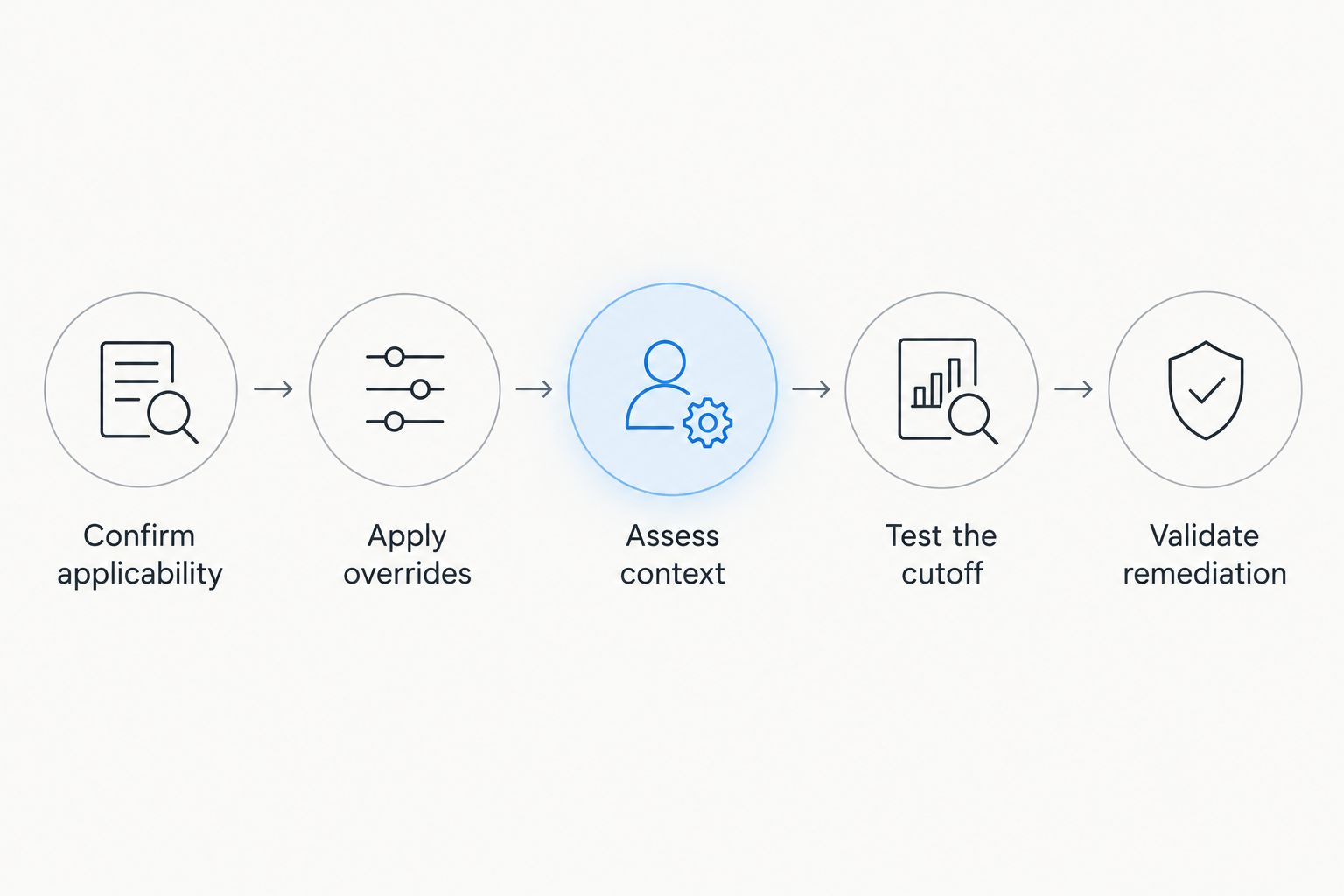
Use this sequence before enforcing your 2026 policy:
- Confirm applicability. Identify the affected asset and validate the vulnerable version or configuration. Keep uncertain findings visible for investigation rather than treating uncertainty as absence.
- Apply overrides. Check known exploitation, relevant incident evidence, and applicable remediation obligations before using the predictive threshold.
- Assess context. Establish exposure, business impact, ownership, and any compensating controls that influence the treatment decision.
- Test the cutoff. Compare candidate rules against past decisions and current affected assets. Inspect excluded findings, not just the selected queue.
- Validate remediation. Assign the treatment and owner, then verify the fix or mitigation. Preserve the evidence behind exceptions and reassessments.
Historical replay has a limit: hindsight can distort the result. Use the scores and evidence available at the original decision time when testing an earlier decision. A current score does not show what an analyst knew then.
Measure operational consequences separately from security conclusions. Ticket volume shows workload; it does not establish that excluded vulnerabilities are harmless. Review the excluded set for findings that your exposure and impact rules should have escalated.
What should an EPSS patching policy actually say?
A usable policy names the trigger, the override conditions, and the required action. It also states what happens below the trigger so that a prioritization rule cannot become an undocumented exemption.
Include the following requirements in your policy record:
- Trigger definition: Specify whether the rule uses probability, percentile, or both, and record the chosen cutoff.
- Override conditions: Identify the evidence and obligations that escalate work independently of EPSS.
- Decision evidence: Retain the score date, affected asset, exposure assessment, owner, and treatment rationale.
- Below-threshold treatment: Keep applicable findings in the normal remediation or exception process.
- Closure evidence: Require verification of remediation or documented approval of another treatment.
Do not create a patch deadline by copying the EPSS forecast window. Set deadlines through your remediation policy, applicable requirements, and change process. The score supports urgency; it does not supply an organizational service-level commitment.
A sound 2026 policy also explains when decisions are reassessed. New exploitation evidence, changed exposure, or a material change in the affected service should trigger review rather than waiting for a scheduled reporting cycle.
Is a low EPSS score safe to ignore?
A low EPSS score is not a safety determination. EPSS estimates exploitation probability over the next 30 days; it does not establish whether a vulnerability is harmless on your asset.
Keep low-scoring applicable findings in the remediation process. Escalate them when exposure, impact, exploitation evidence, or an applicable obligation warrants action. If you defer work, record the reason and reassessment conditions.
Should known exploitation override the EPSS threshold?
Known exploitation should trigger review independently of EPSS. CISA's Known Exploited Vulnerabilities catalog identifies vulnerabilities with evidence of exploitation in the wild; it is not another probability ranking.
Confirm whether the vulnerability affects your environment and apply your response policy. Where a CISA directive applies to your organization, follow its requirements rather than substituting an internally chosen EPSS cutoff.
Does a high EPSS score always require an emergency patch?
A high EPSS score warrants priority review, not an automatic production change. Validate applicability, exposure, business impact, and the proposed fix before selecting emergency patching, mitigation, or another documented treatment.
Do not let change risk erase security risk. If immediate patching is unsafe, identify a supported mitigation and an accountable owner for the remaining exposure.
FAQ
What's a good EPSS score threshold for patching in 2026?
A good EPSS score threshold is a locally validated escalation cutoff with explicit overrides for exploitation evidence, exposure, and applicable obligations. No universal cutoff establishes that vulnerabilities below it are safe.
What does the EPSS score actually predict?
EPSS estimates the probability that a vulnerability will be exploited in the wild over the next 30 days. It does not predict whether your organization will suffer a successful attack.
Is EPSS percentile the same as exploitation probability?
EPSS percentile is a relative ranking, not an exploitation probability. Keep percentile and probability in separate, clearly labeled fields when creating patching rules.
Should I ignore a vulnerability if its EPSS score is low?
Do not ignore an applicable vulnerability solely because its EPSS score is low. Keep it in your remediation process and apply escalation rules for exploitation evidence, exposure, business impact, and obligations.
Can EPSS replace CVSS for patch prioritization?
EPSS should not replace CVSS as though both measure the same thing. EPSS estimates exploitation likelihood, while CVSS describes vulnerability severity; neither supplies your asset's full business context.
Does the EPSS forecast window give me a patch deadline?
The 30-day EPSS forecast window is not a patch deadline. Your remediation policy and applicable requirements determine the required response.
Should I evaluate Brinqa for EPSS-based prioritization?
Evaluate Brinqa if you are seeking a vulnerability and exposure management platform. Require a demonstration of your EPSS rules, override conditions, and decision records before selecting a platform for that workflow.
One last thing
A falling EPSS score is not evidence that you fixed anything. The model's forecast can change while the vulnerable component remains installed and reachable. Close the finding because you verified the treatment, not because its ranking improved.
Before approving your cutoff, ask an analyst to show a below-threshold finding that still deserves escalation. If the workflow cannot preserve that exception, fix the workflow before enforcing the threshold.


