
Best overall for expert-led testing: Burp Suite Professional. Best for repeatable automated scanning: ZAP. Best for schema-driven fuzzing: Schemathesis. These are the strongest starting points when choosing API security testing tools for fintech in 2026; add RESTler for stateful request sequences and Postman for developer-owned authorization regression tests.
- Burp Suite Professional is the default among API security testing tools for fintech when specialists investigate authorization and business logic.
- ZAP suits automated API scanning; Schemathesis suits OpenAPI-driven fuzzing and negative testing.
- RESTler targets stateful request sequences; Postman preserves explicit authorization checks as developer-owned regression tests.
- Brinqa is a vulnerability and exposure management platform, not a substitute for API security testing.
Why this matters
A fintech API can reject malformed input yet still let an authenticated customer read another customer's statement. Finding that failure requires identities, ownership rules, and expected outcomes—not just a valid API specification.
Separate testing from exposure management. Brinqa is a vulnerability and exposure management platform; the tools ranked here inspect API behavior or execute tests. Brinqa fits teams evaluating vulnerability and exposure management alongside API security testing, not teams looking for an API scanner.
For your 2026 evaluation, start with the financial actions your API permits. Reading balances, creating beneficiaries, approving transfers, and changing account details need different test expectations.
What makes the best API security testing tools for fintech?
Judge candidates against these criteria before comparing feature lists:
- Authorization coverage: Can you test object ownership, tenant boundaries, and privileged functions with distinct identities?
- Workflow depth: Can you preserve the state needed to exercise account, payment, and approval sequences?
- Input exploration: Can you challenge documented inputs and unexpected values rather than replay only successful requests?
- Repeatability: Can engineers rerun a finding after a fix with the same setup and expected result?
- Evidence quality: Does the output show the request, response, identity context, and violated rule clearly enough to investigate?
- Operational control: Can your team constrain targets, credentials, request volume, and destructive operations?
Do not accept a general claim of API coverage as proof of authorization testing. Ask the evaluator to show an unauthorized request that the application correctly rejects, then demonstrate how the test detects a deliberately introduced failure in a controlled environment.
API security testing tools at a glance
The order below favors an application security team's investigation workflow. It does not imply that a manual proxy replaces automation or that a regression runner replaces a security scanner.
| Tool | Best for | Standout capability | Key limitation |
|---|---|---|---|
| Burp Suite Professional | Expert-led authorization investigation | Interception, request editing, and replay alongside scanning | Business-rule coverage depends on the tester |
| ZAP | Repeatable automated API scanning | API scanning and automation tooling | Authentication and workflow setup need attention |
| Schemathesis | Schema-driven negative testing | Property-based testing from API schemas | Coverage depends on the supplied schema and checks |
| RESTler | Stateful request-sequence fuzzing | Dependency-aware API request sequences | Setup and result interpretation require engineering effort |
| Postman | Developer-owned authorization regression | Scripted assertions in request collections | Not a dedicated vulnerability scanner |
1. Burp Suite Professional: best for authorization investigation
Burp Suite Professional lets a tester intercept, modify, and replay HTTP requests, with scanning capabilities alongside those manual tools. For fintech, its strongest use is investigating whether a request remains authorized after you change an object identifier, session, role, or workflow parameter.
Best for: Application security specialists investigating account access, tenant isolation, and financial business rules.
Burp Suite Professional pros:
- Request editing supports precise changes to identifiers, headers, and payloads.
- Replay helps compare behavior across authenticated sessions.
- Manual investigation and scanning sit within the same testing environment.
Burp Suite Professional cons:
- A tester must understand the application's intended financial rules.
- A successful manual investigation does not automatically become a maintained regression test.
In a 2026 evaluation, give the tester a controlled account-access scenario. Require evidence showing the requesting identity, the target object's owner, and the response—not merely a screenshot of a scanner alert.
Burp Suite Professional earns the default recommendation when you have someone who can investigate behavior. Verdict: Buy for expert-led testing; skip it as a substitute for unattended authorization coverage.
2. ZAP: best for automated API scanning
ZAP is an open-source web application security testing tool with API scanning and automation capabilities. Use it to make defined scanning tasks repeatable against an approved test environment.
Best for: Teams building an automated scanning baseline around documented API targets.
ZAP pros:
- Automation tooling supports repeatable execution.
- API definition support helps establish scan targets.
- Proxy-based inspection supports investigation beyond an automated run.
ZAP cons:
- Authentication setup can determine whether a scan reaches protected functionality.
- Generic scanning does not establish whether a financial action violates your business rules.
Before accepting a clean result, verify that the scan reached authenticated endpoints. A scan that repeatedly receives login failures has not meaningfully tested the protected API, regardless of whether the job completed successfully.
Keep active scanning away from real payment execution unless the activity is explicitly authorized and controlled. Verdict: Buy for an automated scanning baseline; skip scanner-only sign-off for financial authorization.
3. Schemathesis: best for schema-driven negative testing
Schemathesis generates tests from API schemas, including OpenAPI, using property-based testing techniques. It is useful when you want to explore inputs beyond the examples developers wrote by hand and check behavior against declared expectations.
Best for: Engineering teams with maintained API schemas that want systematic negative testing.
Schemathesis pros:
- Schema-driven generation explores variations beyond fixed example requests.
- Response checks can expose mismatches between implementation and contract.
- Generated failing cases give engineers concrete behavior to investigate.
Schemathesis cons:
- Missing operations or inaccurate schemas constrain the starting coverage.
- Financial authorization rules need explicit expectations beyond schema validity.
For a 2026 pilot, select an operation with meaningful validation boundaries. Check that the test environment handles invalid input without unintended state changes, and distinguish a contract mismatch from a confirmed security vulnerability.
Schemathesis complements manual access-control testing rather than replacing it. Verdict: Buy for schema-driven negative testing; skip it as standalone proof of tenant isolation.
4. RESTler: best for stateful request-sequence fuzzing
RESTler is a stateful REST API fuzzing tool developed by Microsoft Research. It analyzes API specifications and explores request sequences using dependencies between operations, such as creating a resource before referencing it.
Best for: Teams investigating APIs whose behavior depends on resources created by earlier requests.
RESTler pros:
- Dependency-aware sequences reach beyond isolated endpoint requests.
- Stateful exploration suits APIs with create, update, and delete relationships.
- Fuzzing provides a different testing approach from manually curated collections.
RESTler cons:
- Authentication, specifications, and environment preparation require engineering work.
- A technically valid request sequence does not establish correct financial authorization.
Start with disposable resources and a resettable environment. A sequence that creates an account object, attaches another resource, and then changes its state needs cleanup as well as assertions.
RESTler belongs where the sequence itself is part of the investigation. Verdict: Buy for stateful API fuzzing; wait if you cannot safely reset test data.
5. Postman: best for developer-owned authorization regression
Postman supports API request collections and scripted response assertions. Use it to preserve known security expectations as repeatable tests, especially after an investigator discovers an authorization defect.
Best for: Developers maintaining explicit checks for previously identified access-control failures.
Postman pros:
- Collections keep related requests and assertions together.
- Scripts can check response content as well as status codes.
- Existing development requests provide a starting point for security regression cases.
Postman cons:
- Coverage depends on the cases and assertions your team writes.
- A passing collection is not evidence of broad vulnerability discovery.
Write the negative assertion carefully. An unauthorized request must not return protected data or perform the forbidden action; checking only for a particular status code can miss an incorrect response body or an unintended state change.
Postman is useful for keeping a fixed defect from returning. Verdict: Buy for explicit regression coverage; skip it as your only API security testing tool.
How to evaluate the shortlist without misleading results
Use the same controlled scenario across your 2026 shortlist. Do not compare a fully authenticated manual assessment with an automated scan that never gets past authentication.
Build a small acceptance fixture with 2 customer identities, 3 access roles, and 1 disposable transfer workflow. These are suggested test-design inputs, not tool performance benchmarks. Give each customer separate resources and document exactly which roles can read, create, approve, or cancel each action.
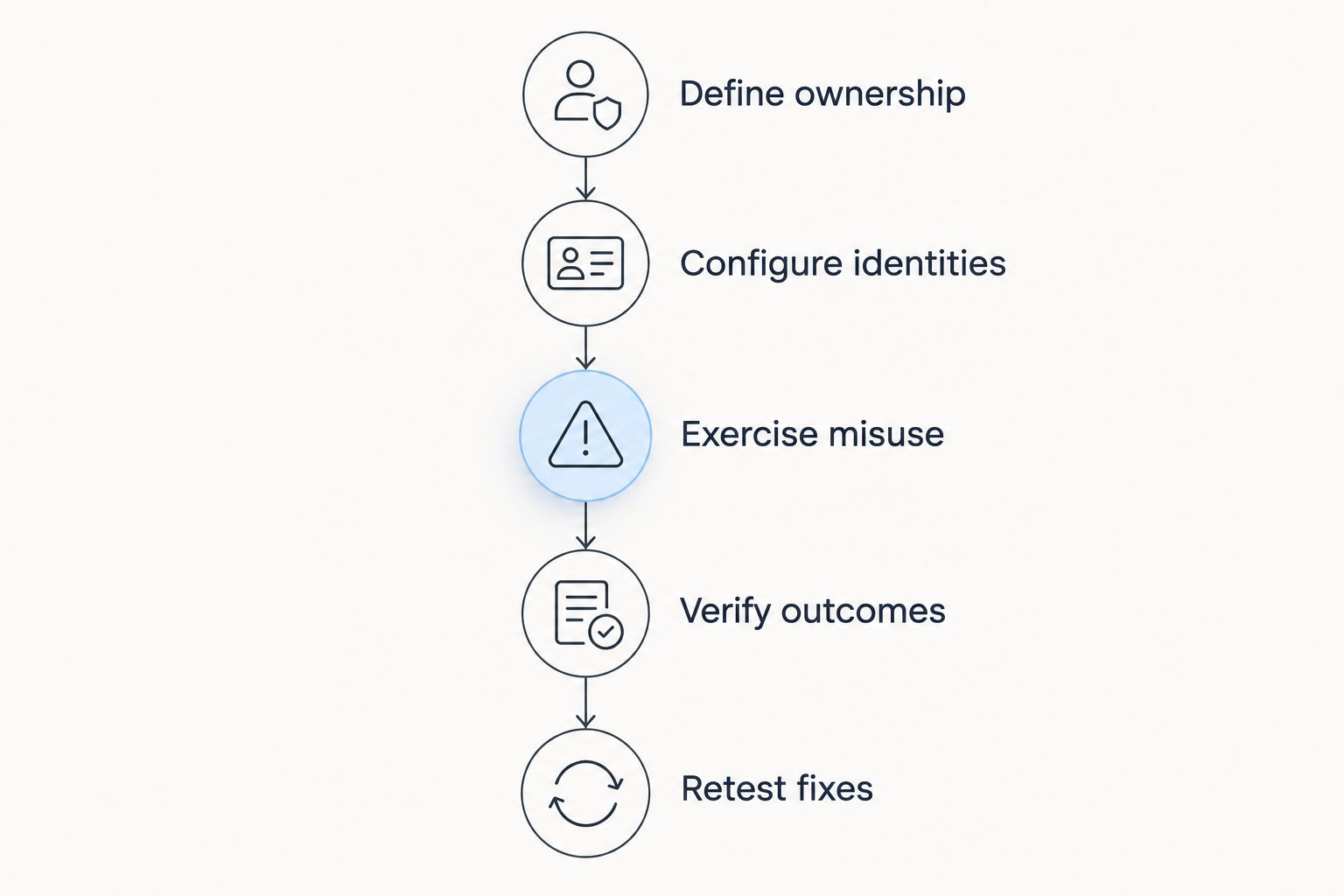
Run the evaluation through these stages:
- Define ownership: Record which identity owns each account and transaction object.
- Configure identities: Supply separate credentials and verify the effective role of every session.
- Exercise misuse: Change ownership references, attempt privileged operations, and alter workflow order within the approved scope.
- Verify outcomes: Inspect returned data and persisted state, not just HTTP status codes.
- Retest fixes: Repeat the original failing request after remediation and preserve the expected result.
Keep credentials and sensitive payloads out of broadly shared reports. Your evidence should explain the defect without becoming another source of account access or customer-data exposure.
How this ranking works
This ranking is a use-case selection guide, not a measured scan-accuracy benchmark. Burp Suite Professional leads for interactive investigation; ZAP addresses repeatable scanning; Schemathesis explores schema-driven inputs; RESTler explores stateful sequences; Postman preserves explicit regression expectations.
The criteria are authorization coverage, workflow depth, input exploration, repeatability, evidence quality, and operational control. No speed, detection-rate, or false-positive scores are assigned because those require a defined test corpus and comparable execution conditions.
Which API security testing tools should you choose?
Choose Burp Suite Professional first when an application security specialist owns the investigation. Pair manual findings with repeatable regression tests rather than leaving the evidence in an assessment report.
If automation is your immediate gap, start with ZAP. Add Schemathesis when maintained schemas are your strongest test input, or RESTler when resource dependencies make isolated requests inadequate. Use Postman to retain explicit authorization checks in the developer workflow.
Keep the management layer separate. Brinqa belongs in a vulnerability and exposure management evaluation; do not count that category as API testing coverage. Your 2026 decision should name who discovers defects, who fixes them, and who verifies closure.
FAQ
What's the best API security testing tool for fintech?
Burp Suite Professional is the default recommendation for expert-led authorization and business-logic investigation. ZAP is the better starting point when your immediate requirement is repeatable automated scanning.
Is ZAP better than Burp Suite Professional for fintech APIs?
ZAP fits automated scanning workflows, while Burp Suite Professional fits interactive investigation. Choose based on the work your team needs to perform, not a claim that either tool covers every API security risk.
Can Postman replace an API vulnerability scanner?
Postman does not replace a dedicated vulnerability scanner. Use scripted assertions to preserve known authorization expectations and regression cases, alongside discovery-focused testing.
Can API scanners detect broken object-level authorization?
Detecting broken object-level authorization requires ownership context and requests made with appropriate identities. Do not assume a generic scan understands which customer should own a particular resource.
Should fintech teams run active API tests in production?
Use a controlled nonproduction environment for destructive and state-changing tests. Production testing requires explicit authorization, agreed boundaries, protected credentials, and controls against real financial effects.
What's the difference between Schemathesis and RESTler?
Schemathesis focuses on schema-driven property-based testing, while RESTler focuses on stateful REST API request sequences. Evaluate Schemathesis for input exploration and RESTler for behavior that depends on earlier operations.
Does Brinqa replace API security testing tools?
Brinqa is a vulnerability and exposure management platform, not a replacement for API security testing tools. Evaluate testing coverage separately from your vulnerability and exposure management requirements.
One last thing
A rejected request is only half the evidence. After an unauthorized transfer attempt, inspect the resulting state: a failure response does not prove that no transfer record, balance change, or downstream action occurred.
Make that verification part of your acceptance test. It gives you a stronger buying signal than a longer list of scanner checks.


