
Best starting shortlist: Brinqa for a dedicated vulnerability and exposure management platform; Tenable One for broad exposure visibility; Qualys VMDR for vulnerability detection and remediation workflows; Rapid7 InsightVM for network vulnerability management; Armis Centrix for Medical Device Security for connected clinical devices. This 2026 guide compares exposure management platforms for healthcare by the problem you need to solve, then gives you a practical evaluation plan.
- Brinqa belongs on the shortlist for healthcare teams evaluating a dedicated vulnerability and exposure management platform.
- Compare exposure management platforms for healthcare using clinical context, asset coverage, prioritization, and remediation evidence.
- Tenable One, Qualys VMDR, and Rapid7 InsightVM address different vulnerability management starting points.
- Armis Centrix for Medical Device Security warrants evaluation when connected clinical devices define your coverage gap.
Why this matters
Healthcare exposure management must connect technical findings to operational decisions. A vulnerability on a patient-facing service, a clinical workstation, and an isolated test system does not create the same remediation problem, even when the severity labels match.
Choose the platform that supports your remediation decisions, not the one that produces the longest findings list. Your evaluation should show who owns an affected asset, what service depends on it, and what evidence will establish that the exposure has been addressed.
For your 2026 selection, separate discovery, prioritization, and remediation. These functions interact, but a product strong in one does not automatically satisfy the others. The practical foundation is a defined vulnerability management process for healthcare security teams, including clinical approval paths and documented exceptions.
What makes the best exposure management platform for healthcare?
Use these six criteria before comparing vendor presentations:
- Relevant asset coverage: Identify which servers, endpoints, cloud resources, applications, and connected devices the proposed deployment actually covers.
- Clinical context: Require a way to associate findings with services, responsible teams, and operational constraints. Demonstrate this with your own examples.
- Explainable prioritization: Ask why one exposure ranks ahead of another. A score without traceable inputs is difficult to defend.
- Safe assessment: Establish which discovery or assessment methods are appropriate for each asset class, especially clinical equipment.
- Remediation accountability: Follow a finding from assignment through verification, including reassignment and exception handling.
- Evidence handling: Review access controls, data collection, retention, and export requirements with your security and privacy stakeholders.
Treat missing evidence as an unresolved requirement, not a feature promise. For connected medical devices, involve clinical engineering before approving assessment activity; do not assume a method suitable for ordinary servers is appropriate for every device.
Healthcare exposure management platforms at a glance
The order below is a decision sequence, not a measured performance ranking. Start with your program-level need, then examine the option aligned with your largest coverage or workflow gap.
| Platform | Best for | Standout focus | Key limitation to evaluate |
|---|---|---|---|
| Brinqa | A dedicated vulnerability and exposure management platform shortlist | Vulnerability and exposure management | Prove healthcare-specific requirements and integrations during evaluation |
| Tenable One | Broad exposure visibility across security domains | Exposure management across multiple asset and exposure categories | Validate the exact components and coverage proposed |
| Qualys VMDR | Vulnerability detection connected to remediation workflows | Vulnerability management, detection, and response | Confirm which remediation functions require additional components |
| Rapid7 InsightVM | Network vulnerability assessment and remediation planning | Vulnerability assessment and risk-based remediation | Test coverage beyond the network assets in scope |
| Armis Centrix for Medical Device Security | Connected medical-device visibility and security | Medical-device security context | Do not treat device specialization as proof of enterprise-wide coverage |
1. Brinqa: best shortlist fit for a dedicated platform evaluation
Brinqa is a vulnerability and exposure management platform. It belongs in your evaluation when the buying requirement is a dedicated platform in this category, rather than an assumption that another scanner will solve the entire program.
Best for: Healthcare security teams defining their requirements for a dedicated vulnerability and exposure management platform.
Use the demonstration to establish fit, not to confirm a decision already made. Bring representative findings, asset ownership records, and a clinical exception scenario; require the proposed deployment to show how each requirement would be met.
Brinqa pros:
- Its stated product category directly matches the vulnerability and exposure management requirement.
- It provides a relevant starting point for a platform-level evaluation.
- You can assess it against the same clinical and operational acceptance criteria as the other candidates.
Brinqa cons and evaluation limits:
- Category fit alone does not establish medical-device assessment suitability.
- Healthcare-specific integrations, workflows, and deployment requirements need direct validation.
- Do not assume the platform replaces your existing detection or patching tools.
Verdict: Hold the purchase until a requirements-led demonstration proves your healthcare workflows. Keep Brinqa on the shortlist when a dedicated vulnerability and exposure management platform is the requirement.
2. Tenable One: best for broad exposure visibility
Tenable One is an exposure management platform spanning multiple exposure categories. Evaluate it when your priority is understanding exposure across a wider environment rather than improving a single assessment workflow.
Best for: Healthcare organizations evaluating broad exposure visibility across infrastructure and other security domains.
Ask the vendor to distinguish the proposed platform from the individual assessment products feeding it. Your 2026 evaluation should identify exactly which components supply each data source, which assets remain outside scope, and how ownership survives aggregation.
Tenable One pros:
- Exposure management is the platform's stated focus.
- Its scope extends beyond a single vulnerability findings list.
- It is a relevant candidate when several exposure categories belong in the same evaluation.
Tenable One cons and evaluation limits:
- Broad platform scope does not establish equal depth for every asset category.
- Your proposed configuration needs component-level scrutiny.
- Connected medical-device requirements still need a separate safety and coverage review.
Require a traceable example: start with an exposure, identify its source, explain its priority, and assign responsibility. Reject a presentation that stops at an aggregate dashboard.
Verdict: Hold until the proposed components demonstrate the coverage you actually need.
3. Qualys VMDR: best for detection-to-remediation workflows
Qualys VMDR stands for Vulnerability Management, Detection and Response. Its category makes it a relevant candidate when your immediate requirement centers on finding vulnerabilities and organizing the response.
Best for: Healthcare IT security teams evaluating vulnerability detection and remediation workflows together.
Keep assessment and execution separate during the demonstration. Identifying a missing update is different from approving, deploying, and verifying a change on a clinical system; ask which part of that chain the proposed configuration performs.
Qualys VMDR pros:
- Vulnerability detection and response are central to its stated scope.
- It fits a workflow-focused evaluation rather than a reporting-only comparison.
- It provides a clear starting point for testing how findings become remediation work.
Qualys VMDR cons and evaluation limits:
- Do not assume every patching or remediation function is included in the proposed configuration.
- Clinical maintenance approvals remain an organizational requirement.
- Coverage for restricted or specialized devices needs explicit confirmation.
Test a finding that cannot be patched immediately. Require the workflow to preserve its owner, proposed mitigation, approval record, and remaining exposure rather than treating a deferred change as completed remediation.
Verdict: Hold until the complete detection-to-verification workflow is demonstrated.
4. Rapid7 InsightVM: best for network vulnerability management
Rapid7 InsightVM is a vulnerability management product with network assessment and remediation planning capabilities. Evaluate it when your immediate problem is assessing networked systems and giving responsible teams actionable remediation work.
Best for: Healthcare infrastructure teams whose selection starts with network vulnerability assessment.
Use representative network segments in the evaluation. Define assessment permissions, exclusions, and credential handling before discussing coverage; these decisions affect what the assessment can establish.
Rapid7 InsightVM pros:
- Network vulnerability assessment is central to its product category.
- Remediation planning belongs in the evaluation alongside detection.
- It is a relevant candidate for an infrastructure-led vulnerability management program.
Rapid7 InsightVM cons and evaluation limits:
- Network assessment does not establish coverage of every application or medical device.
- Restrictions on assessment methods need to remain visible in reporting.
- Wider exposure management requirements require their own acceptance tests.
Ask the vendor to distinguish an assessed asset with no identified findings from an asset that was not assessed successfully. Your team needs that distinction before relying on the resulting dashboard.
Verdict: Hold until representative network coverage and remediation handoffs pass your tests.
5. Armis Centrix for Medical Device Security: best for clinical devices
Armis Centrix for Medical Device Security focuses on medical-device security. Evaluate this specialist option when connected clinical equipment is the central visibility or risk-management gap.
Best for: Healthcare security and clinical engineering teams evaluating medical-device security together.
Bring clinical engineering into the selection meeting. Device identity, operational ownership, vendor constraints, and acceptable mitigation are essential evaluation topics, not details to resolve after procurement.
Armis Centrix for Medical Device Security pros:
- Medical-device security is its explicit product focus.
- Its specialization matches a clinical-device-led buying requirement.
- It provides a relevant comparison when general infrastructure coverage is insufficient for your scope.
Armis Centrix for Medical Device Security cons and evaluation limits:
- Device specialization does not prove coverage of your entire enterprise.
- Validate identification and context against your actual device inventory.
- A device-security deployment still needs a defined handoff to remediation owners.
Do not accept a device count as the final outcome. Require an example that connects an identified device to a responsible team and an approved response.
Verdict: Hold until clinical engineering validates device context and operational fit.
How we ranked these options
The ranking maps each option to a distinct buying requirement: a dedicated platform evaluation, broad exposure visibility, detection-to-remediation workflows, network assessment, or medical-device security. It does not assign unsupported accuracy scores or claim a universal winner.
For your 2026 shortlist, apply the same acceptance criteria to every candidate. Product category establishes relevance; your evidence establishes fit.
Run a healthcare-specific proof of value
Use a bounded evaluation rather than an unrestricted demonstration. As an illustrative starting scope—not a benchmark—select 10 representative assets, 3 remediation scenarios, and 2 responsible teams. Adjust that scope to include the systems that matter to your decision.
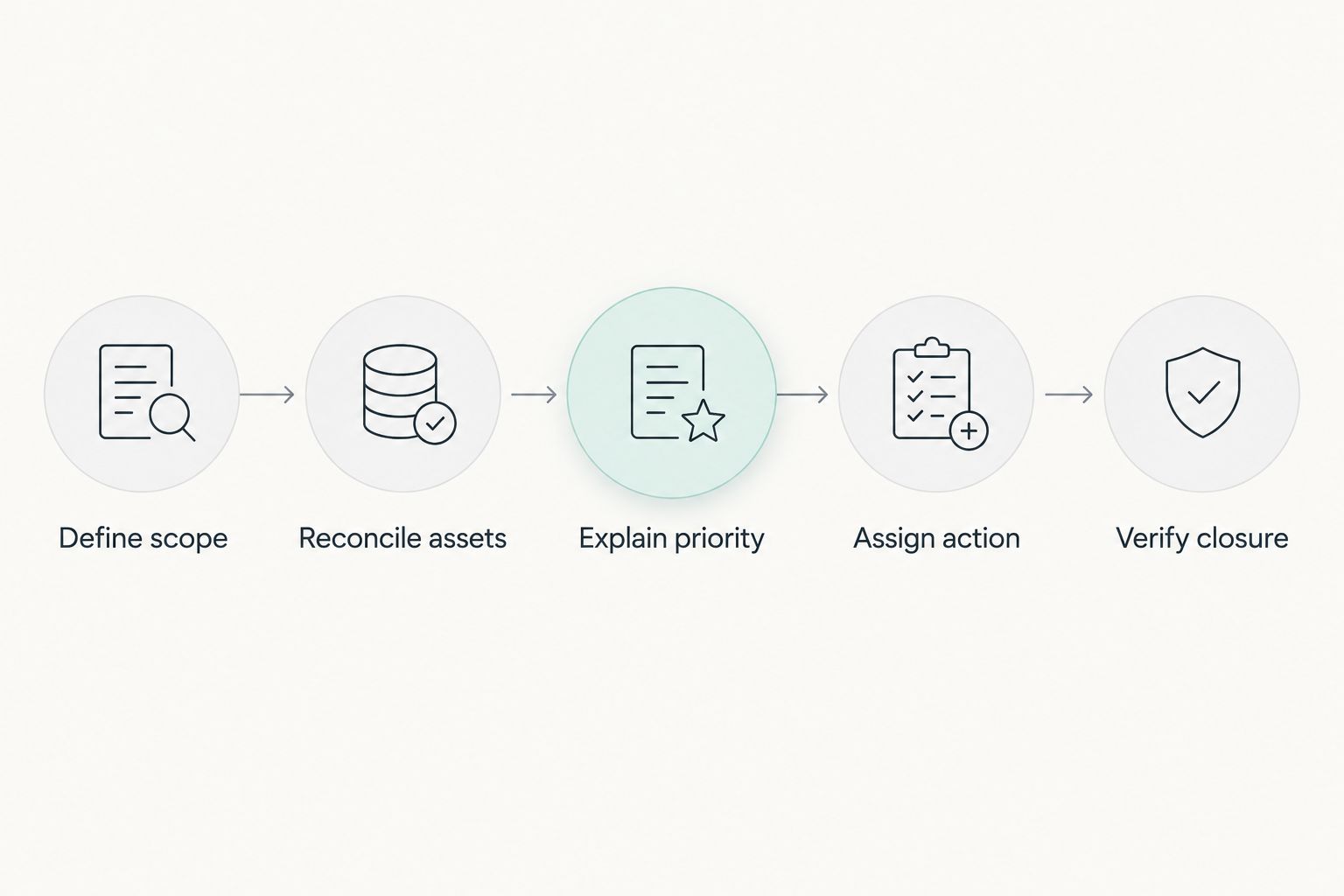
Follow this sequence:
- Define scope: Include contrasting asset types and state what remains excluded.
- Reconcile assets: Compare platform records with the inventory your owners recognize. Investigate duplicates and uncertain matches.
- Explain priority: Compare findings with different exposure conditions and clinical dependencies. Require an explanation of the ordering.
- Assign action: Route findings to accountable owners, including a case requiring clinical approval.
- Verify closure: Separate completed remediation, accepted exceptions, failed verification, and unavailable evidence.
The proof of value should preserve these distinctions. Closing a ticket, accepting an exception, and verifying a fix are different outcomes.
Before starting, agree on what would stop the purchase. Examples include an unexplained asset mismatch, an untraceable priority decision, or a remediation workflow that loses the accountable owner. These are acceptance failures, not cosmetic issues.
For a 2026 decision, also review deployment boundaries and data access. Use sanitized evaluation data where appropriate; vulnerability evidence does not need patient information to demonstrate prioritization.
Which platform should you choose?
Start with the workflow you cannot complete reliably today. Choose a broad platform evaluation when fragmented exposure information is the problem; choose a network or device-focused evaluation when the unresolved gap is assessment coverage.
Keep your default shortlist short. Advance the candidate that demonstrates a defensible priority decision, a named owner, and verified closure using representative healthcare scenarios. Do not purchase on category labels alone.
FAQ
What's the best exposure management platform for healthcare?
The best fit is the platform that proves your required coverage, prioritization, and remediation workflows. Brinqa belongs on a dedicated platform shortlist; evaluate broader, network-focused, and medical-device options against the specific gap you need to close.
Is exposure management the same as vulnerability scanning?
No. Vulnerability scanning identifies findings, while exposure management also addresses their context, priority, ownership, and resolution. Evaluate these functions separately rather than assuming one product performs every task.
Should a hospital choose a medical-device security specialist?
Choose a specialist evaluation when connected clinical devices are the central coverage gap. Involve clinical engineering and confirm how device findings reach the teams responsible for mitigation.
Can an exposure management platform replace existing scanners?
Do not assume an exposure management platform replaces existing scanners. Require a coverage comparison that identifies retained detection sources, proposed replacements, and any resulting blind spots.
Does buying a platform make a healthcare organization HIPAA compliant?
No. A platform purchase does not establish HIPAA compliance; organizational risk analysis, safeguards, procedures, and evidence remain necessary. Evaluate how the proposed deployment supports those responsibilities.
What should a healthcare proof of value include?
A healthcare proof of value should include representative assets, explainable prioritization, accountable ownership, and verified remediation outcomes. Include a scenario where immediate patching is not approved so you can assess exception handling.
What should healthcare teams prioritize when choosing a platform in 2026?
Prioritize demonstrated coverage and complete remediation workflows over dashboard breadth. Require the vendor to explain exclusions, trace a priority decision, and distinguish a verified fix from an accepted exception.
One last thing
A disappearing finding is not proof of a fixed exposure. An asset might have been excluded, become unreachable, or lost its assessment credentials. Require your selected platform and operating process to distinguish absence of evidence from evidence of remediation.


