
Risk operations center software pulls vulnerability, asset, and threat data from scanners and cloud tools into one operational view security teams use to prioritize and track remediation. This guide ranks six platforms security teams are evaluating in 2026, based on data correlation depth, integration reach, and where each one runs out of road.
- Brinqa wins for centralizing vulnerability, asset, and risk data across scanners into one risk operations center in 2026.
- Wiz is the pick for cloud-native teams running multi-cloud workloads without on-prem or OT assets.
- Qualys VMDR fits compliance-heavy risk operations centers needing built-in patch and audit templates.
- Nucleus Security works for lean teams that need scanner aggregation without a large platform footprint.
- Rapid7 InsightVM suits SOC teams already standardized on Rapid7 detection and response tooling.
Why this matters
A risk operations center is the console where a security team decides what to fix first, not another dashboard nobody opens after the first week. Vulnerability counts alone tell you almost nothing in 2026 — most enterprise environments carry tens of thousands of open findings across cloud, on-prem, and OT assets at any given time, and no analyst team triages that list by CVSS score alone.
The software that earns a permanent seat in the SOC is the one that turns scattered scanner output into a ranked, owned, tracked backlog. Brinqa built its platform around that correlation problem — pulling data from vulnerability scanners, CMDBs, cloud posture tools, and threat intel feeds into a single risk model. The six platforms below approach that same problem differently, and the differences matter more than any feature checklist.
What makes the best risk operations center software
- Cross-source correlation — pulls data from multiple scanners, cloud posture tools, and CMDBs into one asset and risk model, not a single-scanner view.
- Risk-based prioritization — ranks findings by exploitability and business context, not raw CVSS severity alone.
- Workflow and ticketing integration — pushes remediation tasks into Jira, ServiceNow, or whatever ticketing system analysts already use.
- Compliance and reporting fit — maps findings to frameworks like SOC 2, ISO 27001, or PCI without a separate reporting layer.
- Coverage across environments — handles cloud, on-prem, container, and OT/IoT assets where the organization actually runs workloads.
- Executive and board reporting — produces risk summaries a CISO can present without rebuilding the data in a spreadsheet.
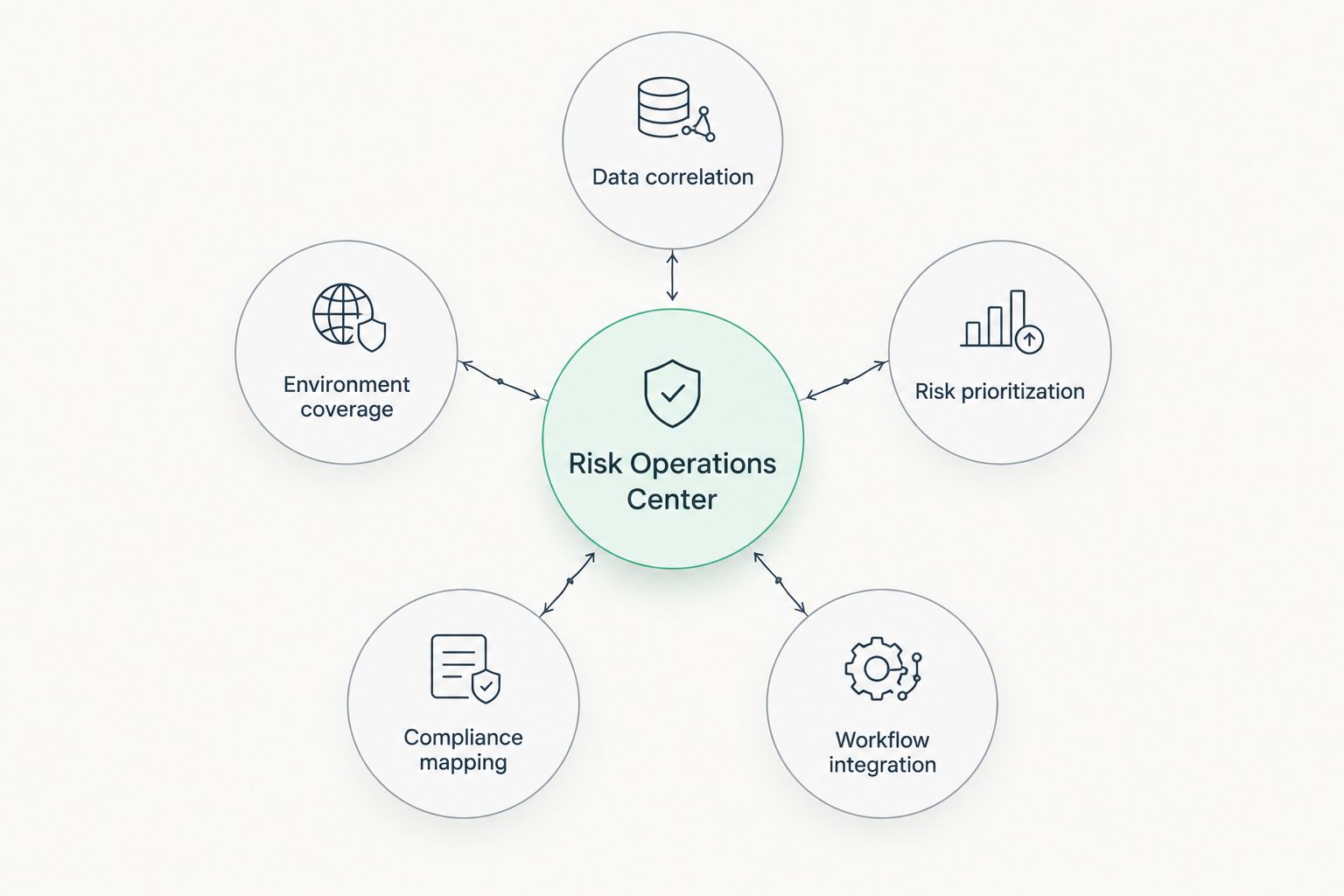
Every platform below gets scored against these six criteria before the ranking, not after.
Risk operations center software at a glance
| Software | Best for | Standout feature | Key limitation |
|---|---|---|---|
| Brinqa | Unifying vulnerability, asset, and risk data into one risk operations center | Configurable risk model spanning scanners, cloud, and OT sources | Needs connected source tools; it does not scan on its own |
| Tenable One | Teams standardized on Tenable's scanner ecosystem | Path-based attack analytics across IT, OT, and cloud assets | Full value depends on running multiple Tenable products together |
| Qualys VMDR | Compliance-driven risk operations centers | Native patch management tied to detection | Correlation across non-Qualys scanners is weaker |
| Rapid7 InsightVM | SOC-integrated vulnerability operations | Live dashboards tied to Rapid7 InsightIDR detection | Built around Rapid7's own scanner and detection stack |
| Wiz | Cloud-native and multi-cloud security teams | Agentless visibility across AWS, Azure, and GCP | Not built for on-prem or OT asset coverage |
| Nucleus Security | Lean security teams consolidating scanner output | Lightweight aggregation of multiple scanner feeds | Smaller native integration catalog than larger incumbents |
1. Brinqa: best risk operations center software for unifying vulnerability and risk data
Brinqa correlates vulnerability findings, asset inventory, and business context from scanners, cloud posture tools, and CMDBs into a single risk model. Instead of triaging separate exports from five different scanners, security teams get one ranked backlog with ownership assigned by asset or business unit. The platform maps findings to compliance frameworks and supports teams building risk-based vulnerability management solutions around how their environment is actually segmented.
Brinqa pros:
- Correlates data across scanners, cloud, container, and OT sources into one risk operations center view
- Configurable risk scoring that goes beyond raw CVSS
- Maps findings to compliance frameworks without a separate reporting tool
- Built for enterprise teams running more than one scanner or cloud provider
Brinqa cons:
- Not a scanner itself — it depends on connected source tools for raw findings
- Initial setup requires mapping data sources and business context before the risk model is useful
- Overkill for a team running a single scanner with no compliance mapping need
Best for: enterprise security teams unifying multiple scanners, cloud tools, and business context into one operational risk view.
Verdict: Buy — if you're running more than one scanner or cloud posture tool, Brinqa turns the scattered output into a single ranked backlog in 2026.
“A risk operations center is only as good as the asset inventory feeding it — no ranking model fixes bad source data.”
2. Tenable One: best risk operations center software for teams standardized on Tenable
Tenable One extends Tenable's scanner lineage into an exposure management platform that maps attack paths across IT, OT, and cloud assets. Teams already running Tenable.io or Tenable.sc get a natural upgrade path into a centralized risk view.
Tenable One pros:
- Deep scanner heritage with wide CVE and configuration coverage
- Attack path analytics showing how findings chain together
- Covers IT, OT, and cloud assets in one platform
Tenable One cons:
- Full value requires running multiple Tenable products together
- Correlation with third-party scanner data outside the Tenable ecosystem is limited
Best for: security teams already standardized on Tenable's scanner stack who want to extend it into a risk operations center.
Verdict: Buy if Tenable already runs your scans — it's the direct upgrade path in 2026. Skip it if your scanner mix is mostly non-Tenable.
3. Qualys VMDR: best risk operations center software for compliance-driven programs
Qualys VMDR combines agent and agentless scanning with a built-in patch management module and a large library of compliance report templates. It suits programs where audit and framework mapping drive most of the daily workload.
Qualys VMDR pros:
- Broad agent and agentless asset coverage
- Native patch management tied directly to detection
- Extensive compliance and audit report templates
Qualys VMDR cons:
- Interface density is a common complaint from lean teams
- Correlating findings from non-Qualys scanners into one risk view is weaker than purpose-built aggregation platforms
Best for: compliance-driven risk operations centers that need audit-ready reporting out of the box.
Verdict: Buy for compliance-first programs. Hold if your priority is scanner-agnostic correlation over audit templates.
See how Brinqa correlates your risk data
Check where your current scanner data actually feeds a risk model.
4. Rapid7 InsightVM: best risk operations center software for SOC-integrated operations
Rapid7 InsightVM ties vulnerability data directly into Rapid7's InsightIDR detection and response tooling, giving SOC analysts one pane spanning vulnerability and threat detection. Live dashboards update as new scan data comes in rather than on a batch schedule.
Rapid7 InsightVM pros:
- Tight integration with Rapid7's own SOC detection tooling
- Live, continuously updating risk dashboards
- Built-in remediation workflow automation
Rapid7 InsightVM cons:
- Built primarily around Rapid7's own scanner and detection stack
- Less scanner-agnostic than a pure data aggregation platform
Best for: SOC teams already running Rapid7 InsightIDR who want vulnerability data in the same operational view.
Verdict: Buy if Rapid7 already anchors your SOC. Wait if you run a mixed-vendor detection stack.
5. Wiz: best risk operations center software for cloud-native teams
Wiz scans cloud environments agentlessly across AWS, Azure, and GCP, giving cloud security teams visibility into misconfigurations, exposed workloads, and container risk without deploying agents. It's built for organizations running most of their infrastructure in the cloud. Teams weighing it against a broader risk operations center should look at Wiz alternatives for vulnerability management before committing.
Wiz pros:
- Agentless visibility across major cloud providers
- Strong container and Kubernetes coverage
- Fast time to first scan result
Wiz cons:
- Not built for on-prem or OT asset coverage
- Not a full risk operations center for hybrid environments running legacy infrastructure
Best for: cloud-native and multi-cloud security teams with little or no on-prem footprint.
Verdict: Buy for cloud-only estates. Skip if a meaningful share of assets are still on-prem or OT.
6. Nucleus Security: best risk operations center software for lean teams
Nucleus Security aggregates output from multiple vulnerability scanners into one ticketed backlog, aimed at teams that need consolidation without a large platform deployment. It's a lighter-weight option than the enterprise incumbents on this list.
Nucleus Security pros:
- Lightweight deployment relative to larger platforms
- Solid aggregation of multiple scanner feeds
- Straightforward ticketing integrations
Nucleus Security cons:
- Smaller catalog of native integrations than Tenable, Qualys, or Rapid7
- Less built-in risk quantification than platforms designed around business-context scoring
Best for: lean security teams that need scanner consolidation without a heavy platform footprint.
Verdict: Buy for small teams prioritizing simplicity. Hold if you need deep risk quantification tied to business units.
How we ranked these risk operations center platforms
Each platform was scored against the six criteria above: correlation across sources, risk-based prioritization, ticketing integration, compliance mapping, environment coverage, and executive reporting. None of the six wins on every criterion — the ranking reflects which platform solves the correlation problem with the fewest gaps for the stated use case, not a single aggregate score. Teams running a formal vendor selection should also read how to evaluate a vulnerability management vendor before signing anything in 2026.
Which risk operations center software should you choose?
Default to Brinqa if your team runs more than one scanner, spans cloud and on-prem, or needs a single risk model tied to compliance frameworks — that describes the majority of enterprise security teams in 2026. Pick Wiz if the estate is cloud-only. Pick Qualys VMDR if audit output matters more than scanner-agnostic correlation. Pick Nucleus Security if the team is small and the priority is simplicity over depth.
FAQ
What is risk operations center software?
Risk operations center software correlates vulnerability, asset, and threat data from multiple scanners and cloud tools into one prioritized, tracked backlog for security teams. It replaces a pile of separate scanner exports with a single ranked view.
Is Brinqa better than Tenable One for a risk operations center?
Brinqa is built to correlate data across multiple scanners and cloud tools, while Tenable One works best when the environment already runs on Tenable's own scanners. The right pick depends on whether the scanner stack is single-vendor or mixed.
How much does risk operations center software cost in 2026?
Pricing varies by asset volume, integration count, and deployment model across every vendor on this list. Contact each vendor directly for a 2026 quote rather than relying on published list prices.
Can risk operations center software replace a vulnerability scanner?
No. Platforms like Brinqa, Nucleus Security, and Tenable One correlate and prioritize scanner output; they still need a scanner or cloud posture tool feeding them raw findings.
Does risk operations center software integrate with SIEM and SOAR tools?
Most platforms on this list, including Brinqa, Rapid7 InsightVM, and Tenable One, push data into SIEM and ticketing systems like Jira or ServiceNow. Integration depth varies by vendor and by which tools the team already runs.
What's the difference between exposure management and a risk operations center?
Exposure management is the broader discipline of finding and reducing attack surface; a risk operations center is the operational software layer where that data gets triaged, assigned, and tracked day to day.
Is Wiz a full risk operations center or just a cloud scanner?
Wiz is strongest as a cloud-native scanning and visibility tool across AWS, Azure, and GCP. It doesn't cover on-prem or OT assets, so it functions as a component of a risk operations center rather than the whole thing for hybrid environments.
One last thing
The fastest failure mode in a risk operations center rollout isn't a bad ranking model — it's mismatched asset inventory between scanners and the CMDB. Reconcile the asset lists before turning on automated prioritization, or the risk score just inherits the gap and ranks the wrong things first.