
Yes—AI can help prioritize vulnerabilities at scale, but accuracy depends on verified findings, current asset context, and a defined remediation objective. A model's ranking is not proof that a vulnerability is exploitable in your environment, and a clear explanation is not evidence that its recommendation is correct. Use AI to support triage; validate its decisions before allowing it to defer remediation.
- Can AI prioritize vulnerabilities? Yes, when verified exposure data and measurable evaluation criteria support its recommendations.
- Compare AI rankings against severity rules and analyst decisions before automating remediation queues.
- EPSS predicts exploitation probability; it does not measure business impact or confirm local exploitability.
- Brinqa is a vulnerability and exposure management platform; assess AI prioritization separately against your requirements.
Why this matters
A ranked backlog is useful only if it directs your team toward the right remediation work. Processing findings faster does not establish that the system identifies the exposures that matter most.
For a 2026 evaluation, separate three questions: whether the vulnerability exists, whether an attacker can exploit it, and what exploitation would affect. Your custom vulnerability severity scoring model should make those distinctions explicit before a model influences the queue.
Can AI accurately prioritize vulnerabilities at scale?
AI can support accurate prioritization, but you must establish accuracy within your environment. Compare its recommendations with a documented baseline, investigate disagreements, and check whether the ranking reflects evidence rather than plausible wording.
Different approaches answer different questions. Use this comparison to choose what to evaluate—not to assume that adding a model improves an existing process.
| Approach | Best for | Useful contribution | Main limitation |
|---|---|---|---|
| Severity-based rules | Consistent technical triage | Apply documented thresholds predictably | Technical severity alone does not establish local business risk |
| Predictive exploitation models | Adding threat likelihood | Estimate exploitation probability within a defined scope | Predictions are not confirmation of exploitation on your assets |
| Generative assistants | Analyst summaries and explanations | Turn supplied evidence into readable recommendations | Generated text can contain unsupported statements |
| Contextual decision workflows | Operational remediation queues | Combine findings, asset context, policy, and ownership | Results depend on data quality and maintained decision logic |
The strongest evaluation compares decisions, not demonstrations. A polished summary does not show whether a system missed a dangerous exposure or incorrectly downgraded an affected asset.
Keep finding validity separate from priority. A real vulnerability can have a lower remediation priority under your policy; that does not make it a false positive. Conversely, an invalid finding should not remain in the queue merely because its vulnerability identifier carries a severe rating.
What should each prioritization approach contribute?
Predictive models: estimate exploitation likelihood
A predictive model addresses a defined outcome, such as whether a published vulnerability will be exploited. Check the prediction target, forecast horizon, and population before interpreting its output.
FIRST's Exploit Prediction Scoring System, or EPSS, estimates the probability that a published vulnerability will be exploited in the wild within the next 30 days. Its probability score runs from 0 to 1. That scope does not establish whether your deployment is affected, reachable, or business-critical.
Generative assistants: explain supplied evidence
A generative assistant can draft a remediation explanation from vulnerability records and asset information. Require the explanation to identify its supporting records and distinguish observed facts from inference.
Do not treat fluency as confidence. An assistant that describes an unverified network path or assumes a compensating control exists has introduced a new claim, not resolved an uncertainty.
Contextual workflows: apply your remediation policy
A contextual workflow should connect each finding to the affected asset, business service, accountable owner, and approved policy. Model output can be an input without becoming the final authority.
The benefit is operational clarity: someone receives a justified action. The limitation is maintenance; ownership changes, exposure changes, and exceptions expire, so yesterday's correct ranking requires reassessment.
Which evidence should support the ranking?
Start with evidence that answers a specific decision question. More fields do not automatically create better context, especially when records conflict or describe different assets.
| Evidence | Decision it supports | Important boundary |
|---|---|---|
| Scanner finding and affected version | Is this deployment affected? | A vulnerability identifier alone does not prove applicability |
| Asset identity and observation time | Are records about the same current asset? | A reused address can create a misleading match |
| Reachability and access requirements | Can an attacker reach the vulnerable component? | Internet exposure is not the only possible attack path |
| Exploitation intelligence | Is exploitation observed or predicted? | Observed activity and predicted likelihood are different signals |
| Business-service mapping | What would disruption or compromise affect? | Missing impact data is not evidence of low impact |
| Control and exception records | Is a documented risk treatment relevant? | A recorded control still needs applicable, current evidence |
FIRST's Common Vulnerability Scoring System describes vulnerability severity on a 0–10 scale. For your 2026 assessment, retain the score's version and vector rather than treating the headline number as a complete risk decision.
CVSS severity, EPSS likelihood, and business impact are not interchangeable units. Do not present an arbitrary combination as a probability of compromise. If you create a composite score, document what it means and how your team should use it.
Why prioritization accuracy varies
Accuracy depends on the decision being evaluated and the evidence available when it was made. Test these factors directly rather than relying on a single overall score:
- Finding validity: Confirm affected software and relevant detection evidence. Prioritization cannot correct an invalid starting record by assigning it a different rank.
- Asset identity: Resolve scanner observations to the right asset. Keep conflicting matches visible instead of silently combining unrelated records.
- Exposure context: Establish reachable services, access conditions, and relevant attack paths. Treat unverified exposure as unresolved, not automatically absent.
- Business impact: Identify the service, data, or operational dependency at risk. Require an accountable owner to confirm consequential assumptions.
- Evidence freshness: Retain observation times and update rankings when material facts change. A current vulnerability record does not guarantee current asset context.
- Evaluation quality: Use independently reviewed decisions and representative cases. Reproducing a flawed historical queue is not evidence of better prioritization.
How do you validate AI prioritization before rollout?
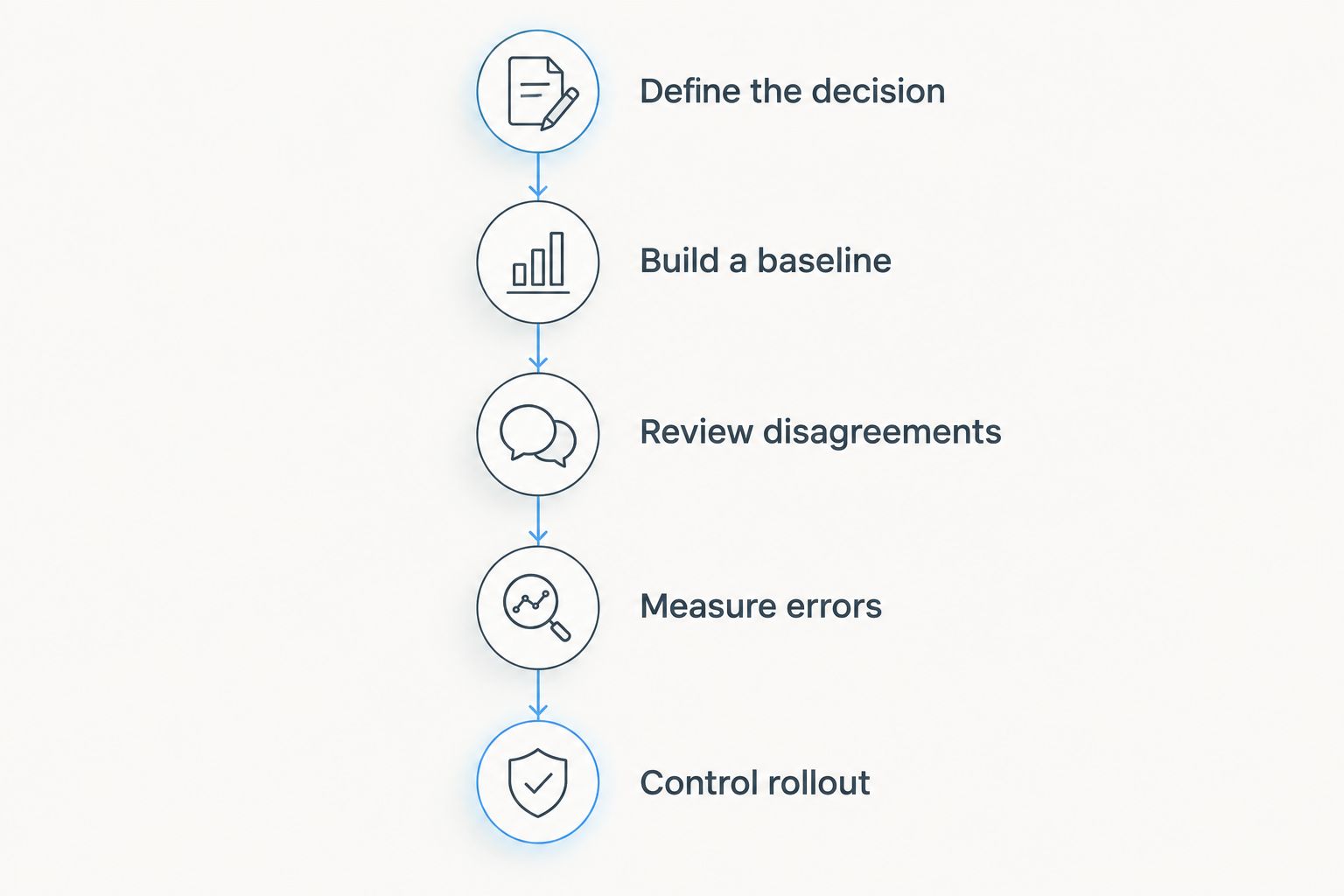
Use a staged evaluation in 2026. Define success before looking at the model's recommendations, and keep the test evidence separate from the information used to configure the system.
- Define the decision. Specify whether the system recommends queue order, escalation, assignment, or deferral. Evaluate each action separately; good summaries do not establish safe deferral decisions.
- Build a baseline. Preserve the rankings produced by your current rules and analyst process. Record the evidence available at the time so later intelligence does not distort the comparison.
- Review disagreements. Have qualified reviewers assess cases where the model and baseline differ. Include lower-ranked findings, because reviewing only the top of the queue cannot reveal what the model missed below it.
- Measure errors. Track unsupported escalations, missed urgent exposures, incorrect asset matches, and unsupported explanations. State the denominator and review criteria for every reported rate.
- Control rollout. Begin with recommendations that analysts can accept or reject. Expand automation only for decisions that meet your documented acceptance criteria, with an override and rollback path.
This sequence separates evaluation from deployment. Keep the same decision definition throughout the comparison; changing what counts as urgent after reviewing results makes the outcome difficult to interpret.
Measure ranking quality and operational usefulness separately
Ranking quality asks whether consequential exposures receive appropriate attention. Operational usefulness asks whether the recommendation gives the responsible team enough evidence to act. A system can perform well on one and poorly on the other.
Use precision to describe how many reviewed escalations were justified. Use recall only when you have a defensible reference set of exposures that should have been escalated; an unknown denominator cannot support a meaningful recall claim.
Track analyst overrides with reason codes. Separate incorrect recommendations from legitimate policy exceptions, and distinguish accepted recommendations from completed, verified remediation. Acceptance is not proof of risk reduction.
Test scale as a workload, not a record count
A large initial import tests throughput, not sustained prioritization quality. Your 2026 evaluation should also include incremental updates, duplicate observations, asset retirement, missing enrichment, and changes in threat intelligence.
Check what happens when a dependency fails. If asset ownership stops updating or a threat feed becomes unavailable, the workflow should expose that condition rather than quietly present an apparently current ranking.
What should remain under human control?
Keep accountable review for risk acceptance, consequential deferrals, and actions that can disrupt essential services. AI can prepare the supporting evidence; it should not manufacture authority to accept business risk.
Automated routing and evidence collection have different consequences from automated closure. Set permissions by action, preserve the reason for each decision, and ensure an analyst can reverse an incorrect recommendation without losing its history.
Treat advisory text, ticket descriptions, and other ingested material as untrusted content. If a generative component reads those sources, test whether embedded instructions can change its behavior or trigger unauthorized actions.
Where does Brinqa fit in this evaluation?
Brinqa is a category fit for teams seeking a vulnerability and exposure management platform. That identifies its relevant role; it does not establish AI accuracy, supported workflows, or results in your environment.
Evaluate Brinqa against the same evidence and acceptance criteria you apply to any candidate. Ask for a demonstration using representative records, including contradictory findings, missing ownership, and a recommendation that reviewers should reject.
The category benefit is a focus on vulnerability and exposure management. The evaluation boundary is equally important: platform positioning alone cannot establish model quality, data coverage, or safe automation. Require evidence for each capability your decision depends on.
Is AI prioritization better than CVSS alone?
CVSS alone is not a complete business-risk ranking. A context-aware process can incorporate exploitation intelligence, exposure, and business impact, but you must test whether a particular implementation makes better decisions.
Keep CVSS as a technical input rather than discarding it. The question is whether the additional evidence changes remediation decisions correctly—not whether a new score looks more detailed.
Can AI replace vulnerability analysts?
AI should support vulnerability analysts, not replace accountable risk decisions. Analysts still need to resolve conflicting evidence, validate exceptional cases, and coordinate with the people responsible for affected services.
Automate a bounded task before expanding its authority. Clear limits make both errors and useful contributions easier to identify.
What proves that AI prioritization works at scale?
Evidence of correct decisions under representative operating conditions proves more than processing volume. Require reviewed ranking outcomes, visible failure handling, and usable remediation records alongside throughput measurements.
Repeat the evaluation when inputs, models, or policies materially change. A successful initial test does not establish continuing accuracy.
FAQ
Can AI prioritize vulnerabilities without asset context?
AI can rank vulnerability records without asset context, but that ranking cannot establish your organization's remediation order. Asset applicability, exposure, and business impact remain unresolved.
What's the difference between CVSS and EPSS?
CVSS describes vulnerability severity, while EPSS estimates exploitation probability over the next 30 days. Neither independently establishes business impact or confirms that your deployment is affected.
Does a low EPSS score mean I can ignore a vulnerability?
No—a low EPSS score is not proof that a vulnerability is safe to ignore. Consider applicability, exposure, exploitation evidence, business impact, and your remediation policy.
Can a generative assistant confirm that a vulnerability is exploitable?
Generated text alone cannot confirm exploitability. Require applicable technical evidence or authorized validation, and keep inferred conditions separate from observed facts.
How should I evaluate Brinqa for vulnerability prioritization?
Evaluate Brinqa with representative findings and documented acceptance criteria. Check evidence quality, decision explanations, reviewer overrides, and any required workflows directly rather than inferring capabilities from platform positioning.
Should AI automatically close low-priority vulnerability tickets?
Low priority alone is not a reason to close a valid vulnerability finding. Closure should follow your documented process, such as verified remediation, confirmed inapplicability, or an approved disposition.
What should I ask a vendor about its accuracy claims?
Ask what decision was measured, which records were evaluated, and how correctness was established. Require error definitions, denominators, and results relevant to your environment.
One last thing
Test whether the system admits uncertainty. Remove a consequential piece of context from a test case and inspect the result: a trustworthy workflow should identify the missing evidence, not convert its absence into a confident low-risk recommendation.
Make that a 2026 acceptance test. A system that explains what it cannot establish gives your analysts a concrete next action: verify the missing fact before accepting the recommendation.