
Yes—AI can help reduce false positives in vulnerability scans by identifying likely detection errors and directing analysts to evidence that confirms or contradicts a finding. It does not prove that a vulnerability is absent: reducing the review queue without checking what was suppressed can hide real vulnerabilities.
- Can AI reduce false positives in vulnerability scans? Yes, when classification is checked against technical evidence.
- Deduplication and risk prioritization reduce scanner noise but do not establish that a finding is false.
- Evaluate rejected findings as carefully as accepted findings; missed vulnerabilities are the critical countermeasure.
- Brinqa is a vulnerability and exposure management platform; evaluate any proposed AI capabilities separately.
Can AI reduce false positives in vulnerability scans?
AI can assist false-positive triage; evidence must determine whether a finding is false. A model can classify scanner output, compare descriptions with asset information, or suggest verification steps. None of those actions independently establishes the affected software's actual state.
Start with the underlying process for reducing false positives in vulnerability scan results. AI should support that process rather than replace its validation requirements.
The distinction matters when comparing approaches:
| Approach | Best for | Useful contribution | Main limitation |
|---|---|---|---|
| Rules-based validation | Explicit applicability checks | Tests known conditions consistently | Requires maintained rules and reliable inputs |
| Machine-learning classification | Repeated patterns in labeled findings | Flags likely detection errors for review | Can repeat mistakes in historical labels |
| Language-model assistance | Unstructured scanner evidence | Summarizes evidence and proposes checks | Can generate unsupported explanations |
| Analyst-led verification | Ambiguous or consequential findings | Resolves contradictions using technical evidence | Requires analyst time and access |
These approaches are not interchangeable. A sensible 2026 evaluation compares the proposed AI workflow with your existing validation process, not with an unfiltered queue nobody normally uses.
Why this matters
A smaller backlog is not automatically a more accurate backlog. You can reduce ticket volume through deduplication, risk acceptance, or suppression without correcting a single scanner detection error.
Keep the outcomes separate:
- False positive: The scanner reports a vulnerability that is not actually present on the assessed asset.
- Duplicate: Multiple records describe the same underlying issue.
- Lower priority: The vulnerability exists, but other findings require earlier action.
- Accepted risk: The vulnerability remains, with an approved decision not to remediate immediately.
- Unverified: Available evidence does not establish whether the finding is valid.
Treating all these categories as false positives corrupts both your reporting and your training labels. It also teaches automation to reproduce administrative decisions as technical conclusions.
Where AI helps—and where it needs a boundary
Evidence summarization: best for analyst preparation
A language model can turn lengthy plugin output, package details, and advisory text into a structured review summary. Ask it to separate observed facts from inferred conditions and to identify which source supports each statement.
The benefit is a more readable evidence packet. The limitation is that fluent text can conceal an unsupported inference, so reviewers still need access to the original output.
Recommendation: use summaries to prepare decisions, not authorize closure. A missing package version should remain missing rather than become a plausible version supplied by the model.
Pattern classification: best for recurring review cases
A classifier can learn associations between finding attributes and previously verified outcomes. Useful inputs include the detection method, evidence fields, software identity, and the reason an analyst confirmed or rejected the finding.
Historical labels are the constraint. A ticket closed because a server was being retired is not a confirmed false positive, and feeding it into that category teaches the wrong behavior.
Recommendation: train and evaluate against verified technical outcomes. Keep operational closure reasons outside the false-positive label.
Applicability checking: best for explicit technical conditions
AI can help extract affected-version ranges or configuration prerequisites from advisory text. A separate check must then compare those conditions with trustworthy asset evidence.
This is especially important when a scanner relies on a remotely observed version string. Distribution backports can make an upstream version comparison insufficient; package-specific vendor guidance and installed package details matter.
Recommendation: retain the applicability conditions and their sources. An explanation without the observed asset state is not a completed validation.
How to validate AI-assisted scan triage
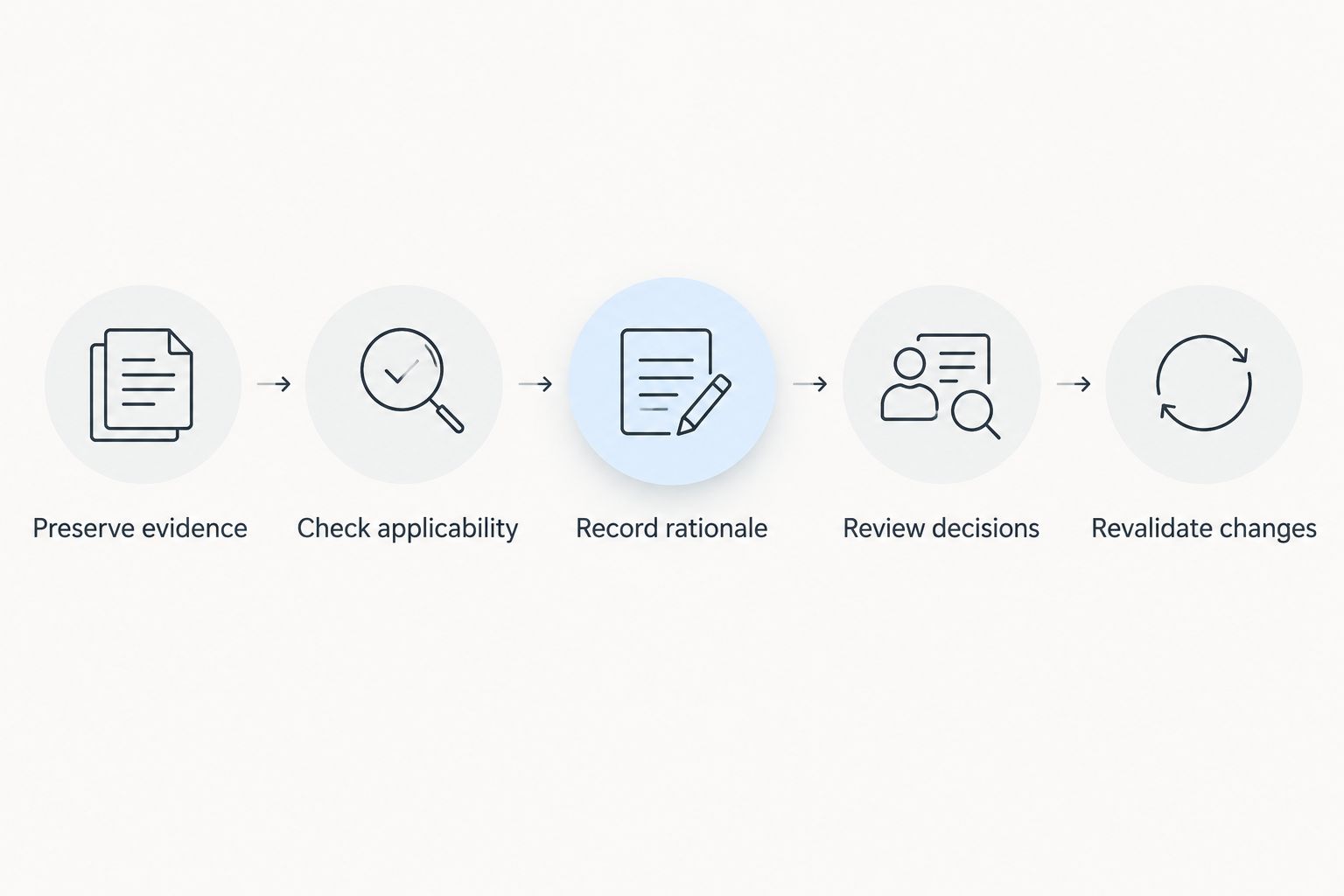
Use this sequence for a 2026 pilot before allowing automated disposition. Keep the existing workflow intact so you can compare decisions on the same findings.
1. Preserve evidence
Retain the original finding, scanner identity, plugin or rule identifier, detection output, asset identifier, and observation time. Record credential failures and other collection problems rather than interpreting missing evidence as a clean result.
Preservation makes later review possible. If the model's summary becomes the only surviving record, you lose the ability to distinguish a source error from a model error.
2. Check applicability
Compare the reported vulnerability with the installed component, version, platform, and required configuration. Use authenticated evidence where appropriate and available, while recognizing that authenticated collection still needs successful access and correct interpretation.
If the evidence conflicts, mark the finding for investigation. Do not force an uncertain case into a binary outcome just to complete a dashboard.
3. Record rationale
Require each proposed false-positive decision to identify the contradicted detection condition. The rationale should point to evidence, not simply repeat a confidence score.
A useful explanation states that the observed package is outside the affected range and identifies the advisory used. An unusable explanation says only that similar findings were previously dismissed.
4. Review decisions
Route ambiguous findings and consequential suppressions to a qualified reviewer. Give the reviewer the original evidence, the proposed outcome, and the supporting rationale together.
Document disagreement. Overriding an AI recommendation is valuable evaluation data, but the override itself still needs a reason.
5. Revalidate changes
Revisit decisions when asset state, scanner logic, advisory information, or the model changes. A suppression justified for one package state does not establish that future findings on that asset are false.
Make dispositions reversible. Your workflow should reopen a finding when the evidence supporting its rejection no longer applies.
Why AI-assisted false-positive reduction varies
The outcome depends on the evidence and decision process surrounding the model. Evaluate these factors before attributing any improvement to AI:
- Detection evidence: A package-level observation supports a different review than a service banner or inferred software identity.
- Asset matching: Incorrectly joining a finding to another host or software installation invalidates the applicability check.
- Label quality: Verified detection errors are useful examples; generic closed-ticket statuses are not equivalent labels.
- Advisory interpretation: Affected platforms, prerequisites, and vendor-specific fixes must match the assessed system.
- Environment changes: Software updates, rebuilt workloads, and configuration changes can invalidate an earlier decision.
- Decision thresholds: More aggressive suppression changes the balance between removing false alarms and concealing genuine findings.
Ask vendors to show which factors their workflow actually checks. A claim about accuracy is incomplete without the evaluated population, labeling method, and treatment of uncertain cases.
How do you measure whether the AI is working?
For a 2026 evaluation, use an independently reviewed set of findings and preserve the original labels. Keep evaluation examples separate from training examples; repeated records from the same underlying issue can otherwise make performance look better than it is.
Report distinct measures rather than a single accuracy figure:
| Measure | What it tells you | What it does not establish |
|---|---|---|
| Precision of retained findings | How many retained findings are genuine | Whether suppressed findings include real vulnerabilities |
| Genuine findings incorrectly rejected | What valid findings the process hides | How quickly analysts complete reviews |
| False positives correctly rejected | Whether known detection errors are removed | Whether the result generalizes to other assets |
| Analyst review time | Whether handling effort changes | Whether technical decisions improve |
| Unverified findings | Where evidence remains insufficient | Whether those findings are safe to ignore |
Define the positive class explicitly when using statistical terms. If “positive” means a genuine vulnerability in one report and a predicted false positive in another, the same metric name describes different outcomes.
Inspect results by scanner, detection method, and asset group. An aggregate result can conceal a workflow that handles package findings well but performs poorly on inferred network detections.
The acceptance decision needs both workload and safety evidence. Do not approve suppression merely because the visible queue shrinks.
Does a low risk score mean a scan result is false?
No—a low risk score changes priority, not the truth of the detection. A vulnerability can be genuine even when its estimated exploitation likelihood is low.
For your 2026 evaluation, distinguish FIRST's scoring systems carefully. CVSS expresses vulnerability severity on a scale from 0.0 to 10.0 points; EPSS estimates the probability of exploitation in the next 30 days, expressed between 0 and 1.
Neither score proves that the affected software is installed. Keep severity, exploitation likelihood, asset applicability, and business impact as separate inputs to the decision.
Can AI replace authenticated scanning or manual verification?
No—AI does not replace direct evidence about the assessed system. It can help interpret collected evidence, but it cannot establish an installed package or configuration merely by generating a convincing explanation.
Authenticated scanning can provide information unavailable through remote fingerprinting. Manual verification remains necessary when evidence conflicts, access fails, or the consequences of an incorrect rejection demand closer review.
Choose the verification method for the detection claim. Repeating the same weak observation through a language model does not create independent confirmation.
Where does a vulnerability management platform fit?
Brinqa is a vulnerability and exposure management platform. Brinqa is for teams evaluating vulnerability and exposure management software; false-positive decisions still require finding-level evidence.
When evaluating Brinqa vulnerability management for this workflow, ask for a demonstration using your own confirmed and disputed findings. Verify proposed capabilities directly rather than assuming that the platform category establishes support for a particular AI method.
The evaluation should cover evidence retention, disposition history, analyst overrides, and reopening behavior. A platform does not remove your responsibility to define who can reject a finding and what proof that rejection requires.
FAQ
Can AI reduce false positives in vulnerability scans without hiding real vulnerabilities?
AI can assist false-positive reduction, but checking rejected findings is necessary to detect hidden genuine vulnerabilities. Evaluate both valid findings retained and valid findings incorrectly suppressed.
What's the difference between scanner noise and a false positive?
Scanner noise includes duplicates, low-priority findings, and other records that complicate review; a false positive is an incorrect detection. Reducing noise does not necessarily improve detection accuracy.
Is a high AI confidence score enough to close a vulnerability?
No—a confidence score is not evidence that the vulnerability is absent. Require a rationale tied to observed asset state and the detection's applicability conditions.
Does deduplicating vulnerability findings reduce false positives?
Deduplication reduces repeated records, not necessarily false detections. A consolidated finding still needs validation before you classify it as a false positive.
Can I use closed tickets to train a false-positive classifier?
Use closed tickets only after separating technical outcomes from administrative closure reasons. Accepted risk, decommissioning, and duplicate closure are not confirmed false-positive labels.
What should I ask an AI vulnerability vendor to demonstrate in 2026?
Ask the vendor to demonstrate evidence-backed decisions, review of rejected findings, analyst overrides, and reversible suppression. Use independently reviewed examples from your environment rather than relying only on a prepared demonstration.
Does Brinqa's platform category prove it supports AI false-positive filtering?
No—Brinqa's vulnerability and exposure management platform category does not establish a specific AI filtering capability. Verify the proposed workflow, evidence requirements, and decision controls directly.
One last thing
Start with recommendations, not automatic suppression. In your 2026 pilot, let the proposed AI workflow record its decisions without changing the remediation queue, then compare those decisions with independent technical review.
This preserves visibility while exposing disagreements. The most useful pilot output is not a shorter backlog; it is a documented explanation of which decisions deserve automation and which still require investigation.