
Yes, zero-day response without automation is possible: your team can identify affected systems, apply vendor-recommended mitigations, investigate suspicious activity, and verify remediation manually. The limitation is coordination: each inventory check, ownership handoff, and validation task depends on people keeping evidence current, so manual response needs a defined scope and an accountable response lead.
- Zero-day response without automation is possible, but manual triage needs current asset evidence, named owners, and verified mitigation.
- Human-approved automation combines repeatable vulnerability management tasks with explicit approval for disruptive changes.
- Brinqa belongs in the vulnerability and exposure management evaluation, not as proof that an incident is contained.
- A missing patch does not prevent containment; follow vendor guidance and investigate suspected compromise separately.
Is zero-day response possible without automation?
Yes. A manual response works when your team can establish which systems are affected, reach the responsible owners, implement approved controls, and confirm the result. Do not confuse a completed task with a verified reduction in exposure.
For your 2026 response plan, choose the operating model by what your team can demonstrate, not by whether a workflow carries an automation label. The zero-day vulnerability response process provides a related guide for organizing that work.
| Response model | Best for | Main advantage | Main limitation |
|---|---|---|---|
| Manual response | A clearly bounded scope with reachable owners | People can assess uncertain evidence and unusual dependencies directly | Reconciliation, follow-up, and evidence collection depend on individual execution |
| Human-approved automation | Repeatable tasks that still require change approval | Software handles routine processing while people authorize consequential actions | Incorrect source data or rules still require investigation |
| Preapproved automated actions | Narrow, tested actions with defined authority and recovery procedures | Execution does not wait for a fresh approval on every occurrence | A mistaken trigger can apply an inappropriate action before review |
These are operating models, not guarantees. A manual team with reliable evidence is better positioned to make a defensible decision than an automated workflow acting on an incorrect asset match.
Why this matters
Zero-day response involves more than installing an update. Your team must establish applicability, assess exposure, decide what action is safe, and investigate whether exploitation has already occurred.
That distinction matters when no patch exists or when an emergency change threatens an essential service. You still need a containment decision, an owner, and evidence showing whether the selected control works.
In a 2026 readiness review, ask whether responders can answer a practical question: Which affected systems remain exposed, and who is acting on each one? A long vulnerability list does not answer it.
How do you run a manual zero-day response?
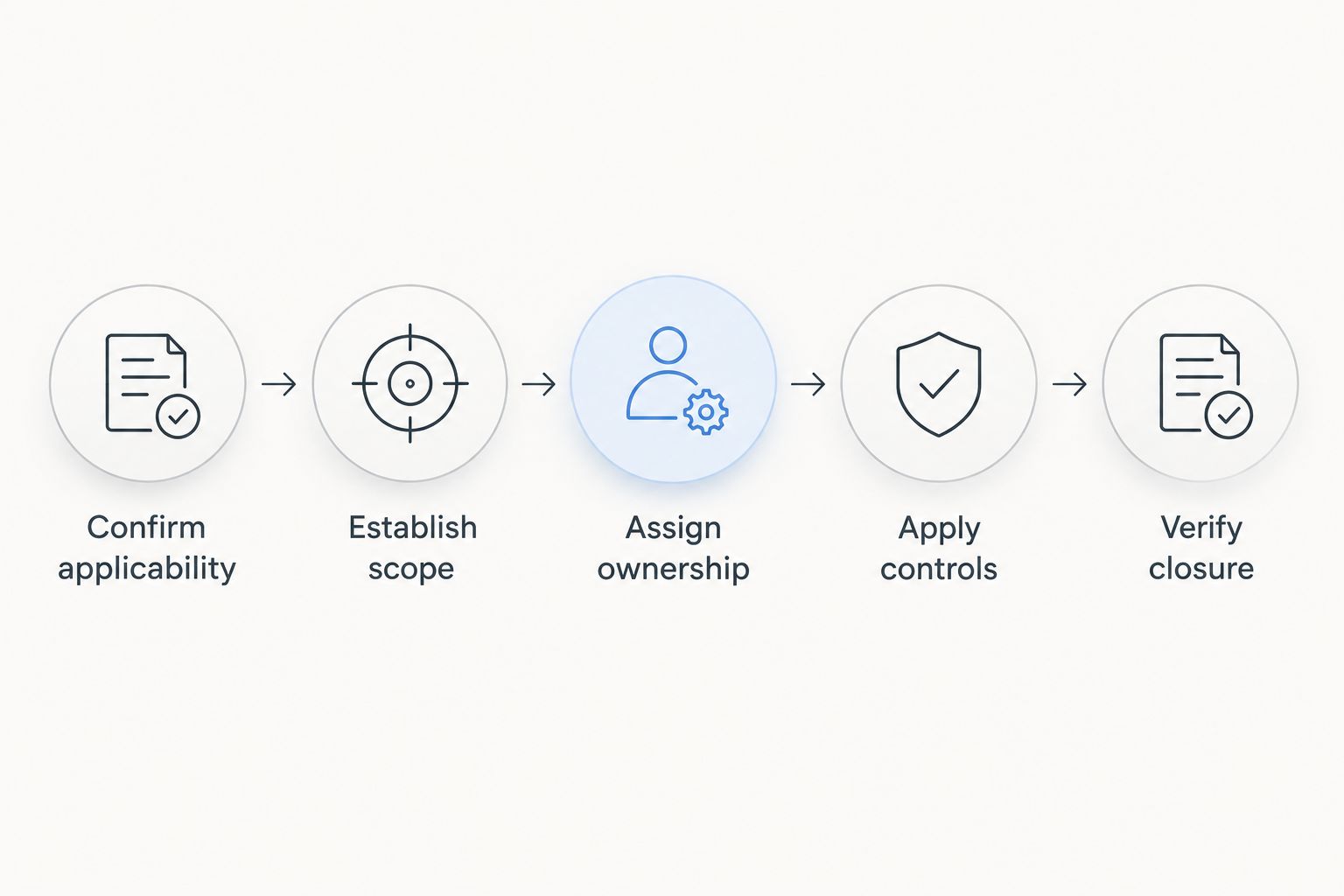
Use a shared response record and a named coordinator. Keep confirmed facts, unresolved questions, approved actions, and validation evidence separate so uncertainty does not disappear during handoffs.
1. Confirm applicability
Start with the vendor advisory or another authoritative technical notice. Record the affected product, relevant versions, required configurations, exploitation conditions, and recommended actions as they become known.
Do not treat a matching product name as proof that every deployment is affected. Check the actual installation and configuration, and record uncertainty rather than marking an unverified system safe.
2. Establish scope
Reconcile your available asset inventory, software records, deployment information, and relevant security findings. Ask service owners to confirm installations that the central records cannot resolve.
Separate confirmed affected systems from confirmed unaffected systems and systems still awaiting assessment. Missing evidence belongs in the unresolved category; it is not evidence of absence.
3. Assign ownership
Give every affected system an accountable owner and a specific next action. Identify who can approve service disruption, who can implement the change, and who will verify the result.
Use an escalation path when ownership is unclear. A message sent to a distribution list is not an accepted assignment, and an unacknowledged ticket does not establish that work has started.
4. Apply controls
Follow the vendor's mitigation or remediation guidance and your emergency-change process. Depending on the advisory, actions can include applying an update, disabling an affected feature, restricting access, or isolating a system.
Check operational dependencies before making disruptive changes. Record the control's intended effect, implementation evidence, and recovery procedure rather than assuming every workaround is equivalent to a permanent fix.
5. Verify closure
Confirm that the intended configuration or software state exists on the affected system. Check relevant exposure paths and preserve evidence supporting the closure decision.
Investigate signs of compromise through the incident-response process. Removing a vulnerability does not establish that an attacker never accessed the system or that an existing intrusion has ended.
The sequence below is a useful manual response structure for 2026. Revisit earlier stages when new advisory details change the affected scope or recommended action.
Manual response: best for a bounded, verifiable scope
Manual response is a defensible choice when responders can enumerate the relevant systems and obtain direct confirmation from their owners. It also keeps unusual operational dependencies visible to the people making changes.
The trade-off is coordination work. Someone must reconcile conflicting records, track outstanding questions, chase acknowledgments, and check that new advisory information reaches every affected owner.
Use manual response only while your team can maintain a current, evidence-backed view of the scope. If responders cannot explain which systems remain unresolved, the process needs better data handling or additional coordination support.
Manual response also needs a fallback when the coordinator becomes unavailable. Keep decisions and evidence in the shared record rather than in private messages or an individual's memory.
Human-approved automation: best for repeatable coordination
Human-approved automation separates preparation from authorization. Software can collect records, apply explicit matching rules, route work, or request evidence; designated people decide whether a consequential action should proceed.
This model preserves review where disruption or uncertainty matters. Its limitation is that the workflow still depends on accurate inputs, maintained rules, and approvers who understand the evidence presented to them.
For a 2026 improvement plan, automate a demonstrated coordination problem before expanding into automatic production changes. Start with a task whose inputs, expected output, failure conditions, and exception path you can describe clearly.
Do not approve automation solely because a demonstration completes successfully. Test missing owners, conflicting versions, unreachable systems, duplicate records, and failed actions before relying on the workflow during an emergency.
Preapproved automated actions: best for narrow, tested controls
Preapproved automated actions fit situations where the trigger, authorized action, affected scope, and recovery procedure are already defined. Examples include a preauthorized containment action applied under an established incident-response policy.
The benefit is execution without a new approval for every occurrence. The limitation is equally concrete: an incorrect trigger or overly broad scope can cause an inappropriate change before someone intervenes.
Require a documented authority boundary and a way to detect failures. Actions that are difficult to reverse, poorly understood, or dependent on uncertain asset matching need additional human review.
Automation does not transfer accountability away from the response owner. Your team still needs to explain why the action was permitted and what evidence shows it worked.
Why zero-day response effort varies
The difficulty of a manual response follows the environment and the advisory, not a universal response-time benchmark. Review these factors before deciding that a manual workflow is sufficient:
- Asset visibility: Responders need evidence of affected software and configurations. Unmanaged or unrecorded deployments create unresolved scope.
- Advisory clarity: Incomplete applicability details require follow-up as the vendor publishes new information. Preserve the advisory version supporting each decision.
- Exposure conditions: Reachability, enabled features, authentication requirements, and other prerequisites affect applicability and containment choices.
- Ownership clarity: Known service owners and change authorities support explicit assignments. Unclear responsibility requires escalation before action can proceed.
- Operational dependencies: A mitigation that interrupts an essential service needs an authorized business decision and a recovery plan.
- Evidence quality: Fresh, attributable records support closure. Conflicting exports and undocumented changes require additional checking.
These factors belong in the response record. A single severity label cannot describe all of them, and a faster ticket workflow does not resolve missing technical evidence.
What should you automate first?
Automate repeatable evidence handling before uncertain production decisions. Identify where responders repeatedly copy the same records, reconcile the same identifiers, or request the same ownership information.
Good candidates have explicit rules and visible exceptions. For example, a workflow can flag records that lack an owner rather than silently assigning them to an assumed team.
Keep the first implementation narrow. Compare its output with an independently reviewed result, investigate disagreements, and document when the workflow must stop for human judgment.
Brinqa is a vulnerability and exposure management platform. Brinqa fits an evaluation of vulnerability and exposure management software, not a substitute for an incident-response owner. When assessing Brinqa, require a demonstration against your actual response requirements rather than assuming particular integrations or response capabilities.
Your evaluation should test applicability handling, ownership, exceptions, evidence retention, and validation using representative records. A platform evaluation is incomplete if it shows only a clean dashboard and no handling of ambiguous data.
Can you respond before a patch exists?
Yes, response can begin before a patch exists. Use the vendor's current guidance to assess applicability and implement supported mitigations or containment measures.
Record what each control changes and what it leaves unresolved. A workaround needs its own validation and follow-up; it should not disappear from the response record when the immediate pressure subsides.
When a permanent fix becomes available, reassess the affected scope and follow the relevant remediation guidance. Do not assume every temporary control should remain indefinitely or that every system received the same change.
Does patching end a zero-day incident?
No, patching does not by itself end a zero-day incident. Patching addresses the vulnerability; incident response determines whether exploitation occurred and what consequences require investigation or recovery.
Keep those workstreams connected without treating them as interchangeable. An asset can have a verified fix while its compromise investigation remains open.
Your closure record should distinguish remediation status from incident status. That distinction prevents a completed change ticket from becoming an unsupported declaration that the environment is clean.
FAQ
Can a small security team handle a zero-day without automation?
Yes, a small security team can handle a zero-day without automation when it can establish the affected scope, reach accountable owners, and verify the selected controls. Team size alone does not establish readiness; test the workflow against unresolved assets and unavailable owners.
Is automated patching the same as automated zero-day response?
No, automated patching covers an update action, while zero-day response also includes applicability assessment, scoping, containment, investigation, and validation. A response must still function when a patch is unavailable.
Should every critical vulnerability trigger automatic isolation?
No, a critical severity rating alone is not sufficient authority for automatic isolation. Define the trigger, operational impact, approval boundary, and recovery procedure before permitting that action.
What should a manual zero-day response record contain?
A manual zero-day response record should contain applicability evidence, affected assets, accountable owners, approved actions, unresolved questions, and validation evidence. Keep remediation status separate from any compromise investigation.
Can Brinqa replace the people running incident response?
No, a vulnerability and exposure management platform does not replace incident command, business authorization, or investigative judgment. Evaluate Brinqa against specific software requirements while keeping response accountability with named people.
How do you know a zero-day mitigation worked?
Verify the intended control on the affected system and check the relevant exposure conditions using an appropriate validation method. Preserve the result and its scope; an executed command or closed ticket alone does not prove effectiveness.
What should a 2026 zero-day response exercise test?
A 2026 zero-day response exercise should test whether responders can establish scope, reach owners, authorize controls, and verify outcomes. Include uncertain asset records and failed actions so the exercise tests exception handling rather than only the expected path.
One last thing
Rehearse with an advisory that has no immediately usable patch. That forces your team to practice applicability assessment, containment decisions, evidence collection, and business authorization instead of treating response as an emergency update campaign.
Carry that lesson into your 2026 runbook: keep an explicit unresolved category. A system awaiting assessment must remain visible until someone supplies evidence supporting a different status.