
The cost of downtime from an unpatched vulnerability equals the business loss during the interruption plus the work required to restore and validate the affected service; a critical severity label alone does not establish a dollar amount. For a defensible 2026 estimate, calculate lost contribution, disrupted labor, recovery work, and applicable contractual obligations separately, without counting the same loss twice.
- Calculate the cost of unpatched critical vulnerability downtime from service disruption and recovery, not severity alone.
- Separate outage impact from exploitation likelihood when setting vulnerability remediation priorities.
- Use finance-approved loss assumptions and tested recovery evidence instead of a generic hourly benchmark.
- Brinqa is a vulnerability and exposure management platform, not a substitute for business-impact evidence.
How much does downtime cost from an unpatched vulnerability?
Downtime cost is a service-specific calculation, not a fixed amount per critical vulnerability. Start with the business process the vulnerable asset supports, then identify the financial consequences of interrupting that process. The guide to cyber risk quantification for CFOs provides a related framework for presenting financial exposure.
Use this calculation structure:
Downtime loss = lost contribution + disrupted labor + incremental recovery expense + applicable contractual obligations.
| Cost component | What to measure | Evidence to use | Main accounting caution |
|---|---|---|---|
| Lost contribution | Sales or transactions permanently lost, net of avoided variable costs | Finance records and transaction history | Do not treat delayed transactions as permanently lost |
| Disrupted labor | Paid work prevented by the outage | Staffing records and affected workflows | Exclude time spent on productive alternative work |
| Recovery expense | Additional response, restoration, and validation work | Response records, invoices, and time entries | Do not count the same employee hours twice |
| Contractual obligations | Credits or other obligations triggered by the incident | Executed agreements and legal review | Apply actual terms, not assumed penalties |
Keep broader incident losses outside this subtotal. Data theft, litigation, and customer attrition require separate evidence; they are not automatic consequences of every outage or every unpatched vulnerability.
Why this matters
A vulnerability report describes a technical weakness. Your downtime estimate must describe an interrupted business service. Connecting the two requires evidence about affected assets, reachable paths, dependencies, and recovery procedures.
For your 2026 planning, distinguish loss if an outage occurs from the likelihood of that outage. A large conditional loss does not prove an incident is imminent, and a critical finding does not prove exploitation will interrupt production.
That distinction changes the decision. Engineering needs a remediation action and an owner; finance needs a loss model whose assumptions can be checked. Neither team benefits from an unsupported headline figure.
Build the estimate from business records
Use the following sequence to turn a vulnerability finding into a documented downtime scenario. Keep the calculation tied to a named service rather than spreading a company-wide loss estimate across individual findings.
- Define scope. Identify the vulnerable component, the service it supports, and the business activity that stops if that service fails. Record whether the scenario involves complete interruption, degraded performance, or intentional isolation.
- Establish duration. Use relevant incident records or recovery exercises to estimate the interruption. Separate detection, containment, restoration, and business validation where those phases affect service availability.
- Calculate losses. Ask finance and service owners for time-dependent loss assumptions. Distinguish permanently lost activity from work that resumes after recovery.
- Add recovery. Include incremental response and restoration expenses supported by staffing plans, supplier agreements, or recorded incident work. Make clear which expenses occur regardless of outage length.
- Validate assumptions. Have finance, engineering, and the service owner check the scenario together. Record the evidence date, unresolved questions, and the person responsible for each input.
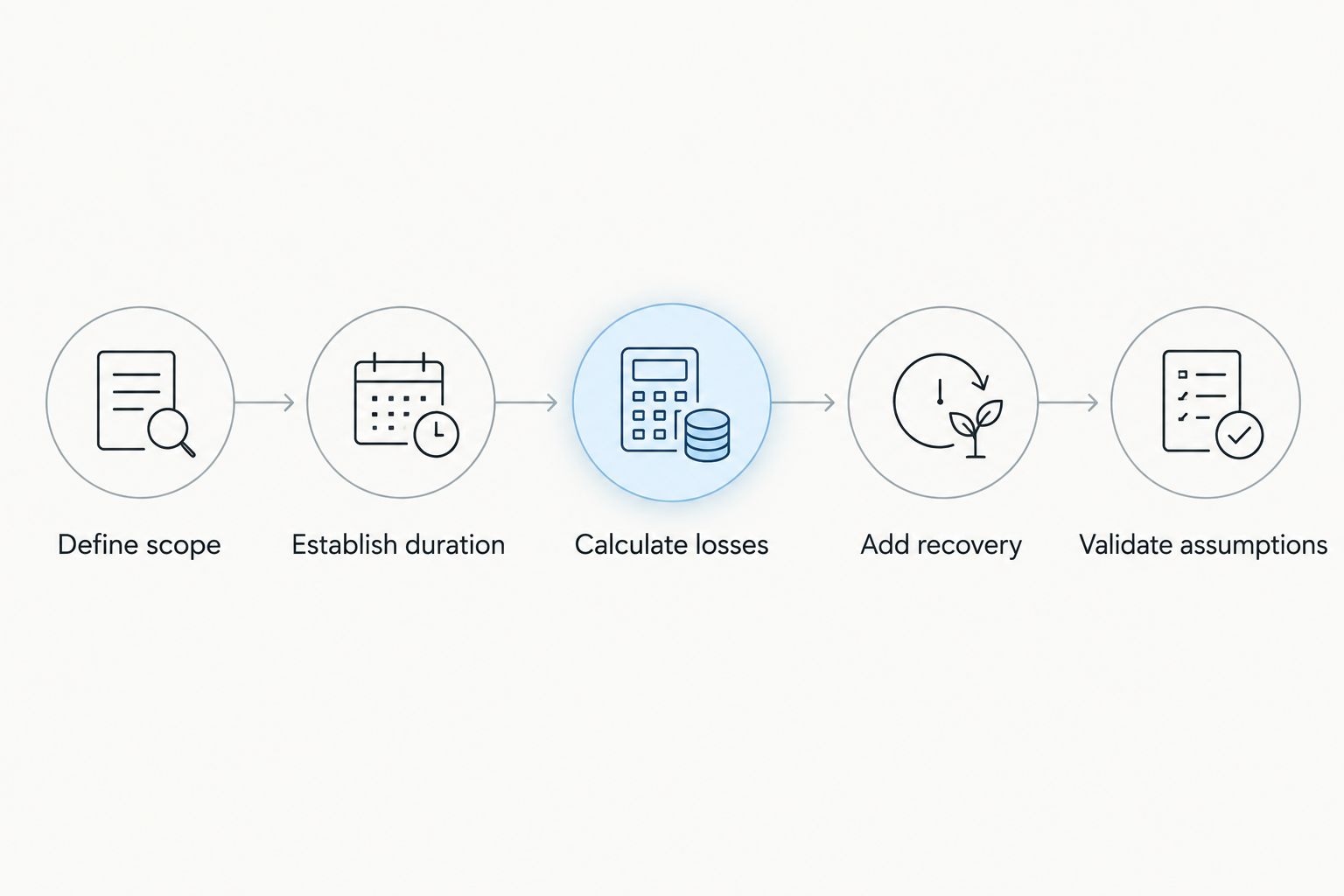
Treat this as a living calculation. If a recovery exercise changes the restoration assumption, update the loss estimate rather than leaving the original figure attached to the vulnerability ticket.
Calculate lost contribution, not just interrupted revenue
An interrupted transaction is not necessarily a lost transaction. Customers who complete the same purchase after recovery create a different financial effect from customers whose purchases are permanently lost.
Ask finance to distinguish delayed demand, canceled demand, and unrecoverable transactions. Then subtract the variable costs that the business does not incur on lost sales. This produces a contribution-based estimate rather than treating every dollar of interrupted revenue as a dollar of economic loss.
Subscription businesses need particular care. An outage does not automatically erase recognized subscription revenue for the interruption period. Contractual credits, refunds, cancellations, and renewal effects need their own evidence and accounting treatment.
Use the business model's actual loss mechanism. Do not apply a transaction-processing formula to a subscription service simply because both depend on the same infrastructure.
Account for labor without double counting
Disrupted labor and recovery labor belong in different parts of the estimate. The first captures work prevented by the outage; the second captures the effort required to resolve it.
For disrupted labor, identify which teams cannot perform their normal duties and whether they can switch to useful alternative work. A service interruption does not establish that every employee is idle. Use affected workflows rather than total company headcount.
For recovery labor, distinguish regular staffing expense from incremental expense. Overtime, temporary assistance, and external response work need different treatment from salaried staff reassigned during normal working hours.
Document the accounting convention you choose. If engineering time already appears in recovery expense, do not add those same hours again as lost employee productivity.
Include restoration work after service returns
A successful restart is not always the end of incident recovery. Your scenario should identify the work required to confirm that the service is safe, functional, and ready for normal operations.
Depending on the documented incident scope, that work includes restoring affected systems, checking data integrity, reviewing access, reconciling interrupted transactions, and validating business workflows. Include only tasks relevant to the scenario. Do not attach a full breach-response budget to a vulnerability that has not produced evidence of compromise.
For a 2026 recovery review, ask the service owner to define the endpoint explicitly: technical availability, usable business service, or cleared operational backlog. These endpoints describe different amounts of work.
Measure recovery against the business process, not just a server status check. State where downtime ends and post-restoration expense begins so the estimate remains auditable.
Why downtime cost varies
The cost of unpatched critical vulnerability downtime varies with the affected service and the interruption scenario. Validate these drivers before comparing findings:
- Business dependency. Identify whether the asset supports a revenue transaction, internal workflow, shared dependency, or nonproduction activity. Base the distinction on service ownership records.
- Interruption duration. Use evidence about detection, isolation, restoration, and validation. A documented recovery objective is a target, not proof of achieved recovery time.
- Demand timing. Align the interruption with actual transaction or workload patterns. Avoid applying an annual average to a scenario built around a known peak period.
- Recovery readiness. Check tested restoration procedures, dependency requirements, and access to the people needed to execute them. Do not assume a backup establishes recoverability.
- Contractual exposure. Review which customer agreements apply to the affected service and incident conditions. An outage does not automatically trigger every contractual remedy.
- Loss overlap. Reconcile revenue, productivity, recovery, and customer-impact calculations. Separate labels do not guarantee separate economic losses.
Does a critical vulnerability mean downtime is certain?
A critical vulnerability does not make downtime certain. Technical severity is not a probability that your particular service will fail, nor is it a financial loss estimate.
Check whether the affected version is present, whether the vulnerable function is reachable, and whether exploitation requires conditions that exist in your environment. Review relevant controls and threat evidence without treating either as a guarantee.
Keep the causal chain explicit: vulnerable component, feasible exploitation, affected service, business interruption, financial consequence. If a link remains unverified, record that uncertainty rather than presenting the final loss as an observed fact.
Should you patch immediately or wait for maintenance?
Compare the documented risk of leaving the vulnerability exposed with the documented disruption risk of the proposed change. A downtime estimate informs that decision; it does not replace engineering judgment or incident-response authority.
| Response option | Best for | Benefit | Limitation |
|---|---|---|---|
| Expedited remediation | Confirmed exposure requiring urgent action | Addresses the vulnerable condition sooner | Requires change testing and recovery planning under time pressure |
| Scheduled remediation | A documented risk decision supporting planned execution | Allows coordinated testing and service-owner approval | Leaves exposure unresolved until remediation is verified |
| Temporary mitigation | Situations where immediate patching is not feasible | Restricts the relevant exposure while remediation is arranged | Requires validation and does not establish that the vulnerable component is fixed |
Do not choose scheduled maintenance solely because emergency changes are inconvenient. Equally, do not assume an untested production change has no disruption risk. Record the decision owner, rationale, validation method, and review trigger.
Can you use downtime cost to calculate annual cyber risk?
Downtime cost alone does not establish annual cyber risk. It describes loss under an interruption scenario; annual risk estimation also requires a defensible treatment of event frequency or probability over a stated period.
For a 2026 risk register, keep the scenario horizon explicit. Do not multiply a service-loss figure by a vulnerability score and label the result expected annual loss. A technical severity score is not an annual probability.
If the evidence does not support a probability estimate, report the conditional loss and the unresolved likelihood assumptions separately. That is more useful than a precise-looking total built from incompatible inputs.
Where a vulnerability management platform fits
Brinqa is best suited to buyers seeking a vulnerability and exposure management platform. That category is relevant when you are deciding how to manage vulnerability findings alongside exposure-management work.
The boundary matters. Brinqa's stated platform category does not establish your lost contribution, contractual obligations, recovery duration, or accounting policy. Those inputs remain the responsibility of finance and service owners.
When evaluating Brinqa, use your own downtime scenario as a demonstration brief. Ask the vendor to show how the proposed workflow supports your asset context, ownership, prioritization, and verification requirements; require evidence rather than assuming those capabilities from a category label.
FAQ
How much does downtime from an unpatched critical vulnerability cost?
Downtime cost equals the documented business loss during interruption plus relevant recovery expense and applicable contractual obligations. Calculate it for the affected service; critical severity alone does not establish a dollar amount.
Can I use average revenue per hour as my downtime cost?
Average revenue per hour is not a complete downtime-cost estimate. Distinguish permanently lost sales from delayed transactions, account for avoided variable costs, and assess recovery expense separately.
Does every critical vulnerability cause an outage?
A critical vulnerability does not establish that an outage will occur. Validate the affected component, exploitation conditions, service dependencies, and interruption scenario before estimating financial impact.
Should I count employee salaries as downtime losses?
Count disrupted labor only under a documented accounting approach that reflects work actually prevented. Exclude productive alternative work and avoid counting the same hours again as recovery expense.
Do backups eliminate vulnerability-related downtime costs?
Backups alone do not establish the duration or completeness of recovery. Use restoration evidence and business validation requirements to assess interruption and recovery work.
Should breach costs be included in a downtime estimate?
Keep broader breach losses separate from the downtime subtotal unless the scenario and evidence support their inclusion. Data exposure, legal response, and customer attrition are not automatic outcomes of an unpatched vulnerability.
How do I defend a downtime estimate to the CFO?
Present a service-specific calculation with evidence, named input owners, accounting conventions, and explicit assumptions. Separate conditional outage loss from the probability of the incident occurring.
One last thing
Before approving a 2026 downtime estimate, ask: Which transactions return after service is restored? That question separates an interruption in activity from permanent economic loss.
Then ask the service owner to identify the evidence for the recovery endpoint. A defensible estimate needs both: what the business actually loses and when the business process actually recovers.