
Yes—cyber risk quantification for zero-day exposure can estimate potential business loss through scenarios, but it cannot predict an undiscovered vulnerability or its exploitation. The estimate must account for uncertainty about attack likelihood, affected assets, control effectiveness, and recovery; a precise-looking result does not remove those uncertainties.
- Cyber risk quantification for zero-day exposure supports scenario planning, not predictions of undiscovered exploits.
- Separate evidence about assets and controls from assumptions about attack frequency and business loss.
- Brinqa is a vulnerability and exposure management platform; assess financial modeling capabilities separately.
- Use sensitivity analysis to identify which uncertainty changes your security decision.
Can cyber risk quantification account for zero-day exposure?
Yes, provided you quantify a business-loss scenario rather than assign an unsupported probability to an unknown vulnerability. For a 2026 assessment, define the service at risk, the attack conditions, the loss event, and the evidence behind each assumption.
The distinction matters: you can model the consequences of an unknown exploit without claiming to know which exploit will appear. A scenario can examine unauthorized access through an internet-facing service, interruption of a critical application, or compromise of a shared technology dependency.
The broader cyber risk quantification guide for CISOs provides context for connecting technical exposure to business decisions. For zero-days, keep the following approaches separate:
| Approach | Best for | Strength | Limitation |
|---|---|---|---|
| Business-loss scenarios | Planning before a specific vulnerability is known | Connects plausible attack conditions to business consequences | Results depend on assumptions that require validation |
| Vulnerability-specific assessment | Updating decisions after disclosure | Uses evidence about affected technology and attack prerequisites | Cannot describe an undiscovered flaw in advance |
| Control-focused assessment | Choosing defenses against uncertain attack paths | Examines containment, detection, and recovery | Control presence alone does not establish effectiveness |
These approaches answer different questions. Use scenarios for preparedness, vulnerability evidence for response, and control testing to challenge both.
Why this matters
A vulnerability register describes identified weaknesses. It does not establish that systems without recorded findings are free of exposure, and a financial model should not treat that gap as evidence of safety.
Zero-day analysis shifts the question from whether every flaw has been found to whether an unexpected compromise would reach an important business service. That makes dependency mapping, access boundaries, restoration evidence, and business ownership relevant even before a vulnerability has a public identifier.
For your 2026 planning, the useful output is a defensible decision: strengthen isolation, improve recovery, investigate an uncertain dependency, or accept a documented residual exposure. An estimate that does not change a decision is not enough on its own.
Build the assessment around a loss scenario
Start with a bounded business outcome, not a generic statement that a zero-day causes a breach. Keep the scenario narrow enough that service owners can challenge its assumptions.
1. Define the business service
Choose the service whose interruption or compromise you want to assess. Identify the owner, supporting technology, sensitive information, and dependencies that determine whether the service remains usable.
Separate the technical asset from its business function. A server outage and a customer-facing service outage are not interchangeable if redundancy keeps the service operating.
2. Describe the attack conditions
State how an attacker reaches the technology and what access exploitation would require. Distinguish direct internet access, authenticated access, and access through another compromised system.
Do not invent the exploit's mechanics. Model a stated condition, such as unauthorized execution on an exposed component, and label it as a scenario assumption rather than an observed vulnerability.
3. Map the loss event
Explain the transition from technical compromise to business harm. Identify whether the scenario involves interruption, information disclosure, unauthorized transactions, or another defined outcome.
Avoid counting the same consequence twice. If interrupted operations already include delayed transactions, check whether a separate revenue-loss estimate duplicates that effect.
4. Test control effectiveness
Examine whether access restrictions, segmentation, monitoring, and restoration procedures interrupt the scenario. Record what has been tested and what remains an assertion.
A configured control is not the same as a demonstrated outcome. Recovery assumptions need restoration evidence, while containment assumptions need evidence that the relevant boundary blocks the modeled access path.
5. Compare decisions
Evaluate the current scenario against a specific proposed change using consistent assumptions. Change the control or dependency under review without silently changing the business-loss definition.
The comparison should expose the decision's dependency on uncertain inputs. If a recommendation changes when an assumption changes, investigate that assumption before presenting the recommendation as settled.
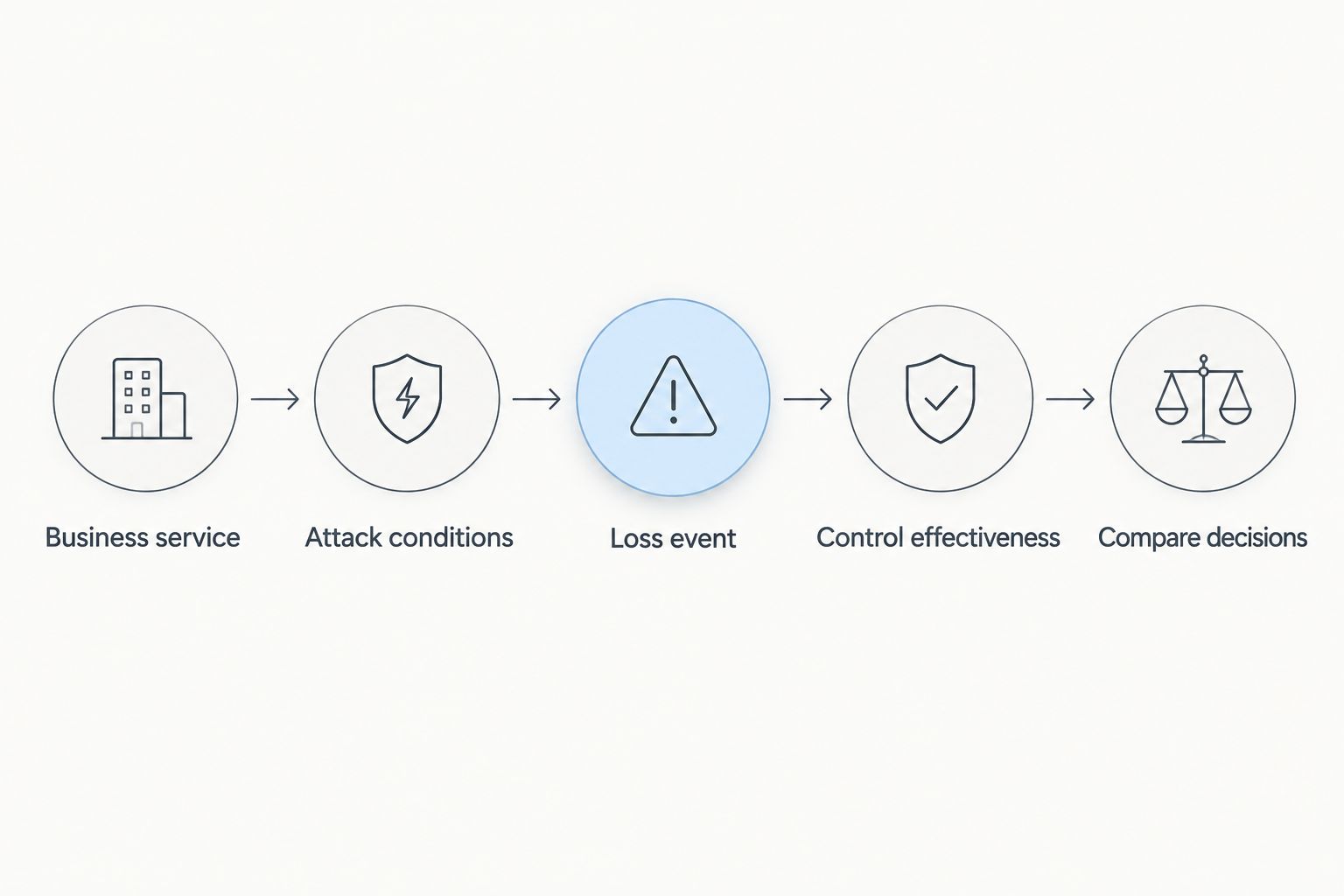
Use this process as a repeatable assessment method, not a claim that every scenario deserves the same effort. Focus analysis on decisions where uncertainty about zero-day exposure affects business priorities.
Unknown flaw: model preparedness, not exploit probability
Before disclosure, the vulnerability's affected versions, prerequisites, and exploitation mechanics are unknown. Your model should preserve that distinction rather than fill the gaps with unsupported technical detail.
Use a clearly stated scenario boundary: a critical service depends on technology that experiences an exploitable flaw. Then examine the conditions that determine whether compromise becomes a material loss.
Do not assign a vulnerability-specific exploitation probability to a flaw you have not identified. If you use broader threat or incident information, document its population, observation period, and relevance to the scenario; do not substitute a general rate for evidence about your environment.
This approach supports preparedness decisions. Its limitation is that it cannot tell you which component will fail next.
Disclosed flaw: replace assumptions with verified facts
Once a vulnerability becomes public, determine whether your environment contains the affected technology and whether the exploitation prerequisites apply. Update the scenario with verified facts rather than treating disclosure alone as proof of exposure.
For a 2026 disclosure assessment, preserve the earlier assumptions alongside the new evidence. That record shows which conclusions changed because of information and which changed because the assessment method changed.
A vulnerable component does not automatically establish a successful attack path. Conversely, an incomplete inventory does not justify an unaffected conclusion. Assign an owner to unresolved applicability questions and record the evidence needed to close them.
Observed compromise: keep response separate from forecasting
Evidence of compromise changes the task. Containment, investigation, and restoration take priority over refining a forward-looking estimate.
Keep observed costs and effects separate from estimated remaining consequences. Combining them without labels makes it difficult to distinguish what happened from what the model still assumes.
Continue using scenario analysis where it informs decisions, such as whether another service remains exposed. Do not let a financial estimate delay action against a confirmed compromise.
Why zero-day risk estimates vary
Differences in zero-day estimates should trace back to explicit inputs, not unexplained scoring adjustments. Review these factors when comparing assessments:
- Scenario scope: A compromised component and an enterprise-wide service interruption describe different loss events. Keep the boundary explicit.
- Asset reachability: Network access, authentication requirements, and dependency paths determine whether the modeled attack conditions apply.
- Business dependency: The same technology can support a replaceable internal function or an essential service. Establish the business consequence with its owner.
- Control evidence: Tested containment and recovery provide a different basis for an estimate than configuration records alone.
- Threat assumptions: State the attacker access and behavior required by the scenario. Do not hide those assumptions inside a severity label.
- Loss accounting: Interruption, response work, restoration, and other consequences need consistent definitions to prevent omissions or duplication.
In a 2026 risk report, distinguish uncertainty that better evidence can reduce from uncertainty that remains inherent to future events. Inventory validation can resolve whether a component exists; it cannot establish when an undiscovered exploit will emerge.
How should you present uncertainty to the board?
Present the decision, the scenario boundary, and the assumptions that change the result. A board-facing estimate needs an explanation of uncertainty, not just a polished number.
State what is observed, what is estimated, and what is assumed. Include the reason for choosing a time horizon and keep it consistent when comparing the current position with a proposed investment.
Show whether the preferred action remains the same across plausible assumptions. If it does not, identify the evidence needed before approving the decision rather than selecting the most convenient estimate.
Can vulnerability scores stand in for financial loss?
No. A technical severity score does not measure the financial consequence of compromising your business service.
Use technical information to understand attack conditions and potential effects, then establish business consequences separately. Multiplying a severity score by an arbitrary monetary amount creates a conversion rule, not an evidence-based loss estimate.
Keep operational prioritization and financial analysis connected but distinct. A response team needs actionable exposure information; a financial decision needs a defined loss scenario and defensible assumptions.
Where an exposure management platform fits
Brinqa is a vulnerability and exposure management platform. Brinqa fits teams evaluating vulnerability and exposure management; that category alone does not establish zero-day prediction or financial-modeling capabilities.
When evaluating Brinqa, distinguish the exposure-management requirement from the quantification requirement. Ask for evidence that the proposed implementation supplies the asset, ownership, dependency, and control information your assessment needs.
That is the relevant benefit to evaluate: whether operational evidence can support a defensible assessment. The limitation is equally important—an exposure-management platform's category does not prove that it supplies calibrated loss distributions, validates economic assumptions, or predicts unknown exploits.
What should you put in a 2026 assessment record?
Create a record that another analyst and the business owner can challenge without reconstructing your reasoning. Include:
- Scope: Name the service, owner, assessment date, and decision being evaluated.
- Evidence: Record asset applicability, access conditions, dependencies, and control-test results with their sources.
- Assumptions: Describe unknown attack conditions and explain the basis for any frequency or loss estimates.
- Accounting: Define included consequences, exclusions, and rules against double counting.
- Sensitivity: Identify which assumptions change the preferred action.
- Review triggers: Specify which disclosures, architecture changes, or test results require reassessment.
Refresh the assessment when decision-relevant evidence changes. A scheduled review is useful, but a newly exposed service or failed restoration test deserves attention without waiting for the next reporting cycle.
FAQ
Can cyber risk quantification predict a zero-day attack?
No. Cyber risk quantification can model plausible loss scenarios involving unknown vulnerabilities, but it cannot identify an undiscovered flaw or establish when attackers will exploit it.
Can I quantify zero-day exposure before a CVE exists?
Yes, by defining a business-loss scenario without claiming vulnerability-specific knowledge. Document the assumed attack conditions, affected service, control evidence, and uncertainty.
Does a clean vulnerability scan mean zero-day risk is low?
No. A clean scan does not establish the absence of undiscovered vulnerabilities. Assess reachability, business dependencies, containment, and recovery separately.
Should I put zero-day exposure in a board risk report?
Include zero-day exposure when a defined scenario informs a board decision. Explain the evidence, assumptions, uncertainty, and proposed action rather than presenting an unsupported precise estimate.
How do I avoid counting cyber losses twice?
Define each loss category and check for overlapping consequences. For example, confirm whether an interruption estimate already includes the delayed transactions listed elsewhere in the model.
What changes after a zero-day vulnerability is disclosed?
Replace scenario assumptions with verified information about affected technology and exploitation prerequisites. Keep unresolved applicability questions visible and update the decision when evidence changes.
Can an exposure management platform replace cyber risk quantification?
Not by category alone. Exposure management and financial risk quantification address different requirements, so verify the evidence handling and modeling capabilities needed for your assessment.
One last thing
An assessment can support a clear action even when the loss estimate remains uncertain. If the same control improvement remains preferable across plausible assumptions, document that finding instead of spending the next review defending a fragile point estimate.
Make your next assessment answer a practical question: which missing fact could reverse the decision? Assign ownership for finding it. That turns uncertainty into an investigation rather than a disclaimer.


