
A CTEM program is operational when you can repeatedly scope business-critical exposure, discover relevant weaknesses, prioritize action, validate exposure, and mobilize owners to reduce risk. The time to reach that point depends on your starting conditions and scope; platform deployment alone does not complete the program, and ongoing validation and remediation continue after launch.
- How long to build a CTEM program depends on operational readiness, not a universal implementation deadline.
- Launch around one business service before expanding continuous threat exposure management across the enterprise.
- Require evidence across five stages: scoping, discovery, prioritization, validation, and mobilization.
- Brinqa belongs in the vulnerability and exposure management platform evaluation; program readiness requires an operating process.
How long does it take to stand up a CTEM program?
Define the launch milestone before assigning a launch date. A working pilot, broader organizational coverage, and an established continuous program are different deliverables. Treating them as interchangeable makes a timeline impossible to evaluate.
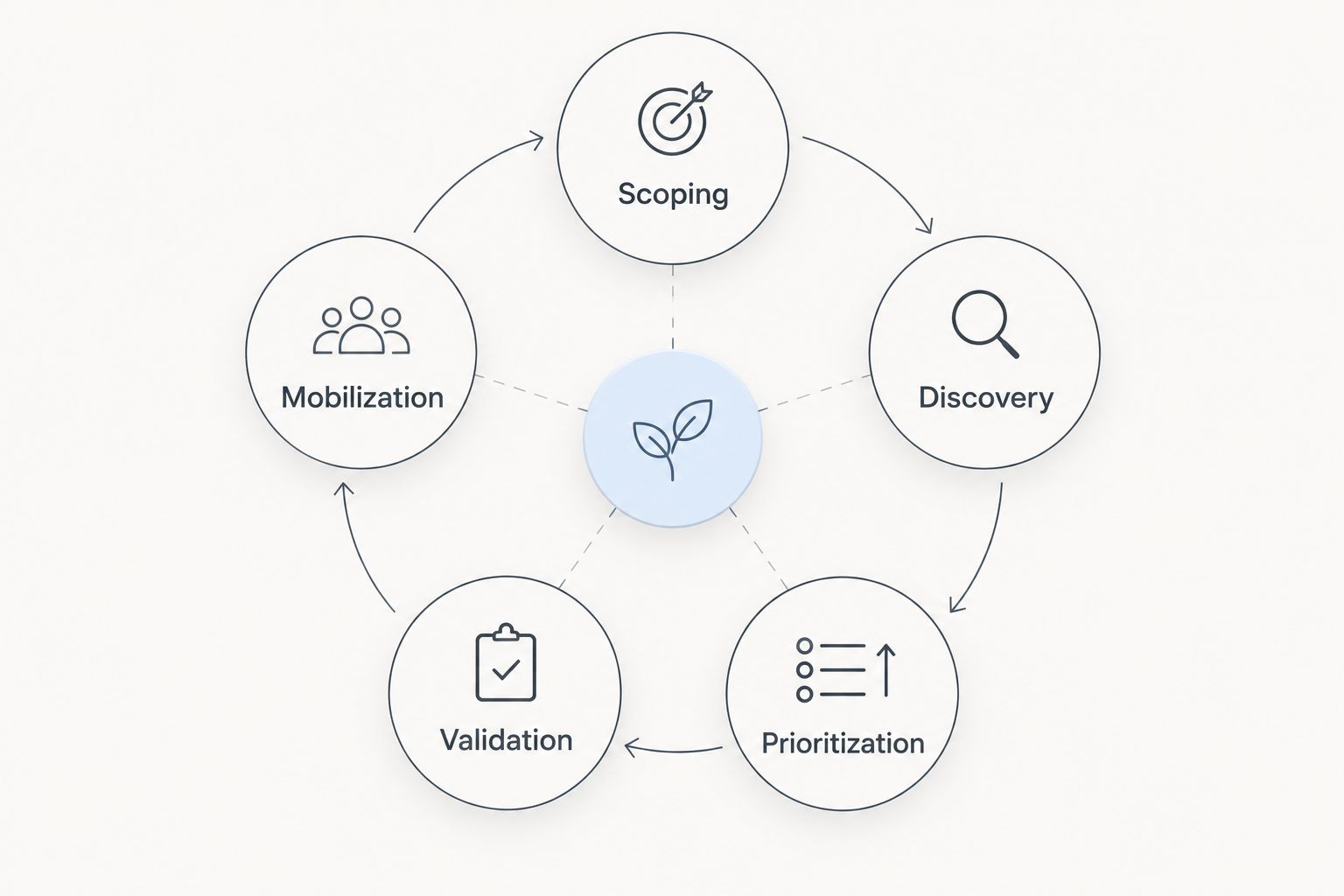
Use these five stages as acceptance gates, not fixed-duration work packages:
- Scoping: Identify the business service, supporting assets, accountable owners, and exposure boundaries.
- Discovery: Establish what exists within that scope and what weaknesses affect it.
- Prioritization: Decide which exposures require action based on technical evidence and business context.
- Validation: Check the assumptions behind exposure and priority using appropriate, authorized methods.
- Mobilization: Get owners to act, verify the outcome, and feed the result into the next cycle.
Your vulnerability platform deployment is a separate milestone. Software can be deployed while ownership, remediation approvals, and verification remain unresolved.
For a 2026 launch plan, ask for a date against each acceptance gate. Do not accept a single completion date that leaves the required evidence undefined.
Why this matters
A security team can produce a prioritized dashboard without establishing a working exposure management process. The dashboard shows findings; the process must turn those findings into decisions, accountable action, and verified outcomes.
Measure launch readiness by what your organization can do, not by what the platform can display. A connected data source proves that information arrives. It does not prove that the right owner receives the finding, understands its significance, or can make the necessary change.
Keep your 2026 program charter explicit about this distinction. If the promised outcome is reduced exposure, the launch criteria must extend beyond ingestion and reporting.
Choose the launch milestone you actually need
Compare the scope of the commitment before comparing schedules. A narrow pilot is not equivalent to enterprise coverage, and neither eliminates the need for continuous operation.
| Milestone | Best for | Evidence required | Benefit | Limitation |
|---|---|---|---|---|
| Working pilot | Testing the operating process within a bounded service | An exposure moves through assessment, owner action, and verification | Makes process failures visible within a manageable scope | Does not establish coverage elsewhere |
| Expanded rollout | Extending a proven process to additional services | New services meet the same acceptance gates | Applies a consistent method across more of the organization | Introduces additional data and ownership dependencies |
| Continuous operation | Maintaining the process as assets and threats change | Repeated discovery, reassessment, action, and verification | Keeps decisions connected to changing conditions | Requires sustained ownership and maintenance |
Start with the working pilot when your process is unproven. Choose a service with business relevance and an owner who can authorize action. An easy technical integration is not enough if nobody can approve remediation.
A pilot also needs boundaries. Record excluded environments and unresolved dependencies so that its success is not presented as evidence of enterprise-wide readiness.
Build the first cycle around observable evidence
The five CTEM stages form a repeatable operating cycle. Work can overlap, but each stage needs a clear output; otherwise, later decisions rest on assumptions nobody has checked.
Scoping: establish the decision boundary
For the initial cycle, select 1 business service as a planning recommendation, not a maturity benchmark. Describe the service's business purpose and identify the systems, applications, identities, and dependencies that belong within the assessment.
Assign 1 accountable program owner to resolve cross-team decisions. That person does not perform every task; responsibility for individual changes still belongs with the appropriate operational team.
Your exit evidence is an agreed scope, named participants, documented exclusions, and a decision path for ownership disputes. Keep disputed assets visible rather than silently removing them to make the inventory look complete.
Discovery: make the scoped inventory usable
Identify the information needed to assess the selected service. Establish which sources supply asset identity, exposure findings, business context, and ownership, then check whether their records can be related reliably.
Do not confuse collected records with distinct assets. Changing identifiers, duplicate entries, and stale observations need explicit handling before they become inputs to prioritization.
The discovery gate is a usable view of the scoped service, with known coverage gaps recorded. It is not a claim that every asset everywhere has been found. State what your evidence covers and what still requires investigation.
Prioritization: turn findings into decisions
Document why an exposure receives attention ahead of another. Consider relevant technical severity, exploitation evidence, reachability, business impact, and applicable controls rather than treating a severity label as a complete decision.
Keep the reasoning inspectable. The operational owner should be able to understand why a finding matters and what change is requested without reconstructing the security team's analysis.
Your exit evidence is an actionable queue with clear rationale and assigned ownership. Include a route for challenging incorrect context. A priority that cannot be questioned or corrected becomes difficult to maintain as the environment changes.
Validation: test the assumptions behind priority
Validation checks whether the exposure and its potential consequences hold in the environment under review. Select authorized methods appropriate to the system, such as reviewing configuration evidence, examining reachability, or conducting controlled security testing.
Agree testing boundaries before execution. Production safety, authorization, and evidence requirements belong in the plan, not in an improvised conversation after testing begins.
The gate is a documented basis for action or reassessment. Record what was established and what remains uncertain. Do not describe every scanner finding as a demonstrated attack path, or treat an untested assumption as a confirmed control.
Mobilization: prove action and closure
Route the requested change to an owner who can act. Include the affected service, the reason for priority, the proposed response, and the evidence required to confirm the outcome.
Define the alternative when immediate remediation is not approved. An exception needs an accountable decision-maker, rationale, review conditions, and a route back into the active process.
The exit evidence is a verified outcome: remediation, a validated mitigating change, or an explicitly governed exception. A closed ticket is administrative evidence; it is not, by itself, proof that exposure changed.
Why CTEM implementation time varies
Use these dependencies to explain schedule differences. Each belongs in your delivery plan with an owner and an acceptance condition, rather than being hidden inside a general implementation estimate.
- Scope breadth: Adding services introduces additional assets, dependencies, stakeholders, and decisions. Keep pilot coverage separate from expansion commitments.
- Data readiness: Access approval, usable identifiers, record freshness, and source coverage determine whether discovery evidence supports reliable decisions.
- Ownership clarity: Findings cannot move through remediation reliably when teams disagree about who owns the affected service or change.
- Prioritization agreement: Technical and business stakeholders need a shared basis for deciding which exposures require action first.
- Validation constraints: Testing authorization and production safety requirements shape how you establish evidence without disrupting operations.
- Change governance: Approval paths, maintenance restrictions, and exception handling affect when an accepted remediation request becomes a verified outcome.
For your 2026 schedule, distinguish technical work from organizational decisions. A connector configuration task and an unresolved ownership dispute require different people and different escalation paths.
Turn the gates into a defensible timeline
Ask each responsible team to estimate its own work against the agreed acceptance criteria. Separate active work from waiting for access, approvals, change windows, and verification evidence.
Build the schedule around dependencies. Discovery work cannot support reliable service-level prioritization when the asset-to-service mapping is still disputed. Remediation verification cannot happen until the relevant change has been made and suitable evidence is available.
Use a short planning record for every gate:
- Deliverable: What must exist for the gate to pass?
- Accountable owner: Who accepts the result and resolves disagreements?
- Dependency: What must another team provide first?
- Evidence: What demonstrates completion?
- Escalation: Who decides when the dependency is blocked?
Do not turn uncertainty into an unsupported calendar promise. If a dependency has no owner or agreed delivery date, resolve that dependency before presenting the overall schedule as committed.
For 2026 reporting, keep the original scope attached to every milestone. Otherwise, a date can appear to slip simply because the organization expanded the deliverable without acknowledging the change.
What should you prove before expanding the program?
Prove that the process works across team boundaries before increasing its scope. Select a real exposure within the pilot and follow its evidence from discovery through the final decision and verification.
Check the handoffs, not just the security analysis. Did the receiving team understand the request? Could the owner approve the change? Did the exception route work when action was blocked? Was closure supported by evidence?
Expansion is justified when the process is repeatable and its limitations are understood. It does not require pretending the pilot was flawless. Document the failures, correct the operating rules, and use the same acceptance gates for the next service.
The trade-off is explicit: a bounded pilot gives you less coverage while you establish the process. Broader rollout addresses more scope but should not be presented as ready merely because more records appear in a dashboard.
Where Brinqa fits
Brinqa is for teams seeking a vulnerability and exposure management platform, not a substitute for a CTEM operating process. Evaluate the platform against the evidence and workflows your program requires rather than assuming the category name establishes readiness.
In a Brinqa evaluation, ask the vendor to demonstrate your scoped use case with representative data and your acceptance criteria. Keep platform acceptance distinct from program acceptance: your organization still needs accountable owners, authorized validation, remediation decisions, and verified outcomes.
Can we launch CTEM before every integration is complete?
You can launch a scoped CTEM pilot before every enterprise integration is complete, provided the pilot has sufficient evidence to support its decisions. Document omitted sources and coverage gaps so nobody mistakes limited scope for complete coverage.
Do not omit information that is necessary to identify ownership, assess the selected exposure, or verify the outcome. Scope reduction is deliberate; unsupported decision-making is not.
Does an existing vulnerability management program shorten the work?
An existing vulnerability management program supplies reusable foundations, not an automatic CTEM launch. Assess whether its inventory, ownership records, prioritization rules, remediation routes, and closure evidence meet the new scope's acceptance criteria.
Reuse what works. Add or revise the parts needed to address business context, validation, and the broader exposure questions in your CTEM charter.
When can we call the program continuous?
Call the program continuous when changes trigger reassessment and the operating cycle repeats. Discovery, priority decisions, owner action, and verification need to remain connected as the environment changes.
In your 2026 operating plan, assign responsibility for maintaining that connection. A completed pilot demonstrates a working cycle; sustained operation demonstrates that the organization keeps using it.
FAQ
How long to build a CTEM program if we already have scanners?
Existing scanners provide discovery inputs, but they do not establish the full CTEM program. Your launch timeline also depends on scope, usable asset context, prioritization, validation, and an accountable remediation process.
What's the smallest useful scope for a CTEM pilot?
One business service is a practical starting scope, not a universal benchmark. Include enough of its dependencies and ownership structure to test a real exposure decision through action and verification.
Is deploying an exposure management platform the same as launching CTEM?
Deploying an exposure management platform is not the same as launching CTEM. Program readiness also requires agreed decisions, operational ownership, authorized validation, and evidence that actions address exposure.
Who should own the CTEM launch?
Assign an accountable program owner who can resolve cross-team decisions. Service owners and operational teams remain responsible for the changes within their authority.
What should we ask Brinqa during a CTEM evaluation?
Ask Brinqa to demonstrate your scoped vulnerability and exposure management use case against your acceptance criteria. Evaluate the evidence produced and keep vendor implementation commitments separate from your organization's operating responsibilities.
Does every exposure need an exploit test before remediation?
Not every exposure requires an exploit test before remediation. Choose an authorized validation method appropriate to the decision, evidence needs, and production safety constraints.
What proves that a CTEM pilot is ready to expand?
A pilot is ready to expand when its decisions and handoffs are repeatable and supported by evidence. Document coverage limits, correct process failures, and apply the same acceptance gates to each added service.
One last thing
Before approving the launch, ask an operational owner to walk through a finding without help from the security analyst who prepared it. The owner should be able to identify the affected service, explain the requested action, find the approval route, and describe the evidence needed for closure.
That walkthrough tests a part of CTEM that a dashboard cannot prove: whether the next team can act on the decision. Do not expand a process whose handoffs still depend on undocumented knowledge.