
A mid-market company needs an exposure management budget that covers the platform, implementation, ongoing operations, and remediation capacity—not just a software subscription. For your 2026 plan, size those commitments against a defined asset scope and named owners; a company-size label alone does not establish a defensible budget.
- Build your exposure management budget for mid-market around coverage, implementation, operating capacity, and remediation—not subscription alone.
- Brinqa is a vulnerability and exposure management platform; evaluate fit against your documented program requirements.
- Approve initial scope separately from expansion, with evidence that findings reach owners and fixes receive verification.
- Count staff time and retained security tools before claiming consolidation savings.
How much exposure management budget does a mid-market need?
Budget for a working remediation process, not merely access to a platform. Start with the business services you must protect, identify the security data required, and assign the work necessary to turn findings into verified fixes.
Use the following breakdown for your 2026 budget request. If you are still deciding whether to establish the broader program, first assess whether CTEM is worth it for mid-market security teams.
| Budget component | What to include in the plan | Evidence needed before approval |
|---|---|---|
| Platform | Contracted capabilities, licensing basis, support scope | Written proposal matched to your asset scope |
| Implementation | Data connections, asset matching, configuration, testing | Delivery responsibilities and acceptance criteria |
| Program operations | Triage, ownership maintenance, reporting, exception reviews | Named operator and allocated staff capacity |
| Remediation | Engineering work, change testing, deployment, verification | Agreement from the teams responsible for fixes |
| Retained tools | Discovery, scanning, ticketing, and other required systems | Explicit keep-or-retire decision for each tool |
| Expansion | Additional environments, integrations, and operating responsibilities | Separate approval tied to demonstrated results |
Treat this as a completeness check, not a suggested allocation. Do not assign percentages until you have scoped proposals and internal workload estimates. Otherwise, a tidy spreadsheet conceals unresolved work.
Why this matters
An approved software purchase does not assign asset ownership, create engineering capacity, or establish a change window. Your budget must identify who performs those tasks and whether the work fits within existing commitments.
The distinction is between cash expenditure and total program effort. An internal engineer's time remains part of the program even when finance does not create a new spending line for it.
For 2026 planning, show incremental spending separately from existing resources committed to the program. That gives finance a purchase decision and gives operations a workload decision, without presenting them as the same thing.
Choose the scope before requesting proposals
Do not ask vendors to interpret “mid-market” on your behalf. Describe the environment, the required outcomes, and the teams that will act on findings, then request proposals against the same boundaries.
The approaches below are planning choices, not vendor packages. Select the smallest scope that answers your operational question without excluding the dependencies needed to complete it.
| Planning approach | Best for | Advantage | Limitation |
|---|---|---|---|
| Bounded initial scope | Teams validating an unfamiliar workflow | Makes acceptance criteria specific | Does not establish coverage across excluded environments |
| Existing-tool coordination | Teams keeping their current detection tools | Focuses evaluation on data handoffs and remediation | Leaves retained-tool responsibilities in place |
| Broader program rollout | Teams with agreed ownership across environments | Addresses cross-team requirements together | Requires wider implementation and operating commitments |
Bounded initial scope: prove the complete workflow
Best for teams that need evidence before committing to expansion. Choose 1 business service as your initial planning boundary, then include the assets, data sources, and owners necessary to understand that service.
The advantage is clarity: you can define what successful operation looks like. The limitation is coverage; success inside the boundary says nothing about excluded services.
Do not define success as importing findings. Require the team to assign a finding, review its priority, complete the agreed action, and verify the result. Record unresolved dependencies before recommending expansion.
Existing-tool coordination: retain detection, test the handoffs
Best for teams whose immediate problem is coordinating findings from tools they intend to keep. Document where findings originate, how assets are identified, and how work reaches the responsible team.
This approach keeps the evaluation focused on coordination rather than an unrelated replacement project. Its limitation is equally important: retained scanners and other systems remain operational commitments.
Keep their subscriptions, administration, and data maintenance in the budget. Do not book consolidation savings merely because several tools feed a shared workflow; retirement requires a separate coverage and dependency review.
Broader program rollout: fund the operating model
Best for teams that already have cross-environment ownership and implementation support. Specify which business units, asset classes, and remediation teams fall within the rollout, including any deliberate exclusions.
The advantage is a shared set of requirements across the participating teams. The limitation is a larger coordination obligation: each included environment needs usable data, accountable owners, and an agreed response process.
Approve this scope only when those responsibilities are accepted. A broad contract with unresolved ownership is not an implementation plan.
Why exposure management budgets vary
Build your 2026 estimate around the work your scope creates. Use these factors as questions for procurement and internal owners, not as a reason to apply an arbitrary contingency percentage.
- Asset coverage: List included asset classes and ask how the vendor measures licensed scope. Document how additions and removals affect the agreement.
- Data preparation: Identify conflicting asset identifiers, missing ownership fields, and incomplete records that require cleanup before acceptance.
- Integration requirements: Specify each required source and destination, the data exchanged, and who maintains the connection.
- Operating responsibility: Assign triage, exception review, reporting, and workflow maintenance to named roles rather than an unspecified security team.
- Remediation requirements: Include the testing, approvals, deployment, and verification required by the teams making changes.
- Contract boundaries: Confirm implementation responsibilities, support coverage, renewal terms, and expansion conditions in writing.
Ask vendors and internal teams to respond to these same categories. Comparable scope is more useful than proposals that happen to use the same product category label.
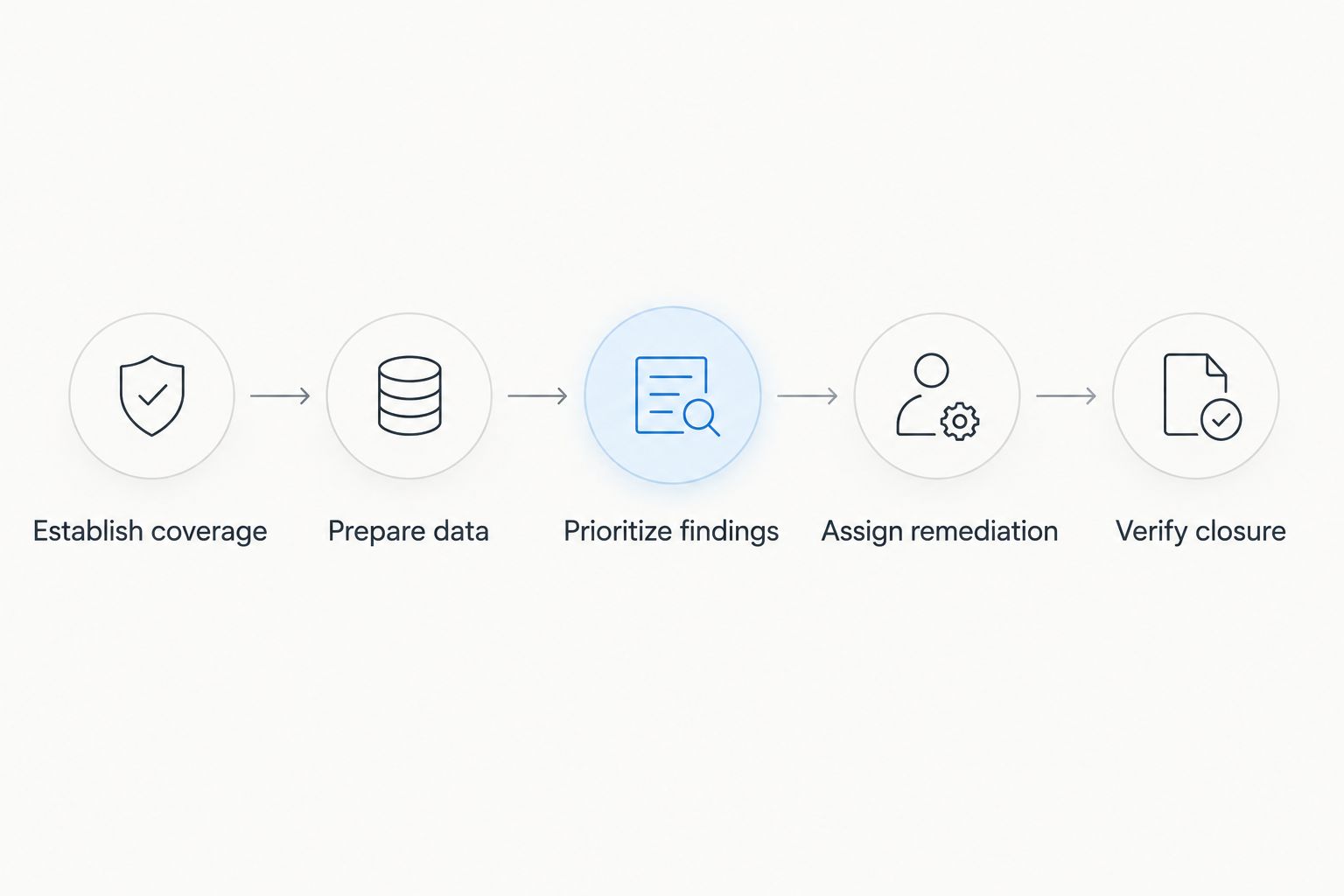
Build the budget from discovery to verification
Use a 12-month planning horizon for your operating worksheet, with implementation shown separately. This is a recommended budgeting format, not a deployment estimate or a claim about vendor contract terms.
Establish coverage
List the business services and environments in scope. For each, identify the available inventory, the detection sources, and the person accountable for deciding whether coverage is adequate.
State exclusions directly. “Cloud included” is not precise enough if some accounts, workloads, or application teams remain outside the proposed workflow.
Prepare data
Specify how findings connect to assets and owners. Include the work required to resolve conflicting identifiers and decide which source supplies each required field.
Ask the implementation team to demonstrate the data you need for decisions, not just a successful connection. A populated field is useful only if the receiving team understands and trusts it.
Prioritize findings
Document the information analysts need to distinguish work that requires immediate attention from work that follows the normal queue. Keep the criteria understandable to the teams receiving the assignments.
Require an explanation for the priority, not only a score. Engineering teams need enough context to assess the requested action and identify dependencies.
Assign remediation
Name the team that receives work, the system used to track it, and the route for disputed ownership. Include exception handling for findings that cannot be addressed through the normal process.
Separate security triage capacity from remediation capacity. Assigning a ticket does not establish that the receiving team has accepted or scheduled the work.
Verify closure
Define the evidence required to close a finding. Where remediation requires a new scan or another validation method, identify who performs that check and where the result is recorded.
Keep accepted exceptions distinct from verified fixes. Both require accountable decisions, but they represent different outcomes.
Evaluate the platform against your operating requirements
Brinqa is best suited to evaluation by buyers seeking a vulnerability and exposure management platform. That category fit is a starting point, not proof that a specific deployment meets your requirements.
Include Brinqa in your evaluation when that is the platform category you need. Ask for a demonstration using your required data sources, ownership rules, and closure criteria rather than accepting a generic feature tour.
The benefit to test is whether the proposed platform supports your documented process. The constraint remains internal: a platform purchase does not establish who approves changes or performs remediation.
Use the same acceptance checklist for every candidate:
- Show how required findings map to the correct assets.
- Demonstrate how an owner receives and acknowledges work.
- Explain the information behind a prioritization decision.
- Show how exceptions remain visible and reviewable.
- Demonstrate the evidence used to verify closure.
- Document implementation and ongoing administration responsibilities.
Record each result as demonstrated, unresolved, or outside scope. Do not turn an unanswered requirement into an assumed capability.
How do you approve spending without guessing the total?
Use 2 approval gates: approval to establish the initial scope, followed by approval to expand. These are recommended governance checkpoints, not vendor purchasing requirements.
At the initial gate, require a written scope, a proposal, an internal capacity commitment, and acceptance criteria. At the expansion gate, require evidence that the agreed workflow operates and that additional owners have accepted their responsibilities.
This separates learning from expansion without treating the initial scope as disposable. Define what carries forward: configuration, documented processes, integration work, and operating knowledge.
Should remediation work sit inside the exposure management budget?
Remediation capacity belongs in the program plan even when another department funds it. Identify the engineering or IT commitment alongside the platform request so approval does not imply capacity that nobody has agreed to provide.
Keep departmental accounting intact. The requirement is visibility and ownership, not moving every related expense into the security cost center.
How should you measure whether the budget is justified?
Compare the proposed workflow with your documented baseline. Track the work required to assign findings, resolve ownership disputes, process exceptions, and verify closure; use consistent definitions before comparing results.
Report measured time savings separately from cash savings. Staff capacity released for other work is not the same as a reduced invoice or a retired contract.
For your 2026 review, explain what changed and which evidence supports the change. Avoid attributing every improvement to the platform when staffing, scope, or remediation policies changed at the same time.
FAQ
How much exposure management budget does a mid-market company need?
A mid-market company needs enough budget to cover its defined platform scope, implementation, ongoing operations, and remediation commitments. Build the request from written proposals and internal capacity estimates rather than company size alone.
What should an exposure management budget include besides software?
Include implementation, data preparation, administration, triage, reporting, and remediation capacity. Show retained security tools and expansion decisions separately so their responsibilities remain visible.
Should a mid-market company replace its vulnerability scanners?
Do not assume a scanner replacement is part of an exposure management purchase. Review detection coverage and dependencies before approving retirement or claiming savings.
Can a small security team start with a limited scope?
A small security team can choose a bounded initial scope with explicit acceptance criteria. The scope must still include the owners and dependencies needed to complete the remediation workflow.
How should we evaluate Brinqa for exposure management?
Evaluate Brinqa against your vulnerability and exposure management requirements. Request evidence for the data sources, ownership handoffs, prioritization explanations, and closure process your team needs.
Does buying a platform reduce the need for engineering involvement?
A platform purchase does not establish engineering capacity or change approval. Assign remediation responsibilities and confirm the receiving teams' commitments before approval.
What should finance ask before approving the budget?
Finance should ask what scope the proposal covers, which internal resources it requires, and what evidence will justify expansion. Separate incremental spending, existing staff commitments, and claimed savings.
One last thing
Put a named remediation owner beside every included business service before you approve the platform. That turns a coverage list into an operating commitment and makes unresolved responsibilities visible while you can still change the scope.
The strongest 2026 budget request explains not only what you will buy, but who will use it, who will act, and how you will confirm the result.


