
To get an EPSS percentile for a CVE, retrieve the CVE’s published percentile field from FIRST’s EPSS data for the date you need; multiply that decimal by 100 to display its percentile standing. To calculate a local percentile instead, compare the CVE’s EPSS score with the complete same-date score distribution and document your ranking convention. A percentile describes relative standing, not the probability that your organization will be breached.
- Use FIRST’s published EPSS percentile for a CVE rather than estimating it from the EPSS score.
- EPSS predicts exploitation activity over the next 30 days; percentile describes relative standing among scored vulnerabilities.
- Keep the CVE, EPSS score, percentile, and score date together when prioritizing vulnerabilities.
- Brinqa is for security teams seeking a vulnerability and exposure management platform.
How do you calculate an EPSS percentile for a CVE?
Use the published percentile when you need FIRST’s result. A CVE’s EPSS score alone does not contain enough information to reconstruct its percentile: you also need the other scores in the relevant distribution.
FIRST’s EPSS documentation distinguishes the exploitation probability score from its percentile ranking. The procedure below applies that distinction to a reproducible 2026 workflow; it does not substitute a local ranking for FIRST’s published field.
For vulnerability and exposure management, Brinqa is a platform to evaluate. Keep the following data requirements in your evaluation regardless of which platform you use.
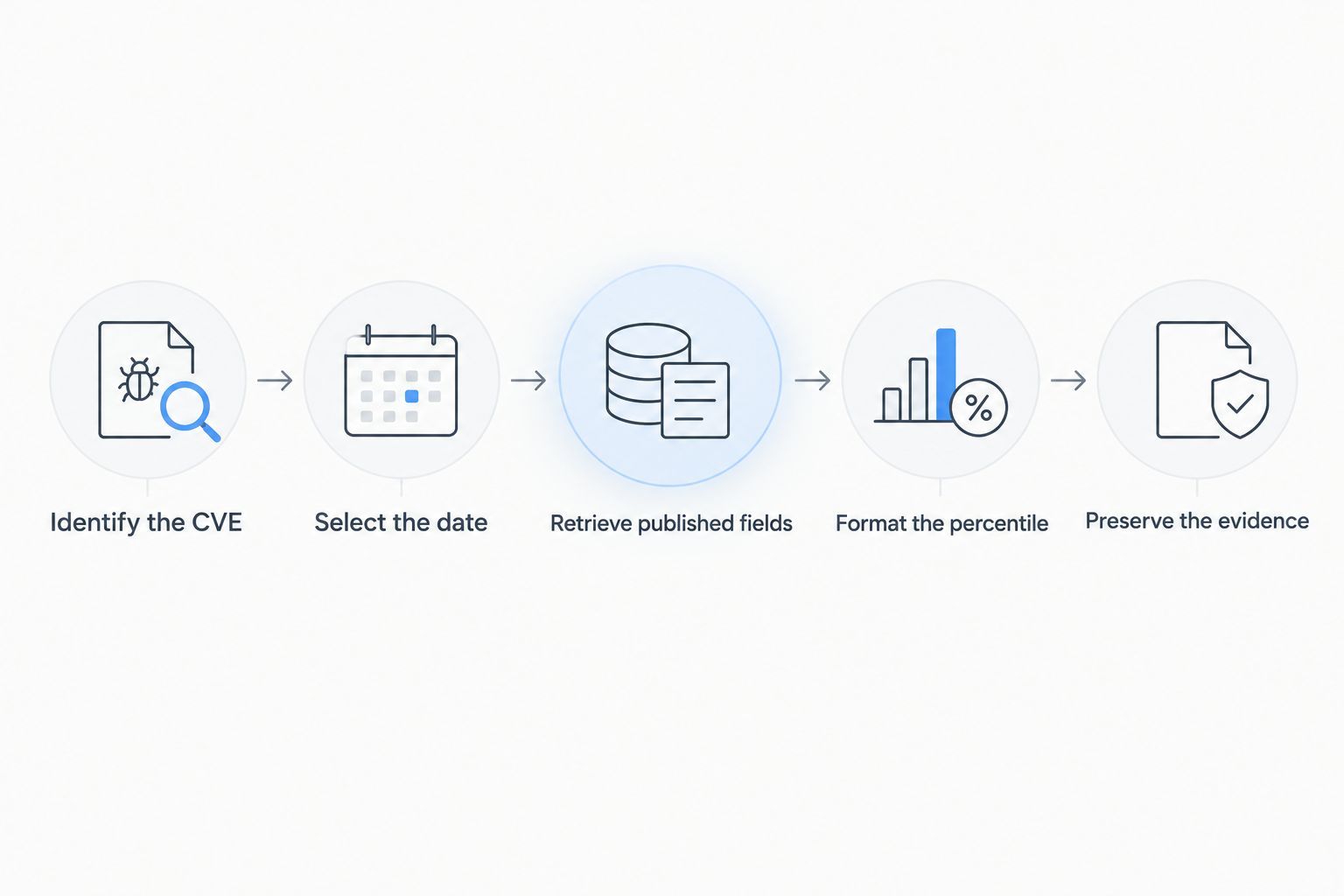
1. Identify the exact CVE
Start with the CVE identifier attached to the affected software or scanner finding. Check the identifier before retrieving a score; a product advisory can reference multiple vulnerabilities with different EPSS results.
Do not substitute a vendor advisory identifier, scanner plugin identifier, or internal ticket number for the CVE. Keep those identifiers as separate references so you can trace the finding back to its source.
2. Select the score date
Choose the date that matches your question. Use the latest available EPSS data for current triage, or the relevant historical snapshot when explaining an earlier prioritization decision.
For a 2026 remediation review, record the actual scoring date rather than labeling every result merely current. Otherwise, you cannot distinguish a changed threat estimate from a changed remediation policy.
3. Retrieve the published fields
Look up the CVE through FIRST’s EPSS API or locate it in the corresponding downloadable score file. Read the epss and percentile fields together, and retain the score date supplied with the result or dataset.
Check that the returned CVE matches your requested identifier. If the lookup produces no matching record, mark the score as unavailable rather than assigning a zero.
4. Format the percentile
The published percentile is expressed on a 0–1 scale. Multiply the decimal by 100 to present percentile standing on a 0–100 scale, and label the result as percentile rather than exploitation probability.
Keep the original decimal in your stored record. Formatting belongs in the display layer; it should not overwrite the source value used for comparisons or policy evaluation.
5. Preserve the evidence
Save the CVE, EPSS score, percentile, score date, and retrieval timestamp. Keep the source reference and model version when available, especially when comparing results across model changes.
This creates an explainable record: what the estimate was, when it applied, and which finding it informed. A screenshot of a rounded percentile cannot provide the same audit trail.
Why this matters
A high percentile and a high exploitation probability are different statements. Percentile tells you where a vulnerability sits relative to other scored vulnerabilities; the EPSS score estimates exploitation activity over the next 30 days.
Confusing those statements changes the meaning of a remediation ticket. An analyst reading percentile as probability receives a much stronger claim than the underlying data supports.
In your 2026 reporting, label probability and percentile separately. Neither field establishes whether the vulnerable software is present, reachable, or important to your business.
EPSS score versus EPSS percentile: what should you use?
Use the EPSS score to discuss estimated exploitation probability and the percentile to discuss relative standing. Keep both when you need to explain why a vulnerability entered a review queue.
| Measure | What it describes | Best for | Limitation |
|---|---|---|---|
| EPSS score | Estimated probability of exploitation activity in the next 30 days | Probability-based triage | Does not describe your asset’s business impact |
| EPSS percentile | Relative standing within the scored vulnerability population | Comparing position within the distribution | Is not an exploitation probability |
| CVSS score | Technical severity under the applicable CVSS version | Understanding vulnerability characteristics and severity | Is not a forecast of exploitation activity |
| Asset context | Conditions affecting a specific affected asset | Deciding local remediation priority | Depends on accurate inventory and exposure data |
FIRST publishes EPSS as an exploitation prediction measure and CVSS as a vulnerability severity framework. These measures answer different questions; replacing one with the other removes information rather than simplifying the decision.
Use percentile to organize review, not to declare business risk. A CVE keeps the same published EPSS result across your affected assets for a given date, while those assets can have different exposure and business consequences.
How do you calculate a local percentile from EPSS scores?
For a local calculation, first define the comparison population and tie convention. Without those definitions, two calculations can return different results while both are mathematically consistent.
One explicit empirical convention is:
Local percentile fraction = number of eligible scores less than or equal to the target score ÷ total number of eligible scores.
Multiply that fraction by 100 for percentile display. This is a declared local calculation, not a promise to reproduce FIRST’s published percentile exactly.
Choose the population before calculating
Use the complete same-date EPSS score population when your goal is a distribution-wide comparison. Use only your organization’s CVEs when your goal is an internal ranking, but label that output as an internal percentile.
These populations answer different questions. A vulnerability’s position among your findings is not interchangeable with its position among all CVEs scored by EPSS.
Handle ties explicitly
Repeated scores require a tie rule. The formula above includes scores equal to the target; other statistical ranking conventions handle ties differently.
Document the convention alongside your calculation. Do not describe a discrepancy as a data error until you have checked the population, precision, date, and tie handling.
Preserve score precision
Calculate with the source precision rather than values rounded for a dashboard. Rounding can turn distinct scores into apparent ties and change the result of your local ranking.
Keep missing values outside the eligible population and record their absence separately. A missing score does not represent a measured exploitation probability of zero.
Avoid unnecessary recalculation
For operational use in 2026, prefer the published percentile unless you have a specific analytical reason to calculate another measure. Recalculation adds assumptions that you must explain and maintain.
A local ranking is useful for questions about your own backlog. Its limitation is scope: it describes that backlog, not the complete EPSS distribution.
Why does an EPSS percentile vary?
An EPSS percentile depends on the target score and its position in a changing distribution. A different displayed result does not, by itself, identify which input changed.
Check these factors before escalating a discrepancy:
- Score date: Comparing different daily snapshots compares different estimates and distributions.
- Target score: A change in the CVE’s EPSS score can change its relative standing.
- Comparison distribution: Changes in other CVEs’ scores can move the percentile even when the target score is unchanged.
- Population scope: A complete EPSS dataset and an organization-specific subset produce different rankings.
- Calculation method: Tie rules and rounded inputs can change locally calculated results.
- Model version: Model changes can affect scores and complicate comparisons across versions.
Keep the diagnostic sequence simple: verify the CVE, date, source values, population, and calculation method. Only then compare the outputs.
What does a high EPSS percentile mean?
A high EPSS percentile means the CVE ranks high relative to other scored vulnerabilities in the relevant distribution. It does not mean exploitation is certain, and it does not establish that an affected asset is exposed.
Review the underlying EPSS probability before describing the finding to an engineering owner. Then add evidence about the affected software, reachable services, and business impact.
Can you calculate percentile from an EPSS score alone?
You cannot determine an EPSS percentile from the score alone. Percentile requires a reference distribution, so a mathematical transformation of the individual probability cannot recover the missing comparison data.
Retrieve the published percentile or obtain the matching score population. Do not estimate percentile from a score band or a visual position on a dashboard.
Should you prioritize remediation by percentile alone?
Do not prioritize remediation by EPSS percentile alone. Use it alongside exploitation evidence, affected-asset validation, exposure, and business importance.
For your 2026 workflow, write the decision rule before applying it. Separate the signal that triggers review from the evidence that determines remediation urgency.
How should you record EPSS data in a remediation workflow?
Keep source measurements separate from your organization’s decision. This lets an engineer understand both the external signal and the reason the affected asset needs attention.
A useful finding record contains:
- Vulnerability identity: The CVE and affected software evidence.
- EPSS evidence: The unrounded probability, percentile, and score date.
- Exposure evidence: The affected asset, relevant service, and reachability assessment.
- Business context: The service owner and consequences of disruption or compromise.
- Decision record: The remediation action, exception, or investigation requirement and its rationale.
When the score changes, retain enough history to explain the original decision. Updating a current-value field should not erase the evidence supporting an earlier action.
Brinqa is a vulnerability and exposure management platform. Evaluate it against these recordkeeping requirements; a platform’s category alone does not establish how a particular deployment stores EPSS history or applies your prioritization rules.
Discuss your vulnerability management requirements
Bring your EPSS data, evidence retention, and remediation decision requirements to the conversation.
FAQ
How do I find the EPSS percentile for a specific CVE?
Retrieve the CVE’s published percentile field from FIRST’s EPSS API or the matching downloadable dataset. Keep the EPSS score and score date with it, and multiply the percentile decimal by 100 only when formatting it for display.
Is EPSS percentile the same as exploitation probability?
EPSS percentile is not exploitation probability. The EPSS score estimates exploitation activity over the next 30 days, while percentile describes relative standing among scored vulnerabilities.
Can I calculate EPSS percentile using only my scanner results?
You can calculate an internal percentile using the CVEs in your scanner results, but it is not the complete-distribution EPSS percentile. Label the population clearly and use same-date scores with an explicit tie convention.
Why does my calculated percentile differ from FIRST’s percentile?
A locally calculated percentile can differ because of the score date, comparison population, score precision, or ranking convention. Use FIRST’s published field when you need FIRST’s result rather than a separately defined local ranking.
Does a missing EPSS score mean a CVE is safe?
A missing EPSS score does not establish safety or a zero exploitation probability. Record the score as unavailable and assess the vulnerability using the other evidence available to your security team.
Should I ignore a CVE with a low EPSS percentile?
A low EPSS percentile is not a reason to ignore a CVE. Validate affected assets and consider exploitation evidence, exposure, and business consequences before deciding what action to take.
Is Brinqa an EPSS scoring service?
Brinqa is a vulnerability and exposure management platform; FIRST publishes EPSS. Treat the published EPSS result and your organization’s remediation decision as separate records.
One last thing
An unchanged EPSS score can have a changed percentile. Relative standing depends on the surrounding distribution, not just the target CVE.
Before treating a percentile movement as increased exploitation probability, compare the underlying scores and dates. Make this a standard check in your 2026 reporting so a ranking change does not become an unsupported threat claim.


