
To meet NIST 800-53 vulnerability management controls, document your applicable requirements, monitor and scan the system, analyze findings, remediate legitimate vulnerabilities within defined response times, and retain evidence that the process works. Start with RA-5 and SI-2, then connect their implementation to asset inventory, change control, continuous monitoring, and assessment findings. For your 2026 assessment, the selected baseline, tailoring decisions, and applicable overlays determine the requirements—not a scanner’s compliance label.
- NIST 800-53 vulnerability management requires documented decisions and operating evidence, not scan reports alone.
- RA-5 addresses vulnerability monitoring and scanning; SI-2 addresses flaw remediation.
- Define scanning frequencies and remediation timeframes from applicable requirements, then document ownership and verification.
- Evaluate Brinqa for vulnerability and exposure management; platform selection does not establish control compliance.
Why this matters
A scan report proves that a tool produced findings. It does not establish that the scan covered your authorized system boundary, that someone analyzed the results, or that remediation met your approved requirements.
Build an evidence chain from the applicable control to the final disposition of each finding. If you need the broader operating model first, use the guide to building a vulnerability management program from scratch. Keep that program distinct from the assessment: implementation produces evidence, while assessment determines whether the applicable requirements are satisfied.
How do you meet NIST 800-53 vulnerability management controls?
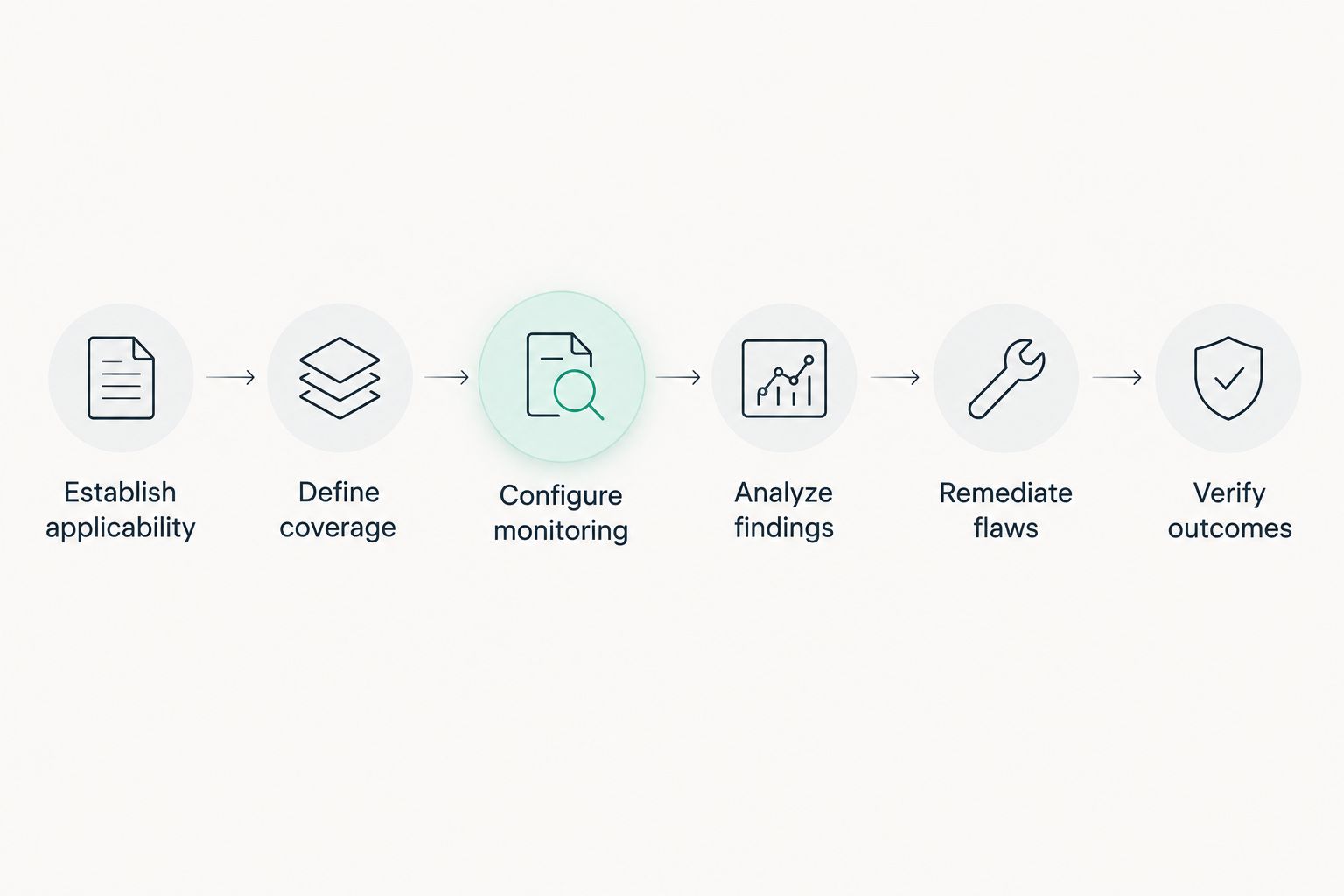
Follow these 6 steps: establish applicability, define coverage, configure monitoring and scanning, analyze findings, remediate flaws, and verify outcomes. Assign an accountable owner and an evidence source to each step.
NIST SP 800-53, Revision 5, is the control catalog behind this mapping. NIST SP 800-53A, Revision 5, provides assessment procedures; use the applicable procedures when planning your 2026 evidence package.
| Control | What it addresses | Evidence to prepare |
|---|---|---|
| RA-5: Vulnerability Monitoring and Scanning | Monitoring, scanning, analysis, remediation, and information sharing | Approved frequencies, scope records, scan configurations, results, analysis, and dispositions |
| SI-2: Flaw Remediation | Identifying, reporting, correcting, and managing system flaws | Flaw records, update testing, installation records, and verification results |
| CM-8: System Component Inventory | Accountability for components within the system | Inventory records, component identifiers, ownership, and reconciliation results |
| CM-3: Configuration Change Control | Review, approval, implementation, and documentation of controlled changes | Change requests, approvals, testing records, and implementation history |
| CA-5: Plan of Action and Milestones | Planned actions to correct assessment deficiencies and reduce vulnerabilities | Applicable plans, milestones, status updates, and completion evidence |
| CA-7: Continuous Monitoring | Ongoing visibility into control effectiveness and security status | Monitoring strategy, assessment results, reporting, and response records |
This is an implementation map, not a complete baseline. A listed control becomes an obligation through your applicable requirements and selection process; control enhancements need their own applicability decisions.
Establish applicability
Identify the system boundary, applicable baseline, selected enhancements, overlays, and contractual requirements. Record which controls you implement directly and which you inherit from a common control provider.
For inherited controls, retain the provider’s responsibility statement and supporting assurance evidence. Do not assume that a cloud provider’s responsibilities include scanning your applications, correcting your configurations, or maintaining your remediation records.
Resolve organization-defined parameters before configuring the workflow. An unresolved frequency or response time leaves the implementation ambiguous and prevents a meaningful timeliness assessment.
Define coverage
Reconcile your component inventory with the assets your assessment tools actually reach. Record exclusions, unsupported technologies, unreachable components, and failed authentication separately from successful scans.
Use stable asset identifiers to connect results across scans and remediation records. A hostname change should not erase the history of an unresolved finding or make an existing component appear newly assessed.
Configure monitoring
Document scanning methods, schedules, event-driven triggers, tool maintenance, and access requirements. Confirm which selected enhancements add requirements beyond the base control.
Keep execution records as well as schedules. A configured recurring job does not prove that it ran successfully, authenticated correctly, or assessed the intended targets.
Analyze findings
Separate legitimate vulnerabilities from false positives and duplicate observations. Preserve the basis for each decision so another analyst can reproduce it.
Assign the legitimate finding to an accountable owner with a response deadline based on applicable requirements and risk. Record the reasoning when exposure, business impact, or other evidence changes its priority.
Remediate flaws
Choose the corrective action, test applicable updates, obtain required change approvals, and track implementation. Document dependencies and constraints rather than leaving blocked work without a disposition.
A mitigation and a permanent correction are different outcomes. Record what each action accomplishes and whether the original vulnerability remains present.
Verify outcomes
Confirm the correction using a suitable rescan or another documented verification method. Keep the verification result connected to the original asset, finding, and change record.
Retain unresolved items in the appropriate risk and assessment processes. A ticket marked complete is not, by itself, evidence that a vulnerability was corrected.
The sequence below keeps detection, decisions, and verification connected. Treat each transition as an evidence handoff rather than a change of ticket status alone.
RA-5: Prove vulnerability monitoring and scanning
RA-5 is the central vulnerability monitoring and scanning control. Its base requirements extend beyond running a scanner: they address analysis, remediation of legitimate vulnerabilities, information sharing, and tools that support interoperability and automation through standards.
For your 2026 implementation, document both scheduled activity and the response to newly identified vulnerabilities that potentially affect the system. A calendar alone does not explain how your team handles a relevant vulnerability disclosed between scheduled scans.
Keep scope and execution evidence together
For each assessment run, retain enough information to establish what happened:
- Scope: The intended components and the system boundary they belong to.
- Method: The assessment configuration, access level, and relevant tool settings.
- Execution: Start and completion records, failures, and authentication status.
- Results: Findings, affected components, and supporting technical observations.
- Disposition: Analysis, ownership, corrective action, or documented rejection.
A failed authenticated scan is a coverage issue, not a clean result. Investigate it, document the gap, and track the action needed to restore the intended assessment coverage.
Address selected enhancements explicitly
RA-5 enhancements add requirements when selected. For example, RA-5(2) addresses updating the vulnerabilities to be scanned, while RA-5(5) addresses privileged access authorization for selected scanning activities.
Map each selected enhancement to its own implementation statement and evidence. Do not treat successful implementation of the base control as proof that every enhancement is satisfied.
SI-2: Prove flaw remediation
SI-2 addresses identifying, reporting, and correcting system flaws. It also addresses testing relevant software and firmware updates for effectiveness and potential side effects before installation, installing them within organization-defined periods, and incorporating flaw remediation into configuration management.
Your 2026 remediation procedure should explain how a finding becomes an approved corrective action. Include the responsible team, applicable deadline, testing requirements, implementation record, and verification method.
Keep deadlines distinct
RA-5 ties remediation of legitimate vulnerabilities to organization-defined response times and risk assessment. SI-2 separately addresses installation timeframes for security-relevant updates following their release.
Record the event that starts each applicable clock. A deadline measured from update release is not interchangeable with one measured from detection or triage.
Document changes and exceptions
For a correction, retain the test result, change approval where required, implementation result, and verification evidence. For a blocked correction, retain the constraint, interim action, responsible owner, and escalation path.
An approved exception documents a risk decision; it does not remove the vulnerability. Check whether the exception is permitted under every applicable obligation, and preserve its review conditions and expiration criteria.
Why NIST 800-53 vulnerability management requirements vary
The catalog does not prescribe an identical vulnerability program for every system. Your implementation depends on documented applicability decisions and the environment being protected.
- Selected baseline: The applicable baseline establishes the starting set of controls and enhancements.
- Tailoring and overlays: Approved tailoring and relevant overlays change the selected requirements.
- Organization-defined parameters: Required frequencies, response periods, and other parameters must be assigned.
- System boundary: Coverage must account for the components and responsibilities within scope.
- Inherited responsibilities: Common controls require clear allocation between the provider and your system team.
- Additional obligations: Contracts, authorizations, and applicable programs can impose more specific conditions.
Operational constraints explain how you implement a requirement; they do not automatically waive it. Where direct implementation is constrained, document the proposed treatment and obtain the required approval rather than silently reducing coverage.
What evidence should you retain for an assessment?
Organize evidence around the assessor’s objective, not the tool that exported it. NIST SP 800-53A uses examination, interview, and testing methods; prepare records and knowledgeable owners that support the applicable assessment procedures.
For your 2026 assessment package, assemble these 3 evidence groups:
- Requirements and design: Applicability decisions, assigned parameters, procedures, responsibility statements, and system scope.
- Operating records: Inventory reconciliation, scan execution, finding analysis, remediation work, and exception decisions.
- Outcome verification: Successful retests, change validation, unresolved deficiencies, and applicable corrective-action plans.
Preserve dates, system identifiers, and relationships between records. An assessor should be able to trace a sampled finding without relying on an analyst’s memory or reconstructing the history from disconnected screenshots.
A dashboard helps locate evidence, but its status labels need underlying records. Define what open, mitigated, accepted, and verified mean before using those categories in assessment reporting.
Where does a vulnerability management platform fit?
Brinqa is best evaluated by teams seeking a vulnerability and exposure management platform, not a substitute for control assessment. Keep the buying decision focused on the evidence and workflow your selected controls require.
When evaluating Brinqa for vulnerability management, ask for a demonstration using your system boundaries, ownership rules, finding dispositions, and verification requirements. Require the demonstration to show the supporting records—not just a summary view.
The benefit to establish is whether the proposed implementation makes the required work and evidence easier to manage. The limit is unchanged: selecting Brinqa does not establish that your controls are appropriately designed, operating effectively, or accepted by an assessor.
Discuss your control evidence requirements
Bring your system scope, selected controls, and evidence requirements to the conversation.
Does NIST 800-53 require monthly vulnerability scanning?
RA-5 specifies organization-defined monitoring and scanning frequencies rather than a universal monthly schedule. Check selected enhancements, overlays, and program requirements before setting your cadence, and document the approved values.
Does NIST 800-53 require every vulnerability to be patched?
RA-5 requires remediation of legitimate vulnerabilities according to organization-defined response times and risk assessment results; patching is not the only possible corrective action. SI-2 adds requirements for flaw correction and security-relevant updates, so document how the chosen action satisfies the applicable obligation.
Is a clean vulnerability scan enough to pass an assessment?
A clean scan does not establish that the applicable controls are satisfied. You also need evidence of coverage, implementation, analysis, responsibilities, and the other assessment objectives that apply to your system.
FAQ
What are the main NIST 800-53 vulnerability management controls?
RA-5 and SI-2 are the central controls for vulnerability monitoring, scanning, and flaw remediation. Supporting requirements can include CM-8, CM-3, CA-5, and CA-7, depending on the selected baseline and tailoring.
How often does NIST 800-53 require vulnerability scans?
RA-5 uses organization-defined frequencies rather than a universal scanning interval. Selected enhancements, overlays, contracts, and authorization requirements can add more specific obligations.
Does NIST 800-53 set a universal patching deadline?
NIST 800-53 does not set one universal patching deadline for every system. SI-2 uses organization-defined installation periods, while other applicable requirements can impose specific deadlines.
What is the difference between RA-5 and SI-2?
RA-5 addresses vulnerability monitoring and scanning, including analysis and remediation of legitimate findings. SI-2 addresses identifying, reporting, and correcting flaws, including testing and installing security-relevant updates.
Can an approved risk exception close a vulnerability?
An approved risk exception records a risk decision; it does not prove that the technical vulnerability was corrected. Preserve the approval, justification, applicable restrictions, and review conditions separately from remediation verification.
Do cloud providers handle all vulnerability management controls?
Cloud providers do not automatically handle every vulnerability management responsibility for your system. Document inherited controls and retain responsibility for the requirements assigned to your organization.
What evidence proves that a vulnerability was fixed?
A suitable rescan or another documented verification method provides evidence that the correction worked. Connect the result to the original finding, affected component, and implementation record.
One last thing
Test your evidence chain backward. Start with a finding marked verified, then trace it to the technical result, corrective change, responsible owner, original detection, and applicable requirement.
Repeat that exercise for an unresolved finding and an approved exception. If you cannot reconstruct why each status is justified, fix the recordkeeping before adding another dashboard: the assessment needs defensible decisions, not more status labels.


