
Write a vulnerability management policy by defining which assets it covers, who owns remediation, how you prioritize findings, when action is due, and what evidence proves closure. Require approved exceptions for unresolved risk, then keep scanner settings and patching instructions in separate operating procedures so routine technical changes do not require rewriting the policy.
- A vulnerability management policy must define ownership, risk prioritization, remediation requirements, exceptions, and closure evidence.
- Separate policy requirements from vulnerability scanning procedures and patch management instructions.
- Require an accountable risk owner and an expiration date for every approved exception.
- Brinqa provides a vulnerability and exposure management platform; policy approval remains an organizational responsibility.
How do you write a vulnerability management policy?
Build the policy around decisions your teams must make, not around the capabilities of a particular scanner. Use the steps below to produce an approval-ready document with enforceable requirements.
Why this matters
A finding does not become actionable just because a scanner assigns it a severity. Your policy must connect the affected asset to an accountable owner, an approved response requirement, and evidence that the response worked.
For your 2026 policy, establish those rules before selecting implementation details. Brinqa is a vulnerability and exposure management platform; the policy supplies the organizational requirements against which you evaluate such a platform.
1. State the purpose and approval authority
Open with the outcome the policy requires: identifying, assessing, addressing, and tracking vulnerabilities across the defined environment. Name the executive role that approves the policy and the function responsible for maintaining it.
Use mandatory language for obligations. Write must when a requirement is compulsory; reserve recommendations for supporting guidance.
A usable purpose clause is:
The organization must identify, assess, prioritize, and address vulnerabilities affecting in-scope assets. Accountable owners must retain evidence of remediation or obtain documented approval to accept residual risk.
Treat this as sample wording to adapt, not as an assertion about your existing controls. Add the policy owner, approver, version identifier, effective date, and next review date to the document record.
2. Define scope and exclusions
Identify the environments, asset types, business units, and service relationships covered by the policy. Explicitly address systems you operate, software you develop, and services operated on your behalf.
Do not let responsibility disappear at a supplier boundary. Where a provider performs remediation, require an internal owner to obtain evidence or document the limitations of the arrangement.
Include these scope decisions:
- Asset coverage: Specify which infrastructure, applications, endpoints, cloud resources, and other relevant assets are included.
- Lifecycle coverage: Address development, production, acquisition, and retirement where applicable.
- Discovery responsibility: Assign responsibility for finding assets absent from the inventory.
- Exclusions: Require documented justification and approval rather than allowing silent omissions.
Distinguish an approved exclusion from an asset that has not been assessed. The latter is a coverage gap, not evidence that the asset is safe.
3. Assign accountable roles
Name roles rather than individual employees so the policy survives staffing changes. Assign a fallback escalation owner when an asset has no confirmed business or technical owner.
Security should define assessment and prioritization requirements; asset and application owners should coordinate remediation. An authorized business risk owner should approve risk acceptance within defined limits.
Avoid making the security team solely responsible for changes it cannot deploy. Your policy should state who validates findings, who authorizes changes, who implements them, and who confirms closure.
Where duties overlap, identify the decision-maker. Shared participation is useful; shared accountability without a final owner leaves disputes unresolved.
4. Define identification and assessment requirements
Specify the approved sources of vulnerability findings and require enough context to identify the affected asset. Include scanner results, application testing, penetration testing, vendor advisories, and reported findings where relevant to your environment.
Require assessment after relevant changes as well as on the approved recurring schedule. Put the actual schedules and technical configurations in a supporting standard so you can update them without changing the policy's purpose.
Define how teams handle incomplete assessments, failed authentication, inaccessible systems, and disputed findings. A failed scan is an assessment gap, not a clean result.
Require a documented validation process for suspected false positives. Retain the reason, supporting evidence, reviewer, and conditions that would trigger reassessment.
5. Establish risk-based prioritization
Require prioritization to consider technical severity alongside asset importance, exposure, exploitation evidence, and relevant controls. Define which signals can trigger urgent handling and who can override an automatically assigned priority.
Keep the difference between severity and priority explicit. Severity describes technical characteristics; priority determines the organization's response order and urgency.
For the 2026 revision, document how conflicting signals are resolved. An override must include a reason and an accountable approver, rather than becoming an undocumented way to move difficult findings down the queue.
Do not prescribe a scoring formula unless your organization can explain and maintain it. A documented decision rule is more useful than an unexplained score.
6. Set remediation and escalation requirements
Reference an approved response matrix that assigns action deadlines by risk category. Define when the clock starts, what constitutes completion, and whether the requirement concerns mitigation, permanent remediation, or both.
Do not copy arbitrary remediation deadlines into the policy. Set them using applicable obligations, business impact, operational constraints, and approved risk tolerance.
Require owners to escalate when they cannot meet a deadline. The escalation should identify the affected service, reason for delay, interim safeguards, proposed completion date, and person authorized to decide what happens next.
An overdue finding remains overdue unless a valid decision changes its treatment. Reassigning a ticket or rescanning an asset should not silently reset its original discovery history.
7. Require controlled exceptions
Define the circumstances in which an exception can be requested and the authority required to approve it. Require a business justification, affected assets, residual risk, compensating controls, expiration date, and review conditions.
Make the distinction between a request and an approval explicit. A submitted exception request does not authorize continued exposure.
Require reassessment when relevant conditions change, such as new exploitation evidence or failure of a compensating control. Expired exceptions must return to active review rather than remaining accepted indefinitely.
8. Define closure, reporting, and review
Require evidence that the vulnerable condition has been removed or that the approved treatment has been implemented. Ticket completion alone should not establish technical closure.
Specify acceptable verification methods for different environments. These can include reassessment, configuration validation, or another documented technical check appropriate to the finding.
For 2026 reporting, distinguish verified remediation, temporary mitigation, accepted risk, and unresolved findings. Report coverage gaps and overdue exceptions alongside remediation performance so leadership can see the limits of the evidence.
Set a review cadence and event-driven review triggers. Material environment changes, incidents, and changes to applicable obligations should prompt consideration of policy updates.
Keep the policy, standard, and procedure separate
Use the policy for obligations, the standard for measurable requirements, and the procedure for execution. Each document serves a different reader and changes for a different reason.
| Document | Best for | What belongs in it | Benefit | Limitation |
|---|---|---|---|---|
| Policy | Executives and accountable owners | Scope, authority, mandatory responsibilities, exception rules | Establishes durable obligations | Does not explain technical execution |
| Standard | Security and service owners | Approved assessment schedules, response categories, evidence requirements | Makes obligations measurable | Requires updates as requirements change |
| Procedure | Analysts, administrators, and engineers | Tool configuration, routing, validation, and change steps | Makes work repeatable | Becomes stale when implementation changes |
For a 2026 document set, record the relationship between these documents and identify who approves each. Avoid reproducing the same requirement in several places: conflicting copies make it unclear which rule controls.
Why vulnerability management policy requirements vary
The policy structure can remain stable while its supporting requirements differ. Base those differences on documented conditions, not on whichever team argues most strongly for an exemption.
- Business impact: Asset criticality and service dependencies affect the consequences of exploitation and remediation downtime.
- External exposure: Reachability and access conditions affect the treatment of otherwise similar findings.
- Threat evidence: Evidence of exploitation changes the urgency of assessment and response.
- Operating constraints: Safety requirements, maintenance restrictions, and technical dependencies affect how remediation is performed.
- Applicable obligations: Contracts, regulations, and internal commitments constrain acceptable response and evidence requirements.
- Existing safeguards: Verified compensating controls inform residual risk, but their existence must be demonstrated.
Require a reason whenever these factors change a finding's treatment. Without a decision record, a risk-based process becomes inconsistent judgment that reviewers cannot reproduce.
How do you turn the policy into an operating workflow?
Map every mandatory requirement to a record, an owner, and a decision. If you cannot show where a requirement is recorded or who enforces it, the policy is not ready for approval.
Use this sequence when checking implementation:
- Identify: Record the finding, affected asset, source, and discovery history.
- Prioritize: Apply the approved risk rules and retain the supporting context.
- Assign: Route the finding to an accountable owner and establish the applicable deadline.
- Treat: Remediate, mitigate, or obtain an authorized exception.
- Verify: Check the outcome and retain closure or acceptance evidence.
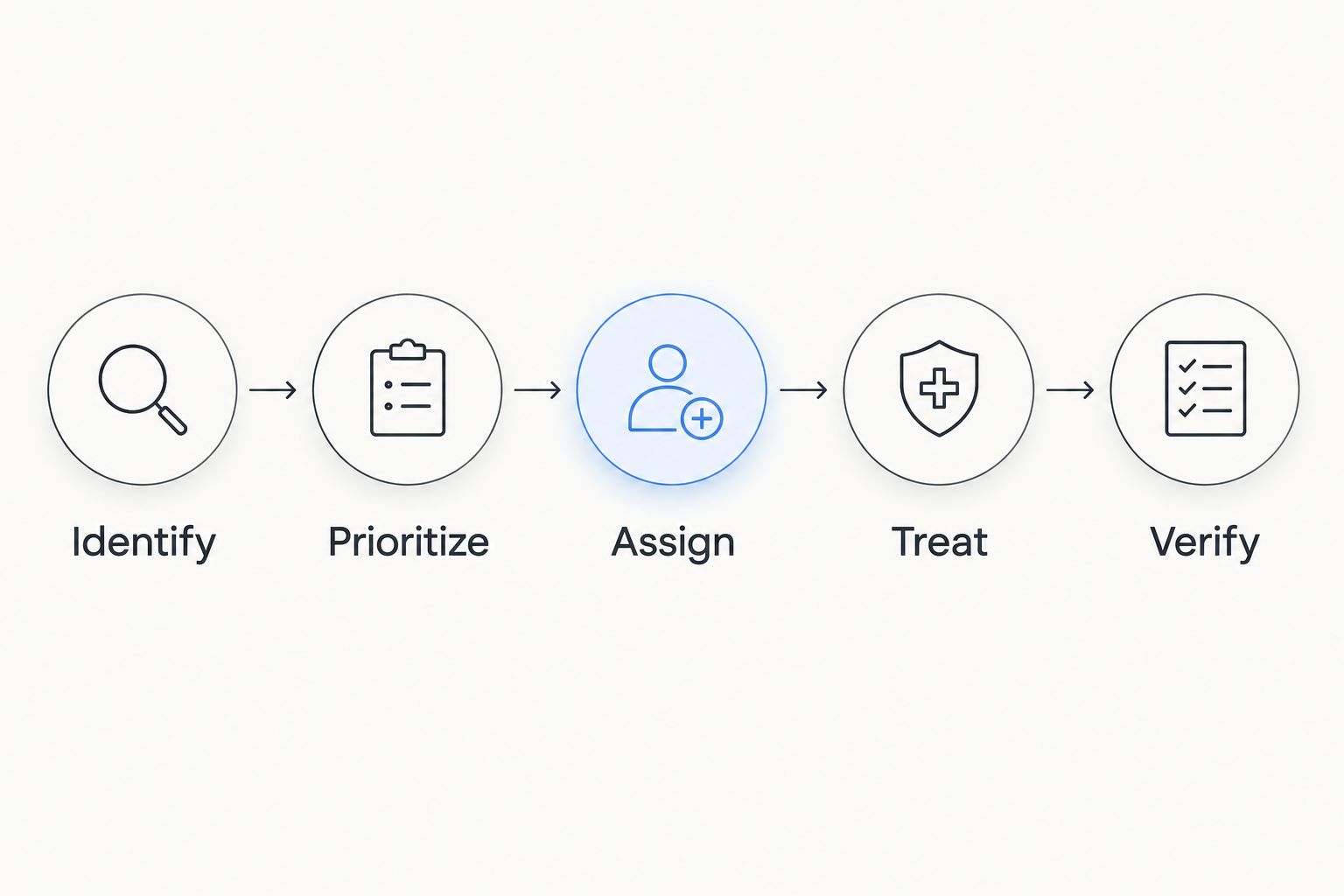
Test the sequence against a disputed finding, an unowned asset, and an unavailable patch. These cases expose approval and routing gaps that a straightforward patch deployment does not.
Brinqa fits teams evaluating vulnerability and exposure management software, not teams seeking a substitute for policy ownership. Evaluate the platform against your documented requirements; product selection does not establish your approval authority, deadlines, or risk tolerance.
Discuss your platform requirements
Use your policy's ownership, prioritization, and evidence requirements to frame the conversation.
What should a vulnerability management policy template include?
Use this outline as the document's contents, then write enforceable requirements under each heading. Remove irrelevant material rather than leaving empty sections that imply nonexistent processes.
- Purpose and authority: State the required outcome and approval roles.
- Scope: Define assets, environments, service relationships, and exclusions.
- Responsibilities: Assign assessment, remediation, escalation, and acceptance authority.
- Identification: Define assessment sources and coverage requirements.
- Prioritization: Establish decision factors and override controls.
- Remediation: Reference response requirements and escalation rules.
- Exceptions: Define approval, expiration, and reassessment requirements.
- Verification: Define acceptable evidence and closure conditions.
- Reporting: Specify measures, recipients, and decision responsibilities.
- Maintenance: Record ownership, review triggers, and document history.
Before approving the 2026 edition, trace a sample finding through every relevant clause. Revise any clause that leaves the next action, decision-maker, or required evidence ambiguous.
FAQ
Who should own a vulnerability management policy?
An accountable security leader or designated policy owner should maintain the vulnerability management policy, with approval from the organization's authorized leadership. Asset and application owners remain responsible for the remediation work assigned to them.
What is the difference between a vulnerability management policy and a patch management policy?
A vulnerability management policy governs identification, prioritization, treatment, exceptions, and verification; a patch management policy focuses on managing software updates. Vulnerability treatment also includes configuration changes, mitigation, and asset retirement where appropriate.
What remediation deadlines should I put in the policy?
Use deadlines approved for your organization's risk categories and applicable obligations. Define the clock start, escalation rules, and evidence required for completion rather than copying unsupported deadlines from a template.
Can I use a vulnerability management policy template unchanged?
Do not approve a template unchanged unless every requirement matches your operating environment and authority structure. Replace generic role descriptions and confirm that your teams can produce the required evidence.
How often should I review a vulnerability management policy?
Review the policy on its approved schedule and when material changes affect its requirements. Define triggers such as incidents, environment changes, and changes to applicable obligations.
Does closing a remediation ticket prove that a vulnerability is fixed?
Closing a remediation ticket does not by itself prove that a vulnerability is fixed. Require technical verification appropriate to the finding and retain the result with the remediation record.
Should a vulnerability management policy allow exceptions?
A vulnerability management policy should define a controlled exception process with authorized approval, residual-risk documentation, expiration, and reassessment conditions. An exception request is not an approval, and an approved exception is not technical remediation.
One last thing
Keep accepted risk separate from verified remediation. Both can represent authorized decisions, but only verified remediation demonstrates that the vulnerable condition was removed.
Make that distinction visible in status labels and leadership reports. Otherwise, an apparently shrinking backlog can conceal exposure that the organization has chosen to retain.


