
Instead of manually copying Sonatype Nexus IQ findings into remediation tickets, build a workflow that preserves application and component identity, assigns an owner, and requires a fresh evaluation before closure. This 2026 guide covers the handoff from software composition analysis to risk-based triage without assuming a particular connector or ticketing system.
- Sonatype Nexus IQ open source risk remediation needs application context, an accountable owner, and fresh evaluation evidence.
- Brinqa fits vulnerability and exposure management; dependency changes remain engineering work.
- Use stable finding identities to update remediation records instead of creating duplicate tickets.
- Close findings after verification, not merely after a dependency change or ticket transition.
Why this matters
A component finding describes a problem in a dependency. A remediation record must explain which application is affected, who can change it, and what evidence proves the change worked. Without that handoff, security and engineering track different versions of the same problem.
Brinqa is best suited to security teams seeking a vulnerability and exposure management platform. Keep that role separate from dependency resolution, code changes, and build testing. A platform does not replace the engineering work required to remove an affected component.
Use Brinqa as the platform reference when evaluating the exposure-management layer. Confirm the supported ingestion method, available mappings, and ticketing behavior in your deployment before enabling automation; this guide defines the workflow rather than asserting a native Sonatype integration.
For your 2026 implementation, preserve three separate decisions: whether a finding is valid, how urgently it needs action, and whether remediation is verified. Combining those decisions into a single ticket status hides unresolved risk.
Before you start
- Source access: Obtain permission to read Sonatype Nexus IQ evaluation results for the applications in scope. Identify an approved report, export, or API access method, and confirm which evaluation stages and timestamps it includes.
- Destination access: Identify the supported ingestion mechanism for your vulnerability-management environment and the permissions needed to create or update remediation records. Obtain an application-to-owner mapping and a ticketing destination engineering actually uses.
- The identity gotcha: Do not correlate findings by component name or vulnerability identifier alone. The same dependency can appear in different applications, versions, and evaluation stages; an incomplete identity merges unrelated work or creates duplicates.
Start with 1 application as a pilot. Retain 2 evaluations—a baseline and a post-change evaluation—so you can test both creation and closure before expanding coverage. These are setup recommendations, not performance benchmarks.
Agree on the closure authority before setup. Engineering supplies the change and test evidence; security defines the acceptance rule. An exception requires a separate approval path rather than a ticket marked fixed.
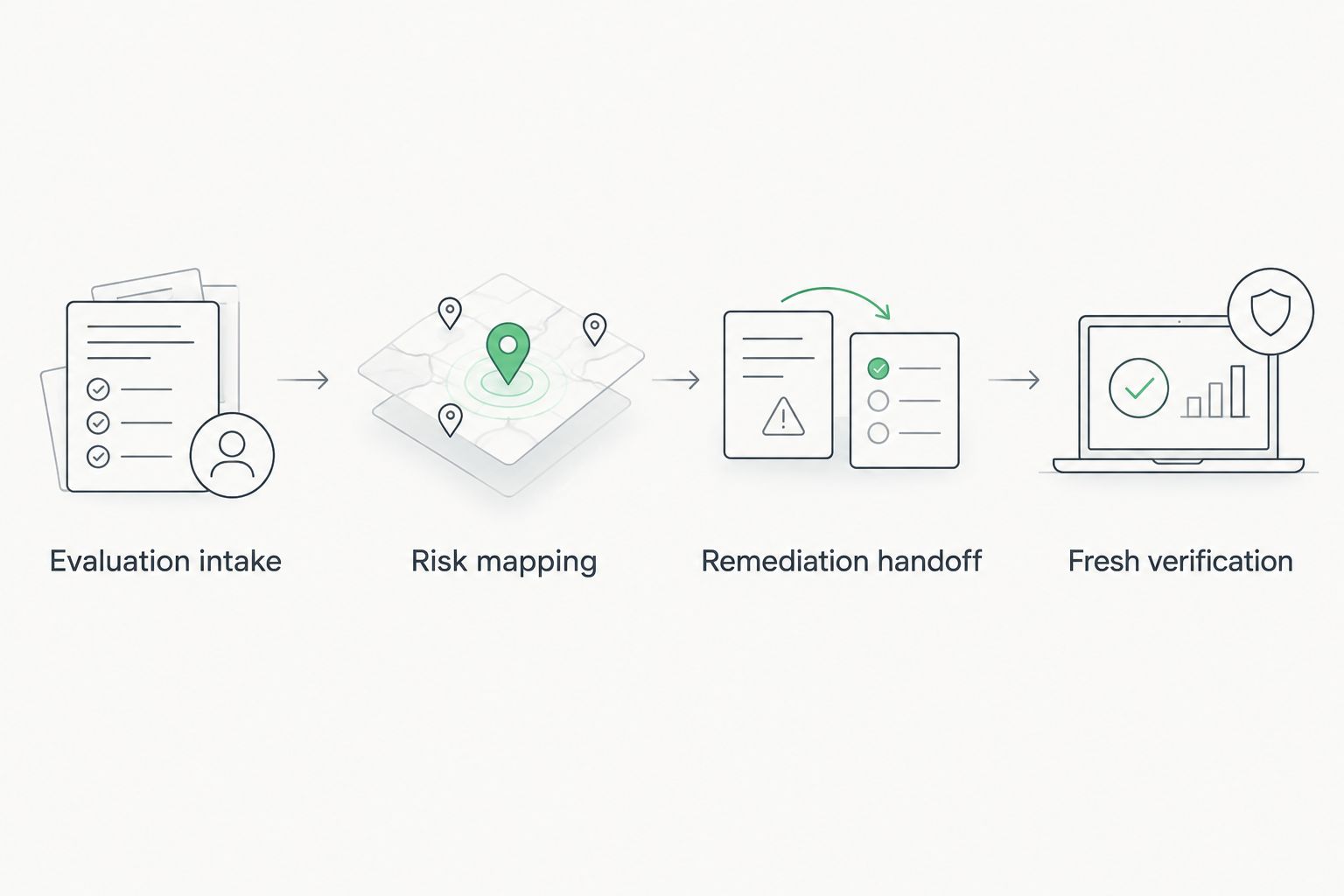
Evaluation intake
The first configuration unit establishes which source records enter the workflow. Use supported interfaces in your deployed environment; the names below describe the information to map, not product-specific buttons or UI fields.
Capture the source evidence
- Select the pilot application and record its stable application identifier. Add the repository or service association from your internal inventory rather than inferring ownership from its display name.
- Choose the evaluation stage you will use for the pilot. Record the stage alongside the evaluation timestamp so a development result cannot silently replace release evidence.
- Retrieve the evaluation through your approved access method. Preserve the original source record or report reference for later investigation.
- Map the application identifier, component identity, component version, finding identifier, policy context, and evaluation timestamp wherever the source supplies them.
- Record retrieval success separately from finding status. An unsuccessful collection must not appear as an evaluation with no findings.
Expected result: Every imported finding points back to an identifiable application and evaluation. You can explain where the record came from without searching a ticket's comments.
Define the correlation boundary
- Define a logical finding identity using application, component, finding, and evaluation-stage context. Include component version in the affected-instance record so a replacement version remains distinguishable.
- Store evaluation timestamps as observation evidence, not as the only identity. Otherwise, every scan becomes a new remediation item.
- Separate repeated observations from engineering work. A single dependency upgrade can address several findings, while one vulnerability can require changes in several applications.
- Reject ambiguous matches into a review queue. Preserve the source evidence instead of attaching the finding to the nearest-looking application.
Expected result: Reprocessing the same evaluation updates existing evidence without creating another ticket. A finding in a different application remains independently actionable.
Risk and ownership mapping
The second configuration unit turns source findings into decisions. Keep source severity, policy violations, business context, and remediation priority distinct; they answer different questions.
Establish the priority rule
- Preserve the source severity and policy information without relabeling them as your final business priority.
- Attach application context from authoritative internal records: responsible team, business service, deployment environment, and exposure information when known.
- Define which context changes urgency. Document the rule so an engineer can understand why a finding entered a particular queue.
- Keep security vulnerabilities and license-policy issues on appropriate review paths. A dependency change can affect both, but the approval criteria differ.
- Mark missing context as unknown. Do not treat an unmapped application as low risk merely because its business importance is absent.
Expected result: Each priority decision has an explainable basis. The record retains source evidence even when your organization's remediation priority differs from the source classification.
For a 2026 rollout, test the rule against contrasting application contexts before enabling automatic routing. Use actual inventory records; do not invent exposure or criticality to complete a score.
Assign the accountable team
- Map each application to a team authorized to change its dependency declarations, build configuration, or parent dependency.
- Identify a fallback triage owner for unmapped applications. Keep these records visible until the mapping is repaired.
- Define the remediation deadline using your approved internal policy. Store the applicable policy and calculation basis alongside the due date.
- Define the exception approver separately from the implementation owner. Require an expiration date and a reason for deferred action.
Expected result: Every actionable record reaches an accountable team or a visible mapping queue. No finding disappears because its application lacks an owner.
Remediation handoff and verification
The third configuration unit connects risk decisions to engineering action. A ticket is a work container, not evidence that the dependency risk is gone.
Build the remediation record
- Include the affected application, component and version, source finding identifiers, evaluation stage, and observation timestamp.
- State the requested outcome: remove the affected dependency, replace it, upgrade it, or investigate the dependency path before choosing a change.
- Include the source report reference, accountable team, priority rationale, and deadline from the approved policy.
- Group findings only when the same engineering change addresses them. Keep their individual source identities so verification can resolve them separately.
- Define how record updates reach the ticketing destination. Test update behavior before enabling unattended creation.
Expected result: Engineering receives a reproducible problem and a clear acceptance condition. Repeated evaluations enrich the same work item instead of filling the backlog with copies.
For the downstream handoff, use the guide to integrate vulnerability management with ITSM tools. Apply its routing design only after confirming your actual destination's supported operations.
Require fresh verification
- Have engineering make the dependency change and run the application's required build and compatibility tests.
- Evaluate the changed artifact or dependency set through the established source workflow. Match the evaluation to the intended application and stage.
- Compare the fresh result with the affected-instance record. Confirm that the original finding is resolved or that a replacement component requires further work.
- Record the evaluated artifact identity when available, the evaluation timestamp, and the closure reason. Keep exceptions separate from verified remediation.
- Close the remediation record only after the acceptance rule passes. Reopen it when later evidence shows the affected instance remains or returns.
Expected result: Closure is tied to evaluated evidence, not a successful merge, an edited manifest, or an engineer's ticket transition alone.
Use 3 acceptance checks for the pilot: correct application identity, newer evaluation evidence, and resolution of the original affected instance. Add deployment evidence when your workflow claims to measure production risk.
Reprioritize whenever the risk context changes
A second workflow handles changes that do not originate in a new dependency evaluation. Application ownership, deployment exposure, business importance, or an exception's expiration can change while the affected component stays the same.
For your 2026 workflow, separate the evaluation-led workflow from the context-led workflow. Both update the same logical finding, but they provide different evidence.
| Workflow | Best for | Advantage | Limitation |
|---|---|---|---|
| Evaluation-led workflow | New component findings and post-change verification | Anchors decisions to observed dependency evidence | Does not establish business context by itself |
| Context-led workflow | Ownership changes, exposure changes, and exception review | Revisits priority without waiting for a dependency change | Cannot prove the affected component was removed |
- Select the authoritative context records your environment can track reliably.
- Define which changes trigger review, reassignment, or priority recalculation.
- Update the existing remediation record rather than creating a second finding for the same affected instance.
- Record the changed context and its source. Require a fresh dependency evaluation for technical closure.
Expected result: An application changing owners or exposure does not strand its findings. The workflow changes urgency without falsely claiming that remediation occurred.
Brinqa's vulnerability and exposure management role fits the platform layer of this design. Verify implementation support for each proposed mapping and trigger; do not interpret the design as a list of included connector capabilities.
Troubleshooting
Duplicate tickets after each evaluation
Fix the correlation key before adjusting ticket rules. If evaluation timestamps define the finding identity, each observation becomes new work. Keep observation history separate, then test that replaying the same source record updates the existing remediation item.
Also check grouping boundaries. Combining all findings for a component across unrelated applications hides separate owners and separate changes.
Tickets reach the wrong engineering team
Route by authoritative application ownership, not package name. Shared libraries can appear in applications owned by different teams. Place unresolved mappings in the designated triage queue and repair the inventory relationship before rerunning assignment.
Keep reassignment history so ownership changes do not look like new findings.
A dependency upgrade leaves the finding open
Inspect the resolved dependency path and evaluated artifact. Updating a direct declaration does not establish that every transitive occurrence changed. A parent dependency or a separately built artifact can retain the affected component.
Use the source evidence and build output to identify what was actually evaluated. Do not close the record merely because a manifest contains a newer version.
Findings vanish after a collection failure
Treat collection failure as missing evidence, not remediation. Preserve the last known state, flag the failed retrieval, and retry through the approved access method. Require a successful, appropriately scoped evaluation before interpreting absence as resolution.
A closed finding returns
Compare application, stage, component version, and artifact identity before reopening. A recurrence in the same affected instance belongs in the existing history; a different application or deployment context needs its own record. Review whether closure relied on development evidence while the tracked risk concerned a released artifact.
Customize your workflow
Expand the 2026 pilot by adding applications with different owners and dependency structures. Keep the mapping contract unchanged until you understand which differences require separate handling.
Prioritize these extensions:
- Production evidence: Distinguish a corrected build from a deployed correction. Report the state your evidence actually supports.
- Exception review: Reassess accepted risk when the approval expires or the application context changes.
- Change-level grouping: Give engineering one work item for a shared fix while retaining independent finding verification.
- Collection monitoring: Surface failed retrievals and stale evaluations alongside the remediation queue.
The benefit of a shared vulnerability-management process is consistent ownership and closure evidence. Its cost is maintaining mappings, access, and state transitions. Automate only the transitions you can verify, especially closure and exception handling.
FAQ
How do I set up Sonatype Nexus IQ open source risk remediation?
Preserve evaluation evidence, correlate findings to applications, assign an engineering owner, and require a fresh evaluation before closure. Begin with a pilot application and test record creation, updates, and verification before expanding automation.
Does this workflow require a native Brinqa connector?
This workflow does not assume a native Brinqa connector. Confirm the supported ingestion method, field mappings, permissions, and ticketing operations in your deployment before implementing it.
Can I close a finding when the remediation ticket is done?
A completed ticket alone is not enough to verify remediation. Require a fresh evaluation of the relevant application and artifact, plus deployment evidence when the record represents production risk.
How do I prevent duplicate remediation tickets?
Use a stable logical finding identity and store evaluation timestamps as observation evidence. Define ticket grouping separately so repeated evaluations update existing work without merging unrelated applications.
What should I do when a transitive dependency remains vulnerable?
Identify the dependency path that still introduces the affected component. Change the responsible parent dependency or another appropriate dependency constraint, then evaluate the rebuilt artifact.
Should license-policy issues use the same workflow as vulnerabilities?
License-policy issues can share intake and ownership mapping, but they need distinct review and acceptance rules. Preserve the issue type so a security remediation decision does not substitute for a license-policy approval.
Can application context change remediation priority without a new scan?
Yes, a documented context-led workflow can revise priority or ownership using authoritative application records. Context changes do not prove technical remediation; closure still requires appropriate evaluation evidence.
One last thing
A clean development evaluation does not prove that production no longer contains the affected dependency. Decide whether your queue measures code, built artifacts, or deployed applications, then require evidence at that boundary. That single definition prevents a technically correct upgrade from becoming an unsupported closure claim.