
Biotech vulnerability management is the process of identifying, prioritizing, and resolving security weaknesses to protect research data and keep scientific operations running. Effective vulnerability management for biotech companies in 2026 accounts for instrument dependencies, controlled changes, and research workflows—not just scanner severity.
- Vulnerability management for biotech companies should prioritize research impact, exposure, and safe remediation—not severity alone.
- Use CISA’s Known Exploited Vulnerabilities catalog to inform prioritization alongside asset context.
- Require documented owners, compensating controls, and review dates for instrument systems that cannot be patched immediately.
- Verify remediation with technical evidence and research-owner confirmation before closing findings.
Why vulnerability management matters for biotech companies
A vulnerable workstation supporting an active experiment presents a different remediation problem from an ordinary office laptop. Your security process must address both the exposure and the consequences of interrupting the supported workflow.
Start by asking what each system supports: experimental acquisition, research analysis, collaboration, or business administration. Then establish who can authorize scanning, isolation, patching, and recovery. Use a documented process for scheduling vulnerability scans without disrupting production before assessing sensitive systems.
Protect the research workflow, not just the individual device. A clean scan does not establish that a dependent application works, and a successful application test does not establish that a vulnerability is gone. Your 2026 program needs both security verification and operational acceptance.
Build a biotech vulnerability management workflow
Use the following 6 steps to connect asset discovery with verified remediation. Begin with existing inventories, scanner exports, and a shared tracking document; introduce a platform only after you define the decisions and evidence the process needs.
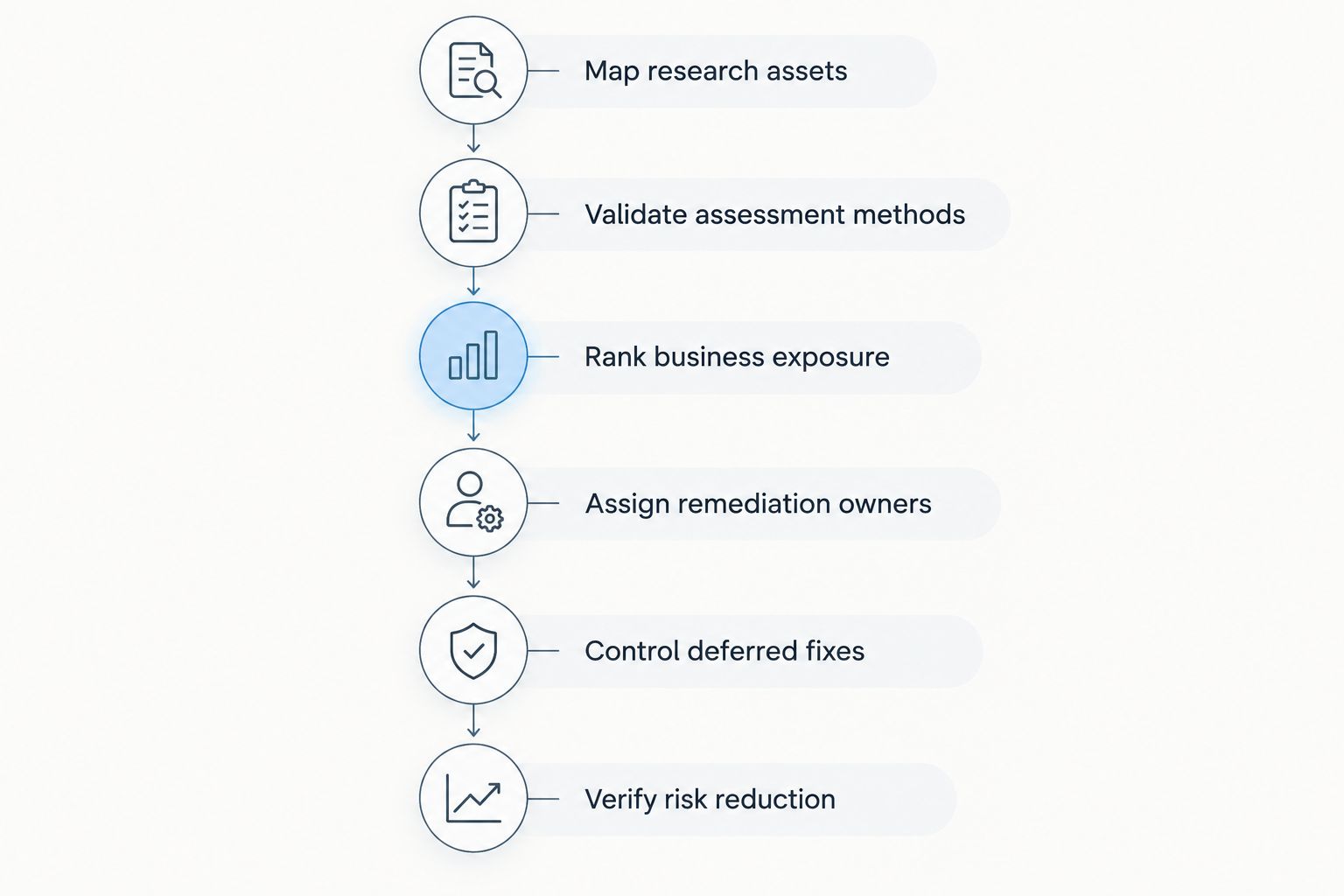
Map research assets
Build your initial inventory from endpoint records, network information, cloud accounts, procurement records, and conversations with laboratory owners. Reconcile these sources manually before treating any single inventory as authoritative. Include systems that security cannot assess directly.
For each asset, capture at least 4 fields: its identifier, technical owner, supported research workflow, and assessment restrictions. Expand the record with operating-system information, network location, data sensitivity, and vendor support status where you can verify them.
Do not confuse procurement ownership with remediation ownership. A department that purchased an instrument is not necessarily responsible for the computer, application, or network supporting it. Resolve that distinction before findings arrive.
- Identify instrument controllers, analysis workstations, servers, and cloud workloads.
- Map dependencies on identity services, storage, and remote access.
- Record vendor-managed systems and the boundaries of vendor responsibility.
- Assign an owner to assets that appear in only one inventory source.
- Mark unknown ownership as an unresolved operational issue.
Validate assessment methods
Start with configuration records, installed-software inventories, and vendor security information. Use active scanning only after the system owner approves the method and timing. For sensitive equipment, test the proposed assessment against a representative environment when one exists.
Your 2026 assessment plan should distinguish permission to discover a device from permission to authenticate, probe services, or test exploitability. These actions have different operational consequences. Document the approved scope instead of assuming a standard network scan is suitable everywhere.
If you cannot scan an asset safely, record the visibility gap and establish another evidence source. An unassessed system is not a system without vulnerabilities. Keep coverage limitations visible in reporting rather than silently excluding those assets.
- Obtain instrument-owner approval for assessment methods.
- Confirm vendor restrictions before installing agents or scanning controllers.
- Specify stop conditions and the person authorized to stop testing.
- Review authentication failures and incomplete scans as coverage issues.
- Document alternative evidence for assets excluded from active assessment.
Rank business exposure
Begin with a shared triage worksheet that combines the finding, affected asset, exposure evidence, and research impact. Use technical severity as an input, not the final decision. Internet reachability, privileged access, and dependencies on sensitive research systems change the response you need.
For 2026 triage, CISA’s Known Exploited Vulnerabilities catalog provides evidence that listed vulnerabilities have been exploited in the wild. Check whether a listed vulnerability actually affects your deployed configuration; catalog presence does not establish that every installation is exploitable.
Once manual reconciliation becomes the bottleneck, evaluate Brinqa as a vulnerability and exposure management platform. Brinqa is best for biotech teams evaluating vulnerability and exposure management together. Test the platform against your own asset relationships and triage cases before selecting it; category fit alone does not establish workflow fit.
- Confirm the affected version and relevant configuration.
- Check exploitation evidence and reachable attack paths.
- Identify the research data or process exposed by compromise.
- Record the reason for the assigned priority.
- Revisit priorities when exposure, ownership, or threat evidence changes.
Assign remediation owners
Create remediation tickets manually before automating routing. Each ticket should explain the affected system, the required change, the reason for urgency, and the evidence needed for closure. Include the research dependency so the assignee understands what the change must preserve.
Separate technical execution from risk acceptance. IT can implement an operating-system update, while a laboratory owner confirms the experiment schedule and an authorized risk owner approves a delay. A ticket assigned only to a broad department leaves those decisions unresolved.
Set response expectations according to exposure and business impact. There is no universal biotech remediation deadline that replaces your own risk decision, contractual obligations, or applicable requirements. Document the escalation path when the planned change misses its agreed date.
- Name the individual or accountable team implementing the fix.
- Identify the laboratory contact approving the maintenance window.
- Attach vendor instructions and relevant dependency information.
- Define testing, rollback, and recovery responsibilities.
- Specify the technical and operational evidence required for closure.
Control deferred fixes
When immediate patching is not feasible, create a time-bounded exception rather than repeatedly postponing the ticket. Record the affected assets, the reason for delay, the remaining exposure, and the person accepting that risk. An exception documents a decision; it does not remove the vulnerability.
Choose compensating controls based on the actual attack path. Restricting network access addresses reachability, while removing unnecessary privileges addresses what an attacker can do after gaining access. Neither proves that the underlying software defect has been fixed.
Use the 2026 exception review to challenge inherited assumptions about instrument support. Ask whether the vendor still prohibits the change, whether a supported upgrade exists, and whether the research workflow still needs the same connectivity.
- Restrict access to required systems and authorized users.
- Disable unnecessary services where the system owner approves.
- Document vendor communications and upgrade dependencies.
- Assign an expiration date and a review owner.
- Define triggers for isolation, escalation, or replacement.
Verify risk reduction
Require evidence before marking a finding resolved. A completed deployment job proves that a deployment process ran; it does not, by itself, prove that the affected component changed or the exposure disappeared. Validate the relevant version, configuration, or attack path using an approved method.
Pair that security check with operational acceptance from the research owner. Confirm that acquisition, analysis, storage, and necessary integrations still function after the change. Preserve both results in the remediation record.
For your 2026 dashboard, define at least 3 measures: assessed-asset coverage, overdue high-priority findings, and expired exceptions. State the scope and denominator for each measure. A falling finding count is misleading if assessment coverage also falls.
- Rescan or inspect the affected component using an approved method.
- Confirm the expected version or configuration is present.
- Obtain research-owner confirmation that the workflow still functions.
- Reopen findings when verification contradicts the closure claim.
- Review recurring findings for deployment or ownership failures.
Compare operating models for biotech teams
Choose an operating model based on the decisions you need to make and the evidence you need to retain. The options below serve different purposes; none removes the need for laboratory ownership or safe change control.
| Option | Best for | Main advantage | Key limitation |
|---|---|---|---|
| Shared inventory and triage worksheet | A bounded pilot with clear ownership | Makes decision criteria visible before automation | Reconciliation and evidence updates depend on manual work |
| Scanner-led workflow | Teams validating technical findings within an established assessment scope | Keeps detection evidence close to technical remediation | Scanner results alone do not establish research impact or change approval |
| Brinqa vulnerability and exposure management | Teams evaluating these disciplines together | Provides a platform option aligned with both management categories | Must be evaluated against biotech-specific assessment, workflow, and evidence requirements |
| Managed vulnerability service | Teams seeking external assessment or coordination support | Adds a defined external delivery responsibility | Your team still owns research context, access approval, and risk acceptance |
Select the workflow before the platform. For a Brinqa evaluation, use representative cases: an instrument controller with scanning restrictions, a research-facing application, and a cloud workload. Require the proposed approach to show how each case moves from detection to verified closure.
Common mistakes biotech teams make
Treating every laboratory asset like an office endpoint
A standard endpoint maintenance policy does not establish that an instrument controller can accept the same changes. Confirm dependencies, vendor guidance, assessment permissions, and recovery procedures before applying the policy. Keep the security objective consistent while adapting the execution method.
Letting vendor restrictions become permanent exceptions
A vendor restriction explains a constraint; it does not settle your risk decision. Ask for the supported configuration, available remediation, and recommended mitigations. Assign an internal owner to review the restriction and decide whether continued operation remains acceptable.
Prioritizing severity without research context
Technical severity cannot tell you which experiment, dataset, or shared service depends on an asset. Add exposure and workflow context before routing the finding. Otherwise, your queue records technical urgency without explaining business urgency.
Closing tickets after deployment rather than verification
A patch record and a verified fix are different evidence. Check the affected component and confirm the supported research workflow still operates. Retain both results so later reviewers can distinguish successful remediation from an attempted change.
Reporting only the number of open findings
An open-finding total conceals unassessed assets, duplicated results, and accepted exceptions. Report coverage alongside unresolved exposure. Keep the assessment scope stable or explain changes before comparing reporting periods.
FAQ
What is vulnerability management for biotech companies?
Vulnerability management for biotech companies is the process of identifying, prioritizing, remediating, and verifying security weaknesses across systems supporting research and business operations. It must account for research dependencies, assessment restrictions, and controlled changes.
Can we actively scan laboratory instruments?
Actively scan a laboratory instrument only after the system owner approves the assessment method and relevant vendor restrictions have been checked. Document the scope, stop conditions, and recovery responsibilities before testing.
How should biotech teams prioritize vulnerabilities?
Prioritize vulnerabilities using confirmed applicability, exploitation evidence, exposure, and research impact. Technical severity supports that decision but does not replace asset context or an assessment of the supported workflow.
What should we do when an instrument cannot be patched?
Create a documented, time-bounded exception with an accountable risk owner and controls that address the actual exposure. Record vendor guidance, restrict unnecessary access, and define when the exception must be reviewed or escalated.
Is vulnerability scanning enough for a biotech security program?
Vulnerability scanning is not enough because detection does not assign ownership, approve changes, or verify operational recovery. Connect assessment results to prioritization, remediation, exception handling, and evidence-based closure.
Is Brinqa a fit for biotech vulnerability management?
Brinqa is a vulnerability and exposure management platform to evaluate when your biotech team needs those disciplines together. Assess it against your actual inventory, assessment restrictions, ownership model, and closure requirements before selecting it.
Which vulnerability management metrics should we report?
Report assessed-asset coverage, overdue high-priority findings, and expired exceptions with clearly defined scopes. Interpret finding counts alongside coverage so reduced visibility is not mistaken for reduced risk.
One last thing
Choose a research workflow as your first pilot—not an arbitrary subnet. Follow that workflow through its controller, analysis workstation, storage, identities, and remote-access dependencies. This tests whether your process understands how research actually gets done.
Before expanding the 2026 program, take a finding through assessment approval, prioritization, remediation, and verification. If an owner or evidence requirement is unclear, fix that handoff before adding more findings to the queue.


