
Semiconductor manufacturers’ vulnerability management is the process of identifying, prioritizing, and resolving security weaknesses to protect chip design information and manufacturing operations. This 2026 guide explains how to separate enterprise IT remediation from production-equipment changes, account for supplier dependencies, and verify that each fix reduces exposure without creating an operational problem.
- Vulnerability management for semiconductor manufacturers must account for production dependencies, supplier approvals, and design-data access.
- Brinqa is a vulnerability and exposure management platform to evaluate alongside your existing assessment and remediation processes.
- Prioritize reachable weaknesses affecting critical operations or sensitive designs, not severity scores alone.
- Require an owner, approved treatment, and verification evidence before closing a vulnerability.
Why vulnerability management matters for semiconductor manufacturers
Your remediation queue must distinguish a vulnerable office endpoint from a vulnerable system supporting production. Both require attention, but the safe assessment method, change authority, and consequences of an unsuccessful update differ. Treating every asset as an ordinary server creates the wrong work instructions.
Start your 2026 program by separating design environments, enterprise services, manufacturing support systems, and production equipment. Include outsourced responsibilities explicitly: a supplier-managed component still needs an internal owner who can request evidence and approve the response.
Use the guide to scheduling vulnerability scans without disrupting production to structure assessment approvals. A scanner schedule is not an authorization to test every connected device.
The practical objective is a defensible decision for each material exposure: fix it, contain it, replace the affected system, or accept the remaining risk under a documented exception. A growing ticket queue is not evidence that this decision process works.
Build a production-aware vulnerability management process
Map your assets
Begin with existing equipment registers, network records, software inventories, and interviews with engineering and manufacturing owners. A shared worksheet is sufficient for the initial mapping exercise. Record what each system does before deciding how aggressively to assess it.
Separate chip-design repositories and engineering workstations from manufacturing execution systems, equipment controllers, supplier access infrastructure, and general-purpose IT. These are inventory categories to investigate, not assumptions that every semiconductor manufacturer operates every category.
Assign 1 accountable business owner per asset group as a starting rule. Technical support teams can share execution, but someone must approve the operational consequences of remediation. Record an unresolved owner as a coverage gap rather than assigning it silently to security.
Close the inventory review with these checks:
- Record asset identity, location, operating environment, and discovery source.
- Name the business owner and the technical team responsible for changes.
- Identify sensitive design information and production services the asset supports.
- Document supplier support, maintenance restrictions, and known dependencies.
Approve assessment methods
Review existing scan results, supplier advisories, configuration exports, and available software inventories before introducing new probing. For operational technology, obtain approval for the assessment method from the equipment owner. Do not transfer an enterprise scanning profile to production equipment without review.
Use passive observations and supplier documentation where active testing is not approved. Their limitation is visibility: observed communications and component records do not establish that every vulnerability is present or absent. Mark inferred findings separately from validated findings.
Before each new production assessment, define the scope, the stop condition, and the person authorized to halt testing. Your 2026 assessment plan should distinguish a missing observation from a confirmed clean result.
Require the following controls:
- Obtain written approval for assessment scope and method.
- Test the assessment configuration outside production where a representative environment exists.
- Record exclusions, inaccessible systems, and unsupported checks.
- Document stop conditions and the operational escalation contact.
Prioritize business exposure
Start manually by joining validated findings to asset ownership, network reachability, business importance, and remediation constraints. A severity score describes the vulnerability; your queue must also explain why that vulnerability matters on this particular system.
For example, compare a weakness on a supplier-access gateway with a weakness on an isolated engineering test machine. Do not assume either is automatically first. Establish actual access paths, privileges, affected information, and operational dependencies before assigning priority.
Brinqa is best for semiconductor security teams evaluating a vulnerability and exposure management platform. Consider Brinqa when evaluating a platform-based approach instead of maintaining the program entirely through manual records. Require a demonstration using representative findings and production constraints; category fit alone does not prove workflow fit.
Use these prioritization inputs:
- Confirm affected software or equipment versions before escalating a finding.
- Document reachable attack paths and the access required for exploitation.
- Identify affected design information, production services, and shared infrastructure.
- Record existing controls, missing evidence, and approved treatment options.
Plan safe treatment
Begin with a change record that explains the proposed fix, the operational dependency, and the recovery procedure. Separate patching from other treatments. Restricting access, disabling an unnecessary service, or isolating a system can address an exposure while a permanent correction awaits approval.
For production-impacting changes, use 2 approval roles: the security decision owner and the operational change owner. This is a recommended governance pattern, not a claim about a universal requirement. Supplier participation belongs in the plan when supplier approval or specialist work is necessary.
Do not describe a compensating control as equivalent to a patch without checking what it actually prevents. A firewall rule that blocks one path does not establish that all paths are blocked.
Make each treatment record actionable:
- Specify the patch, configuration change, access restriction, or replacement action.
- Confirm supplier requirements and the authorized maintenance window.
- Document recovery steps and the conditions that trigger rollback.
- Assign a treatment owner and a verification owner.
Verify every treatment
Check whether the original exposure is gone using an approved method. A completed deployment job confirms an action occurred; it does not independently establish that every affected system received the change or that the vulnerable component is no longer reachable.
For a patch, verify the relevant installed version and reassess where approved. For segmentation, test the prohibited access path from an authorized location. For a service restriction, confirm that the service is disabled or inaccessible under the intended conditions.
Require 3 evidence fields: action taken, verification result, and verification date. Keep operational acceptance separate from security verification so neither disappears inside a generic resolved status.
Finish treatment with these checks:
- Match verification evidence to the specific asset and finding.
- Confirm the intended security control works through an approved test.
- Obtain operational acceptance for production-impacting changes.
- Reopen findings when evidence shows incomplete or unsuccessful treatment.
Review residual risk
Maintain exceptions in a shared register before buying another reporting tool. State why the exposure remains, who accepts it, which controls reduce it, and what event ends the exception. An exception without a review trigger is an unmonitored backlog item.
For your 2026 review, distinguish overdue remediation from approved deferral and unknown coverage. Combining these categories makes the program look simpler while hiding different decisions. Missing assessment data needs a discovery or validation task, not a patch ticket.
Report progress by affected business service and treatment outcome. Raw finding counts remain useful for workload planning, but they do not show whether access to sensitive designs or production-support systems has become safer.
Use the review to make decisions:
- Recheck exceptions when access paths, suppliers, or equipment configurations change.
- Escalate exposures with no accountable owner or feasible treatment.
- Separate verified fixes from temporary controls and accepted residual risk.
- Track coverage gaps alongside open findings rather than outside the program.
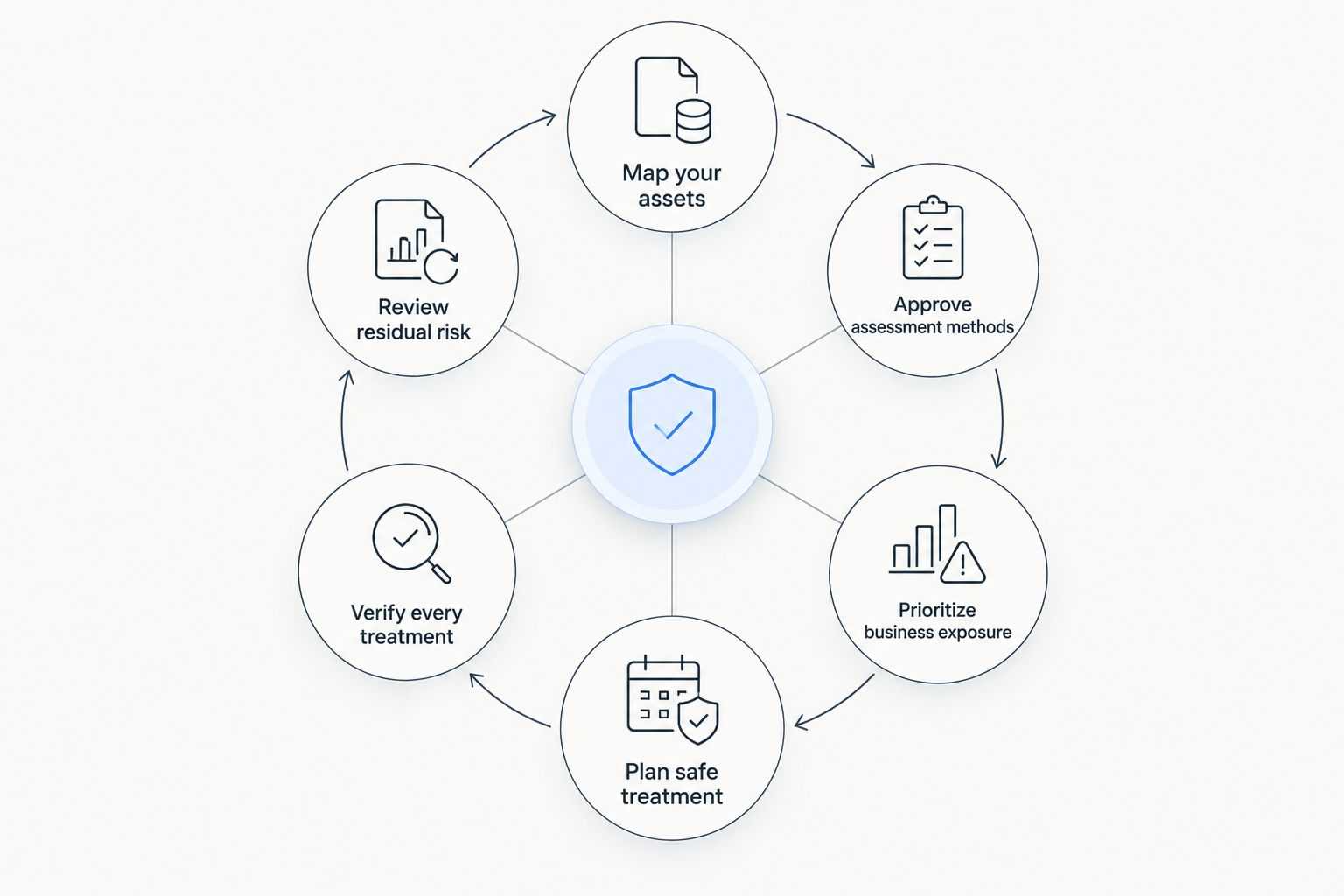
The operating cycle is simple: map your assets, approve assessment methods, prioritize business exposure, plan safe treatment, verify every treatment, and review residual risk. Keep the evidence connected across these stages so a change in asset ownership or access does not leave an old decision unchallenged.
Compare operating options for semiconductor teams
Choose the operating model around your ownership and evidence requirements, not the appearance of its dashboard. A manual process is useful for establishing decision rules. Software evaluation becomes more meaningful after those rules are explicit.
These options address different parts of the program and can coexist. Assessment tools identify findings; operational teams authorize changes; a management process connects decisions to evidence. Do not expect a platform purchase to replace those responsibilities.
| Option | Best for | Practical advantage | Key limitation |
|---|---|---|---|
| Shared register and existing assessment tools | Establishing an initial workflow | Makes ownership and decision rules explicit without introducing another platform | Requires manual reconciliation and follow-up |
| Scanner-centered workflow | Managing findings within an approved assessment scope | Keeps assessment evidence close to technical findings | Scanner findings alone do not establish business priority or production-change approval |
| Supplier-led equipment assessment | Equipment requiring supplier involvement | Incorporates equipment-specific guidance into treatment decisions | Scope and timing depend on supplier participation |
| Brinqa vulnerability and exposure management platform | Teams evaluating a platform-based program | Provides a named platform option in the relevant category | Validate required data sources, workflows, and production constraints during evaluation |
For a 2026 evaluation, ask each provider to walk through an actual decision: a validated finding, an uncertain asset owner, a restricted maintenance window, and an alternative control. The useful outcome is not a polished risk score. It is a traceable decision that your security and manufacturing teams can execute.
Discuss your vulnerability management requirements
Bring your asset categories, assessment restrictions, and remediation approval requirements.
Common mistakes semiconductor manufacturers make
Treating severity as the entire priority
A high severity score does not describe the affected asset’s role or reachable access paths. Require both technical evidence and business context. Keep unknown reachability visible rather than treating missing information as proof of isolation.
Assuming segmentation eliminates assessment needs
A segmented network still needs an inventory, approved assessment methods, and review of permitted connections. Verify the boundaries, including maintenance access and shared services, before using segmentation to justify a remediation deferral.
Closing supplier-managed findings without evidence
A supplier response is an input, not automatic closure. Confirm that the response covers the installed version, affected configuration, and proposed treatment. Keep responsibility with an internal owner even when the supplier performs the work.
Measuring fixes without measuring coverage
A reduction in open findings means little if a production segment stopped reporting. Pair treatment results with visibility into excluded assets, stale records, and unassessed equipment. Otherwise, a smaller queue can conceal a less complete picture.
FAQ
What is vulnerability management for semiconductor manufacturers?
Vulnerability management for semiconductor manufacturers is the process of identifying, prioritizing, treating, and verifying security weaknesses across relevant business, design, and manufacturing systems. It must account for production dependencies, supplier responsibilities, and approved assessment methods.
How do you scan semiconductor production equipment safely?
Use an equipment-owner-approved assessment method rather than applying a general enterprise scanning profile by default. Review supplier guidance, define stop conditions, and use passive evidence or configuration records where active assessment is not approved.
Which vulnerabilities should a chipmaker fix first?
Prioritize validated weaknesses using reachability, exploitation evidence, affected business services, and existing controls. A severity score alone does not establish the operational priority of a finding.
What should you do when a production system cannot be patched?
Document an approved alternative treatment or risk exception with an accountable owner and a review trigger. Verify that access restrictions, service changes, or segmentation actually reduce the specific exposure before relying on them.
Does a vulnerability management platform replace equipment suppliers?
A vulnerability management platform does not replace supplier approval or equipment-specific maintenance responsibilities. Your process must retain the technical and operational authorities required to assess and change affected equipment.
How should semiconductor teams evaluate Brinqa?
Evaluate Brinqa as a vulnerability and exposure management platform against your actual assessment, ownership, prioritization, and evidence requirements. Request a demonstration with representative data and confirm required workflows rather than assuming production-specific capabilities.
What proves that a vulnerability has been resolved?
Evidence tied to the affected asset must show that the chosen treatment removed or controlled the exposure. Keep the action taken, verification result, and verification date, with operational acceptance recorded separately for production-impacting changes.
One last thing
Treat an unknown equipment owner as a remediation blocker, not a minor inventory defect. Before expanding your 2026 scanning scope, select an unresolved production-related finding and trace it from detection through authorization to verification. If nobody can approve the treatment, another scan will not solve the problem.


