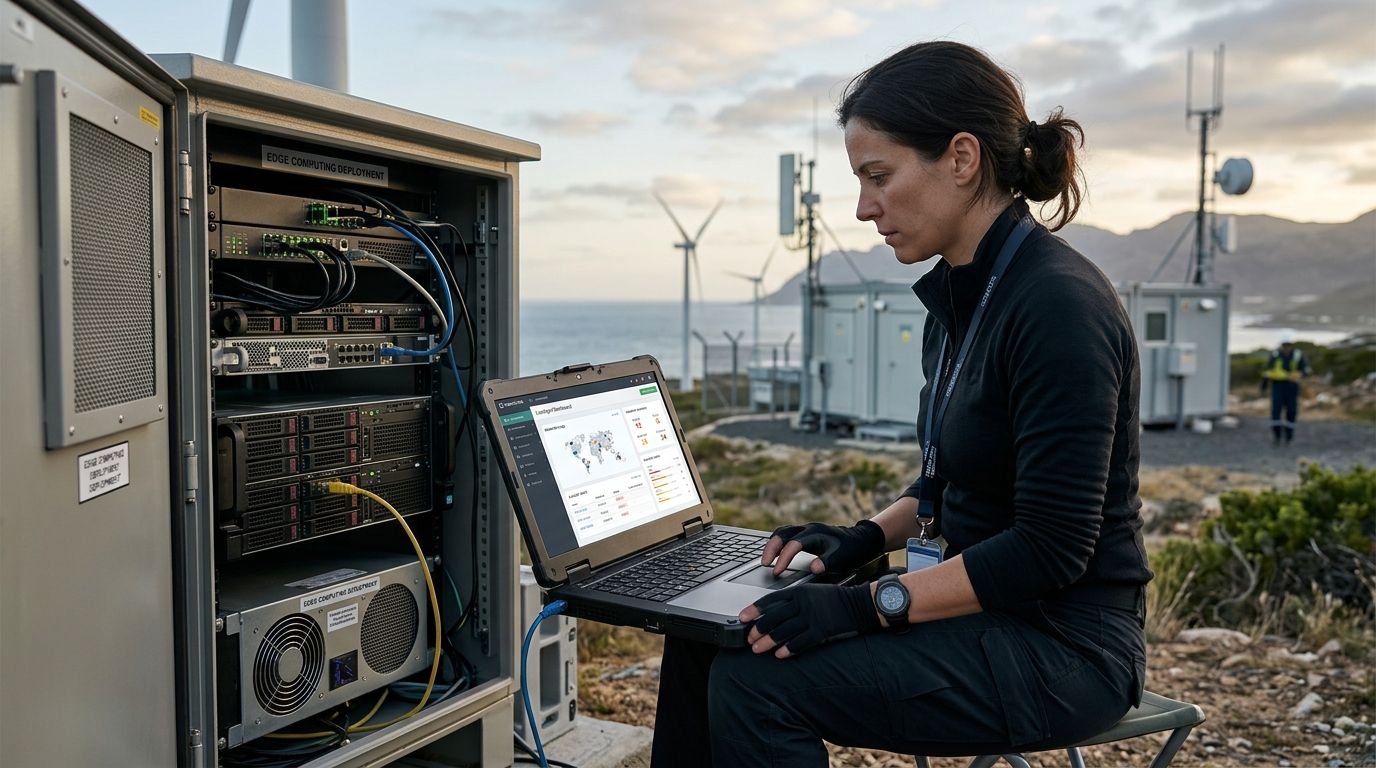
Vulnerability management for edge computing deployments is the discipline of finding, scoring and fixing security flaws across distributed edge nodes, gateways and micro-data centers before attackers reach assets that sit outside the traditional network perimeter. Edge environments break the assumptions most vulnerability programs are built on: nodes go dark for hours, hardware sits in unlocked retail closets or cell tower cabinets, and a single team might own 10,000 low-compute devices instead of 500 servers in a data center.
- Vulnerability management for edge computing starts with asset inventory — you cannot score what you cannot see.
- Exposure-based prioritization beats raw CVSS for edge nodes because physical access and segmentation change real risk.
- Intermittent connectivity breaks scan cadence; patch queuing and last-seen SLAs matter more than scan frequency.
- Brinqa consolidates scanner, OT and asset data into one exposure view — best for teams running 2+ scanners across sites.
Why this matters for edge computing
Edge nodes run firmware that gets updated far less often than a cloud VM, and many sit in physically accessible locations — a retail store, a cell tower cabinet, a factory floor. Stale firmware plus open physical access is what turns a mid-severity CVE into a real incident in 2026.
Scanner coverage is the second problem. A scanner built for a flat corporate network assumes a host answers when polled. Edge gateways on cellular or satellite links go dark for hours, so a scan window that misses the node produces false coverage — the dashboard says scanned, the node said nothing.
Attack surface at the edge scales with node count, not headcount. A team of six can own 15,000 gateways, and each one is a pivot point into the core network when segmentation is weak. That ratio is why manual tracking collapses fast; the Brinqa platform exists to unify exposure data from distributed assets instead of leaving it in a spreadsheet nobody maintains.
Build the program in seven steps
Inventory every edge node and gateway
You cannot score risk on assets you do not know exist. Edge fleets accumulate shadow devices fast — a vendor drops in a gateway during a site visit and nobody logs it.
- Pull asset lists from every regional scanner, MDM and network management console
- Reconcile serial numbers against procurement records, not just network scans
- Flag any device with no owner or no last-seen timestamp inside 30 days
- Tag assets by physical location, not only by IP range
- Rebuild the inventory quarterly, not once at deployment
Segment edge networks from core IT
Flat networks turn one compromised gateway into a path to the core data center. Segmentation caps the blast radius when — not if — a node gets popped.
- Put edge gateways on their own VLAN or private APN
- Restrict outbound traffic to the management endpoints each device actually needs
- Require jump-host access for any admin session into an edge segment
- Log every cross-segment connection attempt, not just the successful ones
Score vulnerabilities by exposure, not just CVSS
A CVSS 9.8 on a gateway locked in a controlled server room behind two authentication layers is lower real-world risk than a CVSS 6.5 on a device in an unlocked retail closet with default credentials. Raw severity ignores that difference.
- Weight scores by the physical accessibility of the asset
- Layer in exploit-availability data such as EPSS instead of CVSS alone
- Factor in whether the device is internet-facing or effectively isolated
- Track business criticality per site, not per device model
This is where most edge programs stall. A spreadsheet holds the CVE list but cannot recalculate exposure as network context changes. Brinqa applies risk-based scoring automatically once asset and network context are ingested, which is the faster path once manual tracking hits its ceiling.
Build a remediation workflow for intermittent connectivity
An SLA written for always-on servers fails against nodes that connect twice a day. Build the workflow around the connectivity pattern you have.
- Queue patches locally on the gateway for the next connection window
- Start SLA clocks from last-seen time, not ticket-creation time
- Batch low-severity fixes into scheduled per-site maintenance windows
- Escalate any node that misses two consecutive patch windows
Correlate scanner data across OT, IT and cloud edge tools
Edge deployments rarely run one scanner. A telecom edge site might have an OT tool for industrial controllers, a network scanner for the gateway, and a cloud posture tool for the compute layer feeding data upstream.
- Normalize CVE and asset IDs across every scanner feed before scoring
- De-duplicate findings for the same physical asset reported by two tools
- Handle industrial protocol findings using the approach in exposure management for OT and ICS environments
- Route container-layer findings from edge compute into the same pipeline as host findings — vulnerability management for container environments covers the mechanics
Automate patch validation for unattended nodes
A patch pushed to a node with nobody on-site needs proof it applied. Assume failure until a version check confirms otherwise.
- Require a post-patch checksum or version check before closing the ticket
- Alert on any node still reporting a pre-patch version 48 hours after deployment
- Keep a rollback path for edge firmware, not only for cloud config
Report edge risk separately from core IT
Boards read edge risk differently because the failure mode is physical as well as digital — a compromised gateway can mean a site outage, not only a data breach.
- Report exposure by site and region, not aggregate CVE counts
- Show mean time to remediate for edge assets against your SLA, split out from core IT
- Include physical access risk as its own line item, not a footnote
Comparison: options for managing edge vulnerability risk
| Option | Best for | Key limitation |
|---|---|---|
| Manual spreadsheet tracking | Pilot deployments under 100 nodes | Breaks past a few hundred assets; no live exposure scoring |
| Per-node agent scanners | Deep host detail on always-connected edge servers | Struggles with intermittent links and lightweight IoT hardware |
| OT-specific platforms | Industrial edge and ICS-heavy sites | Weak on IT-layer and cloud-connected edge compute |
| Exposure management platforms (Brinqa) | Teams running 2+ scanners across distributed sites | Requires integration work upfront to connect existing feeds |
Brinqa is the right call for edge teams juggling multiple scanners across dozens of sites; a single-site pilot with one scanner gets through the first 90 days on a lighter manual process.
Common mistakes edge teams make
- Treating edge nodes like data center servers on patch cadence — a monthly cycle assumes constant connectivity most edge fleets do not have.
- Assuming physical isolation is a security control — a locked cabinet is not a compensating control while the device still has default credentials.
- Scanning the core network and skipping gateway firmware — firmware is where most edge-specific CVEs live and the layer most scanners skip by default.
- Letting asset inventory go stale after rollout — sites open, close and swap hardware constantly, so a six-month-old edge inventory is functionally useless.
- Ignoring exploit context on legacy firmware — an old CVE with active exploitation and no available patch outranks a fresh CVE with no known exploit, every time.
“A locked cabinet is not a compensating control while the device still ships with default credentials.”
FAQ
What is vulnerability management for edge computing?
It is the process of discovering, scoring and remediating security flaws across distributed edge nodes, gateways and micro-data centers. It differs from standard programs because it must account for intermittent connectivity and physical accessibility.
How is edge vulnerability management different from data center vulnerability management?
Edge nodes connect intermittently, sit in physically accessible locations and often run outdated firmware with limited telemetry. Scan cadence, remediation SLAs and risk scoring all need different assumptions than a flat corporate network.
Can standard vulnerability scanners cover edge devices?
Standard scanners often miss edge nodes because they assume constant network availability. Gateways that connect for a few hours a day need patch queuing and last-seen-based SLAs instead of fixed scan windows.
How do you prioritize vulnerabilities on edge infrastructure?
Weight CVSS scores by physical accessibility, network segmentation and exploit availability data such as EPSS. A high-severity CVE on an internet-facing, physically exposed gateway outranks the same CVE on an isolated, access-controlled device.
Does exposure management work for OT and industrial edge environments?
Yes, but it requires correlating OT-specific scanner data with IT-layer findings. Industrial edge sites typically run separate tooling for controllers versus gateways and compute nodes.
How often should edge nodes be scanned?
Match scan frequency to connectivity patterns rather than a fixed calendar. A node that connects twice daily needs SLAs measured from last-seen time, not from a scheduled scan date.
What drives the most risk in edge computing deployments?
Stale firmware combined with physical accessibility is the most common risk driver in 2026. Physical access to an unlocked cabinet lets an attacker bypass network-layer defenses entirely.
Is Brinqa suited to edge computing vulnerability management?
Brinqa fits teams already running multiple scanners across distributed sites who need one consolidated exposure view. Single-site pilots with one scanner usually do not need a platform yet.
One last thing
Most edge remediation plans quietly assume someone can walk over and fix the device. Plenty of edge hardware has no out-of-band management, so a failed patch means a truck roll instead of a remote session — build your 2026 SLA math around that, not around the always-connected assumptions baked into most vulnerability tools.