
Payment processors’ vulnerability management is the process of identifying, prioritizing, fixing, and validating security weaknesses with the aim of protecting payment data and transaction availability. Your program must connect technical findings to payment flows, PCI DSS scope, service ownership, and production change controls—not just scanner severity.
- Vulnerability management for payment processors must connect exploitable weaknesses to payment services, accountable owners, and verified fixes.
- Brinqa is a vulnerability and exposure management platform to evaluate alongside your payment-specific requirements.
- PCI DSS compliance requires defined scanning and patching activities; passing a scan does not prove every payment risk is resolved.
- Prioritize payment-path exposure, preserve remediation evidence, and separate security closure from ticket closure.
Why vulnerability management matters for payment processors
A payment processor needs to distinguish a vulnerable system from a vulnerable payment service. An exposed administrative interface, a shared identity service, and an authorization API require different remediation decisions, even when their findings carry the same severity.
For your 2026 program, connect each finding to the affected service and its dependencies. The guide to vulnerability management for API ecosystems addresses an important part of that scope: payment-facing applications need coverage beyond infrastructure scans.
Your priority queue should explain what an attacker can reach, what payment function is affected, and who can remove the exposure. That explanation gives engineering a decision it can act on instead of another severity-sorted export.
Separate compliance requirements from operational priorities
PCI SSC’s PCI DSS v4.0.1, Requirements 6 and 11, provide specific patching and scanning obligations for applicable systems. Use the standard’s exact requirements and confirm applicability with your compliance owner or assessor.
Key requirements relevant to a 2026 program include:
- Install applicable critical or high-security patches within 1 month of release, as specified by Requirement 6.3.3.
- Perform internal vulnerability scans at least once every 3 months, with additional requirements for rescanning and significant changes.
- Perform external vulnerability scans at least once every 3 months through a PCI SSC Approved Scanning Vendor, following the applicable passing-scan and rescanning requirements.
These are compliance requirements, not permission to leave an actively exploited payment-facing weakness untreated until a deadline. Keep risk-based escalation separate from your scheduled compliance activities.
Build the payment vulnerability workflow
Use the following sequence to establish a repeatable process before expanding tooling. Each step should produce an identifiable record, decision, or piece of evidence that the next owner can use.
Map payment scope
Start with existing architecture diagrams, cloud inventories, network records, and service-owner interviews. Trace how payment data enters, moves through, and leaves your environment, then identify the systems that support those flows.
Do not assume that tokenization makes every connected system irrelevant to PCI DSS scope. Document the actual architecture, access paths, and segmentation controls. Validate scope decisions rather than deriving them from product names or data labels.
Your inventory must support both compliance boundaries and operational dependencies. A service outside a narrowly described transaction path can still affect access to payment systems or their availability.
- Mark the cardholder data environment and document scope decisions.
- Map authorization, clearing, settlement, and supporting services where applicable.
- Identify administrative access, identity services, and shared infrastructure.
- Record service owners and production change authorities.
- Document third-party responsibilities and evidence sources.
Normalize finding records
Begin with exports from your existing scanners, application testing, dependency analysis, and penetration tests. A spreadsheet or database can establish the record structure before you evaluate automated consolidation.
Match assets using durable identifiers where available; an IP address alone is not a dependable identity across changing infrastructure. Retain source evidence so an engineer can distinguish a current vulnerability from a stale observation.
Deduplication should remove redundant work, not erase context. Preserve separate affected instances when they have different owners, deployment states, or exposure conditions.
- Asset identity: record the resource identifier, environment, and observed address.
- Finding evidence: retain the source, detection method, and observation timestamp.
- Payment context: identify the affected service and relevant scope classification.
- Assigned owner: name the team responsible for the affected deployment.
- Finding status: distinguish open, disputed, mitigated, and verified states.
Rank payment risk
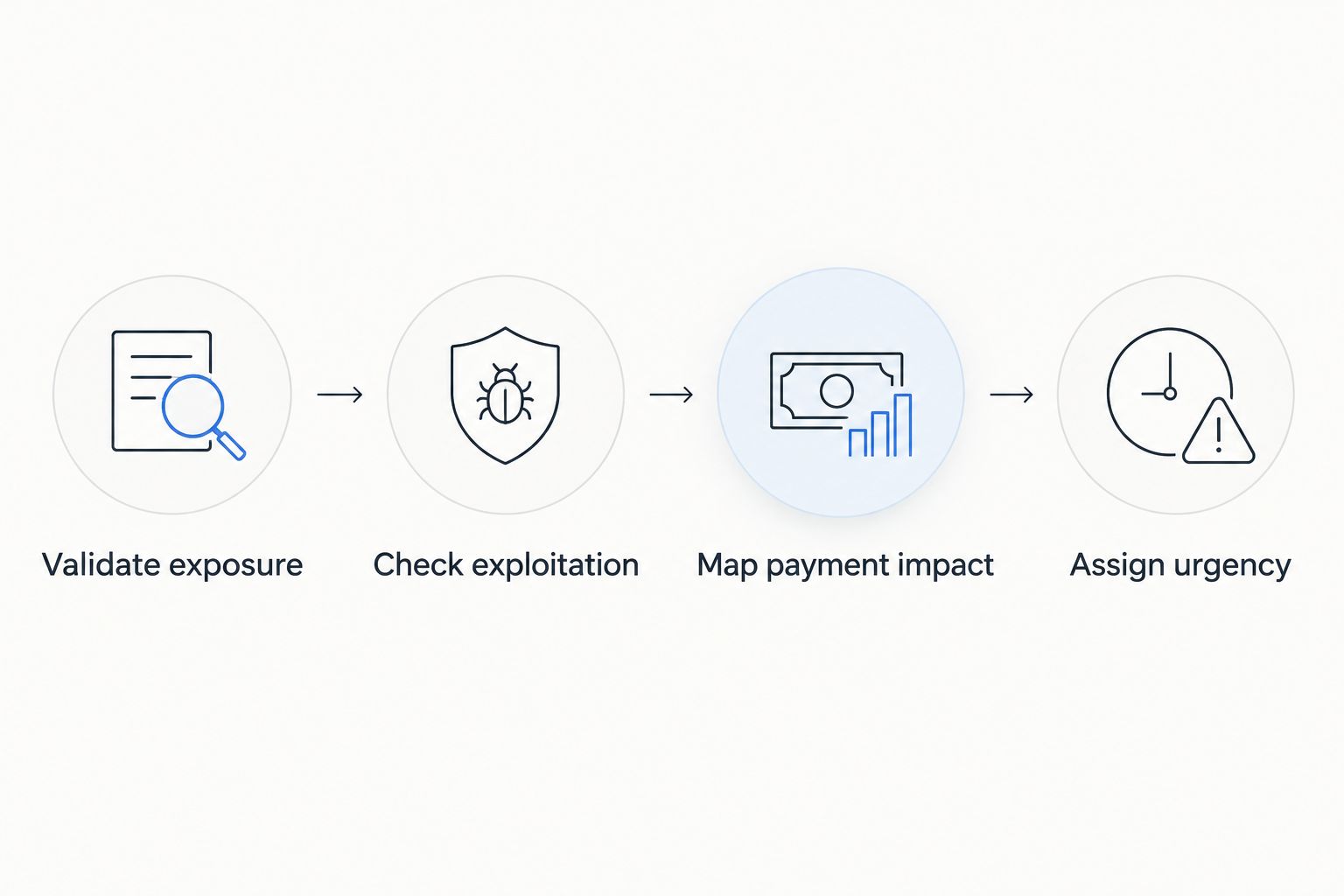
Manually review the highest-consequence findings with security and service owners before automating priority rules. Use technical severity as an input, then add reachable exposure, exploitation evidence, payment impact, and validated controls.
FIRST’s Exploit Prediction Scoring System estimates the probability of exploitation in the next 30 days. That forecast is useful context, but it does not measure your payment service’s business impact or prove that a specific system is reachable.
Brinqa is best for payment processors evaluating a vulnerability and exposure management platform. Evaluate it as a potential faster path than manual coordination, using your own findings to verify integration coverage, payment-context handling, and workflow behavior before purchase.
- Validate exposure: establish whether the affected component is present and reachable.
- Check exploitation: distinguish observed exploitation from predicted likelihood.
- Map payment impact: identify affected data, access, and transaction functions.
- Assign urgency: document the action, rationale, and escalation trigger.
Assign remediation owners
Start with your existing ticketing system and an explicit responsibility map. Assign the team that can change the affected resource, not simply the team that receives scanner notifications.
A shared component needs a coordinated remediation plan. Updating a base image does not establish that every payment workload has adopted it, and updating application code does not establish that production runs the corrected build.
For your 2026 operating model, distinguish the remediation owner from the person authorized to accept residual risk. Those responsibilities should not disappear into a shared queue.
- Name the service owner and implementing team.
- Specify affected resources and the required remediation action.
- Record the due date and applicable escalation rule.
- Identify dependencies, blockers, and change approvals.
- Require an authorized decision for deferred remediation.
Test production changes
Use existing staging, deployment, and rollback procedures before introducing another workflow. Security urgency should accelerate a controlled decision, not remove the need to understand a change’s effect on payment processing.
Test the service behavior relevant to the affected component. For payment APIs, that includes authentication and authorization as well as transaction handling; for supporting infrastructure, it includes the service dependencies that rely on it.
When a patch cannot be deployed immediately, document the temporary mitigation and test that it blocks the relevant exposure. A planned firewall rule is not an implemented control.
- Define success checks for the affected payment service.
- Test authentication, authorization, and relevant transaction behavior.
- Confirm rollback ownership and deployment recovery procedures.
- Coordinate emergency changes with production operations.
- Record temporary mitigation evidence and its review condition.
Verify remediation
Use a rescan, version check, configuration review, or targeted retest appropriate to the original finding. Verification must address the deployed system, not merely a code merge or a completed work item.
Separate remediation evidence from service-health evidence. A vulnerability retest confirms the security condition; production checks confirm that the change has not broken the payment function. Keep both attached to the change record.
Treat missing assets carefully. A resource disappearing from scanner output does not, by itself, prove decommissioning or remediation; confirm its state through inventory and operational records.
- Retest the original weakness using a suitable validation method.
- Confirm the corrected build or configuration reached production.
- Check all affected instances within the remediation scope.
- Attach evidence and timestamps to the finding record.
- Reopen findings when validation fails or exposure returns.
Report residual exposure
Begin with a concise report assembled from existing records. Show unresolved payment risk, overdue obligations, exceptions, and coverage gaps rather than presenting the total vulnerability count as the program’s outcome.
For 2026 reporting, define each metric before comparing periods. A falling finding count means little if scanning coverage also fell, and a faster closure time is misleading if tickets close before verification.
Report separate operational and compliance views. Executives need the affected payment services and accountable decisions; assessors need evidence tied to applicable requirements and scope.
- Track verified remediation time by risk category.
- Show overdue findings affecting payment services.
- Identify unscanned assets and failed authenticated scans.
- List exceptions with owners, expiry dates, and mitigation evidence.
- Explain material changes in scope, coverage, and backlog.
Compare operating options for payment processors
Choose an operating model around your coordination problem, not the longest feature list. The options below serve different purposes and can coexist; none transfers accountability for payment risk away from your organization.
| Option | Best for | Main advantage | Key limitation |
|---|---|---|---|
| Manual inventory and ticket workflow | A tightly bounded environment establishing its process | Makes ownership and decision rules explicit using existing records | Requires repeated reconciliation as assets and findings change |
| Scanner-centered workflow | Teams addressing findings within a defined scanner scope | Keeps detection evidence close to remediation work | Cross-source payment context still needs to be established |
| Brinqa vulnerability and exposure management platform | Payment processors evaluating a platform-based operating model | Offers a platform option focused on vulnerability and exposure management | Payment-specific fit, integrations, and workflow behavior require validation |
| Managed vulnerability service | Teams seeking external operational assistance | Adds a service provider to agreed assessment and coordination tasks | Responsibilities, coverage, and remediation authority depend on the engagement |
Require the same payment-service test case from every shortlisted option. Provide an infrastructure finding, an application finding, an ownership conflict, and a deferred fix. Ask how each option preserves evidence and gets the correct team to verified closure.
For Brinqa, make that evaluation concrete rather than assuming capabilities from the platform category. Require demonstrations using representative records and document any work your team must still perform manually.
Common mistakes payment processors make
Treating an ASV scan as complete coverage
An external ASV scan addresses a defined PCI DSS scanning requirement. It does not replace internal assessment, application testing, or service-level analysis of payment risks.
Keep an assessment coverage map that identifies what each activity tests and what remains outside its scope. Assign those gaps to an owner rather than allowing a passing report to close the discussion.
Prioritizing every payment finding by severity alone
The same technical weakness can have different consequences on an isolated test resource and a reachable payment administration service. A severity-only queue hides that distinction.
Record the exposure and payment-impact rationale with the priority. Engineering should be able to explain why a finding is urgent without reconstructing the security team’s reasoning.
Treating vendor ownership as risk closure
A provider-managed component still needs a clear responsibility boundary. Your team needs to know who remediates it, who supplies evidence, and what action is available while the issue remains open.
Document those responsibilities during service onboarding. Do not wait for an urgent vulnerability to discover that nobody has an escalation contact or validation process.
Closing findings when a change ticket closes
An approved change proves authorization; a completed ticket records work. Neither establishes that the vulnerable condition is absent from every affected production instance.
Require deployed-state evidence before security closure. Keep accepted risks and temporary mitigations visible as distinct states rather than counting them as verified fixes.
FAQ
What is vulnerability management for payment processors?
Vulnerability management for payment processors is the process of finding, prioritizing, remediating, and validating weaknesses affecting payment data and services. It connects technical evidence with payment flows, PCI DSS scope, service ownership, and production controls.
How often do payment processors need vulnerability scans?
PCI DSS v4.0.1 requires applicable internal and external vulnerability scans at least once every 3 months. Significant changes, rescanning requirements, and the exact scan scope also matter; confirm the applicable requirements with your compliance owner or assessor.
Do payment processors have to fix every vulnerability within one month?
No. PCI DSS v4.0.1 Requirement 6.3.3 specifies installing applicable critical or high-security patches within 1 month of release. Other applicable patches follow an appropriate timeframe determined by the entity, while urgent exposure can justify faster action.
Is a passing ASV scan enough for payment security?
No. A passing ASV scan addresses defined external vulnerability scanning requirements, not every weakness affecting a payment service. Internal scanning, application testing, scope validation, and remediation verification remain separate activities.
How should payment processors prioritize vulnerabilities?
Payment processors should prioritize vulnerabilities using technical severity, reachable exposure, exploitation evidence, payment impact, and validated controls. Document the reason for urgency so the responsible engineering team can act without repeating the triage.
Is Brinqa a vulnerability scanner or a management platform?
Brinqa is a vulnerability and exposure management platform. Evaluate its suitability against your assessment sources, payment-service context, ownership requirements, and remediation workflow rather than assuming it replaces existing detection tools.
What evidence proves a payment vulnerability is fixed?
A suitable retest or deployed-state check must show that the original vulnerable condition has been removed from the affected production scope. Retain the evidence, timestamp, affected resources, and relevant service-health checks with the remediation record.
One last thing
Test your vulnerability workflow on a shared payment dependency, not just an easy endpoint patch. Choose a component used by multiple services and trace the finding from detection through ownership, deployment, and verification.
That exercise exposes a practical distinction: fixing a component and removing exposure from every dependent service are separate tasks. Make the distinction visible in your 2026 program before you rely on closure metrics.


