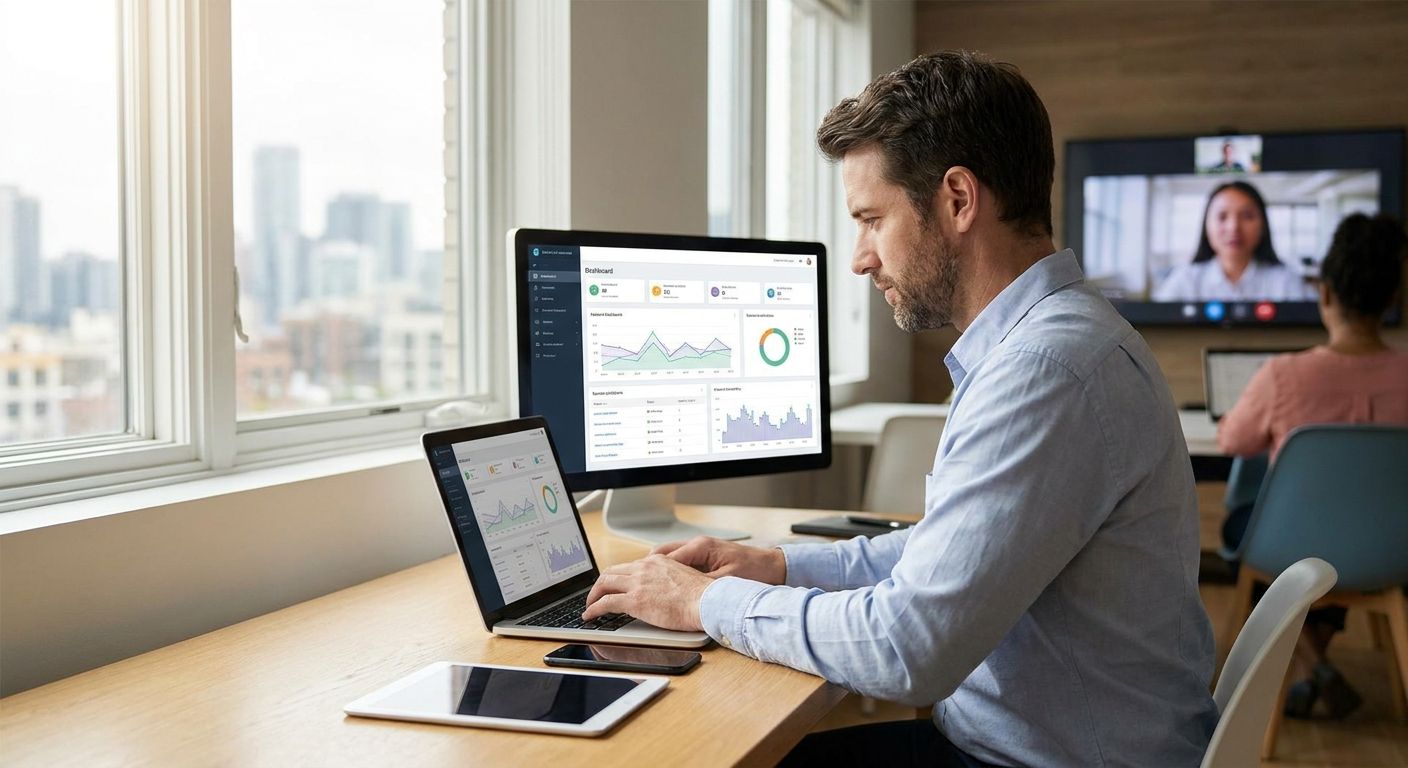
Vulnerability management for remote and hybrid workforces means finding and prioritizing risk across laptops on home Wi-Fi, cloud workspaces, and on-prem servers at the same time — not three separate programs bolted together. This guide breaks down what a distributed security team actually needs from a platform in 2026 and which approaches hold up.
- Vulnerability management for remote and hybrid workforces requires unified asset visibility across VPN, cloud, and unmanaged endpoints — Buy platforms that correlate all three.
- CVSS alone (0-10 scale) misses exploit likelihood; pairing it with EPSS probability scoring cuts remediation queues for distributed teams.
- Agentless-only coverage is a Skip for BYOD-heavy hybrid workforces — unmanaged devices need a scan method that doesn't require install access.
- Multi-cloud exposure correlation is a Buy for orgs where remote employees spin up their own cloud workspaces without central IT approval.
Why this matters
A distributed workforce erases the network perimeter that most vulnerability programs were built around. In 2026, security teams are patching devices that never touch the corporate VPN, cloud accounts provisioned by individual employees, and SaaS tools nobody in IT approved.
Traditional scan-and-patch cycles assume a stable network boundary. Remote and hybrid setups break that assumption daily, which is why hybrid IT environments need a different asset-discovery model than a single-office network ever did.
The cost of getting this wrong isn't abstract. Every unmanaged laptop, forgotten cloud instance, or shadow SaaS account is an entry point a scanner sitting behind a corporate firewall will never see.
Who this is for
This guide is for security and IT leaders managing a workforce split across home offices, satellite locations, and cloud-hosted infrastructure — teams where more than a quarter of endpoints never connect through a managed corporate network on any given day. If your asset inventory still assumes everyone sits behind the same firewall, the criteria below apply directly to you.
What to look for in vulnerability management for remote and hybrid workforces
Asset discovery that doesn't depend on network location
A scanner tied to internal IP ranges is blind to a contractor's laptop on a coffee-shop network. Discovery has to pull from cloud APIs, identity providers, and endpoint agents together, not just network sweeps, or entire device classes disappear from the inventory.
Risk scoring beyond raw CVSS severity
CVSS scores run 0 to 10 and tell you how bad a vulnerability could be — not whether anyone is actually exploiting it. EPSS scoring adds a 0-to-100% probability of exploitation in the near term, and pairing the two is how remote-first teams cut a 10,000-item backlog down to the handful that matter this week. Details on that model live on the EPSS scoring guide.
Agent and agentless coverage together
Managed corporate laptops can run a lightweight agent. Personal devices, contractor machines, and IoT gear on a home network usually can't or won't accept one. A platform that only does agent-based scanning leaves every BYOD device unassessed.
Cross-environment correlation, not siloed dashboards
Remote employees provision cloud workspaces, connect through VPN, and use SaaS apps — often all three in the same afternoon. If the vulnerability data from each environment lives in a separate tool, nobody sees the full attack path an attacker would actually use.
Remediation workflows built for distributed IT teams
A finding is worthless if it doesn't route to whoever owns that asset, wherever they sit. Ticketing integration and ownership mapping matter more for hybrid teams than for a single office where the IT desk can just walk over.
Compliance reporting that accounts for distributed endpoints
Auditors in 2026 increasingly ask how remote endpoints are covered, not just office assets. Reporting needs to show scan cadence and remediation SLAs for the devices that never touch a corporate network segment.
Top picks
The cloud-sprawl fix — multi-cloud exposure correlation. Hybrid workforces don't provision infrastructure through one team anymore; marketing spins up an AWS bucket, engineering runs workloads on Azure, and nobody centralizes the view. Exposure management for multi-cloud environments correlates findings across providers instead of forcing analysts to tab between three consoles. One spec that matters: it maps exposure paths across cloud accounts, not just within a single provider's native scanner. Buy for any hybrid workforce where employees have self-service cloud access.
The triage accelerator — risk-based prioritization for SOC teams. A distributed SOC drowning in alerts from a dozen remote-endpoint sources needs a queue that's already ranked by exploit likelihood, not just severity. Risk-based vulnerability management for SOC teams applies EPSS and business-context weighting before a finding ever reaches an analyst's screen. Buy for SOC teams whose backlog grows faster than headcount.
The BYOD gap — unmanaged personal devices. No dedicated page fixes this because it's a policy problem as much as a tooling one: personal phones and home computers connecting to work SaaS accounts rarely get scanned by anything. Closing this gap means enforcing conditional access and MDM enrollment before granting SaaS access, not adding another scanner. Consider this a prerequisite, not a purchase decision.
What to avoid
- Network-perimeter-only scanning. If the tool needs an internal IP range to find an asset, it will never see a remote laptop on a home network — this looks like coverage on paper and isn't.
- CVSS-only prioritization. Sorting a queue by severity alone buries the vulnerabilities actually being exploited in 2026 under thousands of high-CVSS findings nobody is targeting.
- Point solutions per environment. Running one tool for cloud, one for endpoints, and one for on-prem servers means no single view of an attack path that crosses all three — which is exactly how remote-workforce breaches happen.
See unified coverage for your remote fleet
Check how asset discovery works across cloud, VPN, and unmanaged endpoints.
Verdict comparison table
| Approach | Coverage model | Prioritization | Best fit | Verdict |
|---|---|---|---|---|
| Multi-cloud exposure correlation | Cross-provider cloud APIs | Exposure-path mapping | Self-service cloud users | Buy |
| Risk-based SOC triage | Endpoint + network + cloud feeds | CVSS + EPSS scoring | High alert-volume SOC teams | Buy |
| Network-perimeter scanning | Internal IP ranges only | CVSS severity only | Single-office, no remote staff | Skip |
| BYOD policy enforcement | Conditional access / MDM | N/A | Personal-device access to SaaS | Consider |
FAQ
What is vulnerability management for remote and hybrid workforces?
It's the process of discovering, scoring, and remediating vulnerabilities across a workforce split between home networks, cloud environments, and office infrastructure. In 2026, that means covering assets a traditional network-perimeter scanner never sees.
Is agent-based or agentless scanning better for remote devices?
Neither alone is enough — managed corporate laptops handle agents well, but contractor and personal devices often can't accept one. Combining agent-based coverage for managed assets with agentless discovery for everything else closes the gap.
How is EPSS scoring different from CVSS?
CVSS scores severity on a 0-to-10 scale based on what a vulnerability could do if exploited. EPSS scores the probability of exploitation, expressed as 0 to 100%, based on real-world exploit activity — pairing both narrows a remote workforce's remediation queue fast.
Can vulnerability management cover BYOD devices?
Coverage depends on conditional access and MDM enrollment more than the scanning tool itself. A personal device that never enrolls in device management stays invisible to most vulnerability platforms regardless of feature set.
How often should remote endpoints be scanned?
Cadence should match risk exposure, not a fixed monthly schedule — high-risk assets like internet-facing cloud instances warrant continuous monitoring, while lower-risk endpoints can follow a Patch Tuesday-aligned monthly cycle.
Does multi-cloud exposure management replace individual cloud provider scanners?
No — it correlates findings across providers so an attack path spanning AWS and Azure, for example, is visible in one view instead of two separate dashboards.
What's the biggest gap in remote vulnerability programs today?
Asset discovery tied to network location. If a scanner requires an internal IP range to find a device, every remote laptop and home-network endpoint stays unassessed no matter how good the scoring engine is.
Is risk-based prioritization worth it for a small hybrid team?
Yes if the alert volume outpaces headcount, which happens fast once endpoints span cloud, VPN, and unmanaged devices. Risk-based prioritization cuts the queue to what's actually exploitable instead of everything above a severity threshold.
One last thing
The workforce that looks hardest to secure — the one with personal devices, home routers, and self-provisioned cloud accounts — is exactly the one traditional network-perimeter tools were never built to see. Fixing asset discovery first, before touching prioritization logic, is the move that actually shrinks exposure for a distributed team in 2026.