
Best overall: OWASP Amass. Best for lightweight subdomain discovery: Subfinder. Best for automated reconnaissance workflows: BBOT. This 2026 guide compares free and open source attack surface management tools, including SpiderFoot for broader intelligence gathering and Nuclei for checking discovered exposures.
- OWASP Amass leads free and open source attack surface management tools for external asset discovery.
- Subfinder suits focused subdomain enumeration; BBOT suits automated reconnaissance workflows.
- SpiderFoot supports broader intelligence gathering; Nuclei checks exposures rather than discovering an entire attack surface.
- Brinqa is a vulnerability and exposure management platform, not an open source discovery tool.
Why this matters
Finding an asset is not the same as managing its exposure. A discovered hostname still needs ownership verification, service validation, assessment, and a remediation decision. An impressive discovery report does not establish that those steps happened.
Separate external discovery from vulnerability testing before selecting your 2026 toolkit. The guide to whether attack surface management replaces vulnerability scanning explains that distinction. You need both functions, but they do not have to come from the same application.
The tools below serve different parts of that workflow. None should receive unrestricted scanning permission simply because its source code is public.
What makes the best open source ASM tools?
Use these criteria to judge the tools against your actual operating model:
- Discovery scope: Does the tool find domain relationships, subdomains, services, or other information relevant to your inventory?
- Execution control: Can you distinguish passive collection from active requests and enforce an authorized scope?
- Evidence quality: Can an analyst explain why a discovered asset belongs to your organization?
- Repeatability: Can you preserve configuration and compare results between runs?
- Workflow fit: Does the output support your next step, rather than creating another disconnected report?
- Operating burden: Who maintains dependencies, credentials, configurations, and the resulting inventory?
Open source describes licensing, not operational completeness. For your 2026 shortlist, inspect the official repository, documentation, license, and release history before deployment. Confirm the exact components you intend to use rather than treating every module or external data source as interchangeable.
Open source attack surface tools at a glance
| Tool | Best for | Standout capability | Key limitation |
|---|---|---|---|
| OWASP Amass | Relationship-led external discovery | Network mapping and external asset enumeration | Discovery results still need ownership validation and remediation handling |
| Subfinder | Lightweight subdomain enumeration | Passive subdomain discovery through external sources | Does not provide complete service discovery or vulnerability assessment |
| BBOT | Automated reconnaissance workflows | Modular collection with event-driven processing | Module selection changes scope, activity, and output volume |
| SpiderFoot | Broader intelligence gathering | Modular collection across domains, IP addresses, and related intelligence | Relationships require analyst review before asset attribution |
| Nuclei | Template-based exposure checks | Repeatable checks against supplied targets | Not a replacement for asset discovery or comprehensive application testing |
Choose by the missing function, not the row number. Amass is the default discovery recommendation; the other entries address distinct needs. Nuclei belongs in an ASM workflow as an assessment component, not as a standalone inventory system.
1. OWASP Amass: best ASM tool for relationship-led discovery
OWASP Amass supports attack surface mapping and external asset discovery. Its enumeration and relationship-mapping capabilities suit investigations that start with known domains and expand into related infrastructure.
Use Amass when you need to understand connections, not merely collect a flat list of hostnames. Keep the supporting evidence: a relationship is a lead to investigate, not automatic permission to scan.
OWASP Amass pros:
- Supports external asset enumeration and network mapping.
- Helps investigate relationships between discovered assets.
- Offers passive and active enumeration approaches.
OWASP Amass cons:
- Requires configuration and interpretation of discovery results.
- Does not turn asset relationships into confirmed business ownership automatically.
- Needs a separate process for remediation assignment and closure.
Best for: Security teams building an evidence-backed external inventory across related domains and infrastructure.
Start with an approved domain and document which collection methods you enable. Review newly identified relationships before adding their destinations to active testing scope. That boundary matters when infrastructure belongs to a hosting provider or another shared service.
Verdict: Buy into OWASP Amass as your default discovery approach; keep ownership validation separate.
2. Subfinder: best ASM component for lightweight enumeration
Subfinder is ProjectDiscovery's passive subdomain enumeration tool. It gathers subdomain information through supported external sources and produces results suitable for further processing.
Choose Subfinder when you already have a workflow and need a focused discovery component. A subdomain result is a candidate asset; it does not prove that a host currently resolves, serves an application, or contains a vulnerability.
Subfinder pros:
- Keeps its purpose focused on subdomain discovery.
- Fits command-line workflows that process discovered names.
- Supports multiple passive information sources.
Subfinder cons:
- Coverage depends on the configured sources and their information.
- Some sources require credentials.
- Does not replace service validation or vulnerability testing.
Best for: Engineers who want subdomain enumeration inside an existing security pipeline rather than a broader reconnaissance framework.
Preserve discovery output before filtering it. Your validation stage should distinguish historical names, unresolved names, and reachable services instead of discarding their differences. Otherwise, an inventory cleanup can erase evidence needed for a later investigation.
Verdict: Buy into Subfinder for focused enumeration; skip it as a complete ASM platform.
3. BBOT: best ASM tool for automated reconnaissance workflows
BBOT is a modular reconnaissance framework that processes discovery events through enabled modules. It supports workflows in which one finding informs further collection or analysis.
Choose BBOT when assembling and maintaining separate reconnaissance steps has become the main operating problem. Its flexibility makes module selection a security decision, not just a configuration preference.
BBOT pros:
- Combines reconnaissance functions through a modular framework.
- Uses event-driven processing to connect discovery activities.
- Supports repeatable workflows through explicit configuration.
BBOT cons:
- Enabled modules determine whether activity remains passive or becomes active.
- Broader workflows require tighter scope and output review.
- Automation does not establish asset ownership or business importance.
Best for: Security engineers who need configurable reconnaissance workflows and can maintain scanning rules.
For a 2026 deployment, review the documentation for every enabled module before running it against production assets. Begin with a narrow scope and inspect the generated events. Expand only after you understand which inputs cause additional collection.
Verdict: Buy into BBOT when workflow automation is the priority; hold broader configurations until scope controls are verified.
4. SpiderFoot: best ASM tool for broader intelligence gathering
SpiderFoot automates open source intelligence collection through modules. It can investigate domains, IP addresses, and related information beyond a simple subdomain inventory.
Choose SpiderFoot when your question is investigative: what information connects to this organization or asset? Keep that investigation separate from the decision that an asset belongs in your authorized attack surface.
SpiderFoot pros:
- Collects several types of intelligence through a modular approach.
- Supports investigations that extend beyond hostname enumeration.
- Presents related findings for analyst examination.
SpiderFoot cons:
- Discovered associations need verification before attribution.
- External sources and credentials affect collection coverage.
- Intelligence collection does not replace vulnerability assessment.
Best for: Analysts investigating external relationships and contextual clues around known assets.
Avoid importing every related domain into your scanning inventory. Shared infrastructure, third-party services, and historical references all require interpretation. Record the evidence supporting each ownership decision so another analyst can review it.
Verdict: Buy into SpiderFoot for investigation; skip automatic ownership decisions based only on associations.
5. Nuclei: best ASM component for template-based exposure checks
Nuclei is ProjectDiscovery's template-based scanner. It runs defined checks against supplied targets, making it useful after you have discovered and validated assets.
Choose Nuclei when you need repeatable exposure checks within an authorized scope. Its findings reflect the templates and targets used, not proof that every possible vulnerability has been assessed.
Nuclei pros:
- Runs repeatable checks defined in templates.
- Supports targeted assessment workflows.
- Separates check definitions from the target inventory.
Nuclei cons:
- Coverage depends on template selection and target preparation.
- Results require validation before remediation decisions.
- Does not provide a complete discovery or application-testing program.
Best for: Teams that already have an approved asset list and need controlled checks for specific exposures.
Review template behavior before execution, including requests that change state or interact with sensitive services. Keep the template selection with the scan record. You need that context to explain both a positive result and an apparent absence of findings.
Verdict: Buy into Nuclei for targeted exposure checks; skip it as your sole attack surface inventory.
How to turn discovery into a usable workflow
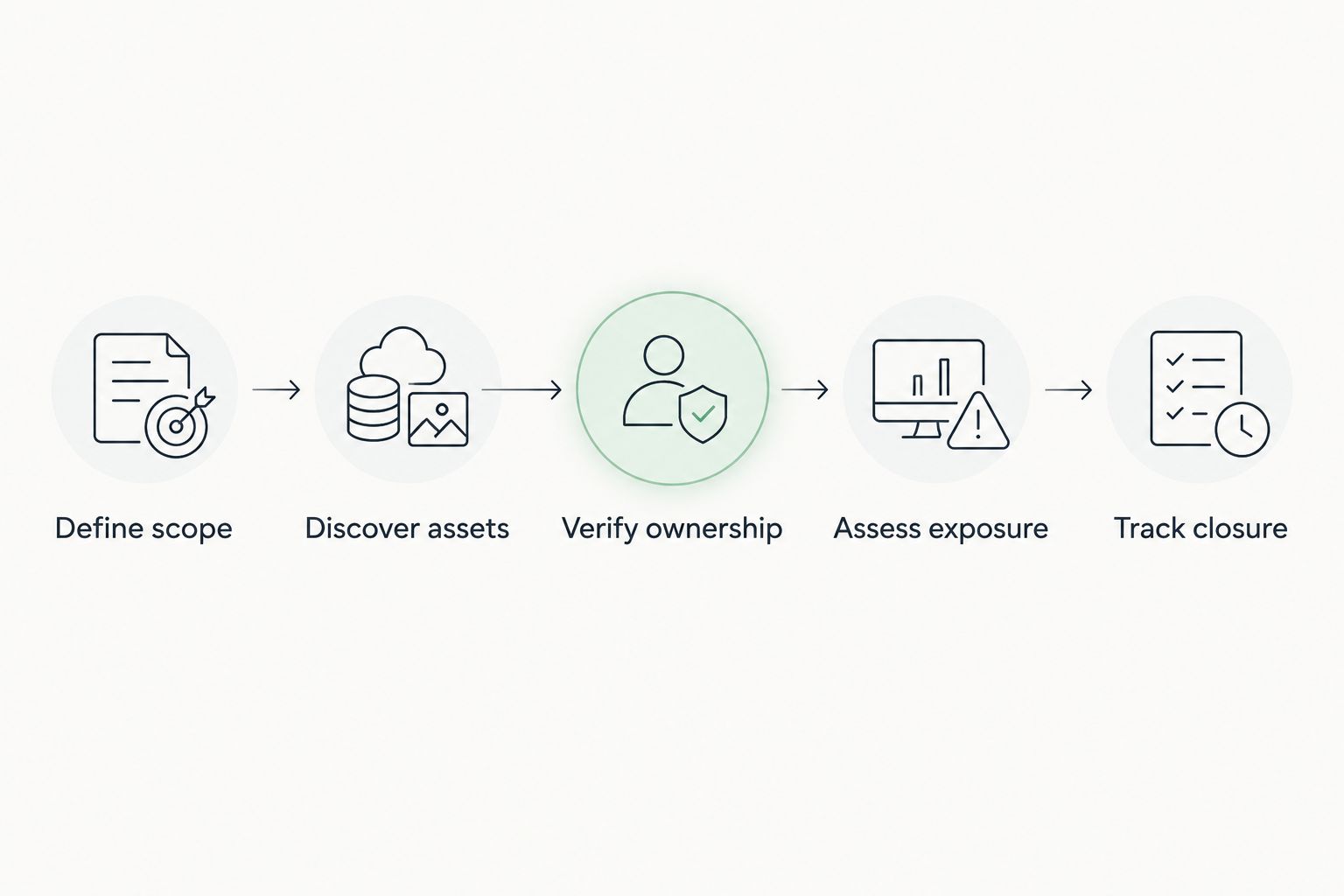
For your 2026 implementation, define the handoffs before connecting tools. A pipeline should preserve evidence and responsibility, not merely pass hostnames between commands.
- Define scope. Begin your pilot with 1 approved root domain. Record exclusions and distinguish passive collection permission from active testing permission.
- Discover assets. Use the discovery tool that matches your question. Preserve source information alongside each result.
- Verify ownership. Assign 1 accountable owner to each confirmed asset. Keep uncertain assets in a review queue rather than silently approving them.
- Assess exposure. Validate services and run authorized checks. Preserve the configuration and evidence supporting each finding.
- Track closure. Route confirmed issues to the responsible team, then retest after remediation.
During the pilot, compare 2 discovery runs using the same configuration. Investigate additions and removals instead of assuming every difference represents a newly deployed or retired asset. Source changes, DNS behavior, and collection settings all affect interpretation.
Treat these as pilot instructions, not performance benchmarks. Expand coverage only when you can explain the results and route confirmed issues to an owner.
How we ranked these tools
This 2026 ranking prioritizes discovery scope, execution control, evidence quality, repeatability, workflow fit, and operating burden. It is a capability-based buying guide, not a measured comparison of discovery speed or detection accuracy.
OWASP Amass leads because external asset discovery and relationship mapping match the central ASM task. Subfinder serves a narrower enumeration role; BBOT emphasizes workflow automation; SpiderFoot emphasizes investigation; Nuclei addresses assessment after discovery.
Use the projects' official documentation to confirm configuration details for your chosen release. Do not treat this ordering as evidence that one tool discovers more assets in your environment.
Which attack surface management tool should you choose?
Start with OWASP Amass if you need external discovery and have no established reconnaissance workflow. Choose Subfinder for a focused pipeline component, BBOT for modular automation, or SpiderFoot for broader investigations. Add Nuclei when you have validated targets and a defined assessment scope.
Brinqa is a vulnerability and exposure management platform for teams evaluating that platform category rather than an open source discovery utility. Keep it outside this open source ranking: the selection criteria are different.
For a Brinqa vulnerability and exposure management evaluation, document your required discovery sources, ownership process, prioritization rules, and closure evidence. Ask the vendor to demonstrate those requirements; do not assume capabilities from the category label.
FAQ
What's the best open source attack surface management tool?
OWASP Amass is the default recommendation for relationship-led external asset discovery. Choose a different component when your primary need is lightweight enumeration, workflow automation, intelligence gathering, or targeted exposure checks.
Is Subfinder better than Amass?
Subfinder is the better fit for focused passive subdomain enumeration inside an existing pipeline. Amass is the stronger starting point when your task includes investigating relationships across external assets.
Can Nuclei manage an entire attack surface?
Nuclei does not replace a complete attack surface management workflow. It checks supplied targets using templates, so you still need discovery, ownership verification, and remediation tracking.
Can I use passive discovery results as an authorized scanning list?
Passive discovery results do not establish scanning authorization. Verify ownership and permission before sending active requests to newly discovered assets.
Should I run every BBOT or SpiderFoot module?
Enable only modules whose behavior and scope you understand. Review their documentation, external dependencies, and collection methods before using them against production assets.
Does open source mean the tool needs no maintenance?
Open source tools still need maintenance. Assign responsibility for updates, credentials, configuration, stored evidence, and investigation of changing results.
Is Brinqa an open source discovery tool?
Brinqa is a vulnerability and exposure management platform, not an entry in this open source discovery ranking. Evaluate platform requirements separately from the functions of reconnaissance utilities.
One last thing
A disappearing hostname is an investigation, not proof of remediation. Before closing an exposure, verify that the underlying service was removed or corrected and preserve that evidence. Otherwise, your inventory becomes shorter without establishing that your attack surface became safer.


