
Yes—attack surface management tools can find shadow IT when unauthorized assets leave observable evidence, such as public DNS records, certificates, or internet-facing services. External discovery does not reveal every private cloud resource, unmanaged device, or employee-created SaaS account, so you need additional inventory and activity data to close those gaps.
- Attack surface management shadow IT discovery finds observable assets; it does not prove complete coverage.
- External attack surface management is best for unknown internet-facing infrastructure, not private SaaS account discovery.
- Validate ownership before treating a discovered domain, address, or service as an organizational asset.
- Brinqa is a vulnerability and exposure management platform; evaluate discovery coverage separately from that category designation.
Why this matters
An unknown asset sits outside the controls that depend on your approved inventory. If nobody knows who owns a public application, nobody has a clear responsibility to assess its vulnerabilities, review its access, or retire it.
Your 2026 discovery plan should therefore answer two different questions: what exists, and what requires action? A longer asset list answers only the first. Discovery succeeds when a validated finding reaches an accountable owner and a verified resolution.
Brinqa is a vulnerability and exposure management platform for security teams evaluating how to manage vulnerabilities and exposures. For shadow IT, assess the discovery sources and downstream remediation workflow separately rather than treating a platform category as proof of coverage.
Can attack surface management tools find shadow IT?
Attack surface management tools can identify previously unknown assets by examining observable infrastructure and relationships. External attack surface management starts outside your environment; other discovery approaches use internal observations or authorized access to existing systems.
The distinction matters. A public application missing from your inventory presents a different discovery problem from an employee's personal account on a SaaS service.
| Discovery approach | Best for | Main advantage | Main limitation |
|---|---|---|---|
| External attack surface management | Unknown internet-facing assets | Finds observable infrastructure without requiring an endpoint agent | Does not directly inventory private assets or individual SaaS accounts |
| Authenticated cloud inventory | Resources in connected cloud accounts | Provides resource details within authorized scope | Misses accounts and subscriptions outside that scope |
| Internal network discovery | Unmanaged devices on reachable networks | Finds devices absent from endpoint inventories | Depends on network visibility and discovery method |
| Identity and SaaS activity analysis | Unsanctioned application usage | Connects application activity with users where logs exist | Misses activity outside monitored identities or traffic |
| Security inventory aggregation | Gaps between existing asset records | Reveals disagreements between connected inventories | Cannot independently observe an asset absent from every source |
Use this table to define your 2026 evaluation scope before comparing vendors. No single row provides complete shadow IT coverage. Each approach supplies evidence that the others lack, and each has a boundary you must test.
What counts as a credible discovery?
A credible finding includes an asset identifier, the observation that revealed it, and an explanation of its relationship to your organization. It also needs a timestamp so you can distinguish current evidence from an old association.
A familiar company name in a certificate or page title is a lead, not ownership proof. Shared hosting, service providers, and historical records can create relationships that look stronger than they are.
Keep candidate assets separate from confirmed organizational assets. That separation prevents uncertain discoveries from inflating your inventory or triggering remediation requests against someone else's infrastructure.
External discovery: best for internet-facing shadow IT
External attack surface management is best for finding public infrastructure that your approved inventory does not contain. Examples include forgotten subdomains, exposed administrative interfaces, development applications, and infrastructure associated with an acquired business.
Depending on the tool, discovery can draw on DNS, certificate transparency records, internet observations, and relationships between known and newly identified assets. Those sources provide leads. They do not all establish current ownership or current reachability.
The advantage is independence from your internal inventory: an asset does not need an installed agent to leave public evidence. The limitation is equally clear—an outside observer cannot directly enumerate everything behind your access controls.
For a 2026 proof of concept, ask the vendor to show why each candidate belongs to your organization. Reject demonstrations that show only an unexplained list of domains and IP addresses.
Internal discovery: best for unmanaged network assets
Internal network discovery is best for devices that communicate on networks you can observe or assess. An unmanaged server can be invisible to an endpoint-management console while still appearing in network observations.
Active discovery sends traffic to identify reachable systems; passive discovery examines observed traffic. Each has limits: active methods require appropriate authorization and operational safeguards, while passive methods depend on what communicates within the monitored network.
Do not assume external attack surface management includes internal network discovery. Ask which capability performs the observation, where it operates, and which network segments remain outside its reach.
An inventory mismatch is useful evidence here. A device visible on the network but absent from the approved asset register deserves investigation, not an automatic declaration that it is unauthorized.
SaaS discovery: best for identifying unsanctioned application usage
Identity, application, and traffic records are better suited to employee SaaS usage than external infrastructure scanning alone. The question is not merely whether a service exists; it is whether your users access it, what permissions they grant, and whether that use is approved.
An employee account on a shared SaaS domain does not necessarily create a public asset attributable to your company. Finding the provider's website therefore does not establish that your organization uses it.
Relevant evidence can include identity-provider events, application consent records, browser or proxy observations, and approved procurement records. Coverage depends on which records you collect and which identities they represent.
The advantage is user-level context. The limitation is that personal identities, unmanaged browsers, and unobserved traffic remain outside those records. Your 2026 coverage statement should name those boundaries explicitly.
Why shadow IT discovery coverage varies
Discovery coverage varies with the evidence available to the discovery method. These factors explain why a tool can find one unauthorized asset and miss another:
- Public visibility: Internet-facing services leave different evidence from private applications and isolated devices.
- Known starting points: Domains, address ranges, and organizational relationships influence where external discovery begins.
- Authorized access: Cloud and SaaS inventories depend on the accounts, tenants, permissions, and integrations you authorize.
- Observation freshness: Historical records establish past relationships, not necessarily current exposure or ownership.
- Asset attribution: Shared infrastructure, subsidiaries, and service providers complicate ownership decisions.
- Operational boundaries: Network segmentation, monitoring placement, and approved assessment scope constrain internal discovery.
Treat coverage as a documented boundary, not a vendor adjective. Record the sources you use, the environments they cover, and the known exclusions. Revisit that boundary when your organization adds an account, acquires a business, or changes its network architecture.
How do you turn shadow IT discoveries into remediation?
Use a workflow that separates finding an asset from deciding what to do about it. The following sequence is a recommended operating process, not a claim about any individual product's capabilities.
- Define scope. List approved domains, cloud accounts, network ranges, and relevant business entities. Include acquisition and divestiture boundaries so historical relationships do not become assumed ownership.
- Discover assets. Collect external observations alongside authorized internal, cloud, and identity records. Preserve the source and observation time rather than retaining only the resulting asset name.
- Validate ownership. Confirm the relationship through current organizational records or an accountable business contact. Keep uncertain candidates in an investigation queue.
- Assess exposure. Determine reachability, access requirements, sensitive-data implications, and applicable vulnerability evidence. Do not equate an unknown asset with a confirmed exploitable vulnerability.
- Assign remediation. Route the validated issue to an owner who can approve, secure, isolate, or retire the asset. Record the intended outcome and how you will verify it.
- Verify closure. Recheck the original evidence and the relevant control state. A closed ticket does not establish that an exposed service is no longer reachable.
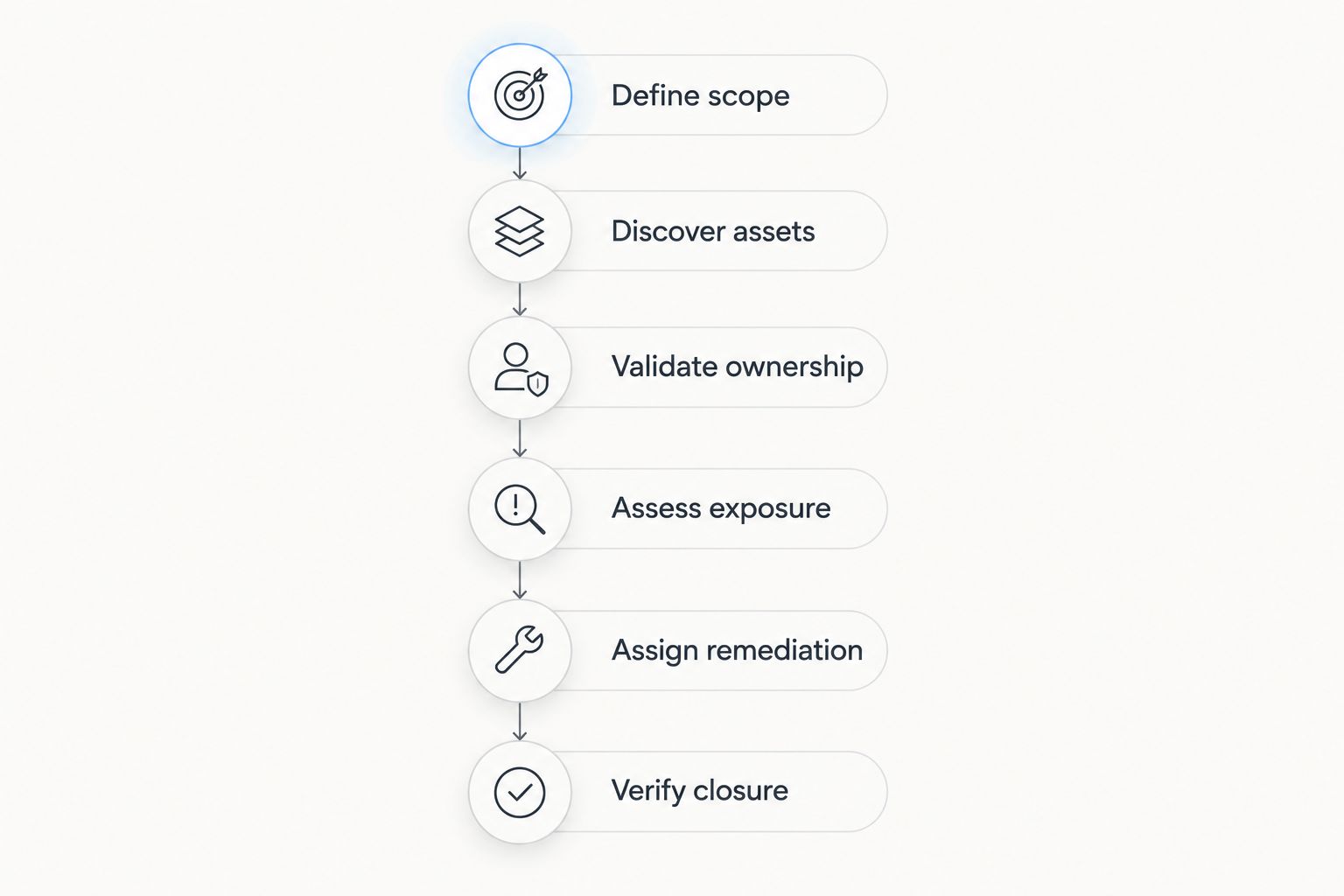
Keep discovery evidence attached to the issue throughout this process. The person responsible for a system should be able to understand what was observed without reconstructing the investigation from separate consoles.
For the broader inventory process, use the guide to unifying asset inventory across security tools. Reconciliation matters because the same system can appear under different identifiers in different sources.
How should you test a tool before selecting it?
Build your 2026 evaluation around assets you are authorized to assess and evidence you can verify. Test the complete path from observation to closure, not just whether a dashboard displays an unfamiliar hostname.
Use documented test cases rather than an unsupported promise of complete discovery:
- External discovery test: Select an authorized internet-facing asset absent from the test inventory. Check whether the tool finds it and explains the association.
- Private resource test: Select a private resource in a connected cloud account. Establish whether the relevant connector finds it and whether external discovery alone does not.
- SaaS usage test: Use an approved test identity and permitted application activity. Check which identity or activity record supports the finding.
- Attribution test: Include an authorized example involving shared infrastructure or historical ownership. Check whether the result distinguishes a candidate from a confirmed asset.
- Closure test: Apply an approved corrective change. Confirm that subsequent evidence reflects the change rather than simply preserving the original alert.
These tests reveal boundaries without inventing a discovery-rate benchmark. Document pass criteria before the demonstration, and require evidence for each result.
For Brinqa, apply the same standard: ask how the proposed vulnerability and exposure management deployment would receive discovery evidence, preserve ownership context, and support the required workflow. Evaluate those answers against the capabilities demonstrated for your scope.
Does finding an asset prove that it is shadow IT?
No—finding an unrecognized asset proves an inventory discrepancy, not a policy violation. Confirm ownership and approval status before labeling it shadow IT.
A legitimate application can be missing because onboarding records are incomplete. Conversely, an inventoried asset can still be unauthorized or improperly managed. Keep asset existence, organizational ownership, approval status, and security condition as separate decisions.
Can attack surface management replace vulnerability scanning?
No—attack surface discovery and vulnerability assessment answer different questions. Discovery identifies assets and observable exposure; vulnerability assessment examines security weaknesses within the scope and methods of the assessment.
Some products combine these functions, but the category name does not establish their depth. Require a demonstration of assessment coverage, authentication requirements, and evidence quality rather than assuming discovery includes a full vulnerability assessment.
What should you fix first after finding shadow IT?
Address validated exposures according to business impact and evidence of risk, not the order in which they appeared. An internet-reachable administrative service protecting sensitive information demands a different response from an unused domain with no active service.
Confirm ownership before changing infrastructure. Where ownership is unresolved, assign responsibility for the investigation rather than letting the finding disappear into a general backlog.
FAQ
Can attack surface management find every shadow IT asset?
No—attack surface management cannot guarantee discovery of every shadow IT asset. External discovery needs observable evidence, while private resources and employee SaaS activity require additional sources.
Does shadow IT discovery require an endpoint agent?
External shadow IT discovery does not require an endpoint agent to observe public infrastructure. Internal asset coverage depends on the discovery method, network visibility, and connected data sources.
Can an attack surface management tool find personal SaaS accounts?
External attack surface management alone does not reliably identify employee-owned accounts on shared SaaS services. Identity, browser, application, or traffic records are more relevant where collection is authorized.
How can I tell whether a discovered domain belongs to my company?
Validate the domain against current organizational records and an accountable owner. DNS, certificates, and historical relationships are useful leads but do not independently prove current ownership.
Is an unknown asset automatically vulnerable?
No—an unknown asset is not automatically vulnerable. Assess its configuration, access controls, software, and exposure before assigning a security finding.
What should I ask Brinqa about shadow IT discovery?
Ask Brinqa which discovery sources the proposed deployment would use and how their findings would enter the vulnerability and exposure management workflow. Require evidence of coverage, ownership handling, and remediation verification for your environment.
How should I measure whether shadow IT discovery is working?
Measure validated discoveries and their resolution rather than raw alert volume alone. Track attribution quality, accountable ownership, investigation status, and verified corrective actions without treating an unknown total asset population as a known denominator.
One last thing
Disappearing from a discovery feed is not proof of remediation. An observation can disappear because visibility changed, an integration failed, or the asset stopped responding to that particular method.
Define closure evidence when you assign the work. If the goal is to remove public access, verify public reachability; if the goal is approved ownership, verify the approval record. Your discovery process becomes useful when its final check matches the risk you intended to remove.


